
LIFESTYLE
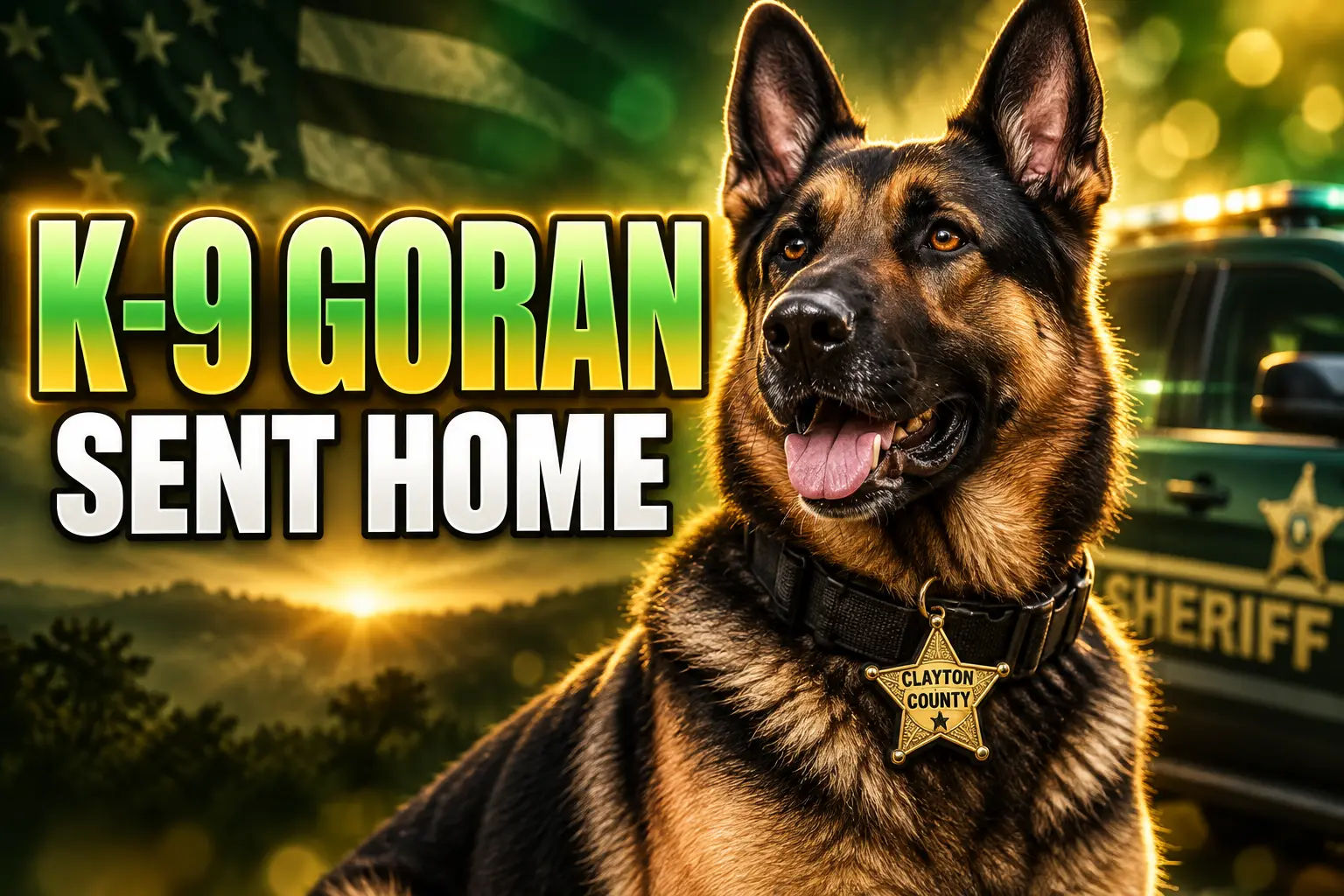
Clayton County Voted to Send K-9 Goran Home
A January 2024 commissioners’ vote gave K-9 Goran to Sgt. Stephen D. Buice, shifting vet bills onto the handler Georgia later tried to help.

Clayton County’s Board of Commissioners voted in January 2024 to give police K-9 Goran to Sgt. Stephen D. Buice, his handler since April 2018. The German shepherd had been county property until that vote took him off the books.
The gift ended a public-safety assignment and opened a household bill. In March 2026, Georgia’s House voted 171-0 to help handlers pay retired dogs’ vet costs, and the Senate never sent the measure to the governor.
The County Had to Vote Him Off the Books
A Jonesboro report on January 10, 2024, said Goran would spend retirement with Buice because of a recent commissioners’ vote. That is how a working dog leaves a county roster. He is equipment until elected officials say he is not.
Buice was listed as K-9 commander, and Goran worked Sector 3 in the Uniform Division. The department’s own unit page still describes a squad of three handler-and-dog teams that back every division, help outside agencies, and handle drug and article detection, suspect hunts, missing-person calls, building searches, high-risk warrants, and public events.
The cars are built around the animals. Each has a cage, a heat sensor, and a remote “hot and pop” release so a handler can send the dog without opening a door. The department calls the canines police officers and issues them first-aid kits.
Under the Georgia Department of Public Safety’s canine rules, a dog that has passed its useful life is treated as having no remaining value to the agency, and the policy gives the handler the option of adoption. Clayton’s vote did the local version of that handoff. Goran did not go home because a ceremony said so. He went home because the board moved him from inventory to a person.
A Problem Child From Harmony, North Carolina
Buice took Goran after finishing an eight-week handler course in Harmony, North Carolina, at Highland Canine Training. The school imports European working dogs for police and military clients. Goran came from Germany as a German shepherd, then four years old, and certified with the National Narcotics Detector Dog Association for patrol and detection.
At the school, the staff had labeled GORAN as a “Problem Child” and approached him with “Kid Gloves”. After forming a bond with GORAN, I learned that he was misunderstood and just a big baby.
Sgt. Stephen D. Buice, K-9 commander, Clayton County Police Department unit page
That pairing ran from April 2018 to the January 2024 vote, 5 years 9 months on the Clayton street. Counted from the age on the unit page, Goran was about 9 years 9 months old when the county let him go, close to the 7-to-10-year window most police dogs get before joints, noses, or drive give out.
Highland’s current dual-purpose handler courses run four weeks and 160 hours, with lodging and basic gear bundled when an agency buys a dog. Buice’s own write-up is an eight-week course, a longer track than that packaged SKU. Either way, the bond the school could not see is the one the commissioners later had to ratify.
Two Partners Were Already Gone
Goran did not retire from a full kennel. In 2023 the same department lost two K-9s in the line of duty, then sent its veteran home the following January.
CLAYTON POLICE K-9S AROUND GORAN’S TOUR
| K-9 | Joined the unit | Assignment | Outcome |
|---|---|---|---|
| Goran | April 2018, Highland Canine | Patrol and detection, Sector 3 | Retired January 2024; gifted to Sgt. Buice |
| Homer | March 2018, Highland Canine | Patrol and detection | NNDDA certified August 27, 2018 |
| Waro | March 22, 2021, Tarheel Canine | Patrol and detection, Sector 2 | Shot and killed September 2, 2023 |
| Wade | Not listed on the unit page | Patrol K-9 | Died May 25, 2023, heat-related illness |
Wade collapsed inside a patrol car at Hartsfield-Jackson International Airport around 2 p.m. on May 25, 2023. His handler started first aid, and veterinary staff at a nearby animal-control facility could not save him. Officials later confirmed a heat-related illness. He was the first of two Clayton police K-9s to die on duty that year, even though the unit’s cars are described as having heat sensors.
Waro, a two-year-old Slovakian-born German shepherd paired with Sgt. James Williams, was shot in the back on September 2, 2023, while tracking 17-year-old Stephon Ford through woods near Tara Boulevard in Jonesboro after Jonesboro officers asked for help around 1:45 a.m. Assistant Chief Bruce Parks said the dog had internal injuries, went into cardiac arrest, and died as officers tried to get him out. Ford was later shot and killed by police. On August 24, 2023, Waro had been approved for a donated bullet-and-stab vest from Vested Interest in K9s, Inc. He had not received it.
By the time commissioners gifted Goran, the published three-dog roster had already been cut by gunfire and heat. Retirement, in that winter, was the quiet loss after two loud ones.
What a Retired Police Dog Costs His Handler
The vote was the cheap part. Once Goran left the roster, Clayton no longer had to treat him as a working asset, and Buice took the feeding, the meds, and the clinic visits. The National Police Dog Foundation puts the dog alone, airfare included, at about $8,000 before training, a vehicle cage, and recertification. Adopter guides published in 2026 put average yearly veterinary costs for a retired K-9 at $2,000 to $3,000, a bill that lands on the house that took the animal in.
WHO PAYS AFTER THE BADGE COMES OFF
- The purchase: Agencies buy the dog and the school. Highland’s federal schedule has listed a dual-purpose narcotics-and-patrol package, four-week handler course included, at $11,904.28, a different product from Buice’s eight-week course.
- The working years: The county pays food, kennel time, certification, and the heat-sensor car while the dog is on the clock.
- The handoff: A board vote, a $1 bill of sale in some departments, or a written adoption offer turns public property into a pet.
- The aftercare: Hip, spine, and joint wear from jumping patrol cars follows the dog home, and the agency is generally not required to keep paying.
That split is why handlers sign up for a second career as unpaid vet techs. It is also why a “hero’s farewell” can read as a budget trick: the county keeps the arrests and dumps the arthritis.
Georgia’s House Voted 171-0 for Vet Bills
On January 15, 2026, lawmakers dropped House Bill 990, a plan for vet-care grants for retired police dogs. The House passed a substitute on March 4, 2026, on a 171-0 vote, with 1 member not voting and 5 absent. The Senate committee reported it favorably and the chamber read it a second time on March 25, 2026. It never reached the governor.
WHAT THE HOUSE PASSED IN MARCH
- The cap: Reimbursement could not exceed $5,000 per dog per calendar year, and unused money could not roll forward.
- The care: Covered items included exams, vaccines, parasite prevention, medicine, emergency surgery, cancer treatment, euthanasia, and cremation.
- The bar: A dog generally needed five years of service, or a line-of-duty injury, plus records from a licensed veterinarian.
- The money: Later drafts leaned on voluntary contributions rather than a locked state appropriation, so a yes vote did not guarantee a check.
Goran’s Clayton tour was 5 years 9 months, long enough to clear that five-year bar if the grant had become law. Buice would still have needed receipts. The House agreed the aftercare was a public problem. The Senate left handlers where they were in January 2024, paying the clinic.
New Vests Arrived After the Empty Kennels
The department did not stay at two empty slots. On June 4, 2025, Clayton police said K-9 Niko, a 9-year-old Belgian Malinois, received a donated bullet-and-stab vest from Vested Interest in K9s, embroidered “In memory of Sabu.” Niko had helped with a little more than 100 arrests in four to five years with the department after earlier work at a Florida sheriff’s office. By then the nonprofit had given more than 6,074 vests in all 50 states, valued at $6.9 million.
In August 2025 the department posted that K-9s Ozzy, Metro, and Konan had received the same style of armor. A single sponsored vest was listed at a $1,050 donation against an $1,800 value, 4 to 5 pounds, with a five-year warranty. The unit page that still names Goran, Homer, and Waro had not caught up. The vest photos did.
Goran’s story is the one in the middle of that rebuild. The county could vote a tired German shepherd into a living room. It could not vote him a state vet fund, and two years later the legislature proved the same point at a larger scale.
Buice holds the leash now without a resolution attached to it. The House has already said that arrangement is a cost the public ought to share. The Senate never took the roll call that would have made it true.
Frequently Asked Questions
How Do Georgia Agencies Retire a Police K-9?
State patrol rules tell handlers they may adopt, and they bar killing a retired dog unless a medical condition or the law requires it. City and county dogs are still government property, so a council or board often has to approve the transfer, the same extra step Atlanta’s canine policy spells out as legislative approval before placement.
How Old Was K-9 Goran When Clayton Released Him?
The department listed him as 4 years old in April 2018, which puts him at 9 years 9 months in January 2024. That is the arithmetic behind headlines that called him a 10-year-old, not a record of 10 years on the Clayton payroll.
What Does NNDDA Certification Mean for a Patrol Dog?
The National Narcotics Detector Dog Association tests teams for patrol work and odor detection, the dual job Goran and Homer both carried. Homer’s team dated its national certificate to August 27, 2018, a few months after Highland school, which is the usual pattern of imprint, then a scored trial.
Who Pays a Retired Police Dog’s Veterinary Bills?
The adopting handler or family, unless a charity steps in. House Bill 990 would have treated euthanasia and cremation as reimbursable care, a reminder that the last invoice is often the funeral, not the annual exam.
How Much Does a Dual-Purpose Police Dog Cost an Agency?
Highland Canine Training has listed dual-purpose narcotics-and-patrol dogs, with a four-week handler course included, at $11,904.28 on the federal supply schedule. That figure is a packaged school price, not Clayton’s invoice for Goran, whose handler described an eight-week course.

Greed Held After a $697 Million Crypto Long Flush

Fed Minutes Keep a Year-End Rate Hike Alive

A Nanny-Cam Tape Follows Tyreek Hill Into Free Agency

Star Wars Galactic Racer Makes a Crash End the Tour

Amazon Puts Apple’s June MacBook Prices Back on Sale

Sophia Wootten Turns the Miss Georgia Crown Toward Cleft Care

Georgia Beach Bacteria List Leaves Swim Areas Open

The iPhone 16 Pro Flipkart Cut Did Not Last

Little St. Simons Island Hatches Loggerheads at 72.4 Percent

UltraTech’s Ultravolt Launch Puts Cable Multiples on Trial
-
 ENTERTAINMENT4 months ago
Sophia Wootten Turns the Miss Georgia Crown Toward Cleft Care
-
 NEWS4 months ago
Georgia Beach Bacteria List Leaves Swim Areas Open
-
 NEWS1 year ago
The iPhone 16 Pro Flipkart Cut Did Not Last
-
 NEWS3 months ago
Little St. Simons Island Hatches Loggerheads at 72.4 Percent
-
 BUSINESS2 months ago
UltraTech’s Ultravolt Launch Puts Cable Multiples on Trial
-

 NEWS10 months ago
IXI Autofocus Glasses Still Lack a European CE Mark
-

 NEWS2 months ago
Microsoft Prints Azure’s $29.42 Billion Quarter and Shrinks the Map
-

 NEWS3 years ago
Eyal Waldman Keeps a Two-State Bet After Gaza