
LIFESTYLE
A Civilian Tow and a Drop Pump Saved Seven Off Tybee
Station Tybee saved seven people and their flooding boat on June 6, 2026, the same summer a Tybee capsize turned fatal.

A Station Tybee patrol found seven people on a flooding boat off Georgia on June 6, 2026, already under tow by a Good Samaritan. The crew put one member and a dewatering pump aboard, moved all seven onto the Coast Guard boat, and side-towed the disabled vessel to Houlihan Boat Ramp.
That June job is the version of a Tybee flooding case that still ends at a public ramp. Twenty-two days later the same station could not tow a disabled boat in rough water. Thirty-five days later a 21-foot boat took a wave near the north jetties, and a man died.
A Patrol Boat Found a Tow Already Underway
U.S. Coast Guard Southeast said a Station Tybee boat crew was already on patrol Saturday afternoon when it came upon a civilian towing a vessel that was taking on water with seven people on board. This was not a scramble from a distress beacon. The station described the timing as “right place, right time.”
The Coast Guard’s own first line named the civilian. U.S. Coast Guard Southeast posted that “a good Sam” and the Station Tybee crew assisted the flooding boat, dewatered it, and towed it to Houlihan Boat Ramp. The few public replies to that post did the same thing, putting the unnamed boater first.
A good Sam & @USCG Station Tybee crew assisted a vessel taking on water with 7 people aboard, Sat. The crew dewatered the vessel & safely towed it to Houlihan Boat Ramp.
Our @USCGSoutheast crews are trained, equipped & ready to save lives and protect our waterways every day. pic.twitter.com/otNoKYvIbv
— U.S. Coast Guard Southeast (@USCGSoutheast) June 7, 2026
Once the patrol boat was alongside, the sequence was short and specific. A crewmember went across with a dewatering pump to slow the flooding while the crew judged the hull. The seven passengers moved to the Coast Guard boat. The disabled vessel went under a side tow for the run to the ramp.
THE JUNE 6 SEQUENCE
- June 6, 2026, Saturday afternoon: A Station Tybee patrol meets a Good Samaritan already towing a vessel taking on water with seven people aboard.
- On scene: The Coast Guard transfers one crewmember and a dewatering pump onto the flooding boat to control the water.
- Still on scene: All seven passengers move to the Coast Guard boat. Crews work with the Good Samaritan through the transfer.
- After the transfer: The Coast Guard sets a side tow and takes the disabled vessel to Houlihan Boat Ramp.
Southeast District officials said their crews are trained, equipped, and ready to save lives and protect waterways every day. They did not name the Good Samaritan, the boat, or the skipper.
WHAT WE KNOW
- Who launched: A U.S. Coast Guard Station Tybee boat crew on patrol, working with a Good Samaritan already on a tow.
- Who came off: Seven passengers moved to the Coast Guard boat.
- Where it ended: The disabled vessel was side-towed to Houlihan Boat Ramp.
WHAT IS UNCONFIRMED
- The leak: Officials have not said what caused the vessel to take on water.
- The trip: They have not confirmed the vessel’s point of departure.
- Medical care: They have not said whether anyone needed treatment after the transfer.
Those gaps never closed in the public record. The hull still reached a ramp instead of the bottom, which is the part of the job the later Tybee cases did not repeat.
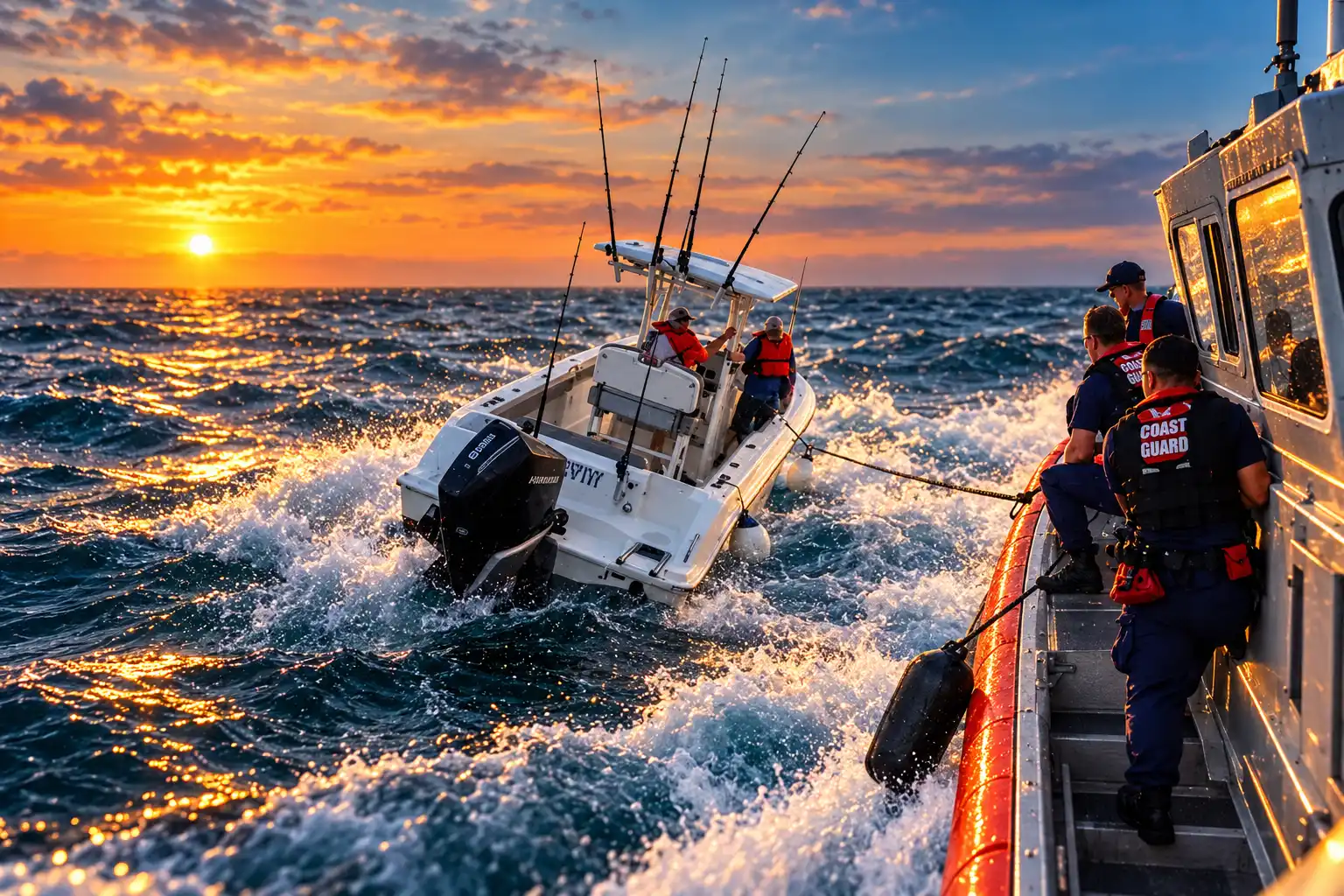
The Pump Went Across With One Crewmember
Coast Guard boat-crew training treats a flooding recreational boat as a two-part problem: get people off, then try to keep the hull from finishing the sink if the sea state allows it. Most Coast Guard boats carry a portable gasoline drop pump for that second part. The typical unit is rated at 150 gallons a minute, and crews pass it in a watertight container, often with two people, because it is heavy and awkward.
The June 6 crew used that playbook in the simplest form. They came alongside, put a person and the pump on the flooding boat, and ran the pump while they moved the seven passengers. Training warns against using a drop pump when fuel has mixed into the bilge, and it tells a coxswain to search the water for people before anyone starts dewatering. Officials never described fuel in this hull. They also never said anyone was in the water.
Saving the boat is not a souvenir. A hull that stays afloat is easier to identify, easier to keep out of a shipping channel, and easier to return to its owner than a wreck on the bottom. Three weeks later, seas off Tybee blocked even a tow. The June 6 water was still kind enough for a pump and a side-tow.
Where the Coast Guard Towed the Flooding Boat
Houlihan is not a beach on Tybee Island. Georgia’s Coastal Resources Division lists Houlihan Park as a Chatham County ramp on the Savannah River at Port Wentworth, on the right before the Houlihan Bridge, with two double-lane ramps on the Savannah River, paved parking, a courtesy dock, restrooms, and life jackets on site.
That is an inland public ramp, upriver from the ocean approaches Station Tybee actually patrols. The flooding boat did not get nudged onto the nearest sand. It made a river tow to a Georgia Department of Natural Resources facility built for trailers and recovery.
HOULIHAN PARK ON THE RIVER
- The water: Savannah River at Port Wentworth, Chatham County, just before the Houlihan Bridge.
- The ramps: Two double-lane paved ramps with a courtesy dock.
- The extras: Paved parking, restrooms, and life jackets available at the park.
Life jackets sitting at the ramp do not tell us what anyone wore on June 6. They do mark Houlihan as a working recovery point, not a scenic overlook. When a patrol can still steer a waterlogged hull, this is where that hull is supposed to end up.
Three Weeks Later, the Same Station Left a Boat at Anchor
Sunday, June 28, 2026, gave Station Tybee two jobs. In the first, Sector Charleston watchstanders sent a Tybee crew to a 40-foot houseboat aground near the entrance to Lazaretto Creek with two people and two dogs aboard. Before the Coast Guard arrived, a passing boater had already taken one person and both dogs ashore. The remaining mariner reported feeling unwell after striking his head. The crew ran him to Lazaretto Creek Boat Ramp for an EMS check. Officials said there were no serious injuries.
The second job that Sunday started on VHF channel 16. Two people on a 23-foot boat offshore of Tybee Island asked for help. A commercial salvage crew launched and could not reach them in the sea state. Station Tybee launched while Charleston watchstanders stayed on the radio. The Coast Guard crew could not set a safe tow either. They took the two mariners aboard and left the disabled boat at anchor for the owners to recover later.
U.S. Coast Guard Southeast put that outcome in plain language: due to the sea state, the crew left the vessel at anchor, embarked the mariners, and took them to shore. The pump-and-side-tow sequence from June 6 needs water calm enough to come alongside and stay there. On June 28 it did not have that.
The civilian pattern held anyway. A passing boater stripped the houseboat of one person and two dogs before the government boat arrived, the same way a Good Samaritan was already towing on June 6.
Search Crews Recovered Dominic Dasher on July 15
On July 11, 2026, a 21-foot center console took on a wave near the north end of Tybee Island, took on water, and flipped. Tybee Island Fire Rescue said the first call came at 8:32 a.m., with three people reported aboard. Two were located. One was not.
Lt. Chris Epley said the missing man never came up when the boat went over. U.S. Coast Guard Southeast said two people went into the water and a Good Samaritan rescued one of them. The station and partner agencies then searched for a 44-year-old man described in the first bulletin; recovery teams later identified him as Dominic Lamont Dasher, 45, of Port Royal, S.C.
#USCG & local partner agency crews are searching for a 44-year-old man after a vessel capsized near Tybee Island, #Georgia, sending two people into the water. One person was rescued by a good Samaritan. Anyone with information should call @USCG Sector #Charleston at 833-453-1261. pic.twitter.com/EtZC4CvYIt
— U.S. Coast Guard Southeast (@USCGSoutheast) July 11, 2026
The Coast Guard and local crews searched by air and sea, covering about 594 square miles over 22 hours, then suspended the hunt Saturday evening pending new information. Capt. Tadd Rubin of Tybee Island Ocean Rescue said the work shifted from rescue to recovery. Chatham County Marine Patrol had notified Georgia DNR game wardens of the overturned boat and the missing person around 9 a.m. on July 11. Aviation units kept flying the area through storms.
Dasher’s body was found on July 15, 2026, about 2 p.m., south of the shipping channel offshore from Tybee Island, and turned over to the coroner. The 21-foot hull never made a Houlihan run. There was no working deck left for a drop pump.
STATION TYBEE’S 2026 WATER JOBS
| Date | What went wrong | Who was already there | People | The boat |
|---|---|---|---|---|
| June 6, 2026 | Taking on water | Good Samaritan already towing | Seven transferred | Dewatered and side-towed to Houlihan |
| June 28, 2026 | Disabled in rough seas | Salvage launched, could not reach | Two taken ashore | Left at anchor |
| July 11, 2026 | Wave, water, capsize | Good Samaritan rescued one | Dasher died | Overturned; no tow |
The June 6 boat’s length was never released. The July hull was 21 feet, the size class that dominates drowning numbers nationwide, and it flipped before anyone could put a pump on it.
Georgia Counted 20 Boating Fatalities in 2024
The Coast Guard’s national recreational file counted 3,887 recreational boating incidents in 2024, with 556 deaths, 2,170 injuries, and $88 million in damage across 11,674,073 registered vessels. The death rate was 4.8 per 100,000 registered boats, down 2% from 4.9 the year before.
THE 2024 NATIONAL TOLL
- U.S. deaths: 556 people died in recreational boating, and drowning was the cause in 76% of those deaths.
- Life jackets: Where the cause of death was known, 87% of drowning victims were not wearing a life jacket.
- Small boats: Four of every five boaters who drowned were on vessels less than 21 feet long.
- Training: Where instruction was known, 69% of deaths were on boats whose operator had no boating safety instruction.
Georgia’s own Department of Natural Resources series is a separate count. DNR logged 326,099 boats, 137 incidents, 52 injuries, and 20 recreational boating fatalities in 2024, plus 57 drownings and 259 boating-under-the-influence cases. In 2025 the department counted 66 drownings and 10 boating fatalities.
Alcohol was the leading known factor in 20% of U.S. recreational deaths where a primary cause was listed. Officials never tied alcohol, or anything else, to the June 6 leak. They also never said whether the seven people were wearing life jackets. Georgia law still draws a hard line by age: children under 13 must wear a life jacket on a moving vessel unless they are inside a fully enclosed roofed cabin. Adults must have a Coast Guard-approved jacket they can reach. They do not have to wear it.
A December 2024 case at the north Savannah River jetties already showed the local shape of this. Three people came off a 15-foot boat that capsized, after a Good Samaritan called Station Tybee around 11 a.m. The civilian-first start is not new on that bar. June 6 was the day it still had a pump and a ramp at the end.
Station Tybee Covers the Port of Savannah
Senior Chief Michael Bennett, discussing the station’s daily work, said the unit runs search and rescue and is charged with keeping the port of Savannah and the surrounding waters safe and secure. Watchstanders at Sector Charleston take the radio traffic. Tybee launches the boat.
We essentially run search and rescue and we’re in charge of making sure that the port of Savannah and the surrounding areas are safe and secure.
Senior Chief Michael Bennett, Station Tybee
The station’s current plant is a rebuild. Hurricane Matthew damaged the old facilities in 2016. Wiley|Wilson designed a 31,310-square-foot multi-mission building with Whiting-Turner, a $26 million project that added parking for 65 vehicles, a new concrete boat ramp, and a building raised above the coastal flood level for 24-hour work in hurricane wind and surge. The new house opened in 2023. BMCM Eric Risner, then officer in charge, said the station also got a new dock after the storm and was getting a new ramp so crews could launch faster on search-and-rescue cases.
That is the unit that rolled up on a civilian tow on June 6, left a 23-foot boat at anchor on June 28, and spent 22 hours on July 11 looking for a man who never came up. The plant is built for all three kinds of day.
Frequently Asked Questions
Where Is Houlihan Boat Ramp in Georgia?
Houlihan Park sits in Port Wentworth, Chatham County, on the Savannah River just before the Houlihan Bridge, at about 32 degrees 9 minutes north and 81 degrees 9 minutes west. NOAA’s waterway notes list four paved launch lanes, a playground, a floating dock, picnic tables, restrooms, and a large parking area, and they bar overnight tie-ups at the docks.
What Does a Coast Guard Dewatering Pump Do?
It is a portable gasoline pump crews pass onto a flooding boat to throw water overboard faster than it comes in, so the hull stays high enough to tow. Boat-crew manuals rate the common drop pump at 150 gallons a minute and tell crews not to run it in a bilge contaminated with fuel; some larger CG-P6 units are rated at 250 gallons a minute at a 12-foot suction lift and will run about four to five hours on a full tank.
Does Georgia Require Adults to Wear Life Jackets on Boats?
No. O.C.G.A. 52-7-8 requires a Coast Guard-approved personal flotation device for every person on board, readily accessible, in good condition, and the right size, but only children under 13 must actually wear one on a moving vessel, unless they are inside a fully enclosed roofed cabin. Boats 16 feet or longer must also carry a throwable device, except canoes and kayaks, and everyone on a personal watercraft must wear a jacket regardless of age.
How Should Boaters Call the Coast Guard Off Tybee?
Mariners in distress are told to use VHF channel 16 or to dial 911, the same channel the two people on the 23-foot boat used on June 28, 2026, when Sector Charleston watchstanders picked up their request and sent Station Tybee. The national Coast Guard account repeats that pair of contacts as the way to ask for help, not a social media message.
The June 6 hull reached Houlihan with seven people alive and a pump still in the story. Dasher’s body came out of the water south of the shipping channel on July 15. Station Tybee is the unit that answers both kinds of call, on VHF 16, from the same river mouth.

Greed Held After a $697 Million Crypto Long Flush

Fed Minutes Keep a Year-End Rate Hike Alive

A Nanny-Cam Tape Follows Tyreek Hill Into Free Agency

Star Wars Galactic Racer Makes a Crash End the Tour

Amazon Puts Apple’s June MacBook Prices Back on Sale

Sophia Wootten Turns the Miss Georgia Crown Toward Cleft Care

The iPhone 16 Pro Flipkart Cut Did Not Last

Georgia Beach Bacteria List Leaves Swim Areas Open

UltraTech’s Ultravolt Launch Puts Cable Multiples on Trial

IXI Autofocus Glasses Still Lack a European CE Mark
-
 ENTERTAINMENT4 months ago
Sophia Wootten Turns the Miss Georgia Crown Toward Cleft Care
-
 NEWS4 months ago
Georgia Beach Bacteria List Leaves Swim Areas Open
-
 NEWS1 year ago
The iPhone 16 Pro Flipkart Cut Did Not Last
-
 BUSINESS2 months ago
UltraTech’s Ultravolt Launch Puts Cable Multiples on Trial
-

 NEWS2 months ago
Microsoft Prints Azure’s $29.42 Billion Quarter and Shrinks the Map
-
 NEWS9 months ago
IXI Autofocus Glasses Still Lack a European CE Mark
-
 NEWS3 months ago
Little St. Simons Island Hatches Loggerheads at 72.4 Percent
-

 NEWS3 months ago
OnePlus Ends OxygenOS After Quitting US and Europe