
NEWS
The Crash Axe on Flydubai FZ1073 Was Already There
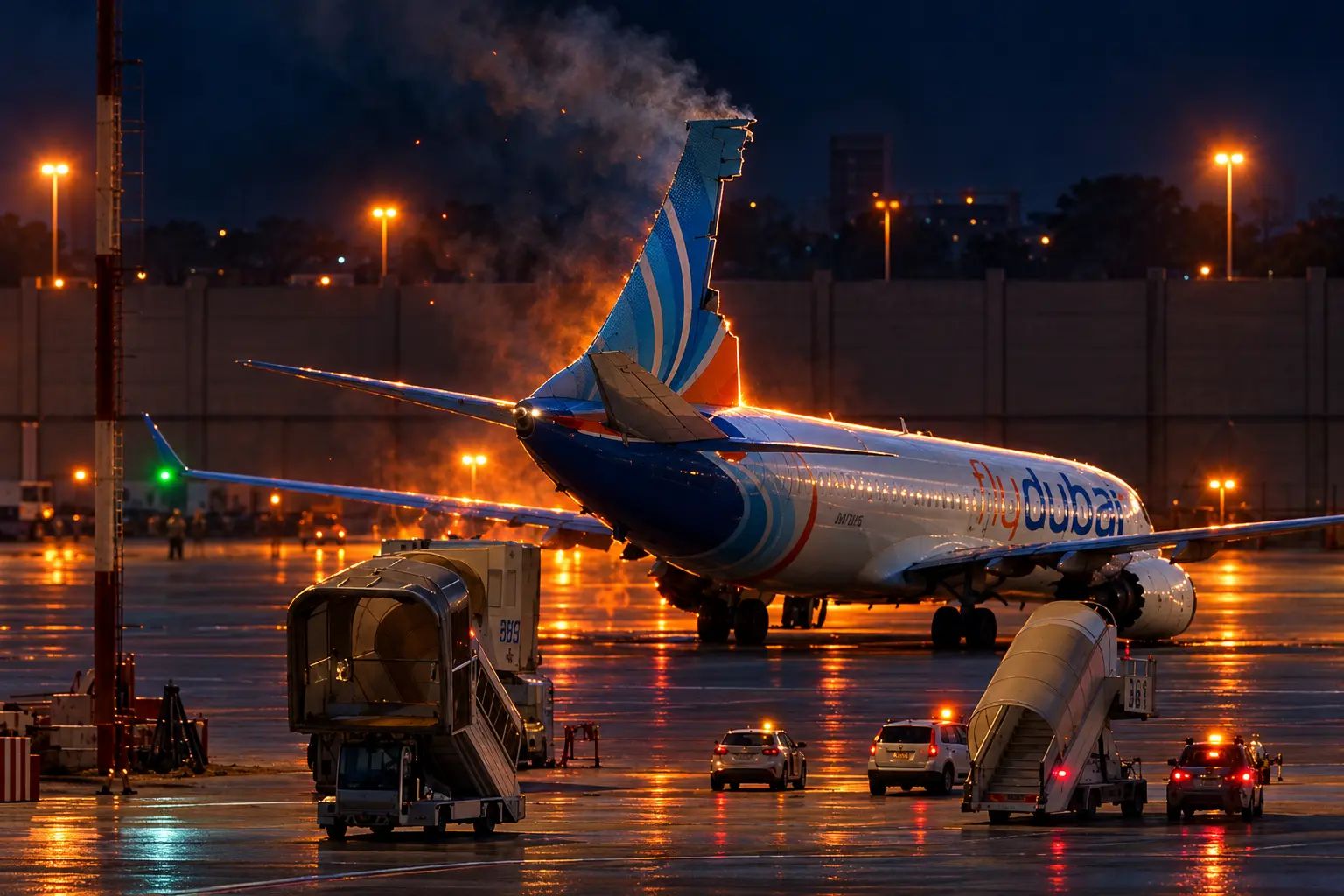
The flydubai FZ1073 co-pilot used the cockpit crash axe the jet must carry, the UAE says, and the captain had to open the locked door to stop him.

UAE Attorney-General Hamad Saif Al Shamsi said Saturday the flydubai FZ1073 co-pilot used the cockpit crash axe in an attempted terrorist act. The Dubai-Tel Aviv Boeing 737 MAX 8, with 174 passengers aboard, most of them Israeli, had already dived 14,300 feet in 37 seconds before crew and passengers pulled the attacker off the controls.
The weapon did not have to clear a checkpoint. It was the emergency axe the flight deck is built to carry. Both pilots were already inside the locked door that, since 2001, is meant to keep everyone else out.
FZ1073 Lost 14,300 Feet in 37 Seconds
Flight FZ1073 left Dubai International at 03:05 UTC on September 30, 2026, as a Boeing 737 MAX 8 registered A6-FKF. It climbed to about 34,000 feet on the usual westbound track toward Ben Gurion. For more than two hours the transponder showed an ordinary code, 0527.
Flightradar24 altitude readings then show the jet falling from 33,225 feet at 05:21:48 UTC to 18,925 feet at 05:22:25 UTC. That is 14,300 feet in 37 seconds. Ground speed peaked at 598 knots. The aircraft climbed, fell again, and bottomed out at 13,675 feet before holding near 15,000 feet toward Tabuk, Saudi Arabia.
ALTITUDE READINGS FROM FZ1073
| Time (UTC) | Altitude (ft) | Ground speed (kt) | Squawk |
|---|---|---|---|
| 05:20:56 | 34,000 | 413 | 0527 |
| 05:21:48 | 33,225 | 387 | 0527 |
| 05:22:25 | 18,925 | 502 | 0527 |
| 05:22:36 | 16,850 | 598 | – |
| 05:22:40 | 16,600 | 593 | – |
| 05:23:25 | 21,725 | 386 | – |
| 05:27:05 | 13,675 | 311 | – |
| 05:31:28 | 15,025 | – | 7700 |
| 05:35:20 | 15,250 | 312 | 7500 |
Someone in the flight deck later set 7700, the general emergency code, then 7500, the code for unlawful interference. flydubai said on-duty crew travelling on the flight secured the aircraft and landed it at Tabuk. Two reserve pilots, riding in the cabin, took the jet in. Photographs on the ground showed most of the rudder gone from the vertical tail, damage that can follow an overspeed; the airline has not spoken to those images.
The Captain Opened a Door Built to Stay Shut
The captain was Smit Machchhar, an Indian national based in Dubai. He was on the floor of the 737 MAX flight deck, badly hurt, when he felt the aircraft going down. The door that had boxed him in with his attacker was the only way to get help. He opened it from the inside.
I was acting for my own life, but at the same time, I knew I couldn’t let all of them die.
Capt. Smit Machchhar, flydubai, on a video call released by Prime Minister Narendra Modi
He told himself to give one last push to the door. Passengers and cabin crew came through. Ayelet Epstein, 47, said her 14-year-old daughter asked if they were going to die when they heard shouting and the jet started a huge fall. Epstein told her they would be all right, then later thanked Machchhar for saving them.
A 737 MAX cockpit is a tight box: two seats, an observer jump seat, and a door that only opens if someone inside lets it. There is nowhere to back up. Once the captain got the latch open, a plumber and other passengers could reach the yoke and drag the first officer out of the chair. Machchhar was treated in Tabuk, then airlifted to Abu Dhabi. Indian Ambassador Deepak Mittal found him talking, smiling, and in good spirits. On Saturday, Dubai Crown Prince Sheikh Hamdan bin Mohammed visited the hospital, kissed the captain’s head, and wrote that he had the full appreciation of the UAE leadership.
Why a Crash Axe Sits in the Flight Deck
Al Shamsi’s Saturday update was the first official word that the weapon was the crash axe. Early talk of a smuggled blade missed the simpler fact. Large airliners keep an axe in the flight deck on purpose, and the co-pilot did not need to bring one through security.
European non-commercial rules for heavier and larger aeroplanes require at least one crash axe or crowbar in the flight crew compartment. U.S. airline operating rules say each airplane must be equipped with a crash ax. If a second axe is stowed in the cabin of a high-capacity jet, it is not supposed to be visible to passengers. The tool in FZ1073 was the one already at the pilots’ hands.
WHAT THE FLIGHT-DECK AXE IS FOR
- Hidden fires: Crews use it to cut into sidewall, ceiling, or floor panels so an extinguisher can reach a fire that started behind the trim.
- Jammed exits: After a crash or evacuation, it can break a window or cut a path if a door will not open.
- Required stowage: The primary axe lives in the flight crew compartment, within reach of the people at the controls.
- Cabin rule: Any extra axe near a galley must be kept out of passengers’ sight.
Pulling every crash axe off every jet is not a serious answer, because a lithium-battery fire behind a panel still needs a way through the lining. A fire extinguisher in the same small cockpit can be used as a blunt weapon too. So can the controls themselves. The awkward part, which maintenance engineers have been saying in plain language since the Attorney-General spoke, is that the industry still needs the tool on the day the fuselage is the problem.
The Two-Person Rule After Germanwings
After the September 2001 attacks, cockpit doors were hardened against guns and forced entry, and they stay locked in flight. A keypad outside can request entry. A pilot inside can still refuse it. That design stopped hijackers from the cabin. It also left whoever was already on the flight deck in charge of the lock.
Germanwings Flight 9525 made that cost obvious on March 24, 2015, when first officer Andreas Lubitz locked the captain out and flew an A320 into the French Alps, killing 150 people. Three days later, the European Union Aviation Safety Agency told airlines to keep at least two authorised people in the cockpit at all times, so a toilet break could not leave one pilot alone behind the door.
HOW COCKPIT OCCUPANCY RULES SHIFTED
- March 27, 2015: EASA recommends two authorised people on the flight deck at all times after Germanwings.
- July 2016: EASA moves to a risk-based bulletin and leaves the two-person practice to each airline’s own assessment.
- 2017: German airlines drop the extra-person rule, arguing that a door held open for cabin crew creates its own exposure.
- February 17, 2024: A Lufthansa A321 first officer has a seizure after the captain steps out; the captain at first cannot get back in, and the flight diverts to Madrid.
- May 18, 2026: EASA revises SIB 2016-09R1 and again prefers that two authorised persons are present in the flight crew compartment during flight.
- September 30, 2026: FZ1073 is attacked with both pilots already on the flight deck; help has to come from the cabin.
The two-person patch was written for a Germanwings problem: one qualified pilot locked outside. FZ1073 was the other case. Both men were already at the controls. A third person in that closet of a MAX cockpit might have been one more body in the way of an axe. What ended the attack was the captain opening the door the last 25 years of security had trained him to keep closed, so people from the cabin could reach the seat.
A Prior Flying Ban Did Not Follow Him to Dubai
UAE authorities have not officially named the co-pilot. Officials briefed on the investigation, speaking without authorisation, have identified him as Hamam al-Hammami, an Omani national. People familiar with his earlier employment said Oman Air had already taken him off flying over concerns he had adopted extremist views, and moved him into an office job. A professional profile under that name listed about seven years at Oman Air, a departure in February 2025, then Royal Air Maroc from June 2025 to January 2026, and no flydubai line. An Israeli official said he had been at flydubai about eight months. Oman Air did not comment. flydubai said it could not go beyond its published statements while the investigation continues.
Israeli Prime Minister Benjamin Netanyahu said Friday the attacker had undergone Islamist radicalization and had come to crash the plane. He said Israel was checking whether anyone had sent him. His spokesman said the man talked on social media about killing Jews. Al Shamsi, in the Saturday statement, said investigators were still working to establish motives and any links, and to finish technical work on physical and digital evidence. President Donald Trump had asked whether Iran was behind the attack; a senior U.S. official briefed on the Israeli investigation said there were no indications that Iran directed it or was involved.
WHAT WE KNOW
- The charge: Al Shamsi said the co-pilot attempted to carry out a terrorist act and used the crash axe to attack the captain and seize the flight controls.
- The flight: FZ1073 carried 174 passengers from Dubai toward Tel Aviv on September 30, 2026, dived 14,300 feet in 37 seconds, squawked 7700 then 7500, and landed at Tabuk.
- The captain: Machchhar opened the cockpit door from the inside, was treated in Tabuk and Abu Dhabi, and was described Saturday as recovering well.
WHAT IS UNCONFIRMED
- His name in court papers: UAE authorities have not formally released the co-pilot’s identity.
- A sender: Netanyahu said Israel is investigating whether anyone dispatched him; Al Shamsi has not announced a finding on direction or a group.
- How he was hired: It is not established on the record how flydubai checked the Oman Air flying ban, or how an Omani first officer was assigned to a Tel Aviv sector.
On October 1, Al Shamsi ordered a Public Prosecution team to investigate, in coordination with the General Civil Aviation Authority, because the aircraft is UAE-registered. Saudi authorities transferred the co-pilot to Abu Dhabi on Thursday and said his health had improved. Israeli investigators are joining the Emirati inquiry. The GCAA later praised Machchhar, the crew, and the passengers who helped bring the situation under control, and asked the public not to circulate speculation.
Flydubai Has Stopped the Tel Aviv Flights
flydubai, owned by Dubai’s government, started the Dubai-Tel Aviv service in late 2020 after the UAE and Israel opened diplomatic ties. The route had become a busy holiday link for Israelis. After FZ1073, the airline paused flights to and from Israel while the investigation continues. Two replacement aircraft lifted the passengers out of Tabuk the same evening.
A flydubai spokesperson said Saturday the airline recognised that many questions remained and was not in a position to comment beyond its published statements. Those statements still describe an altercation in the flight deck that on-duty crew travelling on the flight brought under control. They do not mention a crash axe, a terrorist plan, or the Oman Air history now sitting with prosecutors in Abu Dhabi.
Al Shamsi said final results will be announced when the work on evidence is finished. The crash axe will still be in the next 737 that pushes back from Dubai, because the fire-panel job has not gone away. What the inquiry has to answer is how a man already pulled off flying sat down beside it, on a sector packed with Israeli passengers, behind a door that only the captain could open from the floor.

Greed Held After a $697 Million Crypto Long Flush

Fed Minutes Keep a Year-End Rate Hike Alive

A Nanny-Cam Tape Follows Tyreek Hill Into Free Agency

Star Wars Galactic Racer Makes a Crash End the Tour

Amazon Puts Apple’s June MacBook Prices Back on Sale

Sophia Wootten Turns the Miss Georgia Crown Toward Cleft Care

The iPhone 16 Pro Flipkart Cut Did Not Last

Georgia Beach Bacteria List Leaves Swim Areas Open

Microsoft Prints Azure’s $29.42 Billion Quarter and Shrinks the Map

IXI Autofocus Glasses Still Lack a European CE Mark
-
 ENTERTAINMENT4 months ago
Sophia Wootten Turns the Miss Georgia Crown Toward Cleft Care
-
 NEWS4 months ago
Georgia Beach Bacteria List Leaves Swim Areas Open
-
 NEWS1 year ago
The iPhone 16 Pro Flipkart Cut Did Not Last
-
 NEWS2 months ago
Microsoft Prints Azure’s $29.42 Billion Quarter and Shrinks the Map
-
 NEWS10 months ago
IXI Autofocus Glasses Still Lack a European CE Mark
-

 BUSINESS2 months ago
UltraTech’s Ultravolt Launch Puts Cable Multiples on Trial
-

 NEWS3 months ago
Little St. Simons Island Hatches Loggerheads at 72.4 Percent
-

 NEWS3 months ago
OnePlus Ends OxygenOS After Quitting US and Europe