
BUSINESS
UltraTech’s Ultravolt Launch Puts Cable Multiples on Trial
Nuvama lifted its cables margin hit to 150-250 bps after UltraTech switched on Ultravolt, even as it still prefers Polycab and KEI.

Nuvama on September 4 raised its cables margin-damage range to 150 to 250 basis points after UltraTech Cement launched Ultravolt. It still prefers Polycab India and KEI Industries. The multiple is moving before the electrician does.
That is the gap between a plant turning on and a franchise being rewritten. UltraTech started making house wires on September 1, then put a national brand on the same capacity two days later. Incumbent shares had already fallen on the production notice. The Nuvama note made the argument explicit: the hit is to the sector’s premium, not only to next quarter’s tonnes.
Ultravolt Switched On Three Months Early
UltraTech’s exchange filing recorded commercial production at Jhagadia in Bharuch, Gujarat, on September 1, 2026. The annexure lists house wires and light-duty cables with installed capacity of 1,098,000 km. Company secretary Dhiraj Kapoor signed the notice the same morning.
The board had cleared the plan in February 2025, with about ₹1,800 crore over two years ($190.5 million) and a December 2026 start. Production came in three months early. By June 2026 the company had already put ₹888 crore to work, about 49% of that budget.
THE ULTRAVOLT CALENDAR
- February 25, 2025: UltraTech’s board clears a wires and cables plant near Bharuch.
- June 2026: ₹888 crore of the ₹1,800 crore budget is already spent.
- September 1, 2026: The Jhagadia line starts commercial output at 1,098,000 km.
- September 3, 2026: The group launches the Ultravolt brand and a pan-India retail push.
- September 4, 2026: Nuvama lifts its margin-damage range for listed cable peers.
On September 3 the Aditya Birla Group said Ultravolt would be the second-largest player in the wires segment by capacity at launch, and one of the top two in the category within five years. The business sits inside UltraTech, not a new listed vehicle, and is the group’s fourth new foray in three years after paints, jewellery retail and B2B e-commerce.
Director Dilip Gaur said the company is going national at once rather than testing one region. “We are venturing at pan-India scale rather than testing the market region by region,” Gaur said at the launch. Ultravolt CEO Sriram Rangarajan said the first range covers home wires, flexible wires and cables for homes, offices, factories and infrastructure, with electrical accessories later.
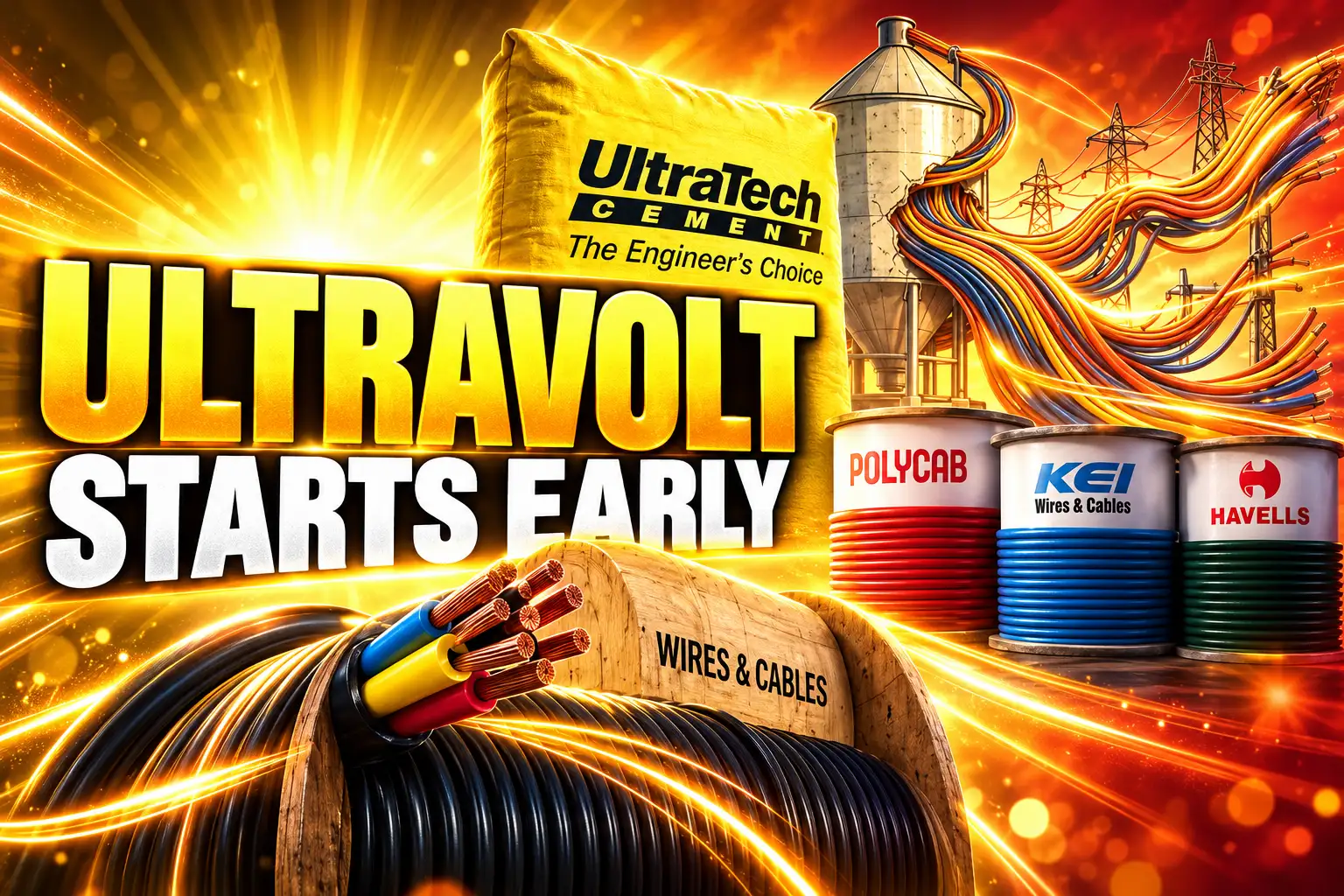
Nuvama Lifts Its Margin-Damage Range
Nuvama’s Friday note is the document the market traded. It said UltraTech’s push could force a near-term de-rating across cables and wires, and that a 150 to 250 basis point gross-margin hit could not be ruled out, against an earlier 100 to 150 basis point view. It still named Polycab and KEI as preferred stocks in the space.
WHAT NUVAMA NOW MODELS
- Margin hit: 150 to 250 basis points, up from 100 to 150 basis points earlier.
- Capacity path: about 1 million km installed now, scaling toward 3.5 to 4 million km.
- Spend to No. 2: ₹5,000 crore to ₹6,000 crore, above the ₹1,800 crore already guided.
- Stock call: Polycab and KEI remain the preferred names inside the group’s coverage.
Morgan Stanley, keeping an Overweight on UltraTech with a ₹14,700 target, flagged the same capacity gap: 1.1 million km running versus 3.5 to 4 million km guided. Jefferies kept a Buy and a ₹14,065 target, and said the new line could add 3% to 7% of UltraTech’s revenue and EBITDA by financial year 2030 once it is at scale. Motilal Oswal put UltraTech at 5% to 7% cables market share by financial year 2031 and said it was not changing UltraTech earnings until it sees revenue and margin guidance for the new business.
Copper and aluminium prices, up 40% to 50% year on year in Nuvama’s tally, still lift rupee sales and reported profit across the industry. That cushion is why a de-rating can show up in the multiple first. Earnings can look fine while the franchise premium comes off.
Why Cable Stock Multiples Moved First
Polycab closed at ₹9,445 on August 31. It closed at ₹8,895.50 on September 1, a 5.8% drop, after the Jhagadia notice. KEI changed hands 6% lower that session at ₹5,398.5. Havells India slipped 1.8% to ₹1,221.3. RR Kabel was still under pressure on September 2, down 7.5% to ₹2,654 in afternoon trade after JM Financial cut ratings on the three names.
Polycab then closed at ₹8,804 on September 2 and ₹8,807.50 on September 3. UltraTech closed at ₹11,312 on September 3, down 0.7% on the day, 6.1% lower over the month and 4.9% lower in 2026. In morning trade on September 4 it bounced to ₹11,330, up 0.49%, after an intraday high of ₹11,434.
JM Financial had already moved on September 2, cutting Polycab and KEI to Add from Buy and RR Kabel to Reduce from Add. Its targets were ₹9,550, ₹5,750 and ₹2,750. The desk said UltraTech and Diamond Power could together book about ₹17,000 crore of cables revenue by financial year 2029 and hold 11% to 12% of a market it put at ₹1.52 lakh crore, growing 15% a year. It called Polycab the most exposed to slower growth and peak margins, then RR Kabel, then KEI.
Of 42 analysts covering UltraTech, 38 had a Buy, with two Holds and two Sells. The cement stock is not the one being recast as a consumer-electricals compounder. Polycab is. Motilal’s June work still had Polycab on 56 times financial year 2026 earnings. That kind of multiple assumes the organised leader keeps taking share without a conglomerate writing a national cheque for the same shelf.
Share Is an Electrician Number
Installed kilometres are a factory fact. Who specifies the coil in the wall is a trade fact. House wire is sold through electricians, contractors and small electrical shops, not only through the counter that already takes a cement bag. UltraTech is betting those two rooms can be joined because it already knows the builder, the contractor and the individual home owner.
Gaur’s rollout plan is built for that join. Ultravolt wants more than 100,000 retailers and will put product into more than 5,000 outlets of UltraTech’s Building Solutions retail chain. The first wave covers more than 500 districts and 6,000 pin codes, backed by more than 20 warehouses. The plant uses German and Korean machines, E-Beam Pro curing and an in-house lab.
THE CHANNEL ULTRAVOLT IS BUYING
- Retailers: more than 100,000 outlets on the target list, from day one rather than a regional test.
- UBS stores: more than 5,000 UltraTech Building Solutions points already talking to home builders.
- Map: more than 500 districts and 6,000 pin codes in the opening wave.
- Warehouses: more than 20 sites, which forces peers to hold more stock if they want matching fill rates.
- Trade: more than 1,600 electricians already onboarded, with more than 40,000 to be trained over the next year with the Electronics Sector Skills Council of India under Skill India.
Kumar Mangalam Birla, chairman of the Aditya Birla Group, tied the product to copper and aluminium knowledge inside the group and to UltraTech’s existing builder relationships. Jefferies made the same point from the other side of the ledger, citing Hindalco’s metal chain as a supply advantage. Capacity still does not pull wire through a wall. The installer does. Until that person switches, Ultravolt is a plant with a brand, not a share number.
The Paints Playbook Comes to House Wires
Birla said new-business creation is now part of the group’s method. Paints is the live case. Grasim’s Birla Opus went to market in 2024 with a ₹10,000 crore commitment and 1,332 million litres of planned capacity across six plants. Grasim’s own paints report now calls Opus India’s third-largest decorative paints brand on a financial year 2025 exit run-rate. In the June 2026 quarter the paints line booked ₹1,661 crore of revenue, up 64% year on year.
We are making a sizeable commitment to Wires and Cables from day one, with the bold ambition of becoming one of the top 2 players in the category within 5 years.
Kumar Mangalam Birla, Chairman, Aditya Birla Group, at the Ultravolt launch
Birla also said India will add more than 100 million homes over the next decade, and that data-centre capacity should roughly quadruple to about 8 GW in four years. Those are demand claims, not share claims. In paints the group spent first, hired into the channel, and took high-single-digit share while the leader’s slice shrank. Cables are more organised than paints were, and house wire is specified by a tradesman who can be slow to move. The method is still the same: national capacity, national distribution, then price and scheme intensity until the trade bench has a second brand it can live with.
The pushback writes itself. Asian Paints is still the paints leader, and Opus has had to keep spending to hold the ground it took. A reply to the Ultravolt launch made that exact point. Speed of capacity is not the same as stickiness of the brand on site. That is the risk UltraTech is underwriting with a cement balance sheet.
What Polycab and KEI Still Control
Polycab is not a small incumbent. Its organised domestic cables-and-wires share rose to 30% to 31% in financial year 2026, from 18% to 19% in financial year 2020 and 26% to 27% the year before. Company figures put financial year 2026 revenue at ₹28,884 crore, with wires and cables at ₹25,179 crore, about 87% of the book. Motilal clocked Polycab’s cables EBIT margin at 13.8%.
KEI is smaller and more institutional. Financial year 2026 revenue was ₹11,748 crore, with an 11.5% EBIT margin in Motilal’s peer set and about 11% organised share. Havells is a broader electricals group; cables are about 9% of that organised market and ₹8,677 crore of revenue, at a 13.1% EBIT margin. Motilal’s June sector note put the whole cables-and-wires industry at ₹1.0 trillion in financial year 2026, with organised players at about 80%, up from about 67% in financial year 2022.
WHERE THE INCUMBENTS STAND
| Company | Organised C&W share, FY26 | FY26 revenue | EBIT margin |
|---|---|---|---|
| Polycab India | 30% to 31% | ₹28,884 crore (W&C ₹25,179 crore) | 13.8% |
| KEI Industries | about 11% | ₹11,748 crore | 11.5% |
| Havells India (cables) | about 9% | W&C ₹8,677 crore | 13.1% |
| UltraTech Ultravolt | nil in FY26 | not disclosed | not disclosed |
Organised players grew about 17% a year from financial year 2022 to 2026, against 12.5% for the whole industry. Motilal still sees demand at about 1.5 times to 2 times real GDP, and about 13% industry growth from financial year 2025 to 2030. UltraTech’s own February 2025 note cited about 13% industry revenue growth from financial year 2019 to 2024. A growing pie is why Nuvama can prefer Polycab and KEI even after it raises the margin warning. Share fights inside a 13% market hurt less than share fights inside a flat one, until price boards start matching a new national brand rupee for rupee.
Anil Gupta of KEI Industries told a television interview that sector demand should absorb the new capacity and that UltraTech may need two to three years to get established and take meaningful share. He also said KEI’s own Sanand plant would run at about 25% this year and about 60% next year. Incumbents are adding lines too. The question is whether they can add them without giving up the 13.8% EBIT Polycab just printed.
Desks Split on How Fast the Share Shifts
The production start was expected. The top-two language and the second-largest-by-capacity claim were not, at least not at this volume. That is why pricing fears travelled faster than volume forecasts. A national brand that needs to fill 1,098,000 km, then several million more, has a reason to buy the electrician early.
WHERE THE DESKS DISAGREE
- Nuvama: Near-term de-rating, 150 to 250 basis points of margin pressure, extra spend to reach No. 2, Polycab and KEI still preferred.
- JM Financial: Add on Polycab and KEI, Reduce on RR Kabel; UltraTech plus Diamond Power at 11% to 12% share by financial year 2029.
- Motilal Oswal: UltraTech at 5% to 7% share by financial year 2031; no change yet to UltraTech earnings; June note still Buy on Polycab and KEI.
- Jefferies: Buy UltraTech; 3% to 7% of group revenue and EBITDA by financial year 2030; Hindalco metals chain as a cost edge.
- KEI’s Anil Gupta: Two to three years before UltraTech is established; demand can take the extra kilometres.
Analyst tallies on the incumbents already showed the split before Ultravolt’s brand night: Polycab 26 Buy, 8 Hold, 1 Sell; KEI 14 Buy, 12 Hold, 1 Sell; RR Kabel 10 Buy, 3 Hold, 3 Sell. JM’s cut moved the sceptical column. Nuvama’s Friday note moved the multiple argument without abandoning the two names it likes.
Ultravolt is now a running plant, a retailer target list and a public promise to be in the top two in five years. Polycab still holds about a third of organised domestic cables. KEI still has the institutional book. The de-rating Nuvama described is the market charging for the chance that those facts get more expensive to defend.
Disclaimer: This article is news reporting and analysis of listed companies, brokerage notes and exchange filings, and is for information only. It is not investment advice, a recommendation to buy or sell any share, or a forecast of returns on Polycab, KEI Industries, UltraTech Cement, Havells India, RR Kabel or any other security. Readers should consult a SEBI-registered investment adviser or other qualified financial professional before acting on any stock, sector or valuation view. Figures, ratings and business plans reflect the cited company filings and brokerage notes as of September 4, 2026 and can change with the next plant update, earnings print or research revision.

Greed Held After a $697 Million Crypto Long Flush

Fed Minutes Keep a Year-End Rate Hike Alive

A Nanny-Cam Tape Follows Tyreek Hill Into Free Agency

Star Wars Galactic Racer Makes a Crash End the Tour

Amazon Puts Apple’s June MacBook Prices Back on Sale

The iPhone 16 Pro Flipkart Cut Did Not Last

Sophia Wootten Turns the Miss Georgia Crown Toward Cleft Care

Microsoft Prints Azure’s $29.42 Billion Quarter and Shrinks the Map

Georgia Beach Bacteria List Leaves Swim Areas Open

UltraTech’s Ultravolt Launch Puts Cable Multiples on Trial
-
 NEWS1 year ago
The iPhone 16 Pro Flipkart Cut Did Not Last
-
 ENTERTAINMENT4 months ago
Sophia Wootten Turns the Miss Georgia Crown Toward Cleft Care
-
 NEWS1 month ago
Microsoft Prints Azure’s $29.42 Billion Quarter and Shrinks the Map
-
 NEWS4 months ago
Georgia Beach Bacteria List Leaves Swim Areas Open
-

 NEWS9 months ago
IXI Autofocus Glasses Still Lack a European CE Mark
-
 NEWS3 months ago
Little St. Simons Island Hatches Loggerheads at 72.4 Percent
-

 BUSINESS3 months ago
Georgia Furniture Mart Closes a Growing 40-Year Business
-

 NEWS3 years ago
Eyal Waldman Keeps a Two-State Bet After Gaza