
NEWS
College Essays Sound Like AI After the Signal Collapsed
College essays got cleaner after ChatGPT, then more alike. Admissions readers now discount that polish.

College essays got cleaner after ChatGPT, then started sounding like one another, and the applicants who leaned on the free bot paid for it in decisions. A college essay coach has been arguing that the sameness started earlier, in twenty years of published samples and how-to blogs that taught teenagers to land on growth, passion, and authenticity. New application files show what that training did once a model could copy it on command.
The ethics fight still asks whether a student cheated and whether a detector caught them. The practical change is quieter. Readers are discounting the polished personal statement, and schools are adding extra proof that a person is attached to the file.
College Essays Got Better and Then Lost Weight
ChatGPT shipped on November 30, 2022. Within a year, the median essay was easier to read and harder to assign to one teenager. Grammar tightened. Transitions smoothed out. The closing lesson still arrived on cue. That is the product both the blogs and the models already knew how to make.
Valerio Capraro, an associate professor at the University of Milan-Bicocca, put the loss in collective terms in June 2026, describing a comparison of 2,200 college admissions essays written by humans before the chatbot with essays generated by GPT-4. Individual pages could look strong. The pool did not grow.
This is the real danger of AI in education. Not that students will write worse. That everyone will write the same.
Valerio Capraro, associate professor, University of Milan-Bicocca, on X
That is why a page can sound like a bot when no bot touched it. The coach’s point still holds: students were already trained to narrate a club, a hospital shift, or a family hard time, then tack on “I learned that.” Models trained on the same advice reproduce the same arc. A detector that hunts for machine syntax will miss the deeper match, which is that the essay no longer could have come from only this student.
The second-order hit is in the decision, not the prose. Writing that used to sort people now sorts them less, because the “good” version is the average version.
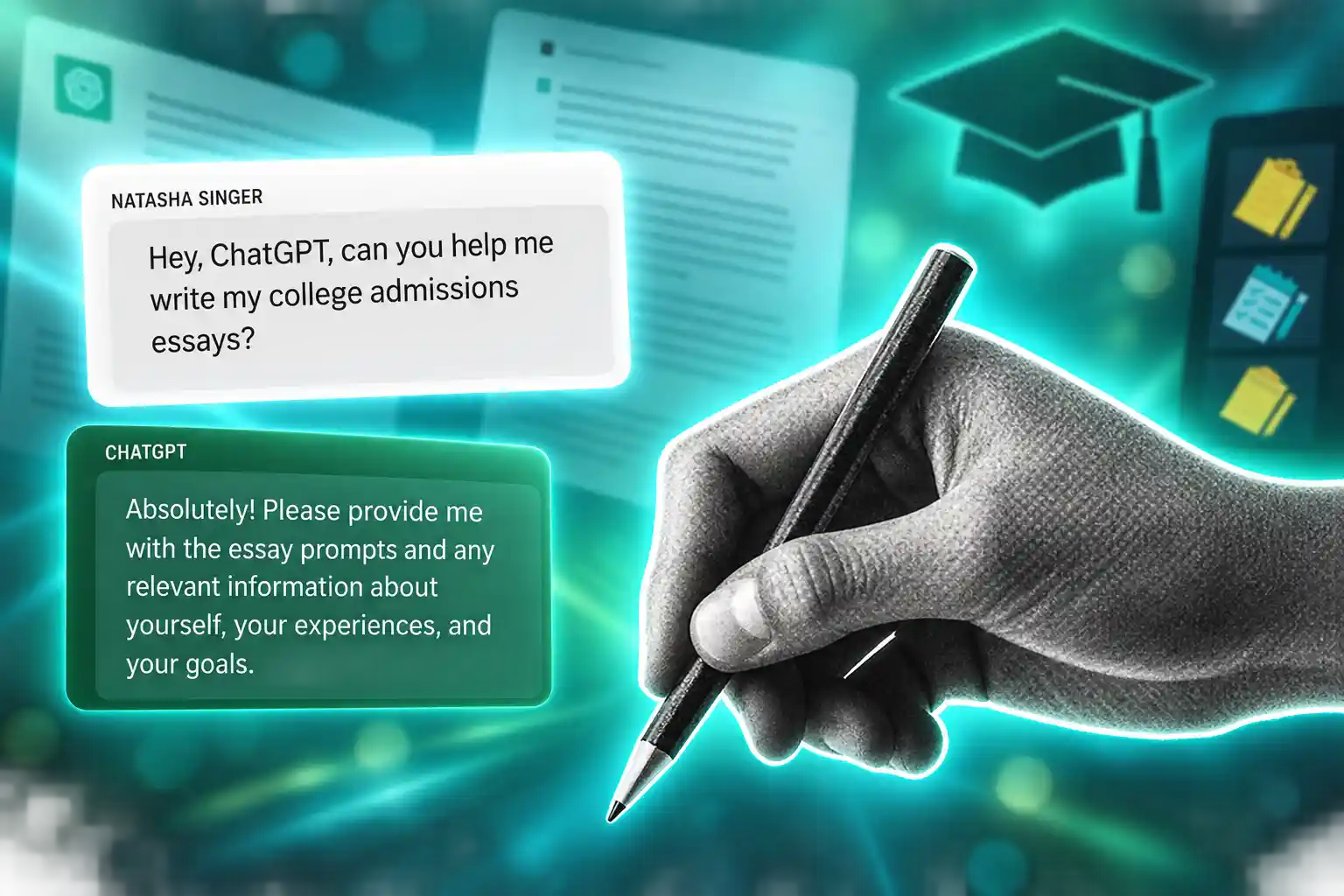
81,663 Files Showed a Narrower Vocabulary
Jinsook Lee, a Cornell Information Science Ph.D. candidate, led a team with Carnegie Mellon researchers that studied 81,663 selective-university applications submitted from 2020 to 2024. After 2023, surface language in the essays moved closer together. The largest shift sat with applicants who received a fee waiver, used in the paper as a stand-in for lower family income, and with applicants the college later rejected.
Estimated model use jumped in 2024 across the pool and rose faster among those fee-waiver students. Lee has described that pattern as an access story: families that already pay for counselors and teachers can treat a chatbot as one more editor, while students who use the free tool alone get the generic default. An earlier Cornell comparison found that model-written admissions essays, measured against real applicant writing, skewed toward a male, continuing-generation, high-activity voice rather than toward the person named on the form.
THE TWO APPLICATION STUDIES
- Undergraduate files: 81,663 applications to one selective university, 2020 to 2024, with the biggest sameness among fee-waiver and rejected applicants after 2023.
- Master’s files: 7,462 applications to a large U.S. public-policy program, 2020 to 2025, with a majority AI-written in 2025 on at least one essay despite a ban.
- College-applicant surveys: 30 percent used generative AI for help on the personal essay, and one in five of those students used it for a final draft, as cited in the master’s paper; a separate 2024 Ruffalo Noel Levitz survey found one-third of high schoolers used AI somewhere in college planning.
- Early Common App trace: Lee’s group had already estimated that about 8 to 10 percent of the text in Common App essays at one competitive engineering school showed model-like patterns in the first year after ChatGPT.
The master’s study, posted in September 2026 by Calvin Isley and Sharad Goel of Harvard and Johann D. Gaebler of New York University, is a different population and should stay labelled that way. In that 2025 cycle, 56 percent of applicants submitted at least one essay GPTZero called primarily AI-written at high confidence. The share was 69.3 percent among international applicants and 38.6 percent among domestic ones, climbing about 20 percentage points a year from 2023. Mechanical scores (grammar, style, clarity) jumped more than the substance scores (voice, leadership, fit).
Those cleaner pages did not buy admission. In the 2023 and 2024 cycles, each AI-flagged essay tracked with a 1.5 percentage-point drop in admission probability after the authors adjusted for a large set of file features. Applicants who used AI submitted 2.32 such essays on average, a 3.48 point combined hit. When the researchers also controlled for essay quality, the penalty rose to 2.6 points per essay, about 6.0 points for a typical AI user, because the AI pages were stronger on the page and that strength had been masking part of the discount. The office was not running a detector. Five officers asked to rate AI-likelihood still separated machine from human at an AUC of 0.70, and they scored pages they believed were AI-written more harshly.
The program changed its process for 2025 after seeing those results, so the authors did not score that year’s decisions. The pattern is still the one that matters for a senior writing now: polish is visible, and visible polish is cheap.
The Counselor Gap That Consultants Filled
The model did not invent the market for a safer essay. Independent educational consultants did, at the scale of a profession, because school counselors cannot sit with every senior for three drafts.
HOW THE COACHING TRADE GREW
- 2010: The Independent Educational Consultants Association counted about 1,500 full-time independent educational consultants in the United States, plus about 150 abroad and 4,000 part-timers.
- 2015: Full-time headcount reaches about 3,500, with 350 international consultants and 5,000 part-timers.
- November 30, 2022: ChatGPT launches the day before many graduate deadlines, and the next undergraduate cycle inherits a public writing engine trained on the same advice students already bookmark.
- August 2023: Common App’s fraud policy is updated to treat misrepresenting AI output as a form of application fraud, without running a detector on the file.
- End of 2024: IECA estimates 8,500 to 10,000 full-time consultants in the United States, 1,500 international, and another 10,000 to 15,000 part-time.
A Lipman Hearne study cited by IECA found that 26 percent of high-achieving high school students heading to a four-year college used an independent consultant, up from 3 percent in an earlier version of that research. IECA says most of its members charge just under $140 an hour, in the neighborhood of a family therapist, and that the number of shops billing more than $40,000 can be counted on one hand. Members are forbidden from writing or heavily editing a student’s essay. Light edits, the way an English teacher might mark a draft, are allowed.
The association’s own case for hiring one is the public-school load. In parts of the country, counselors handle 600 to 1,000 students and still own behavior, scheduling, and college advising. A private college, IECA notes, can cost a family more than $250,000 over four years. Families that can buy time buy it. Families that cannot now buy a chatbot that has read every “essay that worked” post the paid shops also read.
Angel Pérez, chief executive of the National Association for College Admission Counseling, has warned that a chatbot is a poor stand-in for a person who has sat in a reading room. It will average the dataset. It will not tell a student which odd detail is the one a reader has not seen that day.
Virginia Tech Let Software Take a Reader Slot
Colleges did not respond by dropping the essay. They responded by surrounding it. Common App still requires the personal statement, and its member schools inherit a platform rule that treats AI output as application fraud when a student presents “the substantive content or output of an artificial intelligence platform, technology, or algorithm” as original work. Common App does not run a detector and does not define “substantive” in public. Each college still reads the file under its own roof.
An August 2026 review of 50 selective schools found 26 had published their own position for the 2026-27 cycle: 21 allowed limited use (brainstorming, spelling, grammar), 2 (Harvard and Brown) prohibited AI-generated application writing, 3 offered guidance without a hard rule, and 24 had nothing on their admissions pages beyond the platform’s fraud clause. A 2025 Kaplan survey of more than 200 admissions officers found that only 2 percent of colleges said they officially allow applicants to use generative AI to write the essay.
WHERE THE RULES SAT IN 2026
| Office | What applicants may do | What sits behind the rule |
|---|---|---|
| Common App | Grammar-level help is not named as fraud; substantive AI content is | Signed certification, August 2023 language, no platform detector |
| Notre Dame | Spelling, grammar, and brainstorming; not drafting the submission | Offer can be pulled, including after enrollment |
| Caltech | Research, brainstorming, spelling; no outlining, drafting, or translating | Human-help test, mandatory ethics review, rescission warning |
| Virginia Tech | No bright public line for applicants on drafting | Until fall 2025, two humans scored each of four short answers; one of those seats is now a model |
Juan Espinoza, vice provost for enrollment management at Virginia Tech, described the appeal of the school’s own scoring model, trained on past essays and the rubric, as consistency rather than mercy.
Humans get tired; some days are better than others. The AI does not get tired. It doesn’t get grumpy. It doesn’t have a bad day. The AI is consistent.
Juan Espinoza, vice provost for enrollment management, Virginia Tech
UNC Chapel Hill had already used software to score grammar and style on applicant essays, a move that drew complaints when students learned about it. Other campuses have pointed models at transcripts and activity lists. Caltech added an AI-driven video viva for applicants who submit research, generating questions from the paper so faculty can watch the student answer. Ashley Pallie, Caltech’s dean of undergraduate admissions, has described that as a way to pull a human voice back into a package that consultants can over-produce.
The essay is still on the list of things that count. It is no longer being asked to carry identity by itself.
Why Detectors Cannot End the Fight
Parents still want a tool that will say yes or no. Vendors will sell that tool. The application problem is not a clean classification task, because the human formula and the model output share a training set.
The master’s authors replicated their flags with Pangram as well as GPTZero and got the same direction of results. Independent audits have also found Pangram’s false-positive rate on long passages close to zero, which is why some faculties, including Dartmouth’s arts and sciences dean in late September 2026, have authorized it for de-identified coursework. Course papers are not Common App files. A senior who writes the way the blogs taught, in a second language, or after a heavy copy-edit, can still trip a classroom detector that a reader would call “polished.”
Older Stanford tests on TOEFL essays showed some detectors tagging non-native human writing at much higher rates than native writing. The master’s authors, in their own data, did not find a higher false-positive rate for international applicants or language-test takers, and they treat the 69.3 versus 38.6 split as use, not bias. Both things can be true in different tools and different rooms. Neither thing gives a dean a number they can print on a rejection.
So offices do what offices do when a signal decays. They keep the essay, add a signature, and look for a second channel that is harder to outsource overnight.
Timed Writing and Video Checks Fill the Hole
Some high schools and colleges have already added a timed writing sample, in a room or a locked browser, so the file contains a page that could not have been workshopped by a parent, a $140-an-hour coach, and a chatbot in the same evening. That is a crude test. It is also an admission that the polished statement no longer proves authorship.
THE EXTRA PROOF NOW SITTING ON THE FILE
- The signature: Every Common App submitter certifies the writing is their own, with AI named in the fraud definition since August 2023.
- The school overlay: A minority of selective colleges publish a local AI rule on top of that signature; most still do not.
- The live check: Research-heavy applicants at Caltech can be asked to answer model-generated questions on video about work they claim.
- The second reader: Virginia Tech replaced one human essay score with a model trained on its own rubric, a move other large public campuses can copy without saying they “use AI to admit.”
- The timed page: A growing set of programs want a sample produced under watch, because the take-home statement has become too easy to average.
None of those layers restores what the old idiosyncratic essay did, which was to show a mind in motion on a small, specific thing. They restore a chain of custody. The coach who told students to notice a habit, a contradiction, or a stretch of boredom was describing the last kind of page that still cannot be swapped into the next file in the pile. That page is harder to write, and it is the one the models are worst at, because it does not end in a marketable trait.
Johns Hopkins Still Posts the Essays That Worked
The template machine is not a rumor on a Discord server. Johns Hopkins still publishes Johns Hopkins essays that worked, nominated by its own committee, now including pieces from the Class of 2030, and still tells applicants that the most important thing is to be original. The samples are specific and often good. They are also public, indexed, and sitting in the same corpus every chatbot and every anxious senior will find at 11 p.m.
Titles in that archive run toward connection, roots, and a hobby that maps onto character. A student can read five of them, extract the shape, and produce a sixth that a reader has already met. Consultants did not hide this genre. Selective colleges taught it, then built detectors and video tools to cope with how well the lesson took.
The applicants who lose first are not the ones who can buy another round of human edits. They are the fee-waiver students in Lee’s files, the international applicants in the master’s data, and anyone else who used the free model as the whole writing program. Their pages got neater. They also got closer to one another, and closer to the voice officers have learned to mark down.
The personal essay is still on the application. It just no longer does the job it was left on the form to do, which was to pick one human out of a stack that already looks the same on paper.

Greed Held After a $697 Million Crypto Long Flush

Fed Minutes Keep a Year-End Rate Hike Alive

A Nanny-Cam Tape Follows Tyreek Hill Into Free Agency

Star Wars Galactic Racer Makes a Crash End the Tour

Amazon Puts Apple’s June MacBook Prices Back on Sale

The iPhone 16 Pro Flipkart Cut Did Not Last

Microsoft Prints Azure’s $29.42 Billion Quarter and Shrinks the Map

UltraTech’s Ultravolt Launch Puts Cable Multiples on Trial

IXI Autofocus Glasses Still Lack a European CE Mark

Little St. Simons Island Hatches Loggerheads at 72.4 Percent
-
 NEWS1 year ago
The iPhone 16 Pro Flipkart Cut Did Not Last
-
 NEWS1 month ago
Microsoft Prints Azure’s $29.42 Billion Quarter and Shrinks the Map
-
 BUSINESS1 month ago
UltraTech’s Ultravolt Launch Puts Cable Multiples on Trial
-
 NEWS9 months ago
IXI Autofocus Glasses Still Lack a European CE Mark
-
 NEWS3 months ago
Little St. Simons Island Hatches Loggerheads at 72.4 Percent
-
 NEWS4 months ago
Georgia Beach Bacteria List Leaves Swim Areas Open
-
 ENTERTAINMENT4 months ago
Sophia Wootten Turns the Miss Georgia Crown Toward Cleft Care
-
 NEWS3 years ago
Eyal Waldman Keeps a Two-State Bet After Gaza