
AUTO
Georgia Caps Car Booting at $75 but Leaves Lot Patrols
Georgia now caps a passenger boot at $75 a day and bans kickbacks, yet crews can still wait in the lot and Atlanta can tow the car after 24 hours.

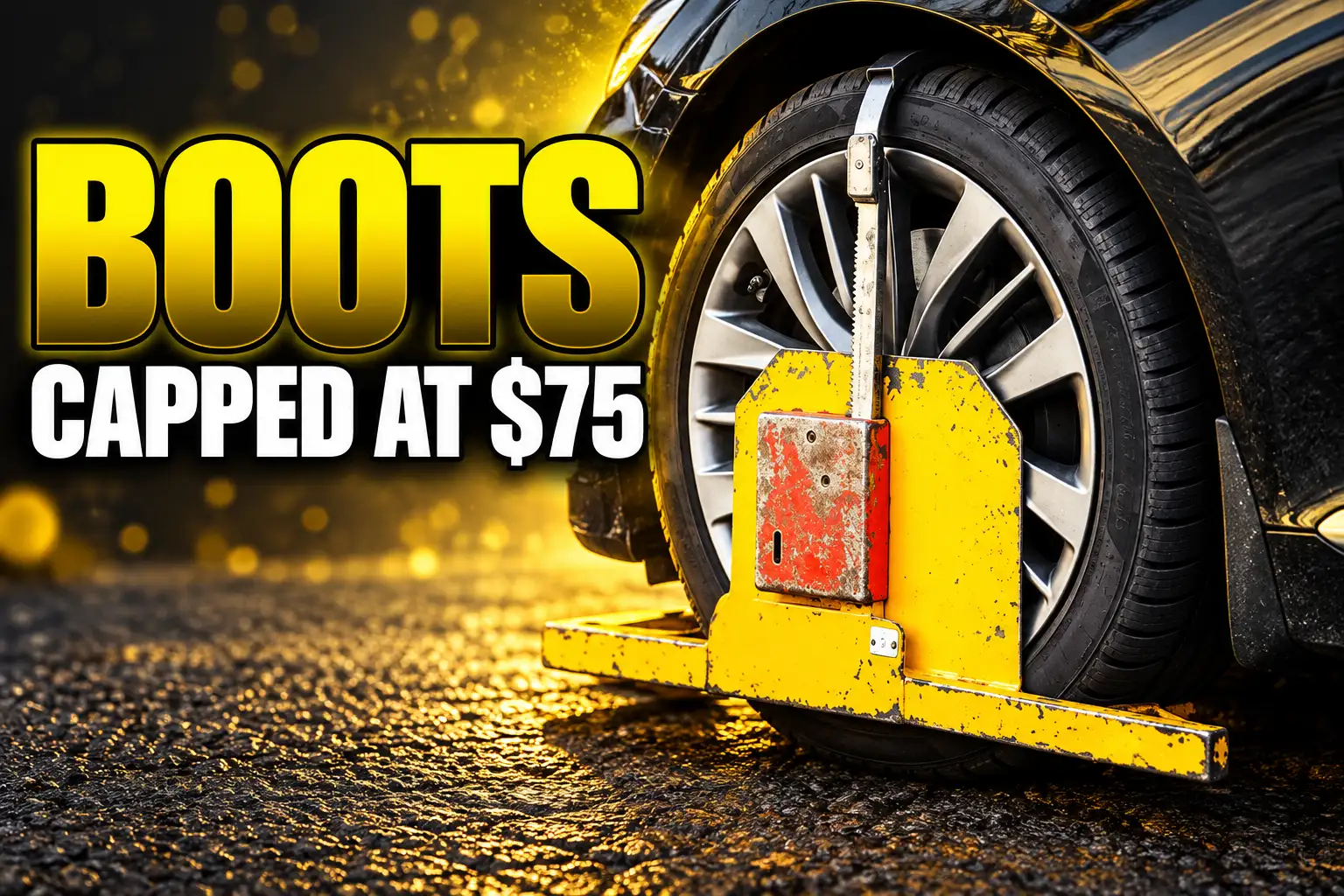
Georgia now caps a private-property car boot at $75 a day for passenger vehicles, but companies can still wait in the lot and clamp a wheel in minutes. House Bill 551 took effect on January 1, 2026, under the Department of Public Safety, with a kickback ban and a one-hour release rule that drivers in Atlanta had asked for after years of Ponce, Buckhead, and apartment-lot clamps.
The price fight is largely over. The patrol fight is not, and that is why a Sandy Springs senator who helped write the 2025 rules came back in February 2026 trying to outlaw the boot altogether.
Passenger Cars Now Cap at $75 a Day
The Board of Public Safety approved its first immobilization tariff on December 11, 2025. That schedule, and the replacement that took effect on February 16, 2026, set a hard ceiling: $75 a day for passenger cars, motorcycles, and trucks at or under 26,000 pounds GVWR, and $125 a day for heavier commercial vehicles. The figures are flat. Travel, labor, “convenience,” retrieval, and processing add-ons are barred.
Those numbers live in the department’s maximum rate tariff for vehicle immobilization, issued under HB 551. Cities may post a lower cap inside their limits. They may not post a higher one.
STATE BOOTING LIMITS UNDER TARIFF NO. 2
| Rule | Limit |
|---|---|
| Passenger, motorcycle, truck (GVWR 26,000 lbs or less) | $75 per day |
| Heavy commercial (GVWR over 26,000 lbs) | $125 per day |
| Liability insurance | $500,000 minimum |
| Surety bond | $10,000 |
| Time to arrive after a release call | 60 minutes |
A company must hold a DPS permit, work only in a city or county that has authorized immobilization by ordinance or resolution, file an employee and vehicle roster, and renew annually. Cash-only shops are out. Tariff No. 2 requires U.S. currency plus at least one major credit card and one major debit card, with no card surcharge. Charge above the posted rate and the fine can hit $1,000, with the permit on the line.
If you walk up while the device is still going on, the crew has to take it off and let you leave at no charge. That is the line Atlanta resident Jacey Colton was waiting for. “I’ve had an issue where I would park somewhere and I’ve had to wait an hour or two before they would come,” she said when the law went live. The tariff now gives the company 60 minutes after the call.
Property Owners Lost the Kickback Cut
The fee cap hurts the old business model. The kickback ban is what breaks the incentive to over-enforce.
State Sen. Josh McLaurin, a Sandy Springs Democrat, told colleagues that booting firms were handing landlords as much as half of each clamp. “Right now, booting companies are paying up to half their boot, half their fee to property owners as kickbacks. And that has caused a lot of predatory activity,” he said as the Senate attached the booting language to HB 551 on a 48-3 vote.
Right now, booting companies are paying up to half their boot, half their fee to property owners as kickbacks. And that has caused a lot of predatory activity.
Josh McLaurin, Georgia state senator, Senate floor debate on HB 551
The codified rule is blunt. $1,000 fine for kickback payments hits any person who pays a property owner, or anyone in possession of the lot, a fee or emolument for the right to immobilize or tow. The same $1,000 attaches to a towing firm that writes an automatic-surveillance deal instead of coming only when the owner calls about a specific trespass.
Atlanta attorney Matt Wetherington, who has spent a decade suing boot companies, called kickbacks the piece that would actually change behavior. “We’ve seen countless people who are shot, stabbed, or just getting into fights with car booters. It’s my hope that we will see a dramatic reduction in that as some of these financial incentives are taken away,” he said in early January.
Joshua Loiten, booted near Ponce and the Beltline, put the old pitch in plainer words. “I mean, I’m happy for them, because I feel like they were being really aggressive and it came off as just trying to make some money,” he said. “So, at least we have some protection and accountability for who is booting our cars.”
Lot Camping Survived the House Rewrite
The Senate amendment would have treated boot crews like tow trucks: no sitting in the lot, no pouncing three minutes after a driver walked inside. McLaurin’s pitch was specific. “Right now, booters can basically camp out in a parking lot, wait for somebody to walk into a store, and then three minutes later, throw a boot on their car,” he said. He also said, “Nobody has to call them. They patrol on their own and they make their own judge, jury, executioner decisions.”
The statute that took effect does not carry that patrol ban for immobilization. The automatic-surveillance penalty in O.C.G.A. § 44-1-13 still names towing and storage firms and the act of removal. Kickbacks now cover the boot. Lot-watching does not, which is why the Attorney General’s consumer page still warns that a company may be watching to see which business you enter.
WHAT STILL GOES IN A GEORGIA LOT
- Still legal: A permitted company may wait on private property that has authorized immobilization and clamp a trespassing car, as long as the entrance signs are up.
- Banned: Paying the landlord for the right to boot, demanding cash only, stacking extra fees on top of the daily cap, and ignoring a driver who returns before the device is on.
- Illegal without a local vote: Booting in a city or county that has never authorized immobilization by ordinance or resolution.
- Required on the sign: Company name, 24-hour phone number, accepted payment methods, and the flat rate by vehicle weight, visible at night from each entrance after February 15, 2026.
That leftover patrol is the part commercial strips already knew. A short stop on a West Midtown block could cost an evening long before the state wrote a tariff, because the crew did not need a landlord to call them first. HB 551 licenses the crew and cheapens the clamp. It does not make them wait for a phone call.
Atlanta’s $75 Rule Predates the State Law
For Atlanta drivers, the headline number is not new. The city’s 2018 parking ordinance already capped a private-lot boot at $75 per 24-hour period and demanded readable signs and identifiable staff. Jonathan Witcher said he had been clamped in Buckhead. Colton listed apartments and lounges. “I’ve been booted at people’s apartments. I’ve been booted at lounges. I’ve been booted all over, many, many times,” she said.
What the state added is the permit, the bond, the card rule, the kickback ban, and DPS as the rate-setter for every Georgia city that still allows the practice. Those statewide rules that took effect in January also freeze a city from going above the tariff. Marietta had already voted in October 2025 to raise its own maximum to $75, matching the figure DPS later wrote into Tariff No. 1.
Outside cities with old caps, the pre-2026 bills were another world. In 2019, ABL Booting billed $650 to free a work truck in DeKalb County after that county had tried to cap boots at $150. Cobb County banned private booting in 2004. Unincorporated Gwinnett followed in 2007. The new state law does not reopen those bans. It also does not create a boot right in a town that never voted one in.
What Happens After 24 Hours on a Boot?
In Atlanta, a booted car can be towed once it has sat immobilized for 24 hours. That is a city rule, not a DPS tariff line, and it is the expensive door the $75 cap does not close. After the wrecker leaves, you are in the towing schedule: a recovery yard, storage, and a notification fee, with a separate state rule that bars storage charges for the first 24 hours after a private-property tow.
Stay into a second 24-hour window on the clamp itself and Atlanta’s ordinance allows another $75 for that day, still with no add-on junk fees. The all-inclusive $75 daily passenger rate is the most the company can ask for each of those days. Anyone quoting more, or refusing a card, is already outside Tariff No. 2.
If someone boots you right now, take photos of the sign, take photos of the lot, take photos of the notice that’s on your car. Make sure that it complies with the new law, and if it doesn’t, dispute it with your credit card company.
Matt Wetherington, Atlanta attorney, January 2026
Wetherington’s punch list is the practical half of the law. Signs had a grace period through February 15, 2026, under a December 29, 2025, administrative order; DPS said enforcement of the night-visible entrance boards would start on or after that date. The rest of HB 551, including the cap and the hour clock, was already live on January 1. A driver who pays should leave with a receipt, the remover’s name, and the company name. That paper is what a card dispute or a later complaint actually uses.
The Georgia Attorney General’s Consumer Protection Division does not police boots. Its state guidance on booting complaints still sends people first to the company, then to the property owner, then to the local licensing office, and to DPS for the permit. In Atlanta, that local shop is the Police Department’s License and Permits Unit. The code also gives a private right of action: actual damages presumed at not less than $100, and three times actual damages if a court finds the violation was intentional.
Forty Senators Could Not Move a Full Ban
McLaurin had tried a statewide ban in 2023 and a towing-style patrol bill in 2024. Landlords and operators told a 2024 Senate hearing that lot patrols were the only workable way to stop illegal parkers. After HB 551 landed without that patrol ban, he filed Senate Bill 541 in February 2026 to prohibit wheel restraints on trespassing cars.
“And what you’ve seen now is 40 senators out of 56 have said that’s not good enough, and we would rather ban the entire booting industry and use alternative technologies for parking enforcement,” McLaurin said. The bill then went to the Interstate Cooperation Committee, which had no chair after Sen. Colton Moore resigned. McLaurin called the assignment “an anti-people power move” and said, “The people want a ban on the boot.” His motion to send the bill somewhere it could get a hearing failed. By late February the ban was dead for the session.
HOW THE BOOTING FIGHT MOVED IN 2025 AND 2026
- May 14, 2025: HB 551 is signed, with a January 1, 2026, effective date for the immobilization chapter.
- December 11, 2025: The Board of Public Safety approves Maximum Rate Tariff No. 1 at $75 and $125 a day.
- January 1, 2026: The law, the permit, the cap, the hour clock, and the kickback ban take effect.
- February 15, 2026: Night-visible entrance signage becomes enforceable.
- February 16, 2026: Tariff No. 2 adds the cash-plus-cards rule and the $1,000 overcharge fine.
- February 2026: SB 541, a full boot ban, is filed and then parked in a committee with no chair.
- September 28, 2026: Atlanta’s Public Safety and Legal Administration Committee holds 26-O-1547, a proposal to cap city booting fees at the DPS figure.
The industry did not vanish. Advanced Booting Services, founded in Atlanta in 1998, still advertised Atlanta and Athens work in September 2026 and told property managers it runs background-checked, uniformed crews. On September 28, Atlanta’s Public Safety and Legal Administration Committee held an ordinance that would have tied the city’s own cap to whatever DPS publishes, a reminder that the city code and the state tariff are still being lined up, not merged.
Today, the Public Safety & Legal Administration Committee favorably recommended several significant pieces of legislation including:
26-R-4001, which would authorize the Mayor to sell the Atlanta City Detention Center to Fulton County. The legislation now heads for… pic.twitter.com/CWnraezMIW
— Atlanta City Council (@atlcouncil) September 28, 2026
Nine months after the consumer-protection law took effect, the clamp is cheaper, licensed, and supposed to come off within an hour. The crew can still be sitting in the lot when you walk into the gym.
Frequently Asked Questions
How much can a booting company charge in Georgia?
The DPS tariff caps a passenger, motorcycle, or lighter truck at $75 per day and a heavy commercial vehicle at $125 per day, with no extra administrative or card fees, and the department says it will review that schedule each year against a transportation inflation index such as the Producer Price Index. A city may require a lower number inside its limits. It cannot authorize a higher one.
Can a company boot my car if the city never passed an ordinance?
No. Only a DPS-permitted operator working in a jurisdiction that has authorized immobilization by ordinance or resolution may place a device, and a residential property with no more than four units is excused from the posting rules that apply to commercial lots. If your town never voted to allow boots, the clamp is not a state-granted right.
Do I have to pay if I return before the boot is fully on?
No. Tariff No. 2 says the vehicle must be released without charge if you arrive before immobilization is complete, and the company still has to take cash plus a major credit card and a major debit card with no surcharge once a fee is actually owed. That free-release rule is the one drivers kept misreading as a grace period after the clamp locked; it is not. It applies only while the device is still going on.
Who handles a complaint when a company breaks the new rules?
Start with the company and the property owner, then the local licensing office (Atlanta’s is the Police Department License and Permits Unit) and DPS, which keeps the permit file; you can also sue under the code for actual damages presumed at not less than $100, or three times that if a court finds an intentional violation. The Attorney General’s consumer shop publishes the path but does not enforce the tariff itself.
Is private booting banned anywhere in Georgia besides the new state cap?
Yes, some local governments already outlawed it, including Cobb County in 2004 and unincorporated Gwinnett County in 2007, and those bans still sit on top of HB 551 rather than being replaced by it. SB 541 would have made that the statewide rule and did not get a working committee in 2026.
Disclaimer: This article is news reporting and analysis of Georgia’s vehicle-immobilization statute, DPS tariffs, and related local rules. It is informational only and is not legal advice, is not a determination of any driver’s rights in a specific dispute, and is not a recommendation to pay, refuse to pay, or sue. Anyone facing a boot, a tow, a fee demand, or a permit fight should consult a Georgia-licensed attorney or the local licensing office that covers the lot before acting. Fee caps, signage duties, permit status, and city ordinances can change after the dates named in the sources above.

Greed Held After a $697 Million Crypto Long Flush

Fed Minutes Keep a Year-End Rate Hike Alive

A Nanny-Cam Tape Follows Tyreek Hill Into Free Agency

Star Wars Galactic Racer Makes a Crash End the Tour

Amazon Puts Apple’s June MacBook Prices Back on Sale

The iPhone 16 Pro Flipkart Cut Did Not Last

Microsoft Prints Azure’s $29.42 Billion Quarter and Shrinks the Map

UltraTech’s Ultravolt Launch Puts Cable Multiples on Trial

IXI Autofocus Glasses Still Lack a European CE Mark

Little St. Simons Island Hatches Loggerheads at 72.4 Percent
-
 NEWS1 year ago
The iPhone 16 Pro Flipkart Cut Did Not Last
-
 NEWS1 month ago
Microsoft Prints Azure’s $29.42 Billion Quarter and Shrinks the Map
-
 BUSINESS1 month ago
UltraTech’s Ultravolt Launch Puts Cable Multiples on Trial
-
 NEWS3 months ago
Little St. Simons Island Hatches Loggerheads at 72.4 Percent
-
 NEWS9 months ago
IXI Autofocus Glasses Still Lack a European CE Mark
-

 NEWS4 months ago
Georgia Beach Bacteria List Leaves Swim Areas Open
-

 ENTERTAINMENT4 months ago
Sophia Wootten Turns the Miss Georgia Crown Toward Cleft Care
-

 NEWS3 years ago
Eyal Waldman Keeps a Two-State Bet After Gaza