
AUTO
GST Made the Brezza Turbo Cheaper Than Its 1.5
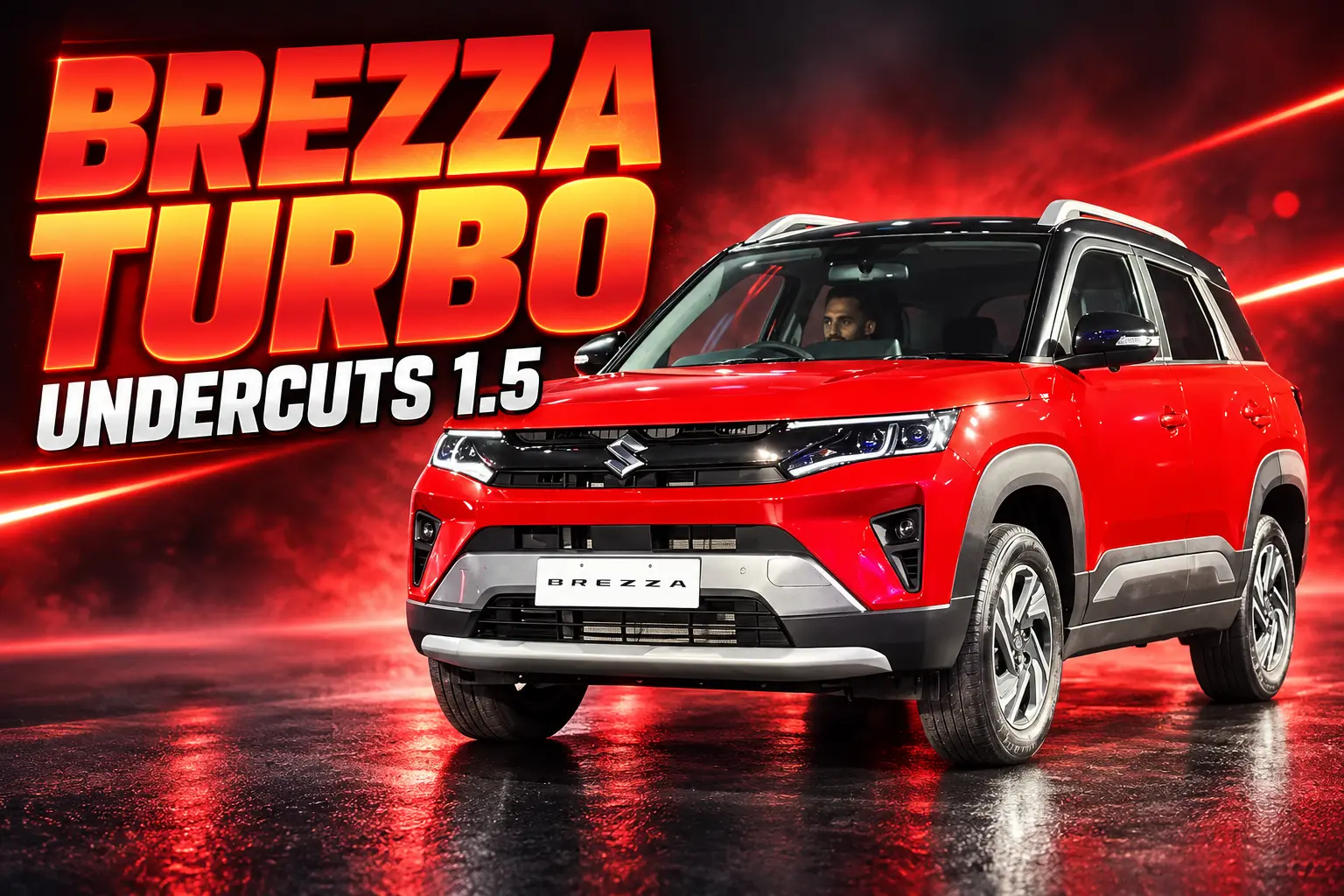
The 2026 Maruti Brezza Turbo undercuts the 1.5-litre because GST 2.0 taxes 997cc at 18 percent. The automatic stays on the costlier engine.

Maruti Suzuki priced the 2026 Maruti Brezza Turbo from Rs 7,39,900 ex-showroom, undercutting its own 1.5-litre petrol after GST 2.0 split the range. The 997cc Boosterjet makes more power than the 1,462cc K15C and still costs less on matching trims because the smaller engine sits in the 18 percent tax band. The six-speed automatic never joined it.
That inversion is the product. Four years after the second-gen Brezza arrived on a single petrol, Maruti used a downsized turbo to climb back into the cheap slab, kept two-pedal cars on the costlier 1.5, and moved the CNG tank under the floor so the 328-litre boot finally survives on gas.
Why the Brezza Turbo Costs Less Than the 1.5
From 22 September 2025, GST 2.0 put petrol, LPG and CNG cars at 18 percent GST on compact SUVs only if the engine stays at or under 1,200cc and length stays at or under 4,000 mm. Everything else, including a sub-4-metre SUV with a 1.5-litre petrol, moved to 40 percent. The Brezza is 3,995 mm long. The turbo is 997cc. The K15C is 1,462cc. The tax gap writes the price list.
Maruti announced the Turbo Boosterjet on 24 July 2026 with introductory prices starting at Rs 7,39,900. The LXi 1.5 manual is Rs 8,30,000. The VXi Turbo is Rs 8,54,900 against Rs 9,26,000 for the VXi 1.5 manual and Rs 10,61,000 for the VXi automatic. The ZXi Turbo is Rs 9,84,900 against Rs 10,50,000 for the ZXi 1.5 manual. The ZXi+ Turbo is Rs 11,15,900. The ZXi+ 1.5 automatic, the dearest metallic car in the range, is Rs 13,55,000.
THE 2026 BREZZA EX-SHOWROOM SPLIT
| Trim | Turbo 6MT | 1.5 6MT | 1.5 6AT | CNG 6MT |
|---|---|---|---|---|
| LXi | Rs 7,39,900 | Rs 8,30,000 | – | Rs 9,29,900 |
| VXi | Rs 8,54,900 | Rs 9,26,000 | Rs 10,61,000 | Rs 9,99,000 |
| ZXi | Rs 9,84,900 | Rs 10,50,000 | Rs 11,85,000 | Rs 11,49,900 |
| ZXi+ | Rs 11,15,900 | – | Rs 13,55,000 | – |
Certified economy on the turbo is 20.47 km/l. The 1.5 manual is 21.09 km/l. The factory S-CNG figure is 26.9 km/kg. Maruti still prints Progressive Smart Hybrid on the petrols, so the 1.0 is not a stripped fleet mill. It is the tax-legal way to sell a 110.2 PS compact SUV without the 40 percent sticker.
The Automatic Stays on the Costlier Engine
Every turbo trim uses a new six-speed manual. The six-speed torque-converter, with paddle shifters, stays glued to the K15C. A VXi automatic is more than Rs 2 lakh above the VXi Turbo. Buyers who want two pedals pay the 40 percent engine for the privilege, and the turbo still skips the automatic even on ZXi+.
That pairing is a choice, not a law. The 997cc unit would still qualify for 18 percent with a gearbox. Maruti already sells this Boosterjet with an automatic in the Fronx. Road testers who drove the Brezza Turbo asked whether the same six-speed auto would follow. The company has not put a date on it.
Leaving the auto off the cheap engine protects mix. Automatics stay in the 1.5 band, where margins and the old customer base live. Manual turbos take the GST gift and the “Spontaneous Play” badges. The 1.5 still gets the line about more than 1.4 million Brezza customers and the quieter four-cylinder.
CNG Still Takes the Largest Slice of Bookings
Partho Banerjee, senior executive officer for marketing and sales, said on the October 1 sales call that Brezza bookings had crossed 95,000 and would near 1 lakh within a day or two. The mix is not the turbo story the launch ads sold.
BOOKING MIX ON OCTOBER 1
- S-CNG: About 40 percent of bookings, still the largest share.
- 1.0 turbo: About 38 percent, close behind and far above a side-grade.
- 1.5 petrol: About 22 percent, the GST-heavy engine now the minority.
- September dispatches: Close to 15,000 Brezzas, with Kharkhoda adding volume.
In early September Banerjee had said more than 40 percent of the first 60,000 bookings were turbos. Gas caught up as underbody tanks reached dealers. The 1.5 did not. Families who run on CNG were never waiting for 170 Nm. They were waiting for a boot that was not a cylinder.
We have crossed the 95,000 booking and within a day or two we will touch the 1 lakh booking mark.
Partho Banerjee, Senior Executive Officer, Marketing and Sales, Maruti Suzuki India
The S-CNG kit is a 55-litre water-equivalent tank under the floor, with a 48-litre petrol tank still on board. Idle start-stop now comes on the gas cars with the new six-speed manual. In CNG mode the K15C makes 64.6 kW (87.8 PS) and 121.5 Nm. That is the volume engine in 2026, even after the turbo posters went up.
What the Turbo Changes on the Road
Maruti’s spec sheet lists 81 kW and 170 Nm of torque from 2,000 to 3,500 rpm, or 110.2 PS at 5,500 rpm. The K15C is 75.8 kW (103.05 PS) and 139 Nm at 4,400 rpm. Testers clocked the turbo from 0 to 100 kph in 12.36 seconds, 0.3 seconds quicker than the old 1.5 with the five-speed manual. The extra mid-range showed up in-gear, not off the line.
The three-cylinder is tuned to feel linear. Peak torque arrives early, lag is mild, and the new six-speed has a light clutch. Highway overtakes still ask for a downshift or two. The same Boosterjet is stronger here than in the Fronx, where it made less power and less torque, because the Brezza is the heavier car. It is not a hot hatch in a crossover shell.
Trip computers on a hard test day have shown 11 to 14 km/l, better than many 1.0 turbos once E20 petrol is in the tank. Official 20.47 km/l remains a lab number under Rule 115. The honest pitch is drivability and tax, not a new sprint time. Owners comparing city runs with a Venue turbo have been posting mid-teens km/l for the Brezza against low-teens for the Hyundai, which matches how mildly this engine is wound.
A Full Boot, No Spare Wheel, Five Stars
The silhouette is the 2022 car with a smoke-chrome grille, a cleaner bumper, triangular fog-lamp housings, dual-tone cladding and new 16-inch alloys. Turbo cars add red trim and Turbo Boosterjet badges. Two new paints, Vivacious Orange and Lustrous Beige, join the dual-tone roofs. Accessory packs (Turbo, Terrascape, Metroscape) sell the rest of the attitude.
CNG packaging forced a spare-wheel delete on every powertrain. You get a puncture kit and an inflator, as on the Victoris. In return the luggage bay stays at 328 litres on petrol and on gas. The old boot-mounted cylinder is gone. ZXi CNG adds a parcel tray, a boot lamp and 60:40 split seats; LXi and VXi gas cars do not.
WHAT THE FACELIFT ADDS
- Screen: 10.1-inch SmartPlay Pro X with Alexa, OTA updates and wireless CarPlay and Android Auto, up from 9 inches.
- Comfort: Ventilated front seats, 64-colour ambient lighting, cooled wireless charger, PM2.5 Autopurify with an AQI readout.
- Safety kit: Blind-spot warning with lane-change alert, rear cross-traffic alert, TPMS, exit support warning, front and rear sensors, a 360 camera with three extra views.
- Crash test: Built for a 5-star Bharat NCAP rating on the petrol, with six airbags and ESP still standard.
It is still not the loaded car in the class. There is no full ADAS suite like the Victoris, no powered seats, no panoramic roof, and the driver’s dials stay analogue. The facelift spends its money on the engine split, the gearbox, the tank and a quieter cabin, not on a new dashboard.
Kia Priced a Turbo Automatic From Rs 9.90 Lakh
Hyundai Venue, Kia Sonet, Tata Nexon, Mahindra XUV 3XO and Skoda Kylaq already sold turbo petrols in this size. Several of them sell those turbos with automatics. In March 2026, Kia put the Sonet 1.0 T-GDi seven-speed DCT on HTK(O) at Rs 9.90 lakh ex-showroom, which is a two-pedal turbo for less than a Brezza VXi automatic.
The Brezza Turbo’s reply is price and smoothness, not a DCT. ZXi Turbo money buys a sunroof, cruise and the partial camera aids, and still undercuts the ZXi 1.5 manual. Against a Kylaq 1.0 TSI the Maruti feels softer in the mid-range and less eager to rev. People who wanted a punchy 1.0 will keep walking. People who wanted a quiet triple and a lower invoice will not.
Maruti’s own Fronx remains the in-house problem. It already has the Boosterjet with an automatic, and it is smaller. The Brezza’s case is space for five, the 328-litre well, and now a gas tank that does not eat it. That is a different shopper from the Fronx Turbo AT buyer, until Maruti bolts the same gearbox into this bay.
95,000 Bookings and a Two-Month Wait
Demand has run ahead of the line. Banerjee said Maruti’s total pending bookings stood above 2 lakh on 1 October, with network stock at 17 days. The new Kharkhoda plant in Haryana is building Brezzas to lift the 15,000-a-month clip. Some ZXi+ Turbo buyers who booked in mid-August have still been told to wait another two to three months, and invoices move with the list price while they wait.
FROM LAUNCH TO THE QUEUE
- 24 July 2026: Maruti launches the Turbo Boosterjet from Rs 7,39,900 and keeps the 1.5 automatic on the K15C.
- 7 September 2026: Banerjee says more than 40 percent of 60,000 bookings are turbos.
- 1 October 2026: Bookings cross 95,000. Mix settles at about 40 percent CNG, 38 percent turbo, 22 percent 1.5 petrol.
The wait is the tell. A tax-cut turbo with no automatic should have been a niche. At 38 percent of a near-lakh order book it is a core engine, sitting a sliver behind CNG, while the 40 percent 1.5 shrinks. Maruti can still add the Fronx-style auto later and keep 18 percent GST. Until it does, the cheap 110.2 PS Brezza is a six-speed car, and the two-pedal one still pays for the bigger motor.

Greed Held After a $697 Million Crypto Long Flush

Fed Minutes Keep a Year-End Rate Hike Alive

A Nanny-Cam Tape Follows Tyreek Hill Into Free Agency

Star Wars Galactic Racer Makes a Crash End the Tour

Amazon Puts Apple’s June MacBook Prices Back on Sale

Sophia Wootten Turns the Miss Georgia Crown Toward Cleft Care

The iPhone 16 Pro Flipkart Cut Did Not Last

Georgia Beach Bacteria List Leaves Swim Areas Open

IXI Autofocus Glasses Still Lack a European CE Mark

Microsoft Prints Azure’s $29.42 Billion Quarter and Shrinks the Map
-
 ENTERTAINMENT4 months ago
Sophia Wootten Turns the Miss Georgia Crown Toward Cleft Care
-
 NEWS4 months ago
Georgia Beach Bacteria List Leaves Swim Areas Open
-
 NEWS1 year ago
The iPhone 16 Pro Flipkart Cut Did Not Last
-
 NEWS10 months ago
IXI Autofocus Glasses Still Lack a European CE Mark
-

 NEWS3 months ago
Little St. Simons Island Hatches Loggerheads at 72.4 Percent
-
 BUSINESS2 months ago
UltraTech’s Ultravolt Launch Puts Cable Multiples on Trial
-
 NEWS2 months ago
Microsoft Prints Azure’s $29.42 Billion Quarter and Shrinks the Map
-

 NEWS3 years ago
Eyal Waldman Keeps a Two-State Bet After Gaza