
NEWS
Rustaveli’s Four-Month Closure Leaves the Protest Stage Dug Up
Tbilisi closed Rustaveli Avenue for a four-month rebuild, while a sidewalk law and nightly remnant rallies show the protest stage is being rewritten.

Tbilisi Mayor Kakha Kaladze closed Rustaveli Avenue to vehicles at midnight on July 23 for a four-month rebuild. City Hall says the job, covering about two kilometres from Tamar Chovelidze Street to Liberty Square plus part of Merab Kostava Street, should finish by the end of November.
On October 2, the 674th night of rallies against Georgian Dream’s freeze of EU accession until 2028, at least 150 people still stood under parliament’s walls. A metal barrier separated them from a roadway that was dug up.
Kaladze Shut the Avenue at Midnight
Kaladze announced the start on July 21, calling the project one of his pre-election promises after earlier tenders drew no bids. He said Rustaveli is the capital’s “visiting card,” and that the works would be run by City Hall’s Urban Infrastructure Development Service.
Documents in the State Procurement Agency system show LLC Smart Solutions was the only bidder across three lots. It offered GEL 19.77 million against an estimate of GEL 19.95 million. The business registry lists businessman Levan Gogsadze as owner of the firm, which was founded in 2015.
THE RUSTAVELI REBUILD ON PAPER
| Item | Detail |
|---|---|
| Stretch | About two kilometres, Chovelidze Street to Liberty Square, plus part of Merab Kostava Street |
| Traffic | All vehicles barred from midnight on July 23, 2026 |
| City Hall deadline | End of November 2026 |
| Lots | Three: Chovelidze to Merani; Merani to Besiki Street; Besiki to Liberty Square |
| Contractor | Smart Solutions LLC, sole bidder |
| Bid / estimate | GEL 19.77 million / GEL 19.95 million |
Kaladze said the first phase would replace water, sewerage, storm drainage, and gas lines. Georgian Water and Power moved onto the site the next day to start that underground work.
WHAT THE CITY SAYS IT IS BUILDING
- Utilities: Water, sewerage, drainage, and gas networks replaced, with overhead cables moved underground.
- Street surface: Sidewalks and asphalt renewed, with LED lighting and underground waste containers.
- Access: New pedestrian crossings, signs, lane markings, green space, and step-free routes for people with disabilities.
City Hall later published additional sidewalk tenders worth GEL 7.8 million, separate from the GEL 19.77 million award. Officials said a full closure would finish the job faster than working around live traffic.
A Sole Bid, Then Four Overnight Fines
The contracts required work around the clock. Inspection reports logged in the procurement system show that did not always happen. City Hall fined Smart Solutions four times, each time at 0.02 percent of the relevant lot, for a total of nearly GEL 5,000.
Inspectors cited the Chovelidze-to-Merani stretch on July 23 and again at 6:34 a.m. on July 29, the Merani-to-Besiki stretch seven minutes later, and the Besiki-to-Liberty Square stretch on the evening of August 7. The fines were posted on July 24, July 29, and August 10.
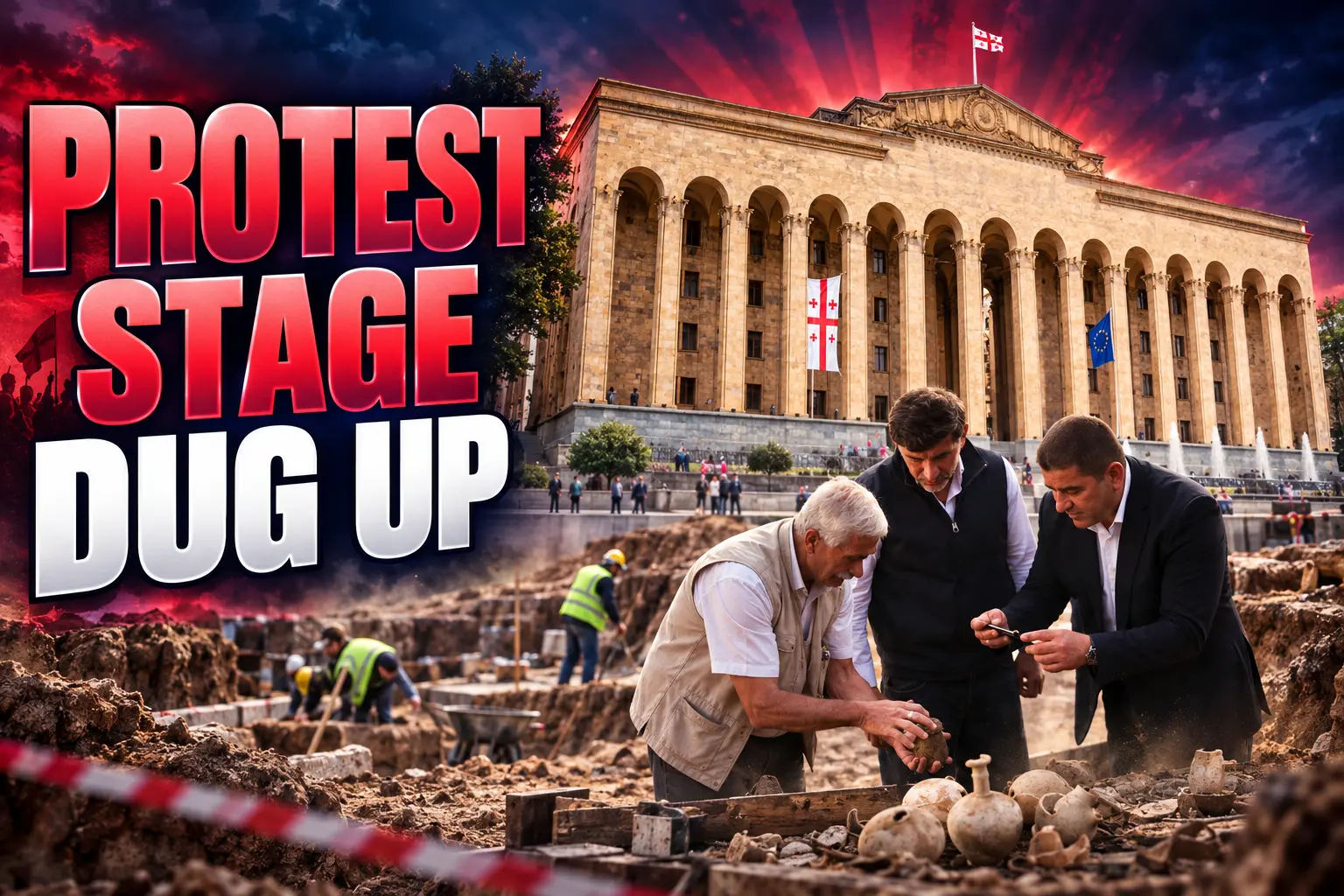
By early September, crews had also hit archaeology. Parliament Speaker Shalva Papuashvili said a pottery workshop from the 10th-11th centuries had been unearthed in front of the parliament palace, on ground that once sat on a Silk Road route. Kaladze said work stopped on that one section and that he saw no reason, at that stage, to move the November deadline.
An ancient pottery workshop, along with impressive artefacts, has been unearthed in front of the Georgian Parliament palace during the renovation of Tbilisi’s famed main thoroughfare, the Shota Rustaveli Avenue.
By early estimates, the workshop belongs to X-XI centuries, when… pic.twitter.com/lnEs5K0dpD
— Shalva Papuashvili 🇬🇪 (@shpapuashvili) September 2, 2026
Georgia’s Public Defender asked City Hall to test pipes found under the avenue after activists alleged asbestos. City Hall has not confirmed asbestos. Late August photographs of the street show dust hanging over shopfronts that were hard to enter. Kaladze, who is also secretary general of Georgian Dream, has said foreign representatives are directing the remaining Rustaveli rallies against the Georgian state.
What the Sidewalk Law Changed
The rebuild did not arrive in an empty legal street. Nightly crowds had blocked Rustaveli in front of parliament for months after November 28, 2024, when the ruling party paused EU accession talks until 2028. Police then pushed demonstrators onto the sidewalks. In December 2025, parliament extended the offence of blocking movement from roads to pedestrian space.
HOW THE PROTEST RULES TIGHTENED
- October 16, 2025: Repeat road-blocking during assemblies becomes a criminal matter, with prison of up to one year.
- December 12, 2025: Amendments to the Law on Assemblies and Manifestations cover sidewalks. Organizers must give the Internal Affairs Ministry five days’ notice. Police may issue binding orders to move a rally. Participants face up to 15 days in detention, organizers up to 20.
- January 23, 2026: Tbilisi City Court sends Sandro Megrelishvili, a 35-year-old international relations specialist, to four days in detention for allegedly obstructing pedestrian movement on a sidewalk on December 17, 2025. Four other protesters receive four or five days the same day.
- May 2026: Zurab Menteshashvili, 61, is sentenced to nine months, the first criminal sentence for peaceful protest under the repeat-offence rules.
- July 23, 2026: Vehicle traffic ends on the avenue as the rebuild begins.
Megrelishvili told Human Rights Watch that police never said whom he had blocked or how. Interior Ministry footage shown in court, the group said, recorded other pedestrians walking past him without trouble. The ministry publicly denied that people were jailed for merely standing on a sidewalk and said the cases were about deliberate obstruction.
These amendments give police dangerously broad powers to decide when, where, and whether people can protest.
Giorgi Gogia, deputy Europe and Central Asia director, Human Rights Watch
Gogia said the law, in practice, looks enforced so as to punish peaceful expression and push critics out of public space. Human Rights Watch described broad powers to restrict protests on roadways and sidewalks, and later documented Menteshashvili’s nine months for a peaceful protest after two October 2025 arrests for standing on a roadway others had already blocked. Those cases continue a longer squeeze described in Amnesty’s account of the 500-day crackdown.
They Are Still Outside Parliament
Closing the carriageway did not empty the civic site. In early August, on about the 615th day of the rallies, some demonstrators discussed moving the nightly action to Tbilisi City Council, a few hundred metres away, until the avenue reopened. Some held a parallel gathering there. They did not abandon parliament.
By October 2 they were back under both buildings. Video from that night shows national, EU, and United Kingdom flags along the parliament wall, with the metal barrier as the edge of a trench. Placards attacked Bidzina Ivanishvili and quoted Orwell. Activists hung medical gloves on the fence after prisoner Giorgi Davitadze accused guards at Rustavi prison No. 6 of sexual violence, a charge the penitentiary service denies.
The crowd that night was a remnant, not the tens of thousands who filled the avenue in 2024 and 2025. It was also stubborn. The people who still come have chosen the symbolic address over a cleaner pavement. City Hall can pour a new surface. It has not yet moved the argument off the steps of parliament.
Rustaveli’s Long Memory as a Protest Street
Kaladze is right that the avenue has seen joy and grief. That is why a four-month closure is never only a utilities job. Soviet troops killed independence demonstrators here on April 9, 1989. Georgia’s independence was declared on the same stretch two years later, and fighting in 1991 wrecked buildings at the eastern end.
THE AVENUE’S POLITICAL DATES
- April 9, 1989: Soviet troops attack a rally in front of parliament.
- 2003: The Rose Revolution gathers on Rustaveli and topples the Shevardnadze government.
- 2007 and 2011: Anti-Saakashvili crowds return to the same pavement.
- June 20, 2019: Police fire rubber bullets and tear gas on Gavrilov’s Night.
- November 28, 2024: Nightly pro-EU rallies begin after the accession freeze, and pass 600 days before this rebuild starts.
A 2019 Carnegie Endowment essay already treated the thoroughfare as Georgia’s perpetual street of protest, listing 1956, 1978, 1989, 1991, 2003, 2007, and 2012 among the years when national arguments were settled here rather than in a chamber. City Hall did a smaller sidewalk renovation beside parliament in 2020; that job took seven months. Kaladze first floated a larger overhaul in late 2023 for a 2024 start that slipped, through failed tenders and estimates that moved from GEL 28 million to GEL 12.3 million before the 2026 award.
Detention Rules That Outlast the Rebuild
Rustaveli Avenue is our capital’s visiting card, both visually and historically, which has seen a lot of joy, victory, pain, or grief, and it must be well-ordered and modern, so that visitors coming to our country, as well as the local population, can feel a sense of pride.
Kakha Kaladze, Tbilisi mayor, at a City Hall meeting on July 21, 2026
Pride, in that telling, is a finished surface. The December 2025 rules do not expire when the last roller leaves. A person standing on the new sidewalk can still be held for up to 15 days if police say the gathering blocks free movement and an order to leave is ignored. Repeat conduct can still be charged as a crime.
Kaladze has kept the end of November as the completion date even after the medieval workshop appeared in front of parliament. Deputy Mayor Irakli Bendeliani said in late September that two weak underpasses, at the Opera and the First Classical Gymnasium, were being strengthened and that road paving would follow. The pipes may well need replacing. The law that turned a sidewalk vigil into a detention offence will still be in force on whatever asphalt the city lays.
On October 2 the remnant hung gloves on the fence and stood in the rain beside the trench. The mayor still says the avenue will be handed back by the end of November. The sidewalk statute has no such date.

Ukraine Hits the Fuel Hub That Feeds Moscow’s Airports

Gold Lost 3% After the Jobs Print It Usually Wants

XRP’s $31.87 Target Is a $2 Trillion Market Bet

Mortgage Rates at 7.28% Push Buyers Into Adjustable Loans

Six Ex-Bills Return as Patriots Open New Highmark

Microsoft Prints Azure’s $29.42 Billion Quarter and Shrinks the Map

UltraTech’s Ultravolt Launch Puts Cable Multiples on Trial

IXI Autofocus Glasses Still Lack a European CE Mark

The iPhone 16 Pro Flipkart Cut Did Not Last

Little St. Simons Island Hatches Loggerheads at 72.4 Percent
-
 NEWS1 month ago
Microsoft Prints Azure’s $29.42 Billion Quarter and Shrinks the Map
-
 BUSINESS1 month ago
UltraTech’s Ultravolt Launch Puts Cable Multiples on Trial
-
 NEWS9 months ago
IXI Autofocus Glasses Still Lack a European CE Mark
-
 NEWS1 year ago
The iPhone 16 Pro Flipkart Cut Did Not Last
-
 NEWS3 months ago
Little St. Simons Island Hatches Loggerheads at 72.4 Percent
-

 BUSINESS3 months ago
Georgia Furniture Mart Closes a Growing 40-Year Business
-

 NEWS4 months ago
Georgia Beach Bacteria List Leaves Swim Areas Open
-

 NEWS3 years ago
Eyal Waldman Keeps a Two-State Bet After Gaza