
NEWS
The Moonless Perseids Still Left India a Hard Target
The 2026 Perseids peaked under a new moon, yet India’s listed maximum fell after sunrise and August cloud still sat between viewers and NASA’s 100-an-hour rate.

The 2026 Perseid meteor shower peaked on the night of August 12 into August 13 under a new moon. NASA still calls the Perseids the best shower of the year, and its own page lists both about 25 meteors an hour and 50 to 100.
For India, the hard parts were never the moon. A listed maximum sat after sunrise, and mid-August is monsoon season.
NASA’s Fast Facts Quote 25 Meteors an Hour
Open the Perseids page at NASA Science and the numbers split on contact. A fast-facts panel, citing the American Meteor Society and NASA’s Meteoroid Environment Office, says observers under dark skies see about 25 meteors per hour. A few lines later, the same page says the shower is one of the most plentiful, with about 50 to 100 meteors seen per hour.
Neither figure is a lie in its own cubicle. They are not the same promise. The 100 that travels with every August forecast is a zenithal hourly rate, a corrected catalog number that assumes a perfectly dark sky, a radiant straight overhead, and an observer who can still see faint streaks. The International Meteor Organization and the American Meteor Society both list that catalog rate as 100. NASA’s 2026 meteoroid forecast for low Earth orbit put the actual 2026 maximum at a ZHR of 92, at 14:09 UT on August 13, which is 7:39 p.m. IST.
RATES THE FORECASTS ACTUALLY PRINT
| Source | Rate | What it assumes |
|---|---|---|
| NASA fast facts | about 25 per hour | Dark skies |
| NASA main text | 50 to 100 per hour | Ideal, plentiful night |
| NASA Meteoroid Environment Office, 2026 | ZHR 92 | 14:09 UT on August 13 |
| IMO and AMS catalogs | ZHR 100 | Radiant overhead, dark sky |
From a dark site near Chennai, the local club told members they might see several meteors in an hour, with a better chance closer to dawn. City haze, a low radiant, and cloud cut that again. Photographs that show a sky packed with trails are almost never a single glance.
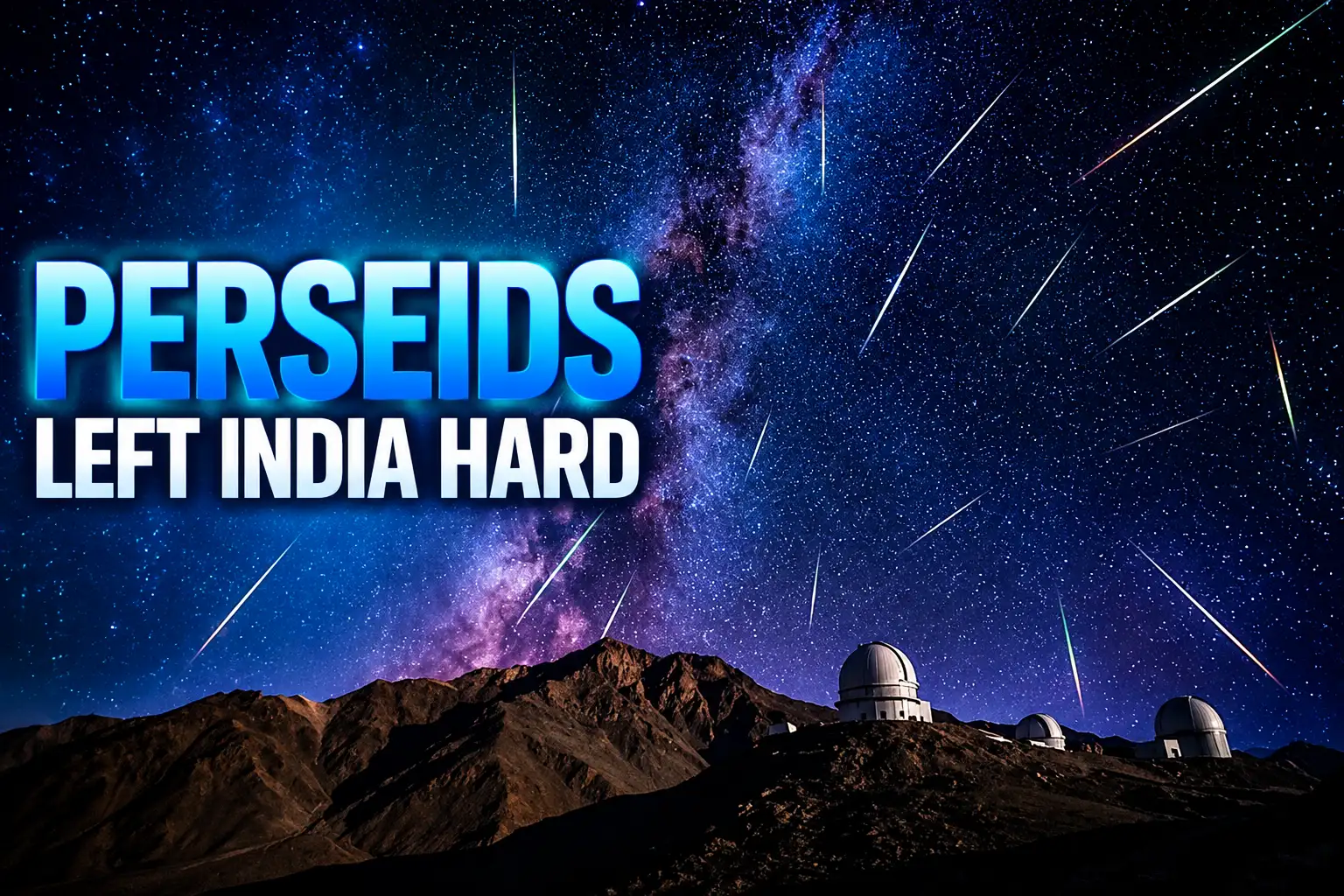
Photographs showing dozens of meteors together are generally composites made by combining images captured over several hours. The sky will not normally look like this at any one moment.
Chennai Astronomy Club, Perseids 2026 observing guide
Time-lapse clips from dark sites abroad packed two hours into 20 seconds, and even then a watcher could count the streaks on one hand. That is the real cadence: long waits, then a scratch of light. The 100-an-hour headline is a lab condition. A night in the field is a handful of bright ones and a lot of empty sky.
A New Moon Lined Up With Peak Night
What 2026 did give the Perseids was darkness from the moon. NASA’s Watch the Skies note said the shower would reach its peak on the night of August 12 into the early morning of August 13, and that visibility should be ideal thanks to the new moon. The agency streamed a watch party from Marshall Space Flight Center starting at midnight ET on August 13, and said the peak can produce as many as 50-100 meteors per hour if viewing conditions are right.
The Perseids Meteor Shower, which peaks in mid-August, is considered the best meteor shower of the year.
NASA Science, Perseids page
The American Meteor Society’s 2026 major-shower list placed the Perseid maximum on August 13, with a catalog ZHR of 100 and a moon age of 01, which is as close to new as the table gets. IMO dates ran from July 17 through August 24. NASA’s Perseids page kept the shower active through August 24, 2026, with peak night August 12-13.
Moonlight was not the filter. Faint meteors that a bright moon would have erased had a free pass. The remaining filters were weather, light, and where the radiant sat in your sky.
Why the Clock Peak Missed Indian Darkness
Two different clocks claimed the 2026 maximum, and neither sat on India’s best dark hours. The IMO’s predicted main maximum was August 13 between 02:00 and 04:00 UTC, which is 7:30 to 9:30 a.m. IST. That window falls after sunrise in Chennai. NASA’s meteoroid office put its 2026 maximum later the same day, at 14:09 UT, or 7:39 p.m. IST, when Perseus is still low in the northeast.
The useful Indian night was the broad rise around those instants, not the instants themselves. Chennai Astronomy Club told observers to use about 11:30 p.m. on August 12 until morning twilight on August 13, with the hours after 2:00 a.m. stronger as the radiant climbed and Earth turned into the stream. Amar Pal Singh, an astronomer at the Veer Bahadur Singh Planetarium in Gorakhpur, put a practical window at roughly midnight to 4:30 a.m., looking northeast toward Perseus.
THE 2026 PEAK CLOCK
- July 17, 2026: IMO listed Perseid activity as open, running through August 24.
- August 12, 2026: New moon. NASA treats the night of August 12 into August 13 as peak night.
- 11:30 p.m. IST, August 12: Chennai’s useful watch window opens.
- 2:00 a.m. to twilight IST, August 13: Best local hours, radiant higher, sky still dark.
- 7:30 to 9:30 a.m. IST, August 13: IMO main maximum, after sunrise in India.
- 7:39 p.m. IST, August 13: NASA meteoroid-office maximum at 14:09 UT, radiant still low.
Anyone who used an earlier India viewing times guide was already being pointed at those pre-dawn hours. The catalog peak on a world clock and the hours when Perseus is high over India are not the same appointment.
August Rain Closed the Sky Over Most of India
The Perseids always arrive in India’s southwest monsoon. By mid-August the rains cover most of the country. The west coast and the Western Ghats stay wet. The northeast and many hill belts stay grey. A meteor shower needs a clear sky, and even thin haze can wipe the faint streaks that a new moon is supposed to reveal.
That is the seasonal bind, not a weather verdict for every town on August 12. Astronomy desks in India spent July telling people the same thing: do not fight the cloud, go where August is drier. Bright fireballs still turned up after the listed peak in places that had clear air, including over cities far from dark-sky country. A washout in Mumbai does not cancel a streak over a high desert.
From Chennai the geometry is tougher even when the sky opens. The Perseid radiant sits near declination +58 degrees, so it stays comparatively low in the northern sky and never climbs as it does from northern India, Europe, or North America. Central Chennai keeps only the brightest meteors. A site two or three hours out of town is the first real upgrade, and only if the cloud breaks.
No telescope helps. Binoculars and tubes narrow the field, and the streaks are gone before you can swing the glass. The kit that matters is a mat, time, and 20 to 30 minutes for the eyes to adapt, with the phone face down. A ten-minute stand on a terrace can land in a quiet spell and convince you the shower is a myth.
Ladakh, Spiti and the Dry Northwest
The Indian map for this shower is a dryness map. Guides pointed at rain-shadow and arid ground: Ladakh and Spiti in the high north, western Rajasthan, and the Rann of Kutch in Gujarat. Those places combine darker skies with a better chance of an August gap in the cloud. They are not a guarantee. They are the only bet that matches the season.
WHERE THE 2026 GUIDES SENT PEOPLE
- Ladakh and Spiti: High, dry, and dark, with monsoon systems weaker than on the coasts.
- Western Rajasthan: Semi-arid ground and a shorter rain year than the Ghats or the northeast.
- Rann of Kutch: Open desert sky on Gujarat’s arid edge, away from the heaviest west-coast rain.
- Aravalli belt near Sariska: A drier northwest option within a long drive of Delhi, still monsoon country but patchier.
Chennai Astronomy Club still ran an overnight trip on August 12-13, about two to three hours from the city, at about 1,200 rupees for adults and about 850 rupees for children under 12, leaving after work and aiming to be back before office hours. That is the other India story around this shower: clubs selling a bus ride to a field, because a terrace will not show what the forecast poster promised.
Look up, not at Perseus. Meteors near the radiant look short. Trails farther from it run longer. A wide northern or overhead patch of dark sky beats a framed constellation. Other showers were still live that week, including the Southern Delta Aquariids and the Alpha Capricornids, plus random sporadics, so not every streak was a Perseid.
Swift-Tuttle Still Returns in 2125
The grains are junk from comet 109P/Swift-Tuttle. Lewis Swift and Horace Tuttle found it independently in 1862. Giovanni Schiaparelli tied it to the Perseids in 1865. NASA says the comet takes 133 years to orbit the Sun, last reached perihelion in 1992, and will return in 2125. Its nucleus is 16 miles (26 kilometers) across, almost twice the size of the object tied to the dinosaur extinction.
SWIFT-TUTTLE IN BRIEF
- Nucleus: 16 miles (26 kilometers) across, per NASA.
- Orbit: 133 years. Perihelion in 1992, next return in 2125.
- Earth pass: Closest approach on August 5, 2126, at 22,944,892 km, a different date from perihelion.
- Meteor speed: 59 km per second (37 miles per second), with fireballs brighter than magnitude -3.
The 2126 Earth pass and the 2125 return are not a collision forecast. They are two points on a long, well-tracked path. The annual show is only the dust. Most Perseid grains are too small to reach the ground. They die as light about 100 km up. The parent comet is a large near-Earth object on a 133-year loop. It is not this August’s problem.
Perseids are fast and often leave wakes of light and color. That is why the shower keeps its reputation in warm northern summers. It is also why a single fireball can make a cloudy hour feel like a success, and why a moonless catalog year can still feel empty if the radiant is low and the sky is wet.
What 2027’s Gibbous Moon Will Do
The 2027 Perseids again peak on August 12-13. The moon will be a waxing gibbous, heading toward full on August 17, 2027, on Griffith Observatory’s U.S. Naval Observatory-based calendar. Faint meteors lose that fight. The workaround is the same as every bright-moon year: wait for moonset and use the last dark hours before dawn, if the monsoon allows a hole.
India’s clearer meteor night on NASA’s 2026 shower list is still ahead. The Geminids are forecast to peak on December 14, 2026, at 13:00 UT, with a ZHR of 90. December sits after the rains. The air is often cleaner. The cost is cold. For a country that spends August under cloud, that trade is the one the Perseids never make.
The 2026 Perseids did what the orbit said they would. A new moon took the glare off. The catalog still printed 100. India’s dark hours sat beside those numbers, not on top of them, and the monsoon kept the last word on whether anyone saw the difference.

Greed Held After a $697 Million Crypto Long Flush

Fed Minutes Keep a Year-End Rate Hike Alive

A Nanny-Cam Tape Follows Tyreek Hill Into Free Agency

Star Wars Galactic Racer Makes a Crash End the Tour

Amazon Puts Apple’s June MacBook Prices Back on Sale

Sophia Wootten Turns the Miss Georgia Crown Toward Cleft Care

The iPhone 16 Pro Flipkart Cut Did Not Last

Microsoft Prints Azure’s $29.42 Billion Quarter and Shrinks the Map

UltraTech’s Ultravolt Launch Puts Cable Multiples on Trial

IXI Autofocus Glasses Still Lack a European CE Mark
-
 NEWS1 year ago
The iPhone 16 Pro Flipkart Cut Did Not Last
-
 ENTERTAINMENT4 months ago
Sophia Wootten Turns the Miss Georgia Crown Toward Cleft Care
-
 BUSINESS1 month ago
UltraTech’s Ultravolt Launch Puts Cable Multiples on Trial
-
 NEWS1 month ago
Microsoft Prints Azure’s $29.42 Billion Quarter and Shrinks the Map
-
 NEWS9 months ago
IXI Autofocus Glasses Still Lack a European CE Mark
-

 NEWS3 months ago
Little St. Simons Island Hatches Loggerheads at 72.4 Percent
-

 NEWS4 months ago
Georgia Beach Bacteria List Leaves Swim Areas Open
-

 NEWS3 years ago
Eyal Waldman Keeps a Two-State Bet After Gaza