
BUSINESS
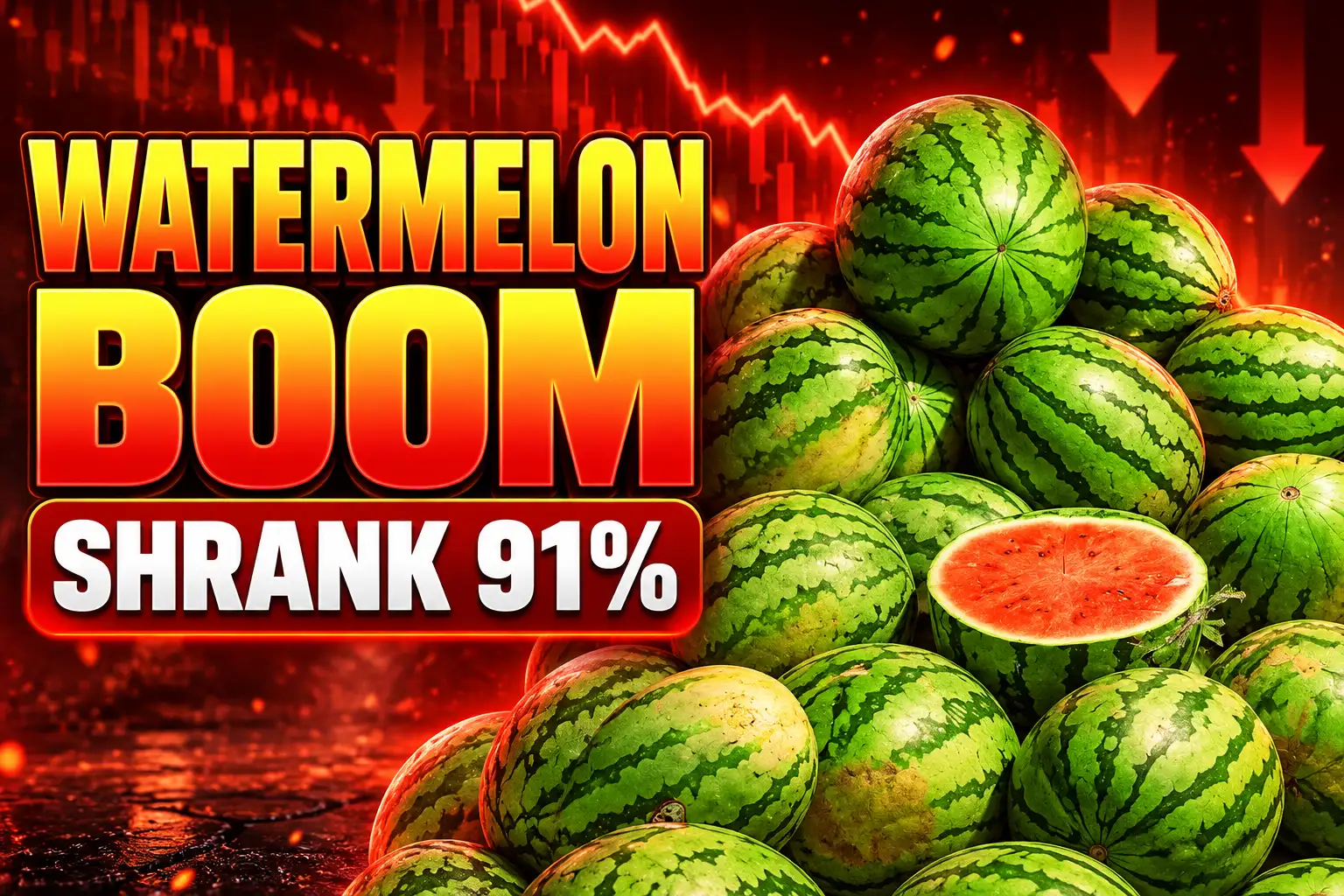
Georgia’s Watermelon Boom Shrank 91% After One Season
Georgia’s 191.4% watermelon-export jump reversed 91% in the first half of 2026, while imports stayed near 9,600 tonnes and Romania disappeared.

Georgia exported 67.4 tonnes of watermelons in the first half of 2026, a 91% drop from the 728 tonnes that produced a 191.4% value surge a year earlier. Those 67.4 tonnes brought in $33,600, 88% below the $275,700 recorded in January-June 2025, according to the National Statistics Office of Georgia (Geostat).
Imports barely moved. The country bought 9,567.5 tonnes worth $2.9 million in the same 2026 window, about 142 times the volume it sold. Romania, the first European Union buyer in the 2025 mix, took nothing.
The 191% Jump Rested on 329 Tonnes
The 2025 headline was real, and it was small. In the first half of 2025 Georgia shipped 728 tonnes of watermelons worth $275,700, up 120% by weight and 191.4% by value from January-June 2024. That earlier period had sent 329 tonnes worth $94,600, all of it to Armenia.
Three buyers appeared in 2025. Armenia still took 638.3 tonnes worth $221,300. Russia took 68 tonnes worth $39,800. Romania took 21.3 tonnes worth $14,600, the first recorded Georgian watermelon sale into the EU in this series. Add the three lines and the tonnes round to Geostat’s 728; the dollars add to $275,700 on the nose.
A full-year compilation of 2025 global watermelon shipments later put Georgia 56th among watermelon exporters, with sales valued at $887,000. That figure is the whole calendar year, not the first half, and it still sits in the noise of a country whose merchandise exports were $7.3 billion in 2025.
Shipments Then Fell 91% in Six Months
January-June 2026 wiped out the new map. Volume fell from 728 tonnes to 67.4 tonnes. Value fell from $275,700 to $33,600. Armenia’s order book, 638.3 tonnes a year earlier, shrank to 5.4 tonnes worth $7,300, a 99% drop in weight. Romania’s 21.3 tonnes went to zero. Russia stayed on the list at 22.9 tonnes worth $13,700. Ukraine, which had bought none in the first half of 2025, took 39.1 tonnes worth $12,600 and became the volume leader on a total that would fit in a few lorries.
WATERMELON EXPORTS, FIRST HALF
| Market | 2025 tonnes | 2025 USD | 2026 tonnes | 2026 USD |
|---|---|---|---|---|
| Armenia | 638.3 | 221,300 | 5.4 | 7,300 |
| Russia | 68 | 39,800 | 22.9 | 13,700 |
| Romania | 21.3 | 14,600 | 0 | 0 |
| Ukraine | 0 | 0 | 39.1 | 12,600 |
| Total | 728 | 275,700 | 67.4 | 33,600 |
Ukraine’s 39.1 tonnes were 58% of a 67.4-tonne total. That is a new flag on a smaller crate, not a replacement for Armenia’s 638.3 tonnes. Russia’s share of the 2026 half-year was 22.9 tonnes, a third of the load and $13,700, which is less than Russia paid for 68 tonnes in the first half of 2025.
Truckloads In and a Few Crates Out
The export chart is the sideshow. In the first half of 2026 Georgia imported 9,567.5 tonnes of watermelons worth $2.9 million. A year earlier the same six months brought in 9,560.6 tonnes worth $2.89 million. The inbound trade did not follow the outbound crash; it sat still.
Iran overtook Turkey as the main supplier. In the first half of 2025 Turkey had sent 5,326 tonnes worth $1.6 million and Iran 4,036 tonnes worth $1.2 million, with Azerbaijan, Uzbekistan and the Netherlands filling the rest of a 9,560-tonne intake. By January-June 2026 the order had flipped.
WATERMELON IMPORTS, JANUARY-JUNE 2026
- Iran: 4,823.5 tonnes worth $1.5 million, about 72 times Georgia’s own export total for the half-year.
- Turkey: 4,335.6 tonnes worth $1.3 million, still the second pipe into the domestic market.
- Uzbekistan: 228 tonnes worth $68,400, ahead of the two smaller neighbours on the list.
- Azerbaijan: 166.4 tonnes worth $53,100, up from 96.4 tonnes in the first half of 2025.
- Netherlands: 14 tonnes worth $21,300, a high-price trickle beside the Iranian and Turkish bulk.
Those five lines add to 9,567.5 tonnes. Against 67.4 tonnes sold abroad, the country bought 142 times what it shipped. In the first half of 2025 the same ratio was 13 times (9,560.6 tonnes in, 728 tonnes out), which already made Georgia a net buyer. World Bank 8,277 tonnes of melons and watermelons recorded under HS 080710 for the full year 2024, worth $2.70 million, show the same shape: Turkey first, then Iran and Azerbaijan. The 2026 half-year watermelon intake alone already exceeds that 2024 combined-fruit total.
Romania Paid a Higher Price, Then Vanished
Value outran volume in 2025 because the new buyers paid more per tonne. The 728 tonnes averaged $379 per tonne, or $0.38 a kilogram. Armenia paid $347 a tonne. Russia paid $585. Romania paid $685, almost double the Armenian unit value, which is why 21.3 tonnes (2.9% of the weight) produced 5.3% of the dollars.
Inbound fruit was cheaper. The 9,560.6 tonnes imported in the first half of 2025 averaged $302 a tonne, or $0.30 a kilogram, so the thin export stream left the country at a better price than the thick import stream entered. That spread is why a 120% rise in tonnes became a 191.4% rise in dollars. It is also why a 21.3-tonne EU sale looked larger on a value chart than it did on a loading dock.
In the first half of 2026 the remaining 67.4 tonnes averaged $499 a tonne, pulled up by the tiny Armenian lot at $1,352 a tonne, a unit value that does not travel as a market price when the shipment is 5.4 tonnes. Russia’s 22.9 tonnes averaged $598, close to its 2025 rate. Ukraine’s 39.1 tonnes averaged $322, nearer the old Armenian price. Romania’s $685 rate had no 2026 observation at all.
A 2021 High Water Mark of 3,300 Tonnes
The 2025 bounce followed a multi-year slide, not a standing start. UN Comtrade figures compiled for Georgia show watermelon exports of 3,300 tonnes worth $1.1 million in 2021, then 1,700 tonnes worth $416,800 in 2022, 412.1 tonnes worth $126,800 in 2023, and 331.2 tonnes worth $96,625 in 2024. Geostat’s first-half 2024 total of 329 tonnes worth $94,600 is almost that full year, which means almost nothing moved after June.
THE EXPORT CYCLE SINCE 2021
- 2021: Ships 3,300 tonnes worth $1.1 million, the recent peak in this Comtrade series.
- 2022: Falls to 1,700 tonnes worth $416,800.
- 2023: Falls again to 412.1 tonnes worth $126,800, as Russia interrupts the trade.
- 2024: Closes at 331.2 tonnes worth $96,625, with the first half (329 tonnes, $94,600) going only to Armenia.
- January-June 2025: Rebounds to 728 tonnes worth $275,700 across Armenia, Russia and Romania.
- January-June 2026: Drops to 67.4 tonnes worth $33,600, with Romania gone and Armenia at 5.4 tonnes.
- July 2026: Records 2,526 tonnes of watermelons and melons combined, worth $1.067 million, mostly to Russia.
Fruit that Georgia does scale looks different. Ministry figures put 2025 apple exports at 20,600 tonnes worth $14 million, about 95% of it to Russia. A separate ministry note on longer-run farm output says grape production rose from 144.0 thousand tonnes in 2012 to 348.9 thousand tonnes in 2025, while tree-nut exports reached $188.5 million in the 2025/2026 season. Watermelon, even in the 728-tonne half-year, is not in that class.
July’s Record Mixed Melons With Russia
The first half of 2026 is a poor window on a summer crop. Harvest runs through the hot months, so January-June catches only the opening of the season. July 2026, measured by Geostat on watermelons and melons together, jumped to 2,526 tonnes worth $1.067 million, against 451 tonnes in July 2025, more than five times that month’s combined volume.
Russia took 1,339 tonnes worth $775,400, about 73% of the month’s revenue from the two fruits. Armenia took 1,079 tonnes worth $259,300. Belarus took 108 tonnes worth $32,200. The three lines add to 2,526 tonnes and $1,066,900. That is a seasonal peak, and it is a different basket from the watermelon-only rows for January-June. It does not put Romania back on the list, and it does not turn the 67.4-tonne first half into a full-year collapse on its own, because July is when the fruit actually moves.
It does show where the lorries go when the crop is on. The EU toehold of 21.3 tonnes in the first half of 2025 did not become a July 2026 lane. The load went east, on a combined-fruit invoice, to Russia first and Armenia second. Kakheti carries the large regional lines in Geostat’s 2025 agriculture tables for watermelon, with Imereti a distant second and Kvemo Kartli near zero on the same sheets, so the fruit that fills those July crates is grown in a short list of eastern fields and then sold into the markets that already take Georgian apples.
Roadside stacks in Georgian towns will still be mostly Iranian and Turkish fruit for the months before local harvest, because 4,823.5 tonnes from Iran in six months is the volume that actually feeds stalls. The 191.4% chart from 2025 measured a rebound off 329 tonnes. The 91% chart from 2026 measured how little of that rebound was still on the books before July’s mixed-fruit rush headed to Russia.
Frequently Asked Questions
How Much Watermelon Does Georgia Grow at Home?
FAO figures put 2024 output at 32.8 thousand tonnes on about 1,000 hectares, a domestic crop far larger than the 728 tonnes exported in the first half of 2025 and large enough that most of the fruit never leaves the country. Imports still fill the early-season gap before those fields come in.
What Were Georgia’s Full-Year Watermelon Exports in 2024?
UN Comtrade records 331.2 tonnes worth $96,625 for the whole of 2024, at an average $0.29 a kilogram, which ranks Georgia outside the world’s top 75 exporters and matches Geostat’s first-half 2024 total of 329 tonnes almost tonne for tonne.
Who Sold Watermelons to Georgia in 2024?
World Bank WITS records for HS 080710 (fresh melons and watermelons) show Turkey at $1.66 million and 5,074 tonnes, Iran at $0.59 million and 1,895 tonnes, and Azerbaijan at $0.26 million and 867 tonnes, with Uzbekistan and the Netherlands further down a $2.70 million invoice.
What Is the Farmgate Price for Watermelons in Georgia?
FAOSTAT producer prices compiled for the country list a farmgate rate of $0.17 a kilogram (0.44 lari), below both the $0.30 a kilogram import unit value and the $0.38 a kilogram export unit value seen in the first half of 2025, which is the gap a trader has to cover between the field and the border.

Ukraine Hits the Fuel Hub That Feeds Moscow’s Airports

Gold Lost 3% After the Jobs Print It Usually Wants

XRP’s $31.87 Target Is a $2 Trillion Market Bet

Mortgage Rates at 7.28% Push Buyers Into Adjustable Loans

Six Ex-Bills Return as Patriots Open New Highmark

Microsoft Prints Azure’s $29.42 Billion Quarter and Shrinks the Map

UltraTech’s Ultravolt Launch Puts Cable Multiples on Trial

IXI Autofocus Glasses Still Lack a European CE Mark

The iPhone 16 Pro Flipkart Cut Did Not Last

Little St. Simons Island Hatches Loggerheads at 72.4 Percent
-
 NEWS1 month ago
Microsoft Prints Azure’s $29.42 Billion Quarter and Shrinks the Map
-
 BUSINESS1 month ago
UltraTech’s Ultravolt Launch Puts Cable Multiples on Trial
-
 NEWS9 months ago
IXI Autofocus Glasses Still Lack a European CE Mark
-
 NEWS1 year ago
The iPhone 16 Pro Flipkart Cut Did Not Last
-
 NEWS3 months ago
Little St. Simons Island Hatches Loggerheads at 72.4 Percent
-

 BUSINESS3 months ago
Georgia Furniture Mart Closes a Growing 40-Year Business
-

 NEWS4 months ago
Georgia Beach Bacteria List Leaves Swim Areas Open
-

 NEWS3 years ago
Eyal Waldman Keeps a Two-State Bet After Gaza