
NEWS
Cordele Held the Watermelon Title Long Before the Feature
Cordele has called itself the Watermelon Capital of the World since 1949. Georgia’s 2025 crop passed Florida, even as other towns still claim the same sign.

Cordele, Georgia, has billed itself as the Watermelon Capital of the World since 1949, a claim a spring travel feature put back in front of weekend drivers. The magazine did not mint the title. It repeated a slogan the town already prints on festival posters, chamber pages, and the state agriculture department’s own feed.
What changed around that feature is the crop underneath it. In 2025 Georgia grew more watermelon than Florida, according to the U.S. Department of Agriculture’s Economic Research Service, while Crisp County crews still cut fruit by hand and send it through a state market that stays open until 11 p.m. in season.
The Magazine Repeated a Claim From 1949
Southern Living’s April 14, 2026, travel story framed Cordele as a small Crisp County hub with farms, open country, and more watermelons than most visitors have seen in one place. It pointed readers at the Watermelon Days Festival, the Cordele State Farmers Market, and a vintage train. The copy treated the world-capital line as local pride tied to a summer harvest and a big produce yard.
City pages had already locked the same branding in place. Cordele’s festival site still runs under Fresh From the Vine Since 1949, calls the 2026 event the 77th annual gathering, and says June 2027 will mark the 78th year of Watermelon Days. The chamber, which stages the month of contests, says it exists to honor farmers, growers, brokers, and buyers, not to decorate a magazine weekend.
THE TITLE ON PAPER
- 1888: Cordele is founded at a railroad junction in what becomes Crisp County and is later named for Cordelia Hawkins, daughter of a Savannah, Americus and Montgomery Railway president.
- 1949: The town begins the harvest celebration it still dates as the start of Watermelon Days; the SAM Shortline’s vintage cars are advertised as the same year.
- Early 1990s: The Cordele-Crisp Chamber says Hope, Arkansas, and Hempstead, Texas, challenged the world-capital line; Cordele kept using it after a taste contest the chamber still cites.
- April 14, 2026: Southern Living publishes the small-town getaway that sent the slogan back through national travel feeds.
- June 20, 2026: The 77th festival parade steps off at 8:30 a.m., months after the magazine piece and in the middle of the packing season.
- September 23, 2026: USDA’s Economic Research Service posts that Georgia led U.S. watermelon output in 2025.
The sequence is the point of the branding. A lifestyle desk found a slogan the packing town had been repeating for three generations, then the federal crop sheet caught up with a number the chamber had been rounding for years.
Seven Towns Still Share the Same Boast
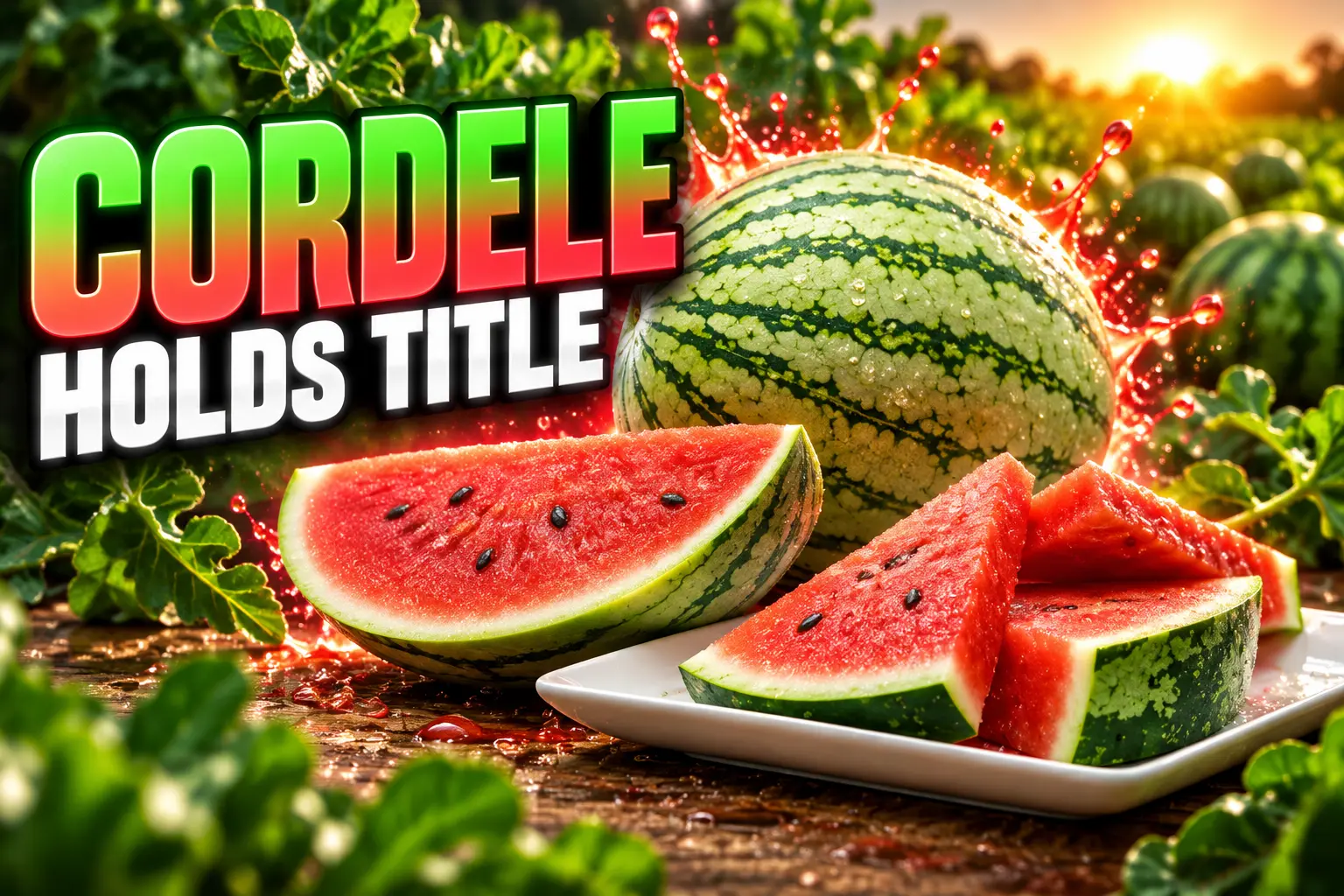
The National Watermelon Promotion Board has counted the fight in public. In a roundup that is still on its site, it says seven U.S. cities share the title, each with a festival, a sculpture, or a production brag, and it does not pick a winner. Cordele sits on that list as the seat of a heavy Georgia county. So does Hope, Arkansas, which grows giant fruit, puts a melon in its municipal logo, and sells the slogan “A Slice of the Good Life.”
WHO ELSE WANTS THE SIGN
| Place | What the claim rests on |
|---|---|
| Cordele, Georgia | County-scale commercial crop, Watermelon Days, a speedway that still uses the capital name |
| Hope, Arkansas | Outsize fruit, a long August festival, a melon in the city logo |
| Weatherford, Texas | A former big Texas grower that once kept a huge melon sculpture by the courthouse |
| Green River, Utah | A wooden “world’s largest watermelon” wedge stored in an airfield hangar for Melon Days |
| Naples, Texas | Local acreage plus a festival that throws in a rodeo |
| Beardstown, Illinois | A shorter “Watermelon Capital” tag and heavy in-state production |
| Rush Springs, Oklahoma | A festival the board says draws more than 20,000 people and serves nearly 50,000 pounds of fruit |
Hope never left the argument. Its festival dates to the 1920s, and the town still trades on size the way Cordele trades on volume and sweetness. Weatherford’s sculpture is mostly memory. Rush Springs still feeds a crowd. On I-75, the dispute shows up as a roadside habit more than a legal brief: people who grew up rolling through Cordele still buy from stands, crack a melon on a tailgate, and leave the rinds for whatever is in the next pasture.
The chamber’s 1990s story is local gospel, not a USDA ruling. It says Cordele-Crisp fruit was judged the crispest, juiciest, and sweetest after Hope and Hempstead pushed the title, and it credits hot, dry nights and Crisp County soil. Other towns never signed that verdict. They just kept their own festivals.
Georgia Passed Florida on the 2025 Crop
The production sheet is less romantic than a capital sign, and it is newer than the magazine feature. On September 23, 2026, ERS economist Helen Wakefield wrote that the United States produced 3.87 billion pounds of watermelons in 2025 and that Georgia took the top state slot with 813 million pounds of watermelons, or 21.0 percent of the country. Florida grew 798 million pounds, 20.6 percent. The gap is 15 million pounds, close enough that a single season of acres and yield flipped the order.
THE 2025 CROP SHEET
| Grower | 2025 output | Share of U.S. crop |
|---|---|---|
| Georgia | 813 million pounds | 21.0% |
| Florida | 798 million pounds | 20.6% |
| California, Texas, North Carolina, Indiana | Not broken out by ERS in the chart | 44.4% combined |
| United States | 3.87 billion pounds | 100% |
Wakefield’s chart, drawn from the March 2026 Fruit and Tree Nuts Outlook, also puts fresh watermelon at just over 15 pounds per person in 2024, third among fresh fruits behind bananas and apples, and double every other melon type combined. The crop runs on more than 100,000 acres nationwide. Imports added 1.8 billion pounds in 2025, 34 percent of domestic supply, with the foreign fruit peaking in May and again in October when U.S. fields wind down.
Cordele’s own figure is a community total, not that statewide 813 million. The chamber says growers there ship more than 200 million pounds a year. The Georgia Department of Agriculture repeated the same round number on July 1, 2026, during National Watermelon Month, and put the state’s 2024 farm-gate value at $220.5 million.
Happy National Watermelon Month! 🍉
Did you know Georgia is one of the nation's top watermelon-producing states? In 2024, Georgia's watermelon crop had a farm-gate value of $220.5M. And in Cordele—the Watermelon Capital of the World—farmers grow more than 200 million pounds of… pic.twitter.com/JhWhRqt8Ik
— Georgia Department of Agriculture (@GaDeptAg) July 1, 2026
Joshua Grant, the University of Georgia extension agent for Crisp County, said in 2022 that a single producer might run fields of two to three hundred acres and that the county as a whole could plant anywhere from six to nine thousand acres of watermelons in a year. That acreage talk is older than the 2025 state lead, but it is how local agents still describe the patchwork that feeds the Cordele yard.
Where the Melons Leave Town After Dark
The place that makes the slogan operational is not a festival stage. It is the Cordele State Farmers Market at 1901 U.S. Highway 41 North, which the Georgia Department of Agriculture calls a major watermelon hub for the Southeast. Retail hours are 8 a.m. to 6 p.m. During watermelon season, early June through August, the yard itself runs from 7 a.m. until 11 p.m. because the trucks do not punch out at supper.
On July 2, 2026, trailers were already stacked for the Fourth, some with a melon sliced open so buyers could see red or yellow flesh. Melissa Delgado, who has sold fruit there for decades after buying from farmers, called it a hard year because of heavy rain and because customers still argue price. Flint Mathis was moving Crimson Sweet melons his family grew and said the week before the holiday had been slow, then picked up, with the rain making it tough to get fruit out of the field early.
Jacob Jackson of Jackson Farms described the 2026 season as drought and heat, then cooler dry days, then a dump of rain all at once. He irrigates on drip and can live with a dry spell. A plant that goes dry and then takes a soaking is another problem. Harvest, he said, is still a hand job.
Watermelons are always going to be labor intensive. When you go into a watermelon field, you hope to get about three to four cuttings per field. You’ve got two crews: cutters and loaders.
Jacob Jackson, Jackson Farms, Crisp County
Greg Leger, president of Leger & Son, had called the 2025 window the payoff after a near-perfect spring, then watched Northeast and Midwest buyers lag on an oversupplied crop. Georgia’s commercial flush, he has said, usually runs from the start of summer through about July 15. By mid-July 2026 the bins were filling again, which is how a capital looks when the magazine readers have already gone home.
A June Parade for Cutters and Loaders
Watermelon Days is the civic version of that packing line. The chamber calls it the oldest festival in Georgia, a claim it repeats without a statewide audit, and it schedules more than thirty events across a month that lands on the harvest. The 2026 main day was June 20. The parade lined up at 7:30 a.m. at South Gate Shopping Center, rolled from 6th Street and 15th Avenue, and charged most entries $20.
WHAT THE MONTH STILL STAGES
- Seed spitting: A 4-H crowd and anyone else willing to measure a shot of seed across a summer street.
- Chunking: Melons thrown for distance, the rough twin of the eating contest.
- Horseshoes and fishing: A watermelon horseshoe tournament and a fishing rodeo sit beside decorating contests and a 4-H dog show.
- Queens: A full court, from Baby Miss Melon up through Miss Watermelon Capital, is named each year before the parade.
The SAM Shortline is the other 1949 prop. City pages sell a 45-mile ride in vintage air-conditioned cars from Cordele toward Archery, Jimmy Carter’s boyhood home, with possible stops at Georgia Veterans State Park on Lake Blackshear, Leslie, Americus, and Plains. Southern Living told readers to time a weekend with the festival. The town already timed the festival with the fruit.
High-school softball keeps the name going after the vines dry. In August 2026, teams still rolled into Cordele for a Watermelon Classic at the Crisp County rec fields, a reminder that the slogan is a local season, not a single Saturday in June.
Nine Thousand Residents and a Statewide Crop
The Census Bureau counted 10,220 people in Cordele on April 1, 2020. Its July 1, 2024, estimate is 9,767. Crisp County as a whole went from 20,128 in the 2020 census to a July 2024 estimate of 19,468. The town is still the county seat, still the I-75 stop about 140 miles south of Atlanta, and still the place state tourism copy calls a gateway to South Georgia.
Those counts sit beside a crop that just made Georgia the country’s largest watermelon state. The people who live in town are fewer than they were at the last census. The trucks in June are not. Cotton, peanuts, pecans, and peaches still share the county, which is why a capital sign here is a packing identity, not a single-crop cartoon.
Visitors who come for the magazine list also get a 3/8-mile asphalt oval, a Titan I missile monument by the interstate, and a golf course at the veterans park. The thing the town ships is still the melon. June 2027 is already on the city calendar as the 78th year of Watermelon Days, which is how Cordele treats a title nobody in Washington issues and nobody in Hope has retired.
Frequently Asked Questions
Why Do Cordele Melons Get Called the Sweetest?
The Cordele-Crisp Chamber ties flavor to hot, dry nights and the county’s soil, the same pitch it used after the early-1990s taste fight with Hope, Arkansas, and Hempstead, Texas. That is a local quality claim, not a federal grade, and other towns still sell sweetness as their own brag.
How Do I Reach the Cordele State Farmers Market?
The yard sits at 1901 U.S. Highway 41 North, Cordele, GA 31015, under Georgia Department of Agriculture manager Jennifer Felton, at (229) 276-2335. In the off months a handful of retailers stay on seasonal produce; the late-night clock is for melon season only.
When Does Georgia’s Commercial Watermelon Window Close?
Grower Greg Leger has described the state’s main shipping flush as the first of summer through about July 15, with June into mid-July as the heavy weeks. Planting in Crisp County often starts from greenhouses in mid-to-late March or early April so fruit can hit the July 4 market.
What Melon Types Turn Up on the Cordele Yard?
Vendors on the July 2, 2026, market day were moving Sangria, Sugar Baby, seedless, and Crimson Sweet fruit, some bought from farmers and some grown by the family selling it. Yellow-flesh cuts show up beside the standard red when a trailer wants to prove what is inside.

Greed Held After a $697 Million Crypto Long Flush

Fed Minutes Keep a Year-End Rate Hike Alive

A Nanny-Cam Tape Follows Tyreek Hill Into Free Agency

Star Wars Galactic Racer Makes a Crash End the Tour

Amazon Puts Apple’s June MacBook Prices Back on Sale

Sophia Wootten Turns the Miss Georgia Crown Toward Cleft Care

The iPhone 16 Pro Flipkart Cut Did Not Last

Microsoft Prints Azure’s $29.42 Billion Quarter and Shrinks the Map

UltraTech’s Ultravolt Launch Puts Cable Multiples on Trial

IXI Autofocus Glasses Still Lack a European CE Mark
-
 NEWS1 year ago
The iPhone 16 Pro Flipkart Cut Did Not Last
-
 ENTERTAINMENT4 months ago
Sophia Wootten Turns the Miss Georgia Crown Toward Cleft Care
-
 BUSINESS1 month ago
UltraTech’s Ultravolt Launch Puts Cable Multiples on Trial
-
 NEWS1 month ago
Microsoft Prints Azure’s $29.42 Billion Quarter and Shrinks the Map
-
 NEWS9 months ago
IXI Autofocus Glasses Still Lack a European CE Mark
-
 NEWS3 months ago
Little St. Simons Island Hatches Loggerheads at 72.4 Percent
-

 NEWS4 months ago
Georgia Beach Bacteria List Leaves Swim Areas Open
-

 NEWS3 years ago
Eyal Waldman Keeps a Two-State Bet After Gaza