
NEWS
iPhone 18 Pro Camera Bets on Blades Samsung Abandoned
The iPhone 18 Pro camera bets on a six-blade iris Samsung dropped, and a digital negative the EU cannot capture at launch.

Apple’s iPhone 18 Pro is the first iPhone with a mechanical variable aperture, four stops from ƒ/1.48 to ƒ/4.0 on the 48MP Fusion Main camera. The company unveiled the hardware on September 9 at its Surprise and Shine event, with pre-orders open since September 12 and units due September 18.
The iris is only half the wager. Apple also wants the same phone to mint a cryptographic “digital negative,” while dedicated cameras already sign files with C2PA Content Credentials, and while Samsung spent August walking away from moving aperture blades.
Samsung Dropped This Hardware a Month Ago
Variable aperture is not a new smartphone trick. Samsung shipped a two-position iris on the Galaxy S9 in 2018, then kept it on the Galaxy S10, switching the opening between ƒ/1.5 and ƒ/2.4. After that generation the company went back to a fixed opening and let software fake the rest.
It tried again for the Galaxy S27 line. Camera-module suppliers MCNEX and Samsung Electro-Mechanics built test units, then Samsung left them out of the phones. The reasons cited in August were higher manufacturing cost, a thicker camera module, and image-quality gains that did not cover either.
Apple is doing the opposite, and on both sizes. Rumours had limited the iris to the Pro Max. The finished iPhone 18 Pro and iPhone 18 Pro Max both carry it, starting at $1,199 and $1,299. Greg Joswiak, Apple’s senior vice president of Worldwide Marketing, put the pitch in one line.
iPhone 18 Pro makes it easy for anyone to capture stunning photos and videos using variable aperture, while providing more versatility for creators and more control for pros.
Greg Joswiak, senior vice president of Worldwide Marketing, Apple newsroom
Kaiann Drance, vice president of Worldwide iPhone Product Marketing, said aperture is one of the fundamental pillars of photography, and that Apple built six laser-cut aperture blades, each thinner than a human hair, riding a new rotor. The blades are a polymer composite. A custom lens sits in front so the image holds together as the opening changes.
THE VARIABLE APERTURE TIMELINE
- 2018: Samsung ships a two-position iris on the Galaxy S9, switching between ƒ/1.5 and ƒ/2.4.
- 2019: The Galaxy S10 keeps that mechanism.
- After the S10: Later Galaxy flagships drop the moving blades and go back to a fixed opening plus software.
- August 2026: MCNEX and Samsung Electro-Mechanics test variable-aperture modules for the Galaxy S27 line; Samsung leaves them out, citing cost, bulk, and limited image-quality gains.
- September 9, 2026: Apple announces a six-blade iris on both iPhone 18 Pro models.
- September 18, 2026: iPhone 18 Pro and iPhone 18 Pro Max go on sale.
Samsung’s old iris had two stops. Apple’s has four, which is a more ambitious piece of watchmaking inside a slab that still has to survive bags, pockets, and concrete. That is the durability question the S9 already asked, and the S27 review already answered with a no.
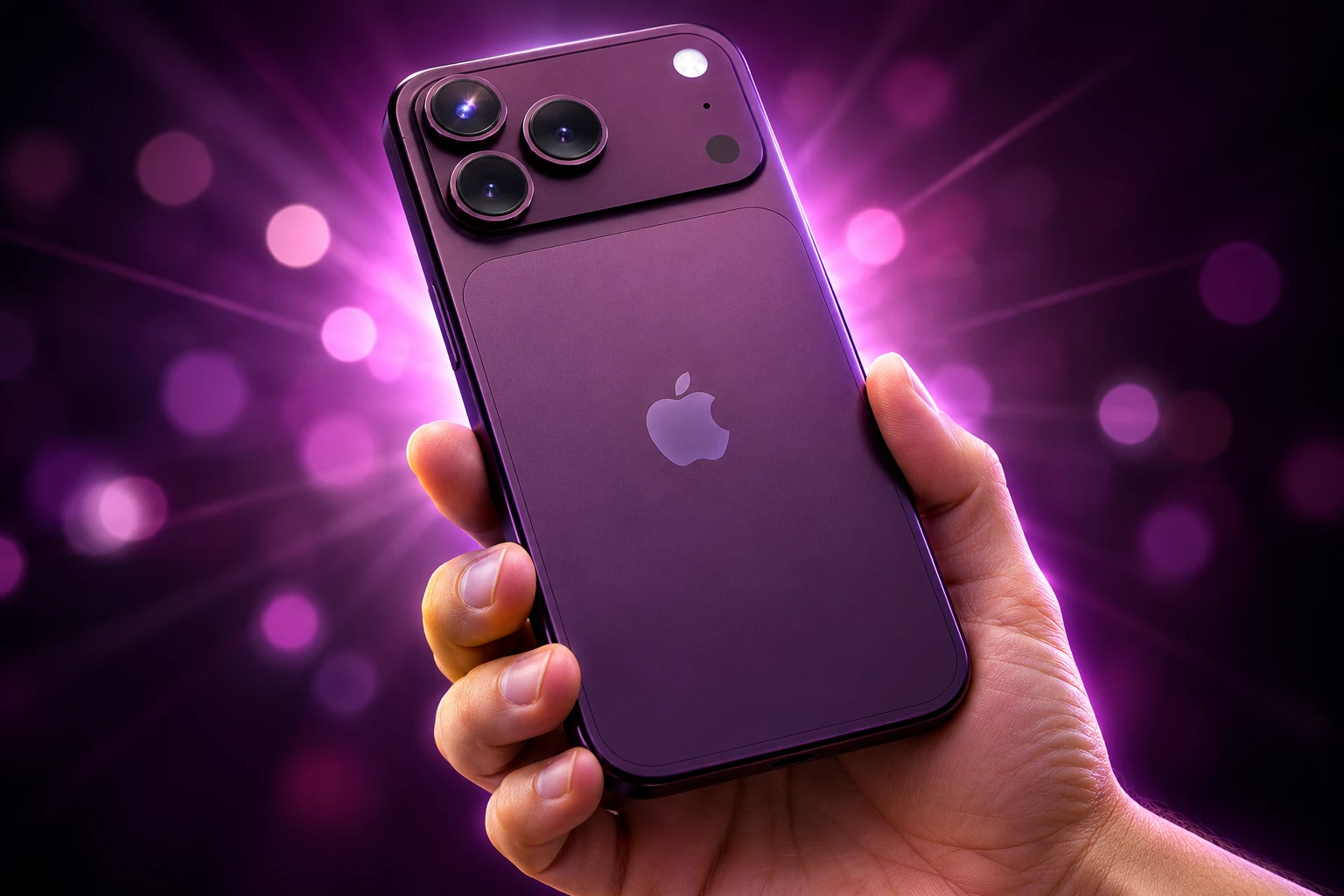
Four Stops on a Sensor That Did Not Grow
The Fusion Main still uses a Type 1/1.28 sensor with 71.5mm² of area and 1.22µm pixels, the same size as the iPhone 16 Pro and iPhone 17 Pro. Apple says a new sensor sits behind the new lens. The extra light does not come from a bigger chip.
Apple’s product copy claims around 50 percent better low-light performance when the iris opens to ƒ/1.48. Last year’s Pro main lens was locked at ƒ/1.78. The jump is about half a stop from a faster lens, which is real, and also the entire gain. Night mode can fire sooner. Group shots can stop down to ƒ/4.0 so faces in the back stay sharp without a software blur map inventing the focus.
On a sensor this small, even ƒ/4.0 still gives a lot of depth of field. Independent camera tests put the wide-open equivalent around ƒ/5.1 in full-frame terms. You can get sun stars if you stop all the way down. You will not get a portrait-lens look from optics alone.
THE REAR CAMERAS, 17 PRO TO 18 PRO
| Part | iPhone 18 Pro | iPhone 17 Pro |
|---|---|---|
| Main aperture | ƒ/1.48, ƒ/1.8, ƒ/2.8, ƒ/4.0 | ƒ/1.78, fixed |
| Main sensor | 48MP, 24 mm, Type 1/1.28 (71.5mm²) | 48MP, 24 mm, Type 1/1.28 (71.5mm²) |
| Ultra Wide | 48MP, 13 mm, ƒ/2.2, 120° | 48MP, 13 mm, ƒ/2.2, 120° |
| Telephoto | 48MP, 100 mm, ƒ/2.8 (200 mm 8x) | 48MP, 100 mm, ƒ/2.8 |
| Front camera | 18MP Center Stage, ƒ/1.9 | 18MP Center Stage, ƒ/1.9 |
The ultrawide, telephoto, and front cameras are last year’s modules. The moving iris is the hardware change. Optical-quality zoom still runs from 0.5x to 8x, a 16x span, with digital stills up to 40x. Second-generation sensor-shift stabilization and 100 percent Focus Pixels stay on the Main. Storage runs 256GB to 2TB. Finishes are black, silver, glacier, and a new burgundy. The 6.3-inch Pro weighs 211 grams; the 6.9-inch Pro Max weighs 249 grams.
Early side-by-sides already match that modest math. Tech reviewer Arun Maini compared an iPhone 18 Pro Max with a 17 Pro Max and wrote, “The wider aperture does make some difference to detail (and colours look better in low light).” The gap is visible. It is not a new camera class. Most people will leave the iris in automatic and never learn the four clicks.
The Camera App Finally Hands Over the Dials
For years, anyone who wanted shutter speed or a live histogram on an iPhone opened Halide or another third-party app. Apple has now put a Pro controls panel in the stock Camera app on the 18 Pro models. It is customizable, and it is limited to this hardware. Apple’s own comparison pages do not bring the panel back to older Pros.
THE NEW PRO CONTROLS
- Aperture: Manual choice among the four Fusion Main aperture settings, or leave the phone to pick.
- Shutter speed: Faster to freeze motion, slower to smear lights or lift a dim room.
- White balance: A direct correction so indoor tungsten does not turn the frame orange.
- Histogram: A small graph of exposure; piled on the left means too dark, piled on the right means blown highlights.
- Missing dial: Apple’s spec sheet never lists manual focus, so when autofocus misses, there is still no ring to grab.
A developer API lets other camera apps drive the iris. Forum posts already ask whether AVFoundation will expose only those four clicks or a continuous range. Apple’s published spec lists the four discrete stops, and that is the working assumption until a third-party app proves otherwise.
Photographic Styles 3 adds texture and grain, so you can soften skin or push a film look at capture and still change it later. Smart focus tracking tries to lock a tapped subject, a child or a dog, and stay with it through the frame. Those are software features that could have lived on last year’s phones. Apple is keeping them on the 18 Pro.
Apple Built Its Own Digital Negative
The stranger half of the camera brief is Apple Reference Image. In a new opt-in Reference mode on the Fusion Main, the sensor signs every pixel it sees. Signed sensor data goes to Private Cloud Compute, which develops what Apple calls an unalterable reference image, “like having a digital negative.” The Photos app shows that file next to the ordinary shot so you can see what changed.
Apple called the bundle of Reference Image, existing metadata, and later SynthID support vital for photojournalists, photographers, and everyday viewers. APIs in iOS 27, iPadOS 27, and macOS 27 let other apps display the negatives. Apple said in a briefing that the files are large, which is why the mode is off unless you turn it on.
Newsrooms already have a standard for this job. Leica, Canon, and Sony bodies can embed C2PA Content Credentials at capture. Google’s Pixel 10 signs every photo by default. Nikon’s own Content Credentials on select cameras went live on the Z6III, then the company suspended the service after a signing-infrastructure flaw. Apple did not join that club. It built a closed negative that lives in Photos and in Apple’s cloud, with a promise to publish viewing docs for Windows, Android, and browsers next year.
SynthID is the other leg, and it does a different job. Google DeepMind’s tool embeds invisible watermarks on AI-generated images, audio, text, and video so a detector can flag synthetic pixels even after a crop. Apple said SynthID support arrives in a software update later this year and will cover most edited images, depending on the edit. Image Playground, Extend, and Spatial Reframing are the Apple Intelligence tools that will need that stamp, because the same event that shipped a “this is real” camera also shipped more ways to rewrite a photo.
Why EU Buyers Cannot Capture a Reference Image at Launch
Apple’s footnotes, not the keynote, carry the catch. Apple Reference Image is not available at launch in China, which Apple attributes to regulatory requirements. In the European Union, capture is also withheld at launch on the iPhone 18 Pro models. People on iOS 27, iPadOS 27, and macOS 27 can still develop and view reference images. Apple has said it wants to widen capture next year. It has not named a date, a law, or a regulator.
The footnote is written against the EU, so UK units are not covered by that capture block. A Scottish or English buyer who actually uses Reference mode will be able to mint a negative on day one. A photographer across the Irish Sea, on the same phone at the same price, will not. That is an awkward split for a feature Apple billed as vital for photojournalists.
WHAT WE KNOW
- The mode: Reference Image is opt-in, Main camera only, and produces a second file beside the normal shot.
- The pipeline: The sensor signs pixels at capture; Private Cloud Compute develops the unalterable negative.
- The maps: China does not get the feature at launch; EU units cannot capture it at launch.
WHAT IS UNCONFIRMED
- EU timing: Apple has pointed at next year for capture in the bloc, with no month attached.
- Newsroom tools: There is no public commitment that agency desks will treat Apple’s negative as interchangeable with C2PA credentials.
- The iris: No public drop test has yet shown how six hair-thin blades behave after a hard hit.
A signed photo that cannot be captured in the EU is a product for press markets that cannot use it on assignment. A format that third-party desks cannot verify next to a Leica or a Pixel file is a provenance system that stops at Apple’s own apps. Those limits sit on the same phone as the moving iris, and they are the part of the camera brief that will still matter in three months, after the keynote demos fade.
Video Inherits the Iris and a Few Quiet Upgrades
The same four stops apply to video. Pro controls, smart focus tracking, and the faster wide-open lens all carry over. Cinematic mode, the software blur Apple already sells, now runs at 4K and 60 fps, and you can apply the effect after you shoot instead of committing in the moment. Time-lapse finally records 4K in Dolby Vision HDR. Audio Mix has new code for cleaner voices and can isolate background music.
The ceiling on the Fusion Main is 4K Dolby Vision at 100 fps or 120 fps. ProRes can go to 4K at 120 fps with an external recorder, with ProRes RAW, Apple Log 2, and genlock on the spec sheet for people who already live in that world. Dual Capture, Action mode, and the 18MP Center Stage front camera are carryovers. Improved low-light video is claimed across the board, including the front camera, which still uses last year’s ƒ/1.9 module.
A20 Pro sits underneath all of that processing. It is Apple’s first iPhone chip on a 2-nanometer process, with a 6-core CPU, a 7-core GPU Apple rates at up to 40 percent faster than A19 Pro, and a Dual 16-core Neural Engine, 32 cores, double last year’s AI throughput. A next-generation vapor chamber, with three times the surface area of the iPhone 17 Pro’s, is there to keep that silicon from cooking the camera pipeline on long 4K takes.
The Phones Arrive on September 18
This has not been in a reviewer’s pocket for a week of rain, drops, and mixed light. Units go on sale September 18, in four colours, with eSIM-only models in the United States and a list of other markets that pick up two extra hours of video playback from the space the plastic SIM tray used to occupy. Wired charging can hit 50 percent in around 15 minutes from a 60W adapter. The Pro Max is rated at up to 45 hours of video playback, the Pro at 36.
Samsung looked at a thicker module and a small IQ bump and stopped. Apple put six laser-cut blades into both Pro phones anyway, then asked Private Cloud Compute to notarize what the new sensor saw. The iPhone 18 Pro variable aperture camera four settings are a real optical choice the company has never offered. The iPhone 18 Pro Fusion Main six-blade iris is also a new thing to break. Friday is when that wager leaves the stage and hits a pavement.

Greed Held After a $697 Million Crypto Long Flush

Fed Minutes Keep a Year-End Rate Hike Alive

A Nanny-Cam Tape Follows Tyreek Hill Into Free Agency

Star Wars Galactic Racer Makes a Crash End the Tour

Amazon Puts Apple’s June MacBook Prices Back on Sale

Sophia Wootten Turns the Miss Georgia Crown Toward Cleft Care

Georgia Beach Bacteria List Leaves Swim Areas Open

The iPhone 16 Pro Flipkart Cut Did Not Last

Microsoft Prints Azure’s $29.42 Billion Quarter and Shrinks the Map

UltraTech’s Ultravolt Launch Puts Cable Multiples on Trial
-
 ENTERTAINMENT4 months ago
Sophia Wootten Turns the Miss Georgia Crown Toward Cleft Care
-
 NEWS4 months ago
Georgia Beach Bacteria List Leaves Swim Areas Open
-
 NEWS1 year ago
The iPhone 16 Pro Flipkart Cut Did Not Last
-
 BUSINESS2 months ago
UltraTech’s Ultravolt Launch Puts Cable Multiples on Trial
-
 NEWS2 months ago
Microsoft Prints Azure’s $29.42 Billion Quarter and Shrinks the Map
-

 NEWS3 months ago
Little St. Simons Island Hatches Loggerheads at 72.4 Percent
-

 NEWS10 months ago
IXI Autofocus Glasses Still Lack a European CE Mark
-

 NEWS3 months ago
OnePlus Ends OxygenOS After Quitting US and Europe