
NEWS
The Heart Scan That Matched Risk With Fewer Statins
CorCal found the same 2.7% event rate with fewer statin prescriptions, then missed noninferiority after guidelines had already dropped its control equation.

A 5,772-person trial found a 2.7% rate of major heart events whether statin advice came from a calcium CT scan or the older risk equation. After 4.2 years, the scan arm had been told to start a statin far less often, and those patients stayed on the pills at more than twice the rate. CorCal Outcomes, presented on 31 August 2026 at the European Society of Cardiology meeting, still missed the test meant to prove that leaner strategy was no worse.
The control tool the study used had already been replaced in U.S. cholesterol guidelines months earlier. The scan did not lose on events. It lost on math, and on timing.
Identical Event Rates After 4.2 Years
Dr. Joseph B. Muhlestein of Intermountain Medical Center in Murray, Utah, the principal investigator, told the Hot Line session in Munich that for far too many patients, “the first symptom of ASCVD is a heart attack.” Statins prevent atherosclerotic cardiovascular disease, he said, but risk tools, first prescriptions, and long-term use still leave a gap, especially in younger people whose first event would not have qualified them for a pill in advance.
Adults with no known atherosclerotic disease, no diabetes, and no prior statin, registered in Intermountain Health’s Canyons and Desert regions, were randomized 1:1. One arm got a statin recommendation from the pooled cohort equations, which fold age, sex, cholesterol, blood pressure, and smoking into a 10-year risk number. The other arm got the recommendation from a coronary artery calcium score on CT. Letters went to patients and their own physicians. The protocol set the advice. The final yes or no stayed in the clinic.
Mean age was 64, and 51% were women. The primary endpoint mixed death from any cause, heart attack, stroke, and procedures to reopen blocked arteries. After 4.2 years, that bundle hit 2.7% in each group. The hazard ratio was 0.99, with a 95% confidence interval of 0.71 to 1.38. The p value for noninferiority was 0.045, and the trial’s own bar for calling the scan no worse was not cleared.
The study was funded from internal Intermountain resources and by the Dell Loy Hansen Foundation. Muhlestein reported no financial disclosures tied to the trial. The registered CorCal Outcomes protocol lists Intermountain Health Care as sponsor and still describes a pragmatic, open-label comparison of calcium screening against the pooled cohort equations.
Age Pushed Statins; Calcium Often Said No
The two methods did not argue about events. They argued about who should swallow a daily pill. On 29 March 2025, while enrollment was still being closed out, Intermountain reported a 50.7 percent statin start rate in the equation arm of 5,615 volunteers, with another 21.7% told a statin should be considered. In the scan arm, only 22.3% were told to start. Dr. Jeffrey L. Anderson, co-principal investigator and a distinguished clinical and research physician at Intermountain Health, said the gap came from age, which drives the equation hard, while many older patients had a zero or low calcium score and were steered off the drug.
A later sex breakdown of the full 5,772-person cohort, presented in 2025 before outcomes were known, found a median calcium score of 0 Agatston units in women and 10 in men. No-statin letters were almost three times more common in the scan arm in both sexes. In Munich, the outcomes presentation put the same pattern in plainer terms: people in the equation group were advised to initiate a statin more than three times as often as people whose advice came from the scan.
THE TWO ARMS SIDE BY SIDE
| Measure | Pooled cohort equations | Coronary calcium CT |
|---|---|---|
| Major events at 4.2 years (n=5,772) | 2.7% | 2.7% |
| Hazard ratio (95% CI) | 0.99 (0.71 to 1.38); noninferiority not met | |
| Statin start recommendation (enrollment, n=5,615) | 50.7% | 22.3% |
| Additional “consider a statin” (enrollment) | 21.7% | Not reported as a separate share |
| Stayed on a recommended statin | 23% | 62% |
Among people who were told to take a statin, persistence flipped the script. Adherence was 62% after a calcium-based recommendation and 23% after an equation-based one. Seeing calcium on a scan appears to change whether the prescription survives the first refill, even when the letter goes to the same kind of primary-care office.
HOW THE SCAN ARM ASSIGNED A STATIN
- Very high LDL-C: LDL-C above 190 mg/dL triggered a high-intensity statin even without a high calcium score.
- Heavy plaque: A score above 100 Agatston units also meant a high-intensity statin.
- Mild plaque, high percentile: Scores of 1 to 100 that sat above the 75th percentile for age and sex meant a moderate-intensity statin.
- Zero calcium: No statin was advised unless LDL-C was in that very high range.
Anderson, speaking while the outcomes were still ahead, put the practical stake in one line: statins cost money and can cause muscle aches and a higher chance of diabetes, so the people who get them should be the people who need them. CorCal was built to test whether a picture of plaque does that job better than a probability score.
Why the Trial Missed Its Own Bar
A matching 2.7% can still fail a noninferiority trial. The design asked whether calcium-guided care was not unacceptably worse than equation-guided care. The point estimate sat on 0.99, essentially a tie, but the upper end of the confidence interval reached 1.38, and the preset criterion was not met. Muhlestein said power fell because events were rarer than the team had planned for.
That drought is not a small footnote. Primary prevention in a relatively healthy, nondiabetic group produces few heart attacks over four years, and a trial that needs those events to declare a winner, or even a draw, can stall. A design paper on CorCal, published in the American Heart Journal, noted that the original event target was unlikely to be reached in a reasonable time. It also flagged a second problem: U.S. prevention had started to move from the pooled cohort equations to the newer PREVENT equations, which made the trial’s control arm look dated while follow-up was still running.
Leslee Shaw, director of the Blavatnik Family Women’s Health Research Institute at the Icahn School of Medicine at Mount Sinai and the ESC discussant, said the cohort had too few higher-risk patients and that treatment goals were not intensive enough, with blood pressure and lifestyle advice left thin. A less loaded sample makes a leaner statin strategy look safe because almost nobody in either arm has an event. It also makes a formal proof of safety almost impossible.
Muhlestein called the adherence and efficiency findings hypothesis-generating and said the data could plan a larger randomized comparison of calcium scoring against current risk-factor algorithms. He did not claim the scan had won.
U.S. Guidelines Had Already Retired the Control Arm
CorCal randomized its first patients in 2019, when the 2018 U.S. cholesterol guideline still used the pooled cohort equations and treated calcium scoring as a reasonable tie-breaker (Class 2a) if a statin decision was uncertain. By the time the Hot Line ran, that world had closed.
On 13 March 2026, the American College of Cardiology and American Heart Association issued a new dyslipidemia guideline that tells clinicians to use the PREVENT equations, not the older pooled cohort equations, for 10-year and 30-year risk in adults aged 30 to 79. In adults at intermediate risk, and in selected adults at borderline risk, if the decision on lipid-lowering therapy remains uncertain, a calcium score now carries a Class I calcium scoring recommendation: it should be used to refine risk and to guide whether to withhold, postpone, or start therapy.
FROM FIRST LETTER TO THE MUNICH STAGE
- 9 August 2019: Intermountain begins screening records and mailing invitations for CorCal Outcomes.
- 29 March 2025: Anderson presents enrollment characteristics in Chicago; 5,615 people are in, and the statin-letter gap is already large.
- 13 March 2026: U.S. guidelines replace the pooled cohort equations with PREVENT and raise calcium scoring to Class I when a statin decision is uncertain.
- 31 August 2026: Muhlestein presents 4.2-year outcomes in Munich; event rates match at 2.7%, and noninferiority is not shown.
The trial answered a 2018-era question with 2026 data. PREVENT sorts 10-year risk as low (under 3%), borderline (3% to under 5%), intermediate (5% to under 10%), or high (10% or more). Those cut points are not the ones CorCal used. A new outcomes trial that wants to change practice now has to beat, or at least match, PREVENT plus selective calcium scoring, not the calculator CorCal carried as its control.
HOW THE U.S. RULE ON CALCIUM SCANS CHANGED
| Item | 2018 cholesterol guideline | 2026 dyslipidemia guideline |
|---|---|---|
| Primary risk equation | Pooled cohort equations | PREVENT equations |
| Calcium score if a statin decision is uncertain | Class 2a: reasonable to use | Class 1: should be used in intermediate and selected borderline risk |
| Role of a zero score | Can support delaying a statin in selected patients | Deferral remains reasonable without high-risk conditions, with repeat scanning in 3 to 7 years |
Europe had already treated a raised calcium score, if it is measured, as a risk modifier around treatment thresholds in a 2025 focused update of its dyslipidaemia guidance. CorCal did not walk into an empty field. It walked into a field that had been regraded while the grass was growing.
What a Coronary Calcium Scan Shows
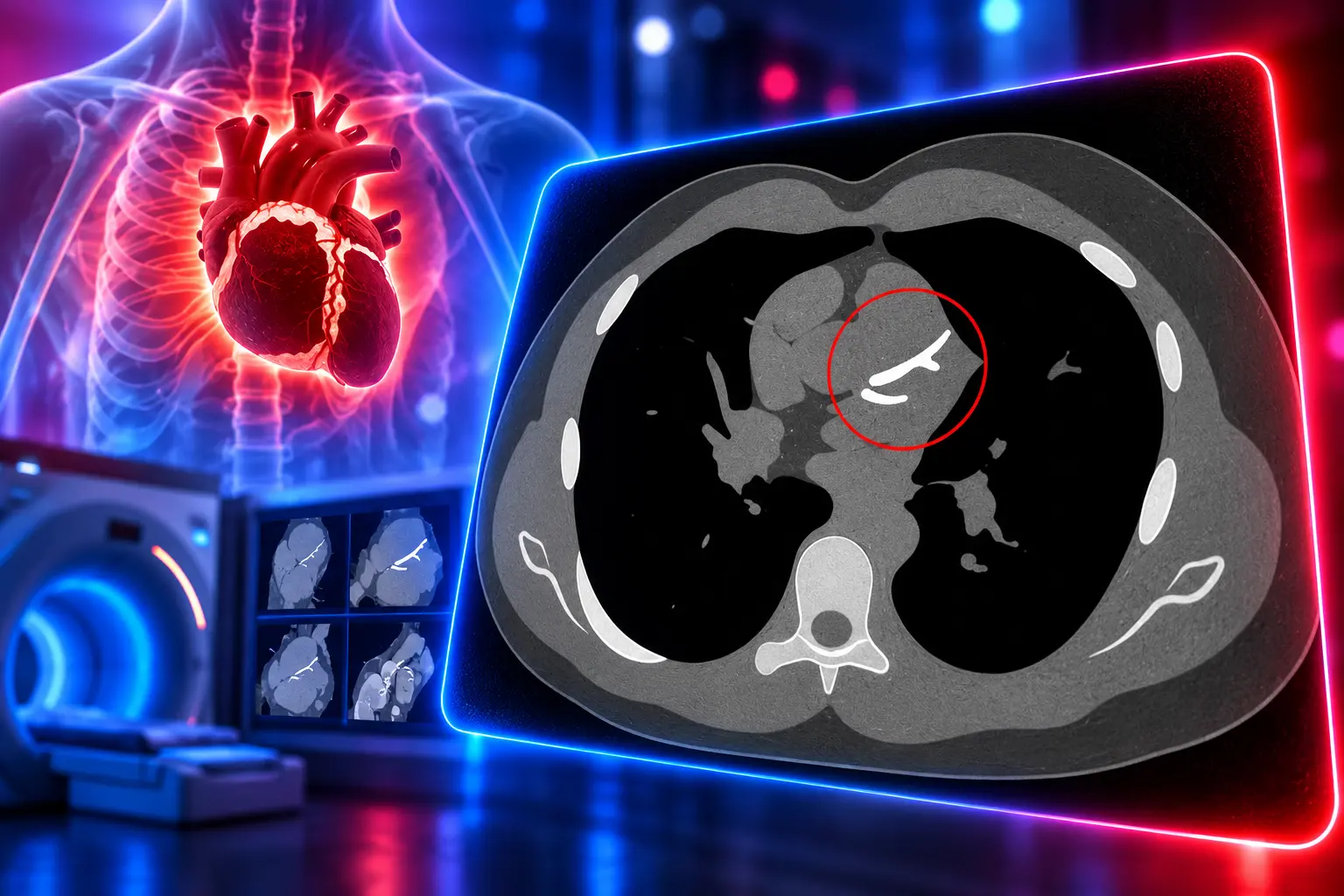
A coronary artery calcium scan is a gated CT of the heart, timed to the heartbeat, that looks for calcified plaque in the arteries that feed the muscle. The usual summary is an Agatston score. Zero means no calcified plaque on that scan. Scores climb past 1,000 in people with heavy burden. Calcium is not the whole of atherosclerosis, and a zero score does not make a current smoker, a person with diabetes, or someone with a very high LDL-C low risk. In CorCal, diabetes was an exclusion, and very high LDL-C still earned a statin in the scan arm.
Anderson asked the question the trial was built around: is it more effective to use direct imaging of plaque, or to drop risk factors into an equation? The scan’s appeal is that it answers a narrower question than a 10-year model. It asks whether calcified plaque is there now. In this Intermountain sample, for a lot of people in their sixties, the answer was no, or barely.
Money still sits outside most insurance contracts. A JAMA patient page on calcium scoring puts out-of-pocket costs of $50 to $400 and notes that Medicare and Medicaid generally do not cover the test in people without symptoms, with private plans often following that pattern. Incidental findings, extra stress tests, and catheterizations can add cost after a high score. CorCal listed cost as a secondary aim. That analysis was not the Hot Line result.
From a patient’s side of the desk, the scan is easy to read as a yes-or-no test for “heart disease,” even when the clinic meant it as a tie-breaker. That label can push someone toward a statin they will actually take. It can also send them into a search bar, a second imaging test, or a week of dread. The trial’s own letters tried to keep the decision inside ordinary primary care. They could not control what a number on a page does once it leaves the building.
Calcium Scoring Pulled People Off Statins
If calcium scoring were a screening net, you would expect more statins, not fewer. CorCal ran the other way. Preventive cardiologist Khurram Nasir, writing after the slides circulated, called the test a “subtractor” rather than a tool that adds treatment. The pragmatic question, he argued, is whether a strategy that treats fewer, better-chosen patients causes harm. Matching event rates are reassuring on that point. They are not, he added, definitive proof of safety or equivalence.
I was the discussant for this trial at ESC. my take – too few higher risk, not intensive enough treatment goals, need more comprehensive bp and lifestyle recs. But, a huge start in the discussion to improve the initial risk assessment for primary prevention.
Leslee Shaw, Director, Blavatnik Family Women’s Health Research Institute, on X after the ESC Hot Line
Adherence is the part of prevention that usually breaks first. CorCal’s scan arm left more people off the drug and held onto the people it did treat. Nasir noted that those patients were also more likely to be on a higher dose and to get better LDL control, though the Munich release itself gave the 62% versus 23% persistence split and not a full lipid table. A scan that subtracts low-yield prescriptions and keeps the rest filled is a different product from a scan that finds hidden high-risk patients the equation missed. This cohort, with its tiny median calcium scores, was built to show the first of those jobs.
Muhlestein still wants a larger trial against whatever risk algorithm is current. Until that study exists, CorCal leaves a clean observed tie at 2.7%, a wide gap in who was told to start a statin, a sharp gap in who kept taking it, and a statistical verdict that refuses to call the tie proven. The people with no calcium in their coronaries, who would have been medicated on age and blood pressure alone, are the ones the old equation would have kept on the list.
Frequently Asked Questions
What Does a Coronary Artery Calcium Score Measure?
It adds up calcified plaque in the coronary arteries on a gated heart CT and reports the total in Agatston units, from 0 (no calcified plaque seen) to more than 1,000 in heavy disease. A JAMA explainer on the test says statin therapy is recommended at 100 Agatston units or higher and may be considered at 1 to 99, especially in people younger than 45. Soft, noncalcified plaque does not add to this number, so a zero score is a strong negative sign, not a promise that the arteries are clean in every sense.
Who Could Join the CorCal Outcomes Trial?
Intermountain screened 73,780 records and mailed 72,280 invitation letters between 9 August 2019 and 29 July 2024, then kept randomizing through April 2025 to reach 5,772 people. Volunteers had to be free of known atherosclerotic cardiovascular disease, diabetes, and any prior statin, and they had to be registered in the system’s Canyons and Desert regions. People who already had a reason for a statin, or who had already had an event, were not the population this comparison was built to sort.
Do 2026 U.S. Cholesterol Guidelines Still Use the Pooled Cohort Equations?
No. The 2026 ACC/AHA dyslipidemia guideline tells clinicians to use the PREVENT equations for 10-year risk in adults aged 30 to 79 with LDL-C between 70 and 189 mg/dL and no known atherosclerotic disease. Low risk is under 3%, borderline is 3% to under 5%, intermediate is 5% to under 10%, and high is 10% or more. CorCal’s control arm used the older pooled cohort equations because enrollment began in 2019, which is why the Hot Line result does not directly test the calculator now in the guideline.
Does Medicare Pay for a Coronary Calcium Scan?
Original Medicare generally does not pay for a standalone calcium score billed as CPT 75571 when it is used as a screening test in people without symptoms. The Centers for Medicare & Medicaid Services has treated isolated quantitative calcium scoring as not reasonable and necessary under standard rules, and the U.S. Preventive Services Task Force still gives the test an “I” grade, meaning evidence is insufficient to recommend for or against it in asymptomatic adults. Some Medicare Advantage and commercial plans make exceptions; most people who want the scan still pay cash.
What CAC Score Usually Leads to a Statin Under 2026 U.S. Advice?
In adults at intermediate risk and selected adults at borderline risk, a calcium score above 0, especially at 100 Agatston units or higher or at or above the 75th percentile for age and sex, is a reason to start lipid-lowering therapy. A score of 0, without high-risk conditions such as diabetes, current smoking, familial hypercholesterolemia, or a strong family history of premature disease, can support deferring medication and repeating the scan in 3 to 7 years. CorCal’s own algorithm was stricter at zero and at 1 to 100 than a blanket “any calcium gets a pill” rule.
Disclaimer: This article is news reporting and analysis of a clinical trial presentation and related professional guidelines. It is informational only and is not medical advice, a diagnosis, or a recommendation to start, stop, or skip a statin, any other lipid-lowering drug, or a heart scan. Readers should review their own cholesterol, calcium-score, and medication decisions with a qualified physician or cardiologist who knows their history before acting. Figures, hazard ratios, guideline classes, and coverage rules reflect the sources on the dates named above and may change when the full paper, longer follow-up, or new recommendations appear.

Greed Held After a $697 Million Crypto Long Flush

Fed Minutes Keep a Year-End Rate Hike Alive

A Nanny-Cam Tape Follows Tyreek Hill Into Free Agency

Star Wars Galactic Racer Makes a Crash End the Tour

Amazon Puts Apple’s June MacBook Prices Back on Sale

Sophia Wootten Turns the Miss Georgia Crown Toward Cleft Care

Georgia Beach Bacteria List Leaves Swim Areas Open

The iPhone 16 Pro Flipkart Cut Did Not Last

Microsoft Prints Azure’s $29.42 Billion Quarter and Shrinks the Map

UltraTech’s Ultravolt Launch Puts Cable Multiples on Trial
-
 ENTERTAINMENT4 months ago
Sophia Wootten Turns the Miss Georgia Crown Toward Cleft Care
-
 NEWS4 months ago
Georgia Beach Bacteria List Leaves Swim Areas Open
-
 NEWS1 year ago
The iPhone 16 Pro Flipkart Cut Did Not Last
-
 BUSINESS2 months ago
UltraTech’s Ultravolt Launch Puts Cable Multiples on Trial
-
 NEWS2 months ago
Microsoft Prints Azure’s $29.42 Billion Quarter and Shrinks the Map
-

 NEWS3 months ago
Little St. Simons Island Hatches Loggerheads at 72.4 Percent
-

 NEWS10 months ago
IXI Autofocus Glasses Still Lack a European CE Mark
-

 NEWS3 months ago
OnePlus Ends OxygenOS After Quitting US and Europe