
NEWS
Food Packaging Chemicals Land on a 38-Group Watch List
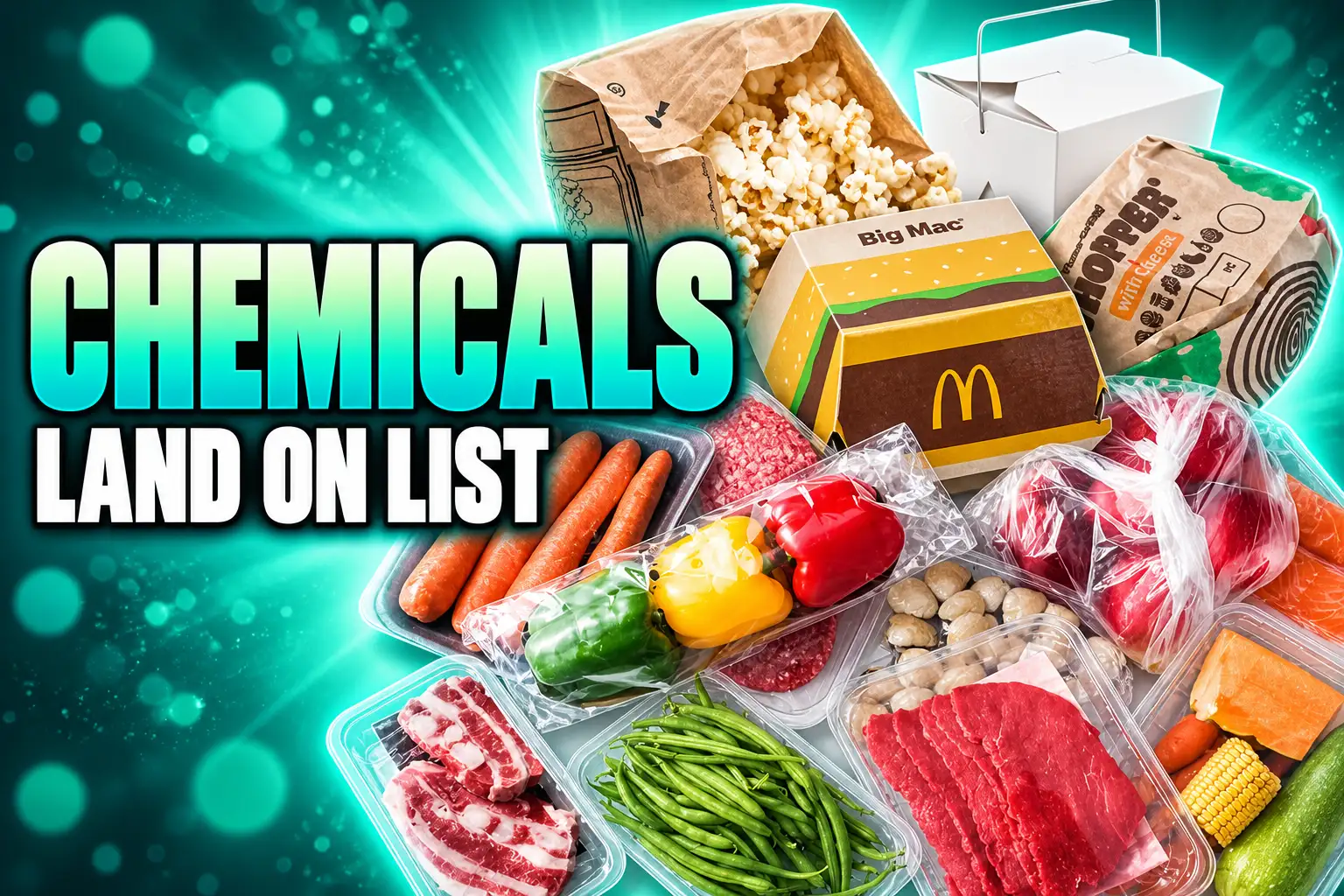
The Food Packaging Forum grouped 4,222 food packaging chemicals into 38 classes for EPR redesigns and FDA’s phthalate review, not a new ban.

A Zurich lab sorted 15,159 food contact chemicals into 38 groups and flagged 4,222 as look-alikes of known hazards. The Food Packaging Forum published the method September 1 in Environmental Science and Technology.
Seven U.S. states already make producers pay to collect and recycle packaging, and the FDA has begun grouping phthalate plasticizers for a combined risk review. The paper is a shopping list for those jobs, not a law that empties the wrap aisle.
They Sorted 15,159 Chemicals Into 38 Groups
Helene Wiesinger, a chemist and scientific communication officer at the Food Packaging Forum, led the team. They took every food contact chemical with a verified CAS number and asked which ones share a skeleton with substances already tied to cancer, hormone disruption, reproductive harm, organ damage, or the persistence that keeps a molecule in people and water.
The known universe is 15,159 substances that can sit in plastic, coatings, inks, adhesives, paper, and kitchenware. Of those, 10,153 show up only on lists of chemicals used to make food contact materials, 3,609 show up only in studies that pulled chemicals out of finished packs, and 1,397 sit in both sets. The paper also counts at least 2,160 chemicals migrate into food.
THE FOOD CONTACT CHEMICAL INVENTORY
| Measure | Count |
|---|---|
| Known food contact chemicals | 15,159 |
| On the FCCprio hazard list | 1,222 |
| Highest-exposure tier (migrate and found in people) | 94 |
| Chemicals inside the 38 priority groups | 4,222 |
| Known to migrate into food | at least 2,160 |
The 4,222 are not a new poison roll call. They are chemicals that look enough like known hazards that a brand swapping a banned additive for a cousin with a thinner file would be walking into the same problem under a new name.
PRIORITY GROUPS NAMED IN THE STUDY
- Ortho-phthalates: Plasticizers used to soften vinyl and other food contact plastics.
- PFAS: Fluorinated chains prized for grease and water resistance that also persist in bodies and the environment.
- Alkyl phenols: Breakdown products and additives that show up in coatings and other food contact uses.
- Organophosphates: A class used as flame retardants, plastic additives, and pesticides.
- Isocyanates: Building blocks for polyurethanes in adhesives, foams, and coatings.
- Primary aromatic amines: A less-discussed class the authors flag beside the usual suspects.
Among chemicals they could tag by job, the team counted 412 light stabilizers, 317 antioxidants, and 276 plasticizers. Those jobs are why the molecules are in the wrap in the first place, and why a ban on one name often produces a near twin.
Why One-by-One Review Cannot Keep Up
One-by-one review cannot keep up because 87% of the 15,159 known food contact chemicals lack adequate public safety data, and swapping a restricted molecule for a cousin with an empty file is the cheap move. The authors say more than 13,000 of those chemicals do not have enough public information to say whether they are safe for people eating off the pack.
The 1,222 hazardous chemicals across four tiers are the ones with harmonized hazard data. Tiers 1 through 4 hold 94, 264, 224, and 640 chemicals. Tier 1 is the short list with evidence of migration into food and presence in blood, urine, or breast milk, including phthalates, metals, and PFAS.
Wiesinger has described the industrial habit in plain terms. “The incentive is, well, use whatever isn’t tested,” she said. The grouping method published September 1 is an attempt to spot the bad ones among those unknowns without waiting for a full toxicology file on each CAS number.
Jane Muncke, managing director of the Food Packaging Forum, called the missing public files the hole in the middle of food contact rules in Europe and North America.
Today’s regulatory approaches in Europe and North America look at each chemical individually, but this is inefficient and does not sufficiently protect consumers. We are proposing an evidence-based grouping approach decision makers can already use now until the proper testing methods and testing data become available.
Jane Muncke, Managing Director, Food Packaging Forum
The louder argument around the paper treats the 1,222 as a fresh death list leaking from every clamshell. That skips what is new. Those 1,222 were already tagged as hazardous. The new work is the 38-group map around them, plus a warning that 70% of the 4,222 look-alikes still lack adequate hazard data.
Seven States Already Bill the Brands
Martin Mulvihill, a chemist and cofounder of Safer Made, a firm that invests in safer chemistry, said companies will not change food packaging just because this study was written. They will change it when a rule makes the current pack more expensive or illegal to sell. Extended producer responsibility laws do that by shifting collection and recycling costs onto the companies that put the pack on the shelf.
Seven states have enacted packaging EPR programs: Maine, Oregon, Colorado, California, Minnesota, Maryland, and Washington. There is no federal packaging EPR law. A national brand now faces seven separate producer definitions, fee schedules, and calendars.
PACKAGING EPR PROGRAMS NOW ON THE BOOKS
| State | Law | Where the program stands |
|---|---|---|
| Maine | LD 1541 (2021) | First U.S. packaging EPR statute; program still being built |
| Oregon | SB 582 (2021) | Regular program fees invoiced from July 2025 |
| Colorado | HB 22-1355 (2022) | Regular program fees invoiced from January 2026 |
| California | SB 54 (2022) | Final rules May 1, 2026; producer registration June 1, 2026; full fees in 2027 |
| Minnesota | HF 3911 (2024) | Producers registered in 2025 |
| Maryland | SB 901 (2025) | Producer registration during 2026 |
| Washington | SB 5284 (2025) | Producer registration due July 1, 2026 |
Oregon and Colorado are already sending invoices. California collected registrations in June 2026 and will move to full fees in 2027. Those bills are written around recycling, recycled content, and what a pack costs to handle at the curb. They are not chemical bans. They still force a redesign, and a redesign is when a converter can drop a flagged additive instead of carrying it into the next bottle.
More packaging EPR bills were filed in 2026, including measures in New York, New Jersey, Massachusetts, and Georgia. New York’s Packaging Reduction and Recycling Infrastructure Act cleared the Senate in prior years and stalled again in 2026. The map is expanding in fits, not as a single national switch.
Mulvihill’s point is narrow. “You get these rare times when change is incentivized by an outside source like a regulation,” he said. If a company is already tearing up a spec sheet to cut EPR fees or hit a recyclability target, a grouped hazard list can travel with that change. Cosmetics and apparel brands already keep restricted-substance lists. Food packaging has had almost none of that guidance, which is why converters keep asking what to take out and what to put in.
Four Phthalates Share One FDA Risk Bucket
The U.S. Food and Drug Administration did not wait for this paper to try grouping. On May 27, 2026, the agency released a scientific evaluation of eight ortho-phthalates still authorized as plasticizers in food contact use, asking whether they should be treated as chemically or pharmacologically related for a cumulative risk assessment.
THE EIGHT FOOD CONTACT PHTHALATES FDA REVIEWED
- DEHP: Grouped with three others for a future combined risk review.
- DCHP: Grouped with DEHP, DIOP, and DINP.
- DIOP: Grouped with DEHP, DCHP, and DINP.
- DINP: Grouped with DEHP, DCHP, and DIOP.
- DIDP: On the authorized list; not in that four-chemical bucket.
- DEP: On the authorized list; not in that four-chemical bucket.
- BPBG: Butylphthalyl butyl glycolate; not in that four-chemical bucket.
- EPEG: Ethylphthalyl ethyl glycolate; not in that four-chemical bucket.
The agency’s findings support grouping DEHP, DCHP, DIOP, and DINP. DIDP, DEP, BPBG, and EPEG stay outside that combined bucket for now. FDA had already taken about 24,000 comments on an earlier request for information about how these plasticizers are used. The May paper is input for a later post-market safety assessment, not a ban.
On May 12, 2026, FDA also finished a systematic post-market process for chemicals already in the food supply, including food contact substances. The first work includes reviews of BHT as a food contact substance, BHA, and other additives. Julia Varshavsky, an environmental health researcher at Northeastern University, has said evaluating chemicals as a class is not a new scientific idea, and that it has rarely been written into food contact rules. FDA’s four-phthalate bucket is an early test of that idea inside the agency that actually clears food wraps.
Industry Says 90% of Additives Have Data
Craig Warren Davis, senior director of plastics chemistry at the American Chemistry Council, said the study does not fully represent the data on food packaging chemicals. He argued that finding a substance in a product does not, by itself, mean a person gets a higher dose, and he pointed companies and regulators to the International Council of Chemical Associations’ Plastic Additives Database.
Industry has and continues to fill many of the information gaps identified in this study.
Craig Warren Davis, Senior Director of Plastics Chemistry, American Chemistry Council
An August 7, 2025 ICCA update identified 4,549 plastics additives in commerce, with 94.5% listed on at least one major chemicals inventory and 90% carrying readily accessible toxicology data for a risk assessment. The same database holds information on nearly 13,400 chemicals associated with plastics, even though far fewer are used as additives in commerce today. Marco Mensink, council secretary of ICCA, called the file the most complete international resource of its kind.
Those two inventories are not the same pile. FPF is counting every known food contact chemical, including inks, adhesives, paper chemicals, and substances found in packs that were never on a manufacturer’s recipe. ICCA is counting plastic additives confirmed in commerce. A 90% data rate on 4,549 additives can sit beside an 87% public-data gap on 15,159 food contact chemicals without either number being a simple lie. They describe different sets, which is why the fight keeps talking past itself.
Davis also noted that the work was supported in part by the Minderoo Foundation, which he said receives funding from a metal company. The ACS paper lists Minderoo and the Environmental Defense Fund as funders. The authors wrote that neither Minderoo nor any of its benefactors had any influence on the conduct or reporting of the study, and they declared no competing financial interest.
BPA to BPS Is the Swap This List Tries to Stop
The paper’s working example is bisphenol A (CAS 80-05-7) giving way to bisphenol S (CAS 80-09-1). BPA drew restrictions in some food contact uses. BPS is a close structural relative that then moved into some of the same jobs. Wiesinger’s team wrote that this is what one-by-one rules produce: a name change, a thinner file, and a molecule that still does the work that made the first one useful.
There are many known hazardous chemicals in food packaging, but replacing them with very similar chemicals that have not been sufficiently tested is not solving the problem. Based on already known hazardous chemicals, we have identified 38 priority chemicals groups, and we developed a method to quickly identify them within any set of chemicals.
Helene Wiesinger, Chemist and Lead Author, Food Packaging Forum
The property that makes a chemical good at a packaging job is often the same property that makes it stubborn in a body. PFAS carbon-fluorine bonds shrug off grease and water; they also shrug off breakdown. A converter who is told to drop one PFAS and reaches for a shorter-chain cousin is doing what the last decade of “PFAS-free” labels often did. Grouping is a way to treat that cousin as part of the same decision, even before a full hazard dossier exists.
Albert Anguera Sempere, a co-author, said the team’s FCCgroup app is built so a company can paste its own chemical set and see which entries fall in a priority group. The pitch to brands is less moral than legal: stay ahead of future restrictions, cut litigation risk, and keep customers. The app is free on the Food Packaging Forum site. The authors presented it on a September 7 webinar.
A Free App for Packs Already Being Redesigned
FCCprio is the avoid-and-phase-out list of 1,222 known hazards. FCCgroup is the screener for the 38 clans around them. Together they give a packaging engineer something cosmetics formulators have had for years: a list that is ugly enough to use in a supplier call. They do not, on their own, change what is legal to sell in a U.S. grocery aisle.
Europe is running a parallel clock. On September 7, the Food Packaging Forum filed comments on a European Chemicals Agency draft list of around 700 substances of concern in packaging, written to inform the EU Packaging and Packaging Waste Regulation, and named 42 extra hazardous chemicals it said belong on that living list. Group-based limits are closer to how Brussels already writes some food contact rules than how FDA has historically cleared substances one petition at a time.
The U.S. path still runs through two slower machines. State EPR programs will keep forcing new pack designs as fees come due in Oregon, Colorado, and, in 2027, California. FDA will keep walking through post-market files, starting with the four phthalates it has already put in one risk bucket. Wiesinger’s 38 groups matter if those two machines pick them up. If they do not, the grocery wrap keeps the same chemistry under a recyclable label.
Disclaimer: This article is news reporting and analysis of a published scientific study, agency reviews, and state packaging laws. It is informational only and is not medical, nutritional, or legal advice, and it does not tell readers which foods, packages, or products to use or avoid. Anyone with a health concern about chemical exposure should speak with a licensed physician, and companies facing packaging or food-contact rules should consult qualified regulatory counsel before changing specifications. Figures, program statuses, and agency dockets reflect the cited sources as of the dates named in the article and can change as lists, fees, and reviews are updated.

Greed Held After a $697 Million Crypto Long Flush

Fed Minutes Keep a Year-End Rate Hike Alive

A Nanny-Cam Tape Follows Tyreek Hill Into Free Agency

Star Wars Galactic Racer Makes a Crash End the Tour

Amazon Puts Apple’s June MacBook Prices Back on Sale

Sophia Wootten Turns the Miss Georgia Crown Toward Cleft Care

The iPhone 16 Pro Flipkart Cut Did Not Last

Microsoft Prints Azure’s $29.42 Billion Quarter and Shrinks the Map

UltraTech’s Ultravolt Launch Puts Cable Multiples on Trial

IXI Autofocus Glasses Still Lack a European CE Mark
-
 NEWS1 year ago
The iPhone 16 Pro Flipkart Cut Did Not Last
-
 ENTERTAINMENT4 months ago
Sophia Wootten Turns the Miss Georgia Crown Toward Cleft Care
-
 BUSINESS1 month ago
UltraTech’s Ultravolt Launch Puts Cable Multiples on Trial
-
 NEWS1 month ago
Microsoft Prints Azure’s $29.42 Billion Quarter and Shrinks the Map
-
 NEWS9 months ago
IXI Autofocus Glasses Still Lack a European CE Mark
-
 NEWS3 months ago
Little St. Simons Island Hatches Loggerheads at 72.4 Percent
-

 NEWS4 months ago
Georgia Beach Bacteria List Leaves Swim Areas Open
-

 NEWS3 years ago
Eyal Waldman Keeps a Two-State Bet After Gaza