
ENTERTAINMENT
Prashanth Neel’s Dragon Holds June 11 After NTR Surgery
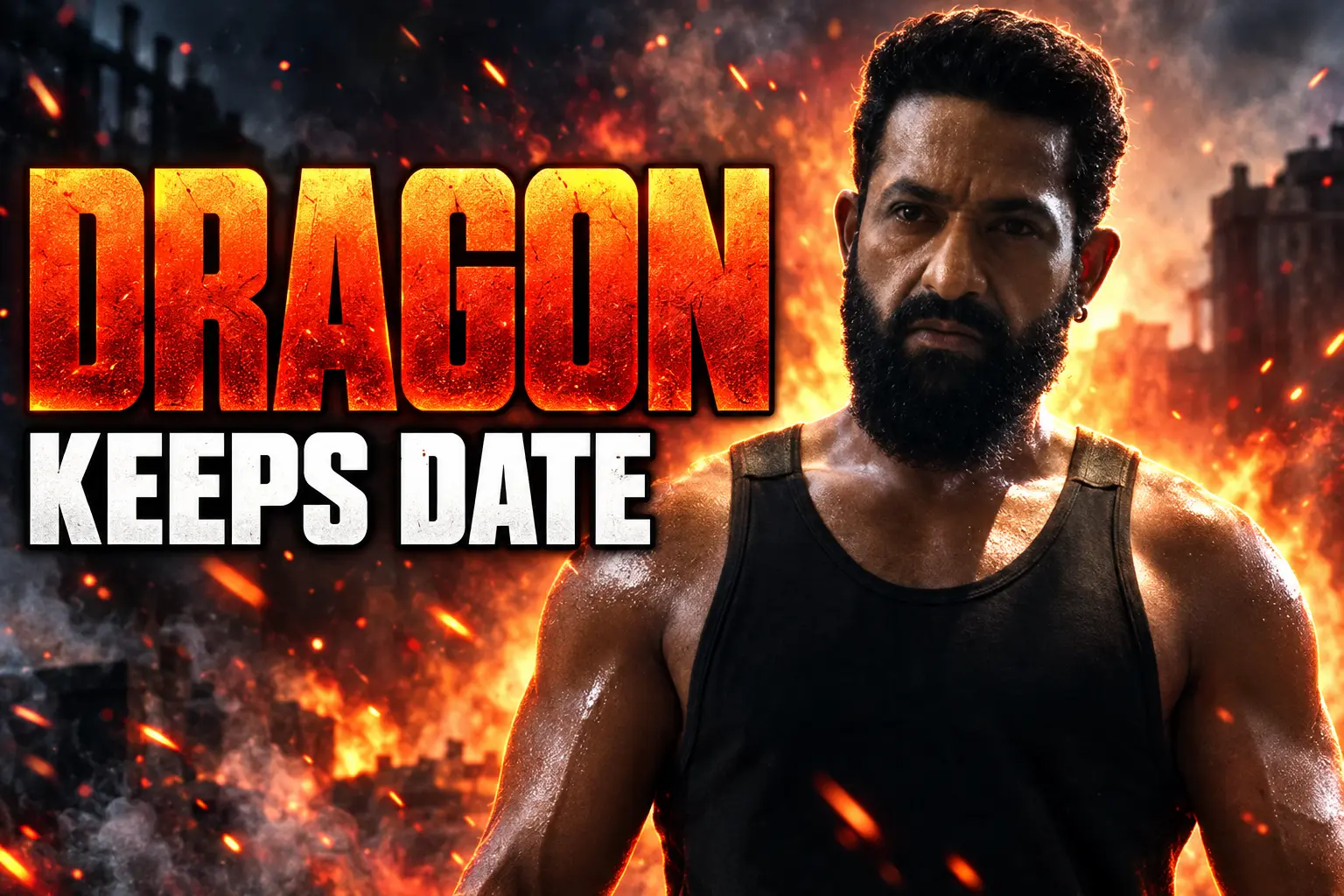
Dragon still targets June 11, 2027 after NTR’s shoulder surgery, locking Prashanth Neel’s Salaar 2 plans behind the wrap of this 1967 opium epic.

Mythri Movie Makers confirmed on September 30, 2026 that Jr NTR’s Dragon still opens on June 11, 2027, after the actor’s shoulder surgery. Producer Ravi Shankar Yellamanchili said the Prashanth Neel film had not lost its date.
That line would have been a routine schedule note if the May glimpse had not already turned Dragon into a pan-India event, and if Neel had not already parked Salaar 2 behind this wrap.
The Glimpse Sold a Killer Named Luger
Mythri Movie Makers put the first glimpse out at 11:52 PM on May 19, 2026, minutes before NTR’s birthday on May 20. The video runs 4 minutes 29 seconds, names the film Dragon, and introduces NTR as Luger, assassin-in-chief of the Afghan Trading Company.
The Telugu upload on the banner’s YouTube channel has 65.96 million views and 542,579 likes. It is still the clip fans reopen as a daily ritual, months after the launch, which is a strange afterlife for a teaser and a useful one for a film that has not shot its last round.
The same cut went out in five languages, Telugu, Hindi, Tamil, Kannada and Malayalam, with T-Series presenting the Hindi version. Early combined views passed 49 million in two days. The later split across official channels is what the theatrical plan is actually built on.
THE FIVE OFFICIAL UPLOADS
| Language | Channel | Views |
|---|---|---|
| Telugu | Mythri Movie Makers | 65.96 million |
| Hindi | T-Series | 52 million |
| Tamil | Mythri Movie Makers | 9.0 million |
| Kannada | Jr NTR | 8.3 million |
| Malayalam | NTR Arts | 4.1 million |
The Hindi glimpse on T-Series is the second engine in that package, and it is the one that has to travel beyond NTR’s home market if June 11 is going to look like a national opening rather than a dubbed add-on.
Neel Calls This His Last Dark Hero Film
Neel, the writer-director of KGF and Salaar, has been frank about what he thinks he is finishing. Rocky was the criminal, Deva the mad man, Luger the assassin. He has said those three stories were the last ones he needed to tell in this register, even if the colour palette makes them look related.
This is probably going to be our biggest attempt at making a patriotic movie.
Prashanth Neel, director, to Variety
The patriotic claim sits under a very dark ad. The glimpse’s own premise holds that British power in India rested on opium, with Britain commanding 95% of the global market through Afghanistan and the Golden Triangle. In that telling, the 1947 exit splits the trade into the Afghan Trading Company and the Golden Trading Company, and the drama detonates in 1967.
NTR’s Luger is named after the German Luger P08 pistol. Neel says the boy is sent to Afghanistan at 10, in 1947, and trained as the Afghan company’s chief enforcer. He has called it the most morally loaded role he has written, a negative man the audience is still asked to understand, closer to how viewers stayed with Pablo Escobar in Narcos than to a clean mass hero.
He also shut down reshoot talk around the glimpse. The break, he said, was so NTR could get fit without CGI. “We never reshot a single scene till now.” The other half of that body story is harder. Neel has said he asked NTR to get thinner for the assassin, and that the actor dropped about 15 kg in four months, enough that the director told him to stop because he looked frail and pale. NTR’s wife and mother, by Neel’s own account, were angry with him.
That is the wager inside the birthday clip. Neel wants a patriot buried in a crime film, and he wants NTR’s actual body to carry it. He has also said this is the first time he will let actors do the heavy lifting, which is a change of method for a director famous for camera thunder.
The June Date Survived a Shoulder Surgery
The 2027 date was already on the glimpse. Dragon had been aimed at June 2026, then moved before the video dropped. The injury did not cause that first slip. It is the threat to the date that replaced it.
THE SHOOT CALENDAR AFTER THE INJURY
- July 27, 2026: NTR’s team says he hurt his shoulder on the Dragon set. Doctors led by Dr. J. Madhusudan Rao and Dr. R. A. Purnachandra Tejaswi advise six to eight weeks of complete rest.
- August 12, 2026: He undergoes arthroscopic surgery at KIMS Hospitals in Secunderabad. The hospital calls the procedure completely successful and projects a return to normal in 2 to 3 months.
- August 13, 2026: KIMS discharges him. Dr. Purnachandra Tejaswi and Dr. Nithin Bejjanki lead the listed surgical team.
- September 30, 2026: Yellamanchili, speaking at the Don’t Trouble the Trouble pre-release event, says June 11, 2027 still holds. NTR, appearing as chief guest, says work will restart soon and that there will be no delays.
NTR wrote after the operation, “The surgery was successful and I’m doing well.” Dr. Tejaswi later said a small joint on top of the right shoulder was involved, that the actor went home within 24 hours, and that a hard rehab load was required. Two to three months from August 12 lands between October 12 and November 12. Production talk of a Mumbai restart around October 10 sits just inside the short end of that window.
Neel did not freeze the unit. He kept shooting passages that do not need the lead, the portions already on the board for this gap. Yellamanchili has said the aim is still to finish the full shoot before the end of 2026, which would leave months for the edit and effects a film of this size will eat. That aim is the studio line. It is also the line that breaks if the shoulder is not ready for the action Peter Hein and Chetan D’Souza still have to mount.
Salaar 2 Waits Until Dragon Wraps
Neel’s calendar is the second bill. He has said Salaar 2, titled Shouryaanga Parvam, “will happen immediately after the Dragon movie is done.” On KGF 3 he would not give a time. After those jobs he wants a mythological series he has been building for about two decades, and he has talked about walking away from large-scale action once they are met.
That queue is why a shoulder in Secunderabad is not only an NTR problem. Prabhas cannot get his Salaar continuation until Luger is in the can. Yash’s third KGF chapter has no slot at all while this film is open. Dragon is the stopper in a pipe that still prints the biggest numbers in Neel’s name.
Sacnilk’s tracker puts the KGF Chapter 2 worldwide gross at ₹1,215 crore, with an India gross of ₹1,000.85 crore. Salaar Part 1 Ceasefire is at ₹617.75 crore worldwide and ₹487.75 crore in India, which is how Salaar in the 500-crore club still reads as a hit that did not match the KGF peak. Dragon is being asked to live in that gap: national enough to chase the first number, distinct enough that a third Neel night-and-blood film does not feel like a copy of the second.
The copy charge is already in the bloodstream of the glimpse. A first watch still reads as KGF coal and Salaar dusk with a new coat of opium. Later watches are what the project is counting on, the slow poison Neel likes, the line reading and the face after the bodies. The sharper objection is simpler and meaner: that NTR’s frame cannot sell a cutout assassin the way a taller mass body would, and that Devara already tested that limit. The film has to answer with performance, because the camera language will not surprise anyone who has sat through the last two Neel events.
What the Five-Language Glimpse Shows
The video is less a trailer than a map. Rukmini Vasanth’s character speaks in verses drawn from Genesis, tying a creation myth to a crime empire, and then names the devil that arrives after men. That devil is Luger. Anil Kapoor lands last as Raghuveer Rathod, chief of India’s Narcotics Bureau, the lawman cut against the assassin.
NTR stands on a rise among the dead, blood on the face, and talks about pulling a trigger. One Telugu line that fans keep looping says the faces in his sleep are not the people he has already killed, only the enemies still left, and that they should not wander into his dreams by mistake. That is the sample of the thing, not a review of it: a killer who sounds tired of the work and is still doing it.
THE WORLD THE GLIMPSE MAPS
- The trade: A fictional war for opium after 1947, staged in 1967 across the Afghan company and the Golden Trading Company.
- Luger: NTR as the Afghan company’s assassin-in-chief, introduced after a long run of other faces, on a field of corpses.
- Rathod: Anil Kapoor as the narcotics chief, framed as the state counterweight, not a cameo walk-on.
- The other throne: The Golden Trading Company’s top seat is held back, which is why some viewers think the title points at that side rather than at NTR’s man.
The 1967 opium-trade assassin story is the plot the birthday clip was willing to show. The Golden company’s leadership is the plot it was not. If that hidden chair is the title character, the film is bigger than one star vehicle, and Neel’s habit of splitting sagas starts to look like a design, not a leak.
Mythri, T-Series and a Kannada Lead’s Telugu Debut
Dragon is produced by Nandamuri Kalyan Ram, Naveen Yerneni, Y. Ravi Shankar and Kosaraju Harikrishna under Mythri Movie Makers and NTR Arts. Gulshan Kumar and Bhushan Kumar present it through T-Series Films, which is why the Hindi upload sits on a music giant’s channel rather than only on a Telugu banner.
Rukmini Vasanth, coming from Kannada cinema, makes her Telugu debut as the female lead and is the voice that births Luger on screen. The rest of the listed company is built like a raid: Biju Menon, Khushbu Sundar, Guru Somasundaram, Rajeev Kanakala, Ashutosh Rana, Anshuman Pushkar, Sidhant Gupta, Prabhas Sreenu, Shatru, Shiva and Bhimal Jeet Oberoi, with Ntuthuzelo Prince Grootboom, Aleksandr Mizev and Benedict Paul Garrett in the foreign ranks.
The craft bench is Neel’s usual war party. Ravi Basrur writes the score, Bhuvan Gowda lights it, Pranav Sri Prasad cuts it, T. L. Venkatachalapathi designs the world, and Peter Hein shares stunts with Chetan D’Souza. Costumes are split between Deepali Noor and Anaita Shroff Adajania. That is a pan-India crew assembled for a pan-India date, not a Telugu film hoping the dub will travel.
Talk of Shahid Kapoor or Alia Bhatt joining has been knocked down. The film does not need more famous faces. It needs NTR’s remaining action days, and it needs Neel to finish a picture he has already described as his last dark-hero job.
October Is the Restart Window
Don’t Trouble the Trouble, the Fahadh Faasil Telugu film NTR helped launch, opened on October 2, 2026. He looked well enough on that stage for the Dragon conversation to restart in public. Yellamanchili used the same night to kill postponement talk. Trade notes point to Mumbai around October 10 for the next block, with a long, tight schedule meant to recover the weeks lost to the sling.
WHAT WE KNOW
- The date: June 11, 2027 is on the official glimpse and was restated by Yellamanchili on September 30, 2026.
- The injury: Right-shoulder arthroscopic surgery on August 12, 2026, after a July 27 set injury, with a 2 to 3 month rehab window from the hospital.
- The queue: Neel has said Salaar 2 starts when Dragon is done, and he has no time for KGF 3 yet.
WHAT IS UNCONFIRMED
- Two parts: Trade reports say both chapters may be shooting, with a short gap after June 11. The makers have not announced a second date.
- The wrap: The producer’s aim is the end of 2026. A later finish would squeeze the effects period, not automatically move June 11.
- Star-director friction: Talk of a script fight has been denied as old business settled before cameras rolled.
October is the first week that can prove those denials. If NTR is in Mumbai and the unit is shooting the hard passages, the birthday glimpse still points at a real June morning. If the shoulder needs the full three months, Salaar 2 waits longer, and the last dark hero film Neel wanted to close becomes the one that holds his next decade open.

Greed Held After a $697 Million Crypto Long Flush

Fed Minutes Keep a Year-End Rate Hike Alive

A Nanny-Cam Tape Follows Tyreek Hill Into Free Agency

Star Wars Galactic Racer Makes a Crash End the Tour

Amazon Puts Apple’s June MacBook Prices Back on Sale

Sophia Wootten Turns the Miss Georgia Crown Toward Cleft Care

The iPhone 16 Pro Flipkart Cut Did Not Last

Microsoft Prints Azure’s $29.42 Billion Quarter and Shrinks the Map

UltraTech’s Ultravolt Launch Puts Cable Multiples on Trial

Georgia Beach Bacteria List Leaves Swim Areas Open
-
 ENTERTAINMENT4 months ago
Sophia Wootten Turns the Miss Georgia Crown Toward Cleft Care
-
 NEWS1 year ago
The iPhone 16 Pro Flipkart Cut Did Not Last
-
 BUSINESS1 month ago
UltraTech’s Ultravolt Launch Puts Cable Multiples on Trial
-
 NEWS1 month ago
Microsoft Prints Azure’s $29.42 Billion Quarter and Shrinks the Map
-
 NEWS4 months ago
Georgia Beach Bacteria List Leaves Swim Areas Open
-

 NEWS9 months ago
IXI Autofocus Glasses Still Lack a European CE Mark
-
 NEWS3 months ago
Little St. Simons Island Hatches Loggerheads at 72.4 Percent
-
 NEWS3 years ago
Eyal Waldman Keeps a Two-State Bet After Gaza