For 141 days across the summers of 2020 and 2021, two waterproof cameras watched the same uninhabited Greek islet. One sat inside the main sea cave at Formicula, a 500-meter speck in the Inner Ionian Sea Archipelago. The other was housed in a watertight casing at the entrance of a flooded passage that opens into something stranger: an air-filled dome accessible only by diving under the rock and surfacing inside.
The seals chose the dome. According to a new study in Oryx, the international journal of conservation published by Cambridge University Press, Mediterranean monk seals (Monachus monachus) used the hidden bubble cave on 119 of the 141 monitoring days. They used the more accessible main cave on just 30. The finding, led by Joan Gonzalvo, director of the Ionian Dolphin Project at the Tethys Research Institute, reframes a basic assumption in marine-mammal conservation: that the caves you can swim into with a snorkel are the caves that matter.
What the Cameras Captured at Formicula
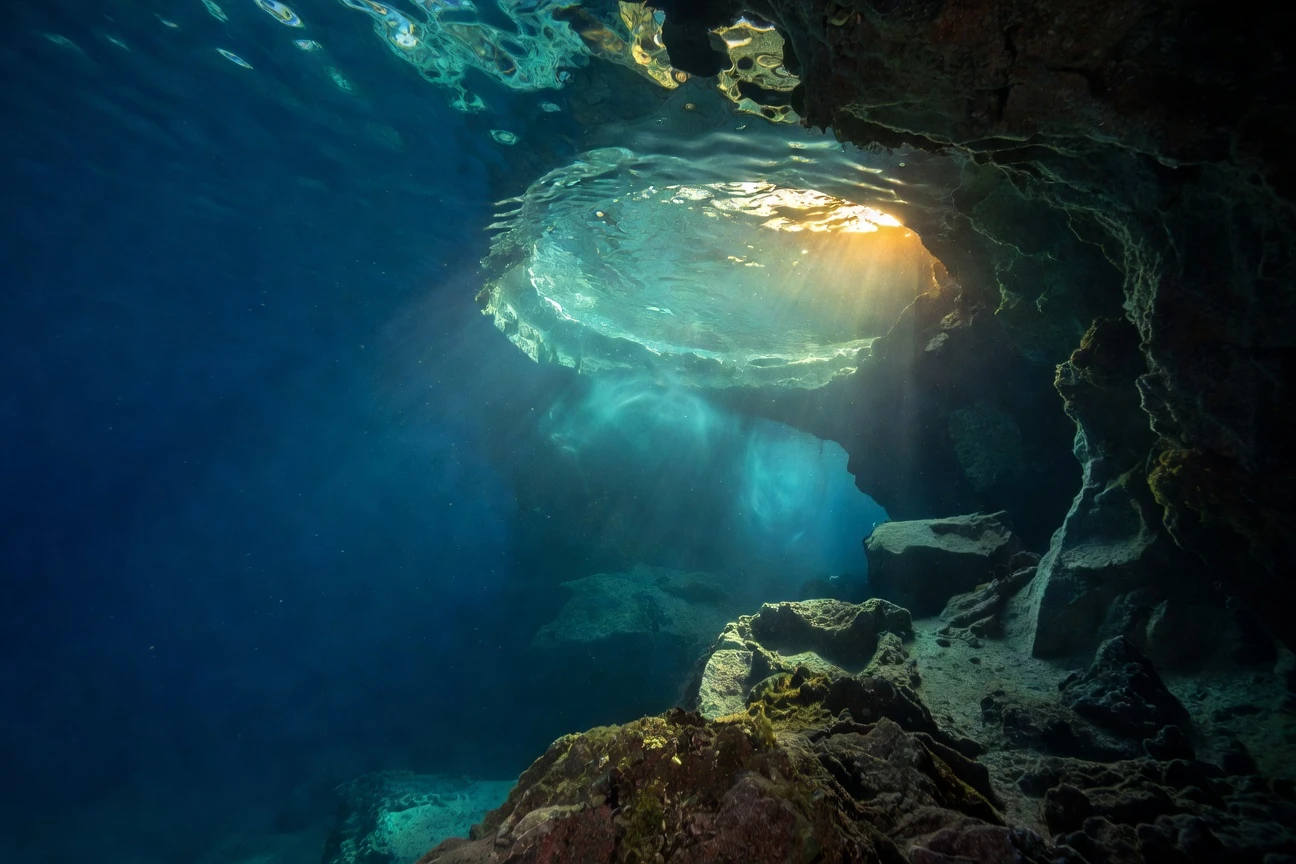
The research team deployed two remote online cameras inside the cave system. One inside the main sea cave, where tourists with masks and fins routinely poke their heads in during July and August. The other inside a sealed pressure housing at the submerged entrance to an adjacent bubble chamber, where the only way in is to dive down, swim through a flooded corridor, and surface in a dim, humid pocket of trapped air.
Inside that dome, the cameras recorded behaviors that scientists rarely catch on film. Seals floated awake at the surface, nostrils above the waterline. Others slept upright in the water column. One large scarred male, identifiable by a white belly patch, was filmed sleeping at the surface with his body draped against the wall. A female rested laterally with her nostrils submerged, exposing her four nipples and umbilicus toward the lens.
| Cave type at Formicula | Days of recorded seal use | Accessible to swimming tourists |
|---|---|---|
| Main sea cave (open entrance above water) | 30 days | Yes |
| Bubble cave (submerged-entry air dome) | 119 days | No |
| Total monitoring window | 141 days | Mixed |
A roughly four-to-one preference for the hidden chamber is not a statistical wobble. It is the entire pattern of how this colony uses Formicula in peak tourist season.
Why Bubble Caves Stayed Off the Map
Conservation biologists have studied Monachus monachus for half a century. Decades of literature describe the species as a beach-rester that retreated into open sea caves as coastal development closed off the sand. Bubble caves barely feature.
The reason is practical. To know a bubble cave exists, you need a diver willing to swim through a dark flooded corridor and resurface inside a sealed chamber. To know it shelters seals, you need to leave a camera there for months without disturbing the animals. Both steps are expensive, slow, and dangerous, which is why traditional habitat surveys for the species have almost always stopped at the waterline of the dry cave entrance.
What the Formicula footage shows is that the survey method, not the seal, defined where biologists thought the seal lived. The team writes that these chambers are “less accessible and inconspicuous,” which is exactly why they were missed and exactly why the seals chose them.
These wet, less accessible and inconspicuous domes may not only provide refuge against human disturbance but also play a role as resting sites.
That is the study’s load-bearing line. The authors are not arguing that bubble caves are an exotic novelty; they are arguing that the caves should be folded into the baseline of what counts as monk-seal habitat across the Mediterranean.
The 40-Seal Population Carrying a Recovery
Formicula is small. The islet itself spans roughly 8.7 hectares, with a 500-meter shoreline and no permanent residents. But monitoring by the Tethys Research Institute since 2012 has photo-identified more than 40 individual monk seals along its shores, a density that ranks Formicula among the most important known sites for the species at a global level.
The population context matters because the global tally is so thin.
- Roughly 800 to 1,000 Mediterranean monk seals remain worldwide, distributed mainly across Greece, Türkiye, Cyprus, Madeira, and the Cabo Blanco peninsula on the Atlantic coast of Africa.
- More than 250 but fewer than 1,000 are estimated mature breeding individuals on the most recent IUCN Red List assessment.
- Vulnerable is the current International Union for Conservation of Nature (IUCN) listing, reclassified from Endangered in June 2023 after coordinated national programs began producing modest population growth.
A site holding 40 photo-identified animals is therefore carrying somewhere between 4% and 5% of every monk seal alive. If a tourist boat anchored over Formicula on a July afternoon flushes a single pup from a resting chamber, the loss is not symbolic. It is a measurable subtraction from a recovery whose margins are razor thin.
A Habitat Model With a Gap
The second-order finding of the Oryx paper is the one that should travel furthest. Habitat-suitability models in the Mediterranean were built around what surveyors could see, and what surveyors could see was dry-entrance caves with visible haul-out beaches inside. Bubble caves, by definition, do not show up on aerial surveys, drone passes, or shoreline boat transects.
If those domes are common along the limestone coastlines of the Ionian, the Aegean, and the southern Turkish coast, current habitat maps are systematically understating monk-seal refuge in heavily touristed waters. That changes what conservation planners should do in three concrete ways.
Cave inventories Need a Second Pass
Existing surveys of Greek and Turkish marine caves were not built to detect submerged-entry domes. A re-survey using technical divers and remote underwater cameras would likely uncover dozens of previously uncatalogued chambers across known monk-seal range, each of which would change the species’ habitat footprint in its host country.
Protected Area Boundaries Drawn Above Water Miss the Real Refuge
Marine Protected Areas in Europe are usually drawn from coastline coordinates and bathymetric depth bands. A dome 30 meters inland of a cliff face, accessible only through a five-meter-deep tunnel, can sit just outside the protected polygon while functioning as the most important room in the colony.
Suitability Modeling Has to Move Underground
The study’s authors note explicitly that habitat-suitability studies for the species “may benefit from including bubble caves, as they provide valuable resting spots, especially in tourist areas.” Read literally, that sentence is asking modelers to find a way to add a habitat class they currently have no remote-sensing signal for.
Greece’s 200-Meter Zone and What It Doesn’t Reach
Greek authorities have already moved on the surface problem. In December 2024, Athens issued Ministerial Decision 123711/3066, establishing a 200-meter no-entry buffer around Formicula. Boats cannot anchor, snorkelers cannot enter, and the islet is now formally part of the Natura 2000 Special Area of Conservation covering the Esoteriko Archipelagos Ioniou, alongside its designation as an Important Marine Mammal Area.
The shielding answers the obvious threat. It does not yet answer the one the Oryx paper identifies.
- The 200-meter perimeter is measured from the shoreline, not from the entrances of submerged passages, some of which run laterally under the rock.
- Cave-disturbance enforcement still depends on surface patrols. A diver entering a bubble cave from outside the buffer is harder to detect than a snorkeler in the main cave.
- Fishing regulations inside the zone remain ambiguously defined in the ministerial text, an issue flagged by the Formicula protection coalition organized by the Ionian Dolphin Project, iSea, Blue Marine Foundation, and the Octopus Foundation.
- Similar protections do not yet exist at most of the other Greek and Turkish sites where bubble caves almost certainly host resting seals, including known colonies along the Karpathos, Alonnisos, and Gökova Bay coastlines.
One precedent from across the Aegean is worth holding next to Formicula. In Gökova Bay on the Turkish coast, researchers documented in a separate Oryx case study that a juvenile monk seal began using an artificial dry ledge built inside a marine cave, logging 420 minutes of cumulative use across four nocturnal visits. The Turkish work and the Greek work share an underlying premise: seal habitat is engineerable and re-mappable, but only if conservation planning starts inside the cave rather than at its mouth.
Frequently Asked Questions
What Is a Bubble Cave?
A bubble cave is a sea cave whose only entrance is submerged below the waterline, with an internal chamber that traps a pocket of breathable air above the water surface. Divers reach the dome by swimming through a flooded passage and surfacing inside. The chamber stays dim, humid, and largely inaccessible to surface boats or snorkelers.
How Many Mediterranean Monk Seals Are Left?
Roughly 800 to 1,000 Mediterranean monk seals survive worldwide, concentrated in Greece, Türkiye, Cyprus, Madeira, and the Cabo Blanco peninsula on the West African coast. The IUCN moved the species from Endangered to Vulnerable in 2023, the first downgrade in decades, after national protection programs began showing measurable population growth.
Why Are the Seals Avoiding Open Beaches?
Open beaches once served as the species’ main resting and pupping sites. Coastal development, beach tourism, recreational boating, and direct disturbance by snorkelers entering open sea caves have made those sites unreliable, particularly between May and October. The seals are not abandoning preferred habitat by choice; they are accepting a wetter, less comfortable alternative because it is the only one without humans in it.
Can Tourists Visit Formicula?
No. Since December 2024, Ministerial Decision 123711/3066 has established a 200-meter no-entry zone around the Formicula islet. Recreational vessels are prohibited from approaching within that radius, and entry into the caves is barred. The restriction applies year-round and is enforced by Greek maritime authorities.
How Did Researchers Film the Seals Without Disturbing Them?
The Tethys Research Institute team installed two remote online cameras inside the cave system, with the bubble-cave camera housed in a watertight pressure casing positioned at the entrance to the flooded chamber. The cameras streamed footage over 141 days across July 2020 and June to October 2021, allowing observation without any human presence inside the dome during the monitoring window.
Does the Discovery Change Conservation Law?
Not yet. The Oryx paper is a scientific finding, not a regulation. Its practical effect will depend on whether national wildlife agencies and the European Union’s Natura 2000 framework choose to update habitat-suitability models and protected area boundaries to include submerged-entry chambers. That work has not started in any formal way at the Mediterranean scale.
The footage from Formicula has answered one question and opened a larger one. Whether the next generation of Mediterranean Marine Protected Areas is drawn to include the rooms biologists cannot see from a boat will determine whether the bubble caves stay sanctuaries or become the next disturbed habitat, mapped only after the seals have left them.