Physicists working in Dresden have pulled traces of supernova-forged iron from roughly 300 kilograms of Antarctic ice older than the last ice age, and the find changes what scientists can read out of polar glaciers. The radioactive isotope, iron-60, was detected in samples between 40,000 and 80,000 years old, at concentrations that rise toward the present and confirm the solar system is drifting through a debris cloud left by stars that died long before the first humans walked.
The study, led by Dr. Dominik Koll at the Helmholtz-Zentrum Dresden-Rossendorf (HZDR), a German national research lab, was published in Physical Review Letters on May 13. It anchors a new use for ice cores: frozen water can now serve as a working chronometer for events that played out across millions of years in our corner of the Milky Way.
The 300-Kilogram Hunt at Dresden
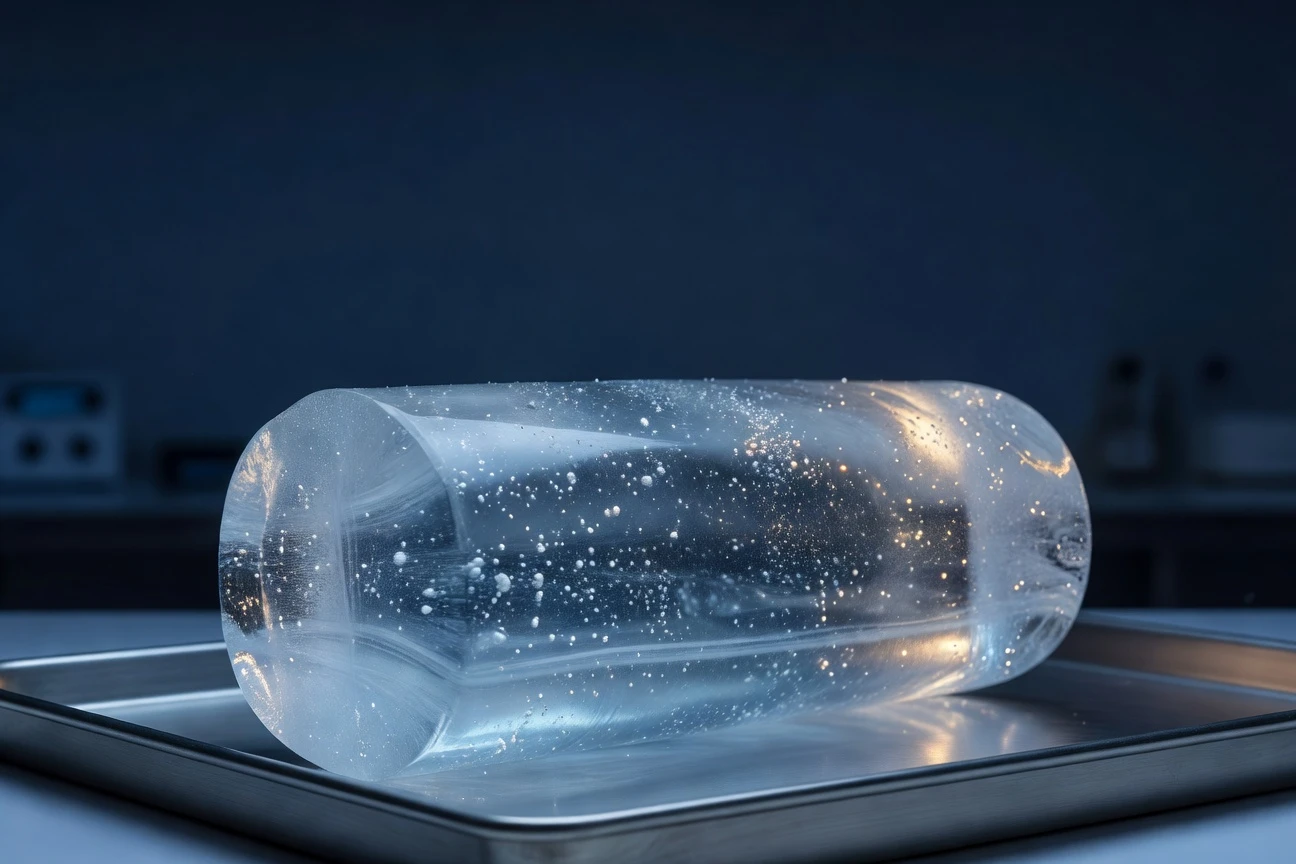
Koll’s team at HZDR’s Institute of Ion Beam Physics and Materials Research started with a freight pallet of Antarctic ice flown to Dresden and ended with a few hundred milligrams of dust. Everything in between was a search for atoms a researcher could count on one hand.
The ice was melted, the suspended dust was concentrated, and the residue was fed into accelerator mass spectrometry (AMS, a technique that uses electric and magnetic filters to separate one rare isotope from a beam of millions of more common atoms). The detection work itself was carried out at the Heavy Ion Accelerator Facility (HIAF) at the Australian National University, where stronger magnets let the team pick iron-60 nuclei out of a crowd that started at roughly 10 trillion candidate atoms.
- 300 kilograms of Antarctic ice melted and concentrated to a few hundred milligrams of dust
- 40,000 to 80,000 years the age range of the samples that yielded the signal
- 10 trillion atoms processed at HIAF to isolate a handful of iron-60 nuclei
- May 13, 2026 publication date in Physical Review Letters
Two verification isotopes, beryllium-10 and aluminium-26, were measured alongside the iron to confirm nothing was lost in the chain. The cross-checks ran at the DREAMS laboratory at HZDR, with full procedural details set out in the Helmholtz-Zentrum’s announcement of the iron-60 detection.
Why Iron-60 Cannot Form on Earth
Iron-60 has 26 protons like the iron in a kitchen knife and four extra neutrons that make the nucleus unstable. It decays with a half-life of about 2.6 million years, short enough that any iron-60 present when the planet formed 4.5 billion years ago would be gone many times over.
Earth, in other words, has no native supply of the isotope. It is produced inside stars at least eight times the mass of the Sun, forged under temperatures and pressures no terrestrial process can reach, and thrown across the galaxy when those stars collapse as core-collapse supernovae. Any iron-60 atom in Antarctic snow had to be made in a stellar furnace and travel through interstellar space to reach the surface.
That rules out competing explanations a careful chemist would normally test first. Cosmic-ray spallation, where high-energy particles smash heavier atoms apart, produces beryllium-10 in the atmosphere but does not produce iron-60 in measurable amounts. Industrial contamination is not a candidate either; the isotope was identified as a recent supernova signature in deep-sea ferromanganese crusts more than 20 years ago, and the assay procedures are tightly controlled.
What was missing until now was a continuous reading. The deep-sea record showed iron-60 pulses millions of years old. Antarctic ice, melted in known stratigraphic order, supplies a younger and more finely dated signal.
The Cloud the Solar System Is Currently Crossing
The vacuum between stars is not empty. Our local stretch of the galaxy sits inside the Local Bubble, a cavity carved by a string of supernovae roughly 14 million years ago that pushed gas and dust outward. Inside the Local Bubble are smaller wisps of denser material, including the Local Interstellar Cloud (LIC), a clump of warm hydrogen and helium roughly 30 light-years across that the Sun has been crossing for tens of thousands of years. The iron-60 trend in the new study tracks the Sun’s path through that wisp: older ice from 80,000 years back carries less of the isotope than more recent layers, the pattern you would expect if the solar system had only recently pushed into a denser interstellar zone.
Three details from the team’s mapping help anchor the picture:
- The LIC is a separate object embedded in the Local Bubble, not a remnant of one specific recent explosion
- It is dusty enough that the heliosphere can pick up detectable amounts of supernova material as it moves through
- Models suggest the Sun will pass out of the LIC into a thinner region within the next few thousand years, possibly inside 1,900
The cloud almost certainly contains debris from more than one star. Supernovae from the Scorpius-Centaurus association, a cluster of young massive stars a few hundred light-years away, are leading suspects, though the study stops short of naming a single source.
Antarctic Ice Becomes a Galactic Recorder
The discovery is interesting on its own. The technique behind it is bigger. With sensitivity now sharp enough to count individual iron-60 atoms in a few hundred milligrams of glacier dust, the Dresden group has shown that polar ice can serve as an archive of galactic events in the same way tree rings record climate.
This means that the clouds surrounding the solar system are linked to a stellar explosion.
That line, from Koll in the team’s press materials, is the load-bearing claim of the paper. The method can in principle reach back millions of years if older ice cores can be drilled and preserved, and the authors have already flagged deeper Antarctic samples as the next target.
A few practical consequences follow. Climatologists already use ice cores to read past temperatures from oxygen isotopes and past volcanic eruptions from sulfate spikes. Adding iron-60 to that toolkit means a single core can carry signatures of climate, geology, and supernova history in the same stratigraphic column. The trick is the assay, not the sample.
Astrophysicists also get a check on cosmic-ray models. Iron-60 detected in galactic cosmic rays by NASA’s ACE spacecraft hinted in 2016 that source supernovae had to be young and nearby. The Antarctic flux now gives an independent number at Earth that those cosmic-ray models have to match. If the two disagree, the disagreement itself becomes a measurement of how supernova debris is mixed in the interstellar medium.
Earlier Iron-60 Hits in the Geological Record
The new ice is not the first place on Earth that iron-60 has shown up. Pacific deep-sea ferromanganese crusts have carried two earlier iron-60 pulses, one dated to roughly 2 to 3 million years ago and another to 5 to 7 million years ago, both interpreted as nearby supernovae that scattered debris into the inner solar system. Lunar regolith returned by Apollo missions has also yielded the isotope.
| Sample | Approximate Age | Detection Site | Likely Source |
|---|---|---|---|
| Antarctic surface snow | Last 20 years | HZDR / Munich AMS | Local Interstellar Cloud |
| Antarctic deep ice | 40,000 to 80,000 years | HIAF, Australian National University | Local Interstellar Cloud |
| Deep-sea sediment | Up to 30,000 years | German AMS facilities | Local Interstellar Cloud |
| Pacific ferromanganese crusts | 2 to 3 million years | Munich AMS | Nearby Pleistocene supernova |
| Pacific ferromanganese crusts | 5 to 7 million years | Munich AMS | Earlier nearby supernova |
| Apollo lunar regolith | Cumulative, tens of millions of years | Munich AMS | Multiple supernovae |
Each of those earlier finds had to argue separately that the signal was supernova debris and not contamination or atmospheric production. The new work makes that argument easier by tying a continuous time series to a known interstellar object. As recent research on massive-star deaths has highlighted, the supernovae that produce iron-60 are exactly the kind of explosions astronomers most want to inventory in our cosmic neighborhood.
The team’s next step is straightforward. Drill older ice. If iron-60 in deeper Antarctic cores tracks the same density gradient predicted by models of the Local Bubble, the case that polar ice is a usable cosmic ledger moves from suggestive to settled. The original Pacific seabed work on iron-60 in deep-sea ferromanganese crusts took two decades to lock down; the ice version has a head start because every layer carries its own date.
Frequently Asked Questions
What Is Iron-60 and Why Does Finding It on Earth Matter?
Iron-60 is a radioactive form of iron with a half-life of about 2.6 million years that does not occur naturally on our planet. It is produced only inside massive stars and ejected during supernovae. Detecting any iron-60 in terrestrial samples is direct evidence that material from an exploded star has reached Earth.
How Did Scientists Detect Iron-60 in Such Small Amounts?
The team melted about 300 kilograms of Antarctic ice, concentrated the dust, and measured it with accelerator mass spectrometry at the Heavy Ion Accelerator Facility at the Australian National University. The technique uses electric and magnetic fields to isolate individual radioactive atoms from beams of millions of more common ones.
What Is the Local Interstellar Cloud and Is the Sun Inside It?
The Local Interstellar Cloud is a wisp of warm gas and dust roughly 30 light-years across, sitting inside the larger Local Bubble. The Sun is currently crossing it, having entered within the last tens of thousands of years, and is expected to exit within a few thousand years.
Was the Iron-60 Produced by One Specific Recent Supernova?
The study attributes the iron-60 to debris carried inside the Local Interstellar Cloud as a whole, not to a single named supernova. The cloud almost certainly contains material from more than one ancient stellar explosion, with the Scorpius-Centaurus association of massive stars among the suspects.
Does the Iron-60 Deposition Affect Life on Earth?
No. The flux is far too small to pose any biological risk. Researchers are tracking individual atoms in a few hundred milligrams of dust, which is a vanishingly tiny amount of radioactive material spread across the polar ice sheet.
Where Was the Study Published?
The paper, titled “Local Interstellar Cloud Structure Imprinted in Antarctic Ice by Supernova 60Fe,” appeared in Physical Review Letters on May 13, 2026, under DOI 10.1103/nxjq-jwgp.
What Is the Team Planning Next?
The group has said it will apply the same accelerator mass spectrometry procedure to older Antarctic ice samples, pushing the iron-60 record further back in time and mapping how the density of supernova debris in the Local Interstellar Cloud has changed over hundreds of thousands of years.