A drought in 2016 drained a communal pond in Ban Pha Nang Sua, a village in northeastern Thailand, and pushed something the size of a kitchen table to the surface. The bone turned out to be a complete humerus measuring 1.78 metres, the front leg of a sauropod that lived roughly 113 million years ago and weighed about 27 tonnes. Researchers from University College London (UCL, the British public research university) and three Thai institutions have now named the animal Nagatitan chaiyaphumensis, the largest dinosaur ever identified in Southeast Asia and Thailand’s 14th formally described species.
The naming paper, published on 14 May in Scientific Reports, lands the biggest dinosaur in the region. The quieter story is what it implies about every other unstudied bone sitting in Thai museum drawers.
Bones in the Mud at Ban Pha Nang Sua
A villager named Thanom Luangnan first noticed the rocks by the pond. The bones were too large to be anything routine, and a team from Mahasarakham University and the Sirindhorn Museum began digging the same year. Excavations ran through 2019, with follow-up work in 2024.
What they pulled out of the sediment, scattered but matching in size and with no duplicate bones, was almost certainly a single individual. The recovered material includes vertebrae from the neck and back, ribs, part of the pelvis, the right humerus and most of a femur.
- 27 metres estimated body length, roughly the span of three city buses
- 27 tonnes estimated mass, heavier than the average humpback whale
- 1.78 metres humerus length, taller than most adults
- 113 million years approximate age, late Early Cretaceous, Aptian to Albian
The size signal is steady across the skeleton. A femur reconstructed from the surviving fragments points to a thigh bone close to 2 metres long in life. Both estimates were used to scale the animal independently, and they agreed. The findings appear in the open-access Scientific Reports description of the Khok Kruat Formation sauropod.
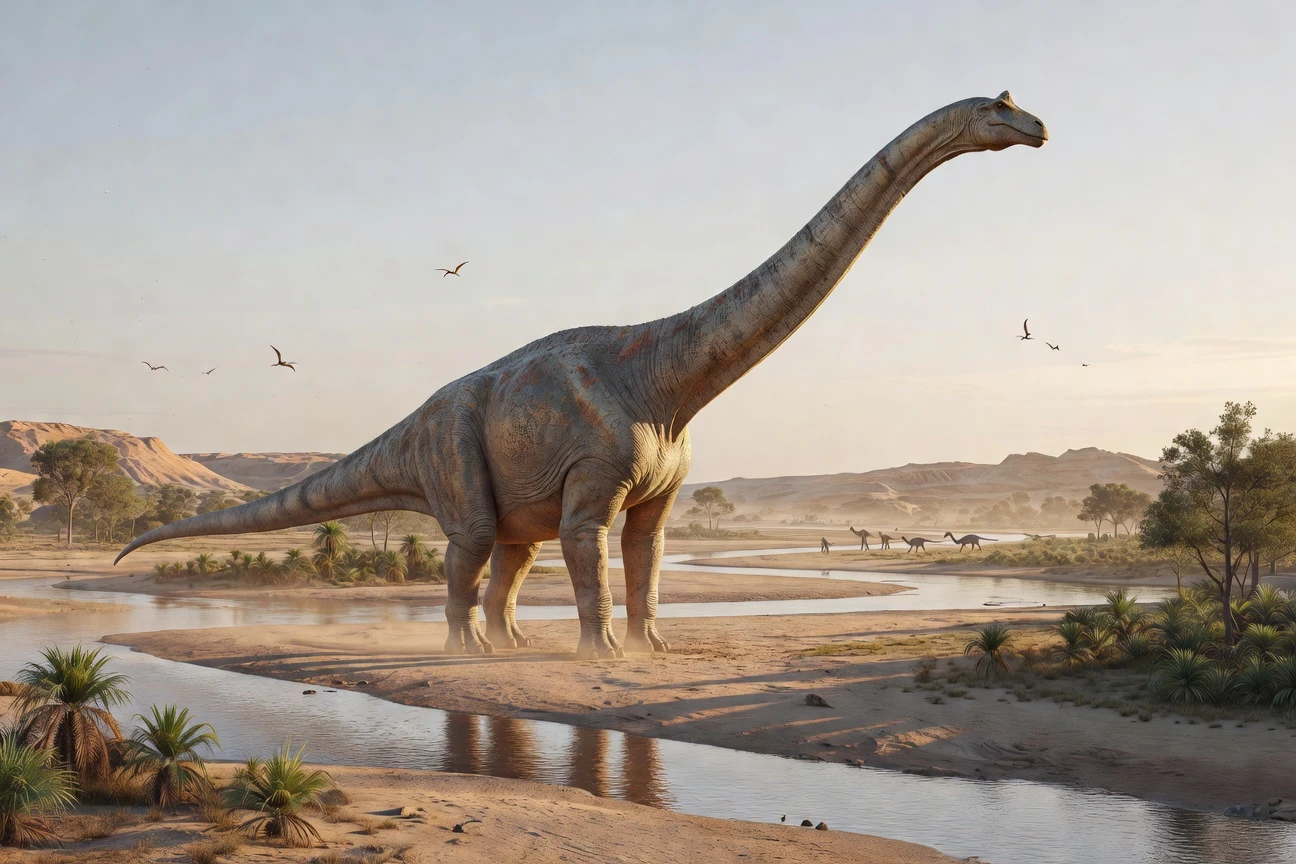
Sizing Up Thailand’s Last Titan
The headline figure travels well, but the regional comparison is where the discovery starts to mean something. Nagatitan is roughly a third larger than Phuwiangosaurus sirindhornae, the Thai sauropod named in 1994 to honour Princess Maha Chakri Sirindhorn. It is close in size to Tangvayosaurus hoffeti from neighbouring Laos. It is well short of the South American and Chinese titans that anchor the global size charts.
The table below uses published body-mass and length estimates from the new paper and from earlier descriptive work cited in it.
| Species | Region | Estimated Length | Estimated Mass |
|---|---|---|---|
| Nagatitan chaiyaphumensis | Thailand | ~27 m | ~27 tonnes |
| Tangvayosaurus hoffeti | Laos | ~15 to 18 m | ~10 to 25 tonnes |
| Phuwiangosaurus sirindhornae | Thailand | ~15 to 20 m | ~17 tonnes |
| Diplodocus carnegii (“Dippy”) | North America | ~25 m | ~12 to 17 tonnes |
| Ruyangosaurus giganteus | China | ~30 m | ~50 tonnes |
| Patagotitan mayorum | Argentina | ~37 m | ~60 tonnes |
Lead author Thitiwoot Sethapanichsakul, a doctoral researcher at UCL Earth Sciences, framed the scale this way in remarks shared by the university: “Our dinosaur is big by most people’s standards. It likely weighed at least 10 tonnes more than Dippy the Diplodocus.” He added that the animal is still “dwarfed by sauropods like Patagotitan (60 tonnes) or Ruyangosaurus (50 tonnes).”
Why the Last Titan Tag Sticks
The phrase is more than marketing. The bones came out of the Khok Kruat Formation, the youngest layer in Thailand’s Khorat Group of dinosaur-bearing rocks. Younger rocks in the region are marine, laid down after the area subsided into a shallow sea, and would not be expected to preserve land animals.
That stratigraphy is what gives Nagatitan its nickname.
That is because it was discovered in Thailand’s youngest dinosaur-bearing rock formation. Younger rocks laid down towards the end of the time of the dinosaurs are unlikely to contain dinosaur remains because the region by then had become a shallow sea. So this may be the last or most recent large sauropod we will find in Southeast Asia.
The speaker is Sethapanichsakul, in a statement issued through UCL Earth Sciences department announcements. The name itself blends two mythologies. “Naga” is the serpent-like water deity threaded through Thai, Lao and broader Southeast Asian folklore. “Titan” is borrowed from the Greek pantheon. The species epithet honours Chaiyaphum Province.
A Family Tree Asia Has Not Untangled
The new animal slots into Euhelopodidae, an early-branching subgroup of somphospondylan titanosauriforms known almost exclusively from Asia. The authors ran two separate phylogenetic analyses on a dataset of more than 150 sauropod species. Both placed Nagatitan inside that Asian family.
That sounds like a clean answer, but the family tree it belongs to is one of the most contested in sauropod paleontology. The fossil record is patchy, some named Asian species are based on incomplete material, and the relationships between Nagatitan, Phuwiangosaurus and Tangvayosaurus could shift as older specimens are reexamined.
Where Nagatitan Sits on the Tree
The animal does not appear to be especially close to the sauropods of China’s Xinlong Formation, despite the geographic and temporal overlap. Diagnostic features the team flagged include triangular projections on the upper part of the back vertebrae’s neural spines, a combination the authors said has not been documented in any other sauropod. The humerus carries a rounded upper outer corner unlike the squarer profile seen in related species.
The Comparisons Still Owed
The authors are unusually candid about caveats. They have not personally reexamined the Phuwiangosaurus type material for this paper, and Tangvayosaurus still lacks a full modern description. That leaves three open questions for the next round of work:
- Whether Phuwiangosaurus is genuinely smaller than Nagatitan, or whether Thai collections include larger Phuwiangosaurus material that has been lumped under older names.
- How Tangvayosaurus from Laos relates to Nagatitan once a full Lao redescription lands.
- Whether the Khok Kruat fauna shares deeper ancestry with Chinese contemporaries than the current analysis suggests.
That last question is the one paleontologists will watch. A different parallel from a separate continent, the recent 168-million-year-old cerapodan fossil from Morocco, showed how a single well-described specimen can pull a regional record forward by tens of millions of years. Nagatitan does not push the Asian record back in time. It does sharpen the resolution at a date and place where the picture had been blurry.
Life on a Semi-Arid Cretaceous River Plain
The world Nagatitan walked through looked nothing like modern Isan. Sediment cycles at Ban Pha Nang Sua point to a meandering river system flowing across a semi-arid floodplain. The same beds preserved fish, freshwater sharks, turtles and crocodile relatives.
Predators were present too. Teeth from carcharodontosaurians and spinosaurids, both large-bodied carnivores, turn up in nearby rock layers. Smaller herbivores in the system included iguanodontians and early ceratopsian relatives. Pterosaurs hunted fish from the air above.
The authors floated a thermal-regulation argument for why huge sauropods might have done well in dry settings: long necks and tails dramatically increase surface area, which helps shed heat. The fauna roster echoes finds from similar-age rocks in Laos and southern China, suggesting a connected mainland-Southeast-Asian ecosystem during the late Early Cretaceous. The story of what survived afterwards is its own puzzle, as the case of the ammonites that outlived the dinosaur-killing asteroid shows.
What Is Still in Thailand’s Museum Drawers
The research was a collaboration between UCL, Mahasarakham University, Suranaree University of Technology and the Sirindhorn Museum in Kalasin province. The team used 3D scanning and printing to study bones across continents without shipping fossils repeatedly. Professor Paul Upchurch of UCL Earth Sciences, a co-author, called it the start of a longer effort to map what happened in Southeast Asia during the Jurassic and Cretaceous.
The team’s broader claim is that Thai institutions hold a sizeable backlog of sauropod fossils that have never been formally described. Some of those specimens may turn out to be additional new species. Others may force a regrouping of what is currently filed under Phuwiangosaurus.
Sethapanichsakul put it personally: “I’ve always been a dinosaur kid. This study doesn’t just establish a new species but also fulfils a childhood promise of naming a dinosaur.” His professional ambition was less sentimental. He wants Southeast Asian dinosaurs treated as a first-tier dataset, not an appendix to North American and South American work.
The 27-metre animal is the headline. The drawers behind it are the story to watch.
Frequently Asked Questions
What Is Nagatitan Chaiyaphumensis?
Nagatitan chaiyaphumensis is a newly named long-necked herbivorous dinosaur from the Early Cretaceous of Thailand. It belongs to Euhelopodidae, an early-branching family of somphospondylan titanosauriforms known mainly from Asia. The animal is estimated at about 27 metres long and 27 tonnes in mass, making it the largest dinosaur described from Southeast Asia.
Where and When Was It Discovered?
A villager named Thanom Luangnan spotted the first bones in 2016 next to a communal pond at Ban Pha Nang Sua in Chaiyaphum Province, northeastern Thailand. Drought conditions had exposed the fossil bed. Formal excavations ran from 2016 through 2019, with follow-up digs in 2024, before the team published the species description in May.
How Old Are the Fossils?
The bones come from the Khok Kruat Formation, dated to the late Early Cretaceous, specifically the Aptian to Albian stages. That places the animal at roughly 113 million years old. The Khok Kruat is the youngest dinosaur-bearing rock formation in Thailand, because younger layers in the region were laid down under a shallow sea.
Why Is Nagatitan Called the Last Titan?
The nickname reflects stratigraphy, not the end of the dinosaurs globally. Because Nagatitan was found in Thailand’s youngest land-animal-bearing rocks, lead author Thitiwoot Sethapanichsakul of UCL Earth Sciences said it may be the most recent large sauropod that paleontologists can expect to find in Southeast Asia. Later rocks in the region preserve marine fossils, not dinosaurs.
How Does Nagatitan Compare to the Largest Dinosaurs Worldwide?
It is large by regional standards and modest by global ones. Nagatitan weighed roughly 10 tonnes more than the famous Diplodocus carnegii (“Dippy”). It is still well below Patagotitan mayorum from Argentina at around 60 tonnes and Ruyangosaurus giganteus from China at around 50 tonnes. Inside Southeast Asia, it surpasses Phuwiangosaurus sirindhornae from Thailand and runs close in size to Tangvayosaurus hoffeti from Laos.
What Does the Name Mean?
The genus name combines “Naga,” the serpent-like water deity of Thai, Lao and broader Southeast Asian folklore, with “titan,” borrowed from Greek mythology to mark the animal’s scale. The species epithet chaiyaphumensis honours Chaiyaphum Province, where the fossils were excavated.
Why Does the Discovery Matter Beyond Its Size?
The discovery strengthens the case that Southeast Asia hosted very large sauropods during the late Early Cretaceous, not just smaller forms as earlier records suggested. It also points to a wider backlog of undescribed sauropod fossils held in Thai museum collections that could yield additional new species or force taxonomic revisions of animals already named, particularly Phuwiangosaurus.