Arsenal are Premier League champions for the first time since the 2003-04 Invincibles, confirmed on Tuesday night when second-placed Manchester City could only draw 1-1 at Bournemouth and handed Mikel Arteta’s side a four-point cushion with one match still to play. The 22-year wait, which had calcified into the club’s defining narrative under three different managers, ended without Arsenal kicking a ball, in pubs across north London and on a televised feed at the squad’s Sobha Realty Training Centre in Hertfordshire.
The mathematics is now settled. Arsenal sit on 82 points; City finished their Vitality Stadium night on 78 with one fixture left. Sunday’s trip to Crystal Palace is a parade fixture rather than a title decider, and Arteta’s team head to the Puskás Aréna in Budapest 11 days later for a Champions League final against Paris Saint-Germain that could turn a long-awaited domestic title into a once-in-a-generation double.
The Bournemouth Result That Crowned Arsenal
Eli Junior Kroupi scored the goal that ended the wait. The 19-year-old Bournemouth striker collected a Milos Kerkez cross on the half-turn in the 39th minute, curled it past Stefan Ortega, and gave the Cherries a lead they would carry until the fifth minute of stoppage time. Erling Haaland’s late header restored parity but could not rescue City’s title hopes; with Arsenal already on 82 points after their 1-0 win over Burnley 24 hours earlier, anything less than a victory in Dorset would settle the title.
The Vitality Stadium did the rest. Andoni Iraola, the Bournemouth head coach and a close friend of Arteta, sent his side out to press City’s build-up with the same intensity that has defined their European-qualification season. Kroupi’s strike was his 13th of the campaign, the highest by any teenager in a Premier League debut season. He stood, arms wide, as the cameras cut to a packed press box already drafting the headline for north London.
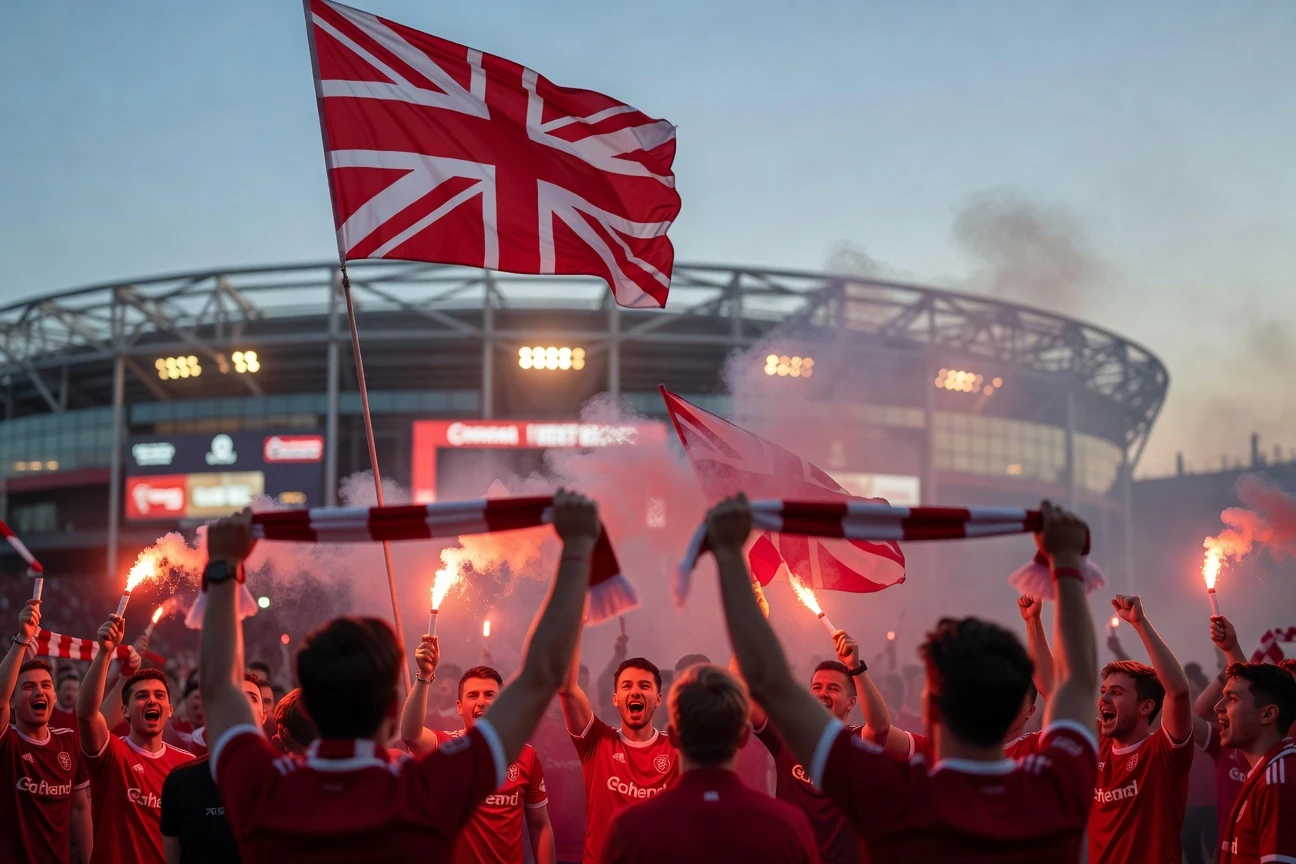
Arsenal’s first-team squad watched from the training ground in Hertfordshire. Videos posted within minutes of the final whistle showed Bukayo Saka, Martin Odegaard and William Saliba running through the building, beer in hand, while staff filmed from balconies. Outside the Emirates Stadium, supporters had already started to gather, many carrying red flares, before the official confirmation lit up the stadium’s exterior screens.
Three Silver Medals Before the Gold
Arsenal’s title arrives at the end of a peculiar sequence. The Gunners finished as Premier League runners-up in each of the previous three seasons, and were the first English club to record three consecutive second-place finishes in the league since they themselves did it between 1999 and 2001. The label ‘nearly men’ was attached, sometimes affectionately, more often not.
What looks in hindsight like a slow build read at the time like a recurring failure. Arteta’s side led the table for 248 days in 2022-23 before collapsing in April; lost the 2023-24 race to City by two points on the final day; and were caught from behind by Liverpool in 2024-25 after a January injury crisis. This season they led for almost the entire campaign, lost first place briefly in April, and recovered with a five-match winning run that proved fatal to City’s defence.
| Season | Finish | Points | Gap to Champions |
|---|---|---|---|
| 2022-23 | 2nd | 84 | 5 points behind City |
| 2023-24 | 2nd | 89 | 2 points behind City |
| 2024-25 | 2nd | 74 | 10 points behind Liverpool |
| 2025-26 | 1st | 82* | 4 points clear of City |
*Arsenal total after matchweek 37. One fixture remains.
The trajectory tells the story the headline number obscures. Arsenal will lift the trophy with fewer points than their 2023-24 runner-up total. The league has become tighter at the top; the team that wins it is not always the one with the historically high count, but the one that survives a six-team European calendar and a 38-game grind. That is what Arteta’s side did this year, and what they could not in the three years before.
Inside Arteta’s Five-Year Project
Arteta arrived as head coach in December 2019, an Arsenal captain returning from Pep Guardiola’s coaching staff at the Etihad. His first season produced an FA Cup. His second produced an eighth-place league finish and open calls for his sacking. The five seasons between then and now have followed a steady upward gradient, broken only by the runner-up plateau.
The 2025 summer transfer window was the decisive one. Arsenal’s board, working with sporting director Andrea Berta who replaced Edu in March, signed seven first-team players and locked down the spine of the squad on long-term contracts. The headline arrivals shifted the team’s profile from young challenger to title favourite:
- Viktor Gyokeres, the Swedish striker bought from Sporting CP, took the number 14 shirt and finished the season as Arsenal’s leading scorer
- Martin Zubimendi, signed from Real Sociedad, provided the deep-lying midfield anchor the squad had lacked since Granit Xhaka’s departure
- Eberechi Eze, recruited from Crystal Palace, gave Arteta a creator capable of operating across the front line
- Noni Madueke, bought from Chelsea, added wide-area depth behind Saka and Gabriel Martinelli
- Christian Norgaard arrived from Brentford as midfield insurance, with Cristhian Mosquera from Valencia as a back-line option
- Piero Hincapie joined on a season-long loan from Bayer Leverkusen with a reported £45 million option to buy
The internal investment was just as material. Saliba’s new long-term contract announcement raised his reported weekly wage from £190,000 to £250,000. Gabriel Magalhaes, Myles Lewis-Skelly and Ethan Nwaneri all signed extensions. Arteta himself extended his deal through 2027 in September 2024 on a reported £9 million-a-year salary. The squad that won the title had been pre-paid through the lockup that follows it.
Arteta turned 44 last month, making him the youngest Arsenal manager to win the English top-flight title. Arsene Wenger was 48 when he won his first in 1998. George Graham was 46. Herbert Chapman, who built the club’s first dynasty in the 1930s, was 51.
Guardiola’s Decade Closes With a Whisper
Manchester City’s season ends as quietly as Arsenal’s reaches its crescendo. The defending champions of the last four seasons finished a distant second, never recovered the rhythm of a squad coming off a treble three years ago, and now face a summer of structural change. Multiple reports out of England suggest Pep Guardiola will leave the club at the end of the season, ending a decade in which he delivered 16 major trophies including six league titles and the 2023 Champions League.
City have not confirmed the departure, and club sources continue to insist publicly that Guardiola’s contract runs to 2027. Reports name Enzo Maresca, the former City assistant who was sacked by Chelsea in January, as the likely successor. Whichever way that decision lands by July, the team that defined Premier League football for half a decade will look different in August.
The contrast is sharp. Arteta is the youngest English-league title-winning manager in 30 years and is contracted to a project still scaling up. Guardiola is 55, has won everything available to him at club level, and reportedly wants international management next. The Premier League’s centre of gravity has shifted geographically by about eight miles, from east Manchester to north London.
Budapest and the Bigger Prize
The Premier League trophy was the headline target. The Champions League final, 11 days later, is the larger prize. Arsenal travel to Budapest on May 30 to play the 2026 Champions League final against Paris Saint-Germain at the Puskás Aréna, with a kick-off scheduled for 18:00 CEST. It is the club’s first European Cup final since 2006, when Wenger’s Arsenal lost 2-1 to Barcelona in Paris.
PSG are the defending champions, having won their first European Cup last year, and are bidding to become only the second club in the Champions League era after Real Madrid to retain the trophy. The Puskás Aréna holds 67,215; Arsenal received an allocation of 16,824 tickets for the North Side of the stadium, with face-value prices ranging from €70 to €950.
Arsene Wenger, the architect of the previous title-winning era, posted his reaction on Tuesday night.
This is your time, Arsenal. You have waited 22 years and you have earned every minute of it. Now the bigger one is waiting in Budapest.
Wenger, now FIFA’s chief of global football development, watched the 2003-04 unbeaten season from the touchline. He has not held an Arsenal role since 2018, when he was replaced by Unai Emery. Arteta succeeded Emery 19 months later.
The Selhurst Park Coronation
Sunday afternoon at Selhurst Park will be the public coronation. Arsenal travel to face Crystal Palace at 16:00 BST in the final round of fixtures, with the trophy presentation expected to follow regardless of the result. Arsenal received 2,687 tickets in the Arthur Wait Stand; the home end has been sold out for weeks. Palace, who beat Manchester City in the FA Cup final last May, sit 12th and finish their season fighting for a Europa Conference League place.
For Arsenal this becomes the club’s 14th English title, behind only Manchester United and Liverpool, who share the record with 20 each. The trophy completes Arteta’s competitive set at the club: an FA Cup in 2020, a Community Shield in 2023, and now a Premier League. The Champions League is the only one left.
At the Emirates on Tuesday night, fans climbed the lamp posts on Hornsey Road. Prime Minister Keir Starmer, the Holloway-born Arsenal supporter who has held a season ticket for decades, posted on X: ’22 long years for Arsenal. But finally we’re back where we belong.’ At the club’s training ground 30 miles north, Arteta stood in a circle of staff while someone uncorked a magnum. The trophy he had spent five years chasing was, at last, on its way to north London. The bigger one is still in Budapest.