
BUSINESS
Amazon Pauses 21 Air and Keeps Its Cargo Fleet Flying
Amazon paused 21 Air seven days after a branded 767 killed five in Miami, a contractor cut that leaves the rest of Amazon Air still flying.

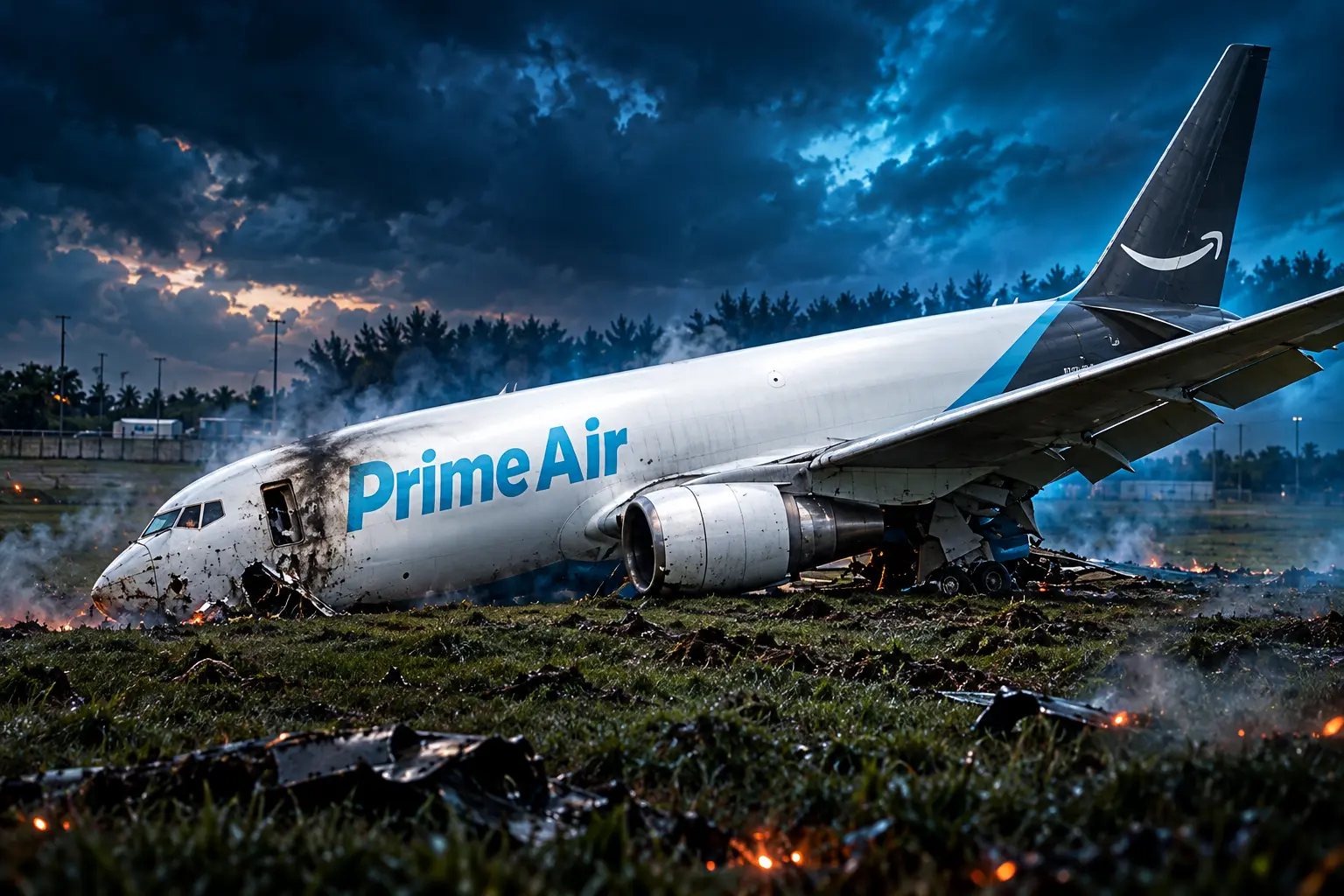
Amazon paused all flying with 21 Air on September 13, seven days after a contractor 767 in Amazon colors killed five people in Miami. The jet was Flight 7598, a 21 Air run from San Juan, Puerto Rico, that overran Runway 30 shortly before 2 p.m. on September 6 and tore 1,300 feet past the pavement into a cleaning van.
The cut is a partner freeze, not a shutdown of Amazon Air. 21 Air flew eight of the roughly 105 jets in that network. Amazon never held the operating certificate.
A Pause That Leaves Amazon Air Still Flying
Amazon spokesperson Kelly Nantel posted the decision on the company’s news page at 4:15 p.m. PT on September 13. She said Amazon had spent the week supporting the National Transportation Safety Board inquiry and reviewing the surrounding circumstances.
Safety has always been our top priority, whether in our own operations or when we’re working with partners. After the tragic incident last weekend, we’ve spent time supporting the investigation and reviewing some of the surrounding circumstances, and we’ve decided to pause our operations with 21 Air, the operator of Flight 7598. We’ll continue working to support the investigation and everyone affected.
Kelly Nantel, Amazon spokesperson, September 13 update
That wording matters. Amazon paused its own work with the carrier. It did not say 21 Air was grounded, and it did not say Amazon Air flights would stop. Nantel’s earlier notes, from September 6 through September 9, had kept repeating the same split: the airplane “was operated by 21 Air,” questions should go to the NTSB, and Amazon would “coordinate closely” with the carrier. By Sunday the coordination became a cutoff.
21 Air’s public page still carried CEO Keith Winters’s first message, that the company was devastated by the accident in Miami and was working with the NTSB, the Federal Aviation Administration, and local authorities. In a later statement the airline said it was confident in its safety policies, procedures, and training. It did not announce a matching halt of its other flying.
The five people killed were on the ground, not in the cockpit. Miami-Dade Sheriff Rosie Cordero-Stutz identified them as Rolando Aleman Leon, 55; Yoel Rodriguez Naranjo, 53; Julio C. Pineda, 75; Carlos Acosta Fajardo, 53; and Javierkys Reyes Quevedo, 47. All five were in a 2012 Ford Econoline van owned by Professional Ocean Service Corporation, a contract cleaning firm. Seven people were in that van. The 767 then hit a Toyota Corolla Cross on Northwest 67 Avenue. Five people were hurt, among them Eugenio Corredor, 79, in the sedan, and Ridoel Averhoff Diaz, 32, in the van. Both pilots survived. They were Captain Joseph Carol, 55, with more than 7,000 flying hours, and First Officer Jaime Felipe Silva Molina, 37, with more than 2,500. NTSB Chair Jennifer Homendy called the scene utter devastation.
Yaraisi Santiso Morejon, Rodriguez Naranjo’s widow, has filed a wrongful death suit against the pilots, Amazon, and 21 Air LLC. The NTSB has not named a cause. A preliminary report is still ahead, and a final probable-cause report typically takes a year or more.
Who Operates Amazon-Branded Cargo Jets?
Amazon Air is a planned network of more than 100 freighters and more than 250 flights a day, and it is not an airline. Amazon.com Services LLC sells the space, paints many of the jets, and hires certificate holders to fly them. The company’s cargo terms put that in one line: Amazon is not an air carrier. It contracts with airlines that operate the aircraft, and the carrier’s pilot-in-command has full authority over cargo acceptance and flight safety.
Cirium, the aviation data firm, counted about 105 aircraft actively flown for Amazon at the time of the crash. 21 Air’s share was eight. Air Transport International, part of Air Transport Services Group, flew about 40. Sun Country Airlines, a passenger carrier that also hauls freight, flew 22. The rest sat with ABX Air, Hawaiian Airlines, Cargojet, ASL Airlines Ireland, Amerijet International, Quikjet, and other partners. Atlas Air, an early Amazon operator, left that work in May 2025. 21 Air had picked up Amazon 767s in that remix, starting in November 2024 with jets Amazon supplied.
AMAZON AIR CONTRACT FLYING
| Carrier | Jets in Amazon service | Status after September 13 |
|---|---|---|
| Air Transport International | About 40 | Still flying for Amazon |
| Sun Country Airlines | 22 | Still flying for Amazon |
| 21 Air | 8 | Amazon work paused |
| ABX, Hawaiian, Cargojet, ASL, others | Remainder of about 105 | Still in the partner list |
Eight jets are a real hole on Miami-San Juan-Cincinnati rotations. They are not the network. ATI’s pilots only this year reached a tentative four-year deal after a long fight, and Amazon has kept adding metal at the carriers that already hold the bulk of the flying. A pause at 21 Air shifts hours toward those larger certificates. It does not force Amazon to become an airline.
The same terms let Amazon change city pairs and times. The FAA still looks at 21 Air, not Amazon, as the Part 121 operator of Flight 7598. That is why Amazon can freeze a partner in a week while the smile stays on other tails.
Recorders Show a 158-Knot Touchdown on Runway 30
Flight 7598 was a Boeing 767-33A on a 14 CFR Part 121 cargo trip from Luis Muñoz Marín International Airport in San Juan to Miami International. It was the airplane’s third sector of the day, after Cincinnati to Miami and Miami to San Juan. Homendy said it left at a takeoff weight of 252,182 pounds and was expected to land at 231,236 pounds. The cargo weighed 32,222 pounds and was mostly contact lenses. Investigators said no hazardous materials were aboard.
The jet was 32 years old. It began life as a passenger 767 in 1994 and was converted to freight in 2015. Flightradar24 logged it as N1997A. NTSB investigators pulled an Acron Aviation FA2100 cockpit voice recorder with more than two hours of audio and an Ontic flight data recorder with about 54 hours and more than 400 parameters. Investigator-in-charge Chihoon Shin briefed the last half-minute of the data. The board warned the times are preliminary and the two boxes have not been precisely synchronized.
THE LAST HALF-MINUTE ON THE FLIGHT DATA RECORDER
- 30 seconds: Nose and right main gear touch down at 158 knots.
- 23 seconds: Brakes applied at 146 knots.
- 19 seconds: Left main gear touches down at 134 knots.
- 15 seconds: Brakes released at 120 knots; throttles rise to go-around thrust.
- 11 seconds: Throttles back to idle and brakes reapplied at 117 knots.
- 7 seconds: Lateral, longitudinal, and vertical accelerations change sharply at 96 knots.
- End of recording: Last groundspeed 65 knots; no recorded deployment of speed brakes or thrust reversers.
The voice recorder fills in the argument in the cockpit. At 1 minute 42 seconds before the tape ends, one pilot called for flaps 20 and the other cautioned they were too fast. The second pilot kept talking about excessive speed. The NTSB said there was not a consistent verbal response. Electronic “sink rate” and “too low terrain” callouts stacked up in the last minute. At 15 seconds a pilot called for a go-around. At 10 seconds the tape picked up sounds similar to the airplane leaving the paved surface.
That sequence is why aviation watchers treated the crash as a landing that came in hot and then dithered between stopping and going around. The 158-knot touchdown on Runway 30 is the hard number. The missing reversers and speed brakes are the open mechanical question. The NTSB has not said whether the crew elected not to deploy them or whether they failed. Interviews with the pilots were set for September 9. Case number DCA26MA352 remains open.
Crane Built 21 Air Around Amazon and DHL
21 Air is a Greensboro, North Carolina, cargo airline founded on February 25, 2014, with a heavy base at Miami. Its call sign is Cargo South. Avia Acquisitions LLC sits over the airline, and Houston logistics owner Jim Crane holds the controlling interest through a joint venture that also included Canadian cargo airline Cargojet at 25 percent. Crane, who owns the Houston Astros and founded Crane Worldwide Logistics, bought in in 2021. In an April interview he was already talking about 777s, long-haul flying, and Cargojet selling its stake.
I own the controlling interest. I’ve got all the buttons. I don’t do deals where I don’t have control.
Jim Crane, 21 Air owner, April 2026 interview
He had installed Keith Winters, a longtime Crane lieutenant and former Crane Worldwide chief, as interim CEO after Tim Strauss, who brought in the Amazon work, reached the end of a two-year contract. When Crane bought the airline it had four or five freighters. By April it was flying 16, including seven Amazon-supplied 767-300 converted freighters plus DHL 757s and other 767s. Strauss had landed Amazon in late 2024. Amazon controlled those 767s and handed them to 21 Air to operate. 21 Air also opened Amazon flying to Colombia and the Dominican Republic in 2025.
DHL is the customer Amazon cannot pause. Those 757s and extra 767s are not on the September 13 letter. If 21 Air keeps that flying, Crane’s airline shrinks back toward the DHL-and-charter shop it was before the Amazon remix. If DHL ever follows Amazon, the growth story he pitched in April, faster decisions than private-equity cargo groups, a 777 certificate by the end of 2026, is a different company. He told the same interviewer that two phone calls get a deal done. Amazon’s call on September 13 ran the other way.
Whistleblower Files and a 2021 Resignation Letter
The NTSB has not tied older complaints to Flight 7598, and 21 Air disputes the picture of a shop that ignored safety. Homendy said on September 8 she did not know anything about the reports she had seen. The files still sit in a Department of Labor case and in emails sent years before the overrun. They are part of what Amazon said it reviewed as “surrounding circumstances.”
WHAT FORMER 21 AIR CREWS PUT ON THE RECORD
- Karl Seuring: A former Delta and 21 Air pilot, fired in July 2022, told a labor tribunal the airline shorted rest, used a checklist he thought raised accident risk, and pushed crews. He said a manager told him, “It’s not going to change.” He later said, “Unfortunately, 21 Air has a long established history of safety problems,” and that ex-pilots “anticipated and we feared” an accident.
- Don Helmig: A retired airline and military pilot, in a June 12, 2021, resignation email to Crane, wrote, “After three months, everywhere I looked, there are issues,” and accused the company of paying lip service to its safety system “then doing exactly nothing.”
- Bruce Joseph: A former chief pilot testified he had personal knowledge of people being discouraged from logging concerns, and that a safety director told him “don’t put anything” in the system before talking to then-CEO Mike Mendez.
- Tony Bless: A retired 21 Air pilot said maintenance pressure, the chief pilot’s office, and hiring quality were perennial worries, and that a crash was “something a lot of us ex-21 Air pilots have been anticipating for a while.”
Attorney Mike Anello, who represents Seuring, said the Labor Department complaint went to a hearing, was lost at that stage, and then to a 2023 trial still awaiting a judge’s ruling. That is not a finding on Miami. It is the paper trail Amazon had in front of it when it decided eight jets were easier to park than to keep on the certificate of a carrier already in a fight with its former crews.
Eight Freighters Are a Hole Other Carriers Can Fill
The hold of Flight 7598 was not a typical Prime cart of household orders. Homendy said the 32,222 pounds were primarily contact lenses. That load is the other half of Amazon Air’s bet. Amazon Air Cargo sells blocked space to outside shippers, freight forwarders, and postal customers. Its own FAQ tells those customers that a booked shipment has a reservation and has priority over Amazon packages. The Miami 767 was wearing the brand and hauling someone else’s freight under that promise.
A pause at 21 Air therefore hits two books at once: Amazon’s internal air plan, and the third-party product that now advertises 1-day airport-to-airport lifts with a money-back window for new customers. Other partners can absorb Miami-Cincinnati-San Juan hours. They cannot rewind a van on Northwest 67 Avenue. Amazon’s first fatal air crash was in February 2019, when an Atlas Air 767 flying Miami to Houston went into Trinity Bay and killed three people on board; federal investigators blamed pilot error. This time the dead were cleaners on a contract Amazon did not sign, hit by a jet Amazon did not certificate, on a route Amazon did schedule.
The contractor model did what it is built to do. Seven days after the overrun, Amazon stopped using 21 Air and left Air Transport International, Sun Country, and the rest of a 100-plus-plane roster on the line. Crane still has DHL, a Labor Department file, and an NTSB docket with a 158-knot landing and no reversers in the data. Amazon still has a network that, on paper, is not an airline.

Greed Held After a $697 Million Crypto Long Flush

Fed Minutes Keep a Year-End Rate Hike Alive

A Nanny-Cam Tape Follows Tyreek Hill Into Free Agency

Star Wars Galactic Racer Makes a Crash End the Tour

Amazon Puts Apple’s June MacBook Prices Back on Sale

Sophia Wootten Turns the Miss Georgia Crown Toward Cleft Care

Georgia Beach Bacteria List Leaves Swim Areas Open

The iPhone 16 Pro Flipkart Cut Did Not Last

Microsoft Prints Azure’s $29.42 Billion Quarter and Shrinks the Map

UltraTech’s Ultravolt Launch Puts Cable Multiples on Trial
-
 ENTERTAINMENT4 months ago
Sophia Wootten Turns the Miss Georgia Crown Toward Cleft Care
-
 NEWS4 months ago
Georgia Beach Bacteria List Leaves Swim Areas Open
-
 NEWS1 year ago
The iPhone 16 Pro Flipkart Cut Did Not Last
-
 BUSINESS2 months ago
UltraTech’s Ultravolt Launch Puts Cable Multiples on Trial
-
 NEWS2 months ago
Microsoft Prints Azure’s $29.42 Billion Quarter and Shrinks the Map
-

 NEWS3 months ago
Little St. Simons Island Hatches Loggerheads at 72.4 Percent
-

 NEWS10 months ago
IXI Autofocus Glasses Still Lack a European CE Mark
-

 NEWS3 months ago
OnePlus Ends OxygenOS After Quitting US and Europe