
LIFESTYLE
How to Prevent Calcium Build Up in Your Swamp Cooler: Bleed-Off Steps
Calcium build up in your swamp cooler slows when you bleed off pan water at the right rate. Set a home or pad-wall stream, then clean pads without bleach.

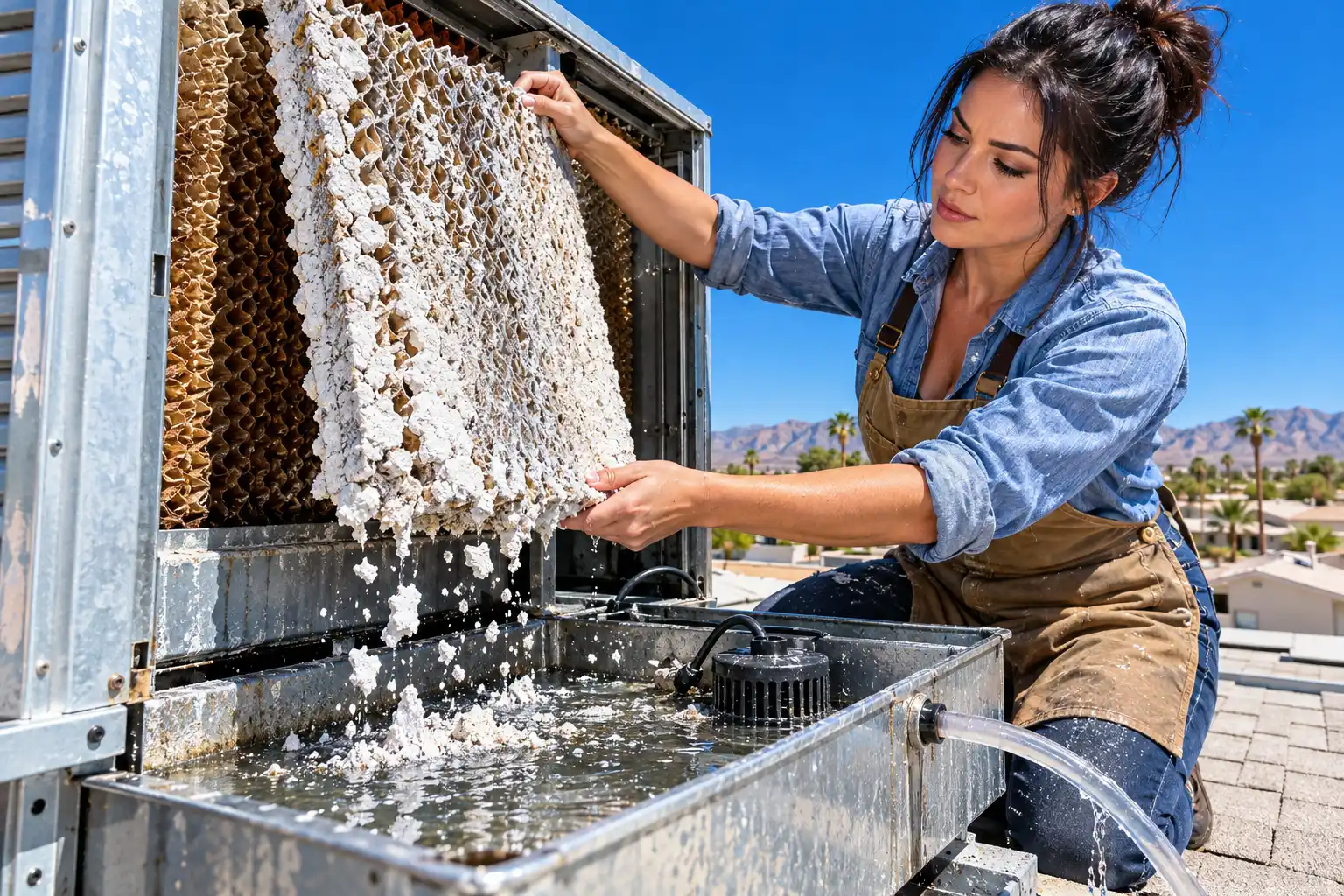
You slide the panel off and the pads are chalky, with a white ring in the pan and weaker air than last month. Only pure water leaves as vapor, so the calcium and magnesium in the tap water stay behind and harden on every wet surface.
That film is calcium build up in your swamp cooler, and it blocks air, plugs the small water holes, and makes the pump work harder. Scrubbing takes off crust that has already stuck. A small bleed-off stream, running the whole time the pump runs, is what slows the next layer. The steps below set that stream for a home cooler or a long pad wall, then cover cleaning that spares the pads.
Mineral Scale on Pads and in the Pan
Evaporation is the whole cooling trick, and it is also the reason the minerals pile up. Hot air passes through a soaked pad, picks up water vapor, and drops in temperature. Dissolved calcium and magnesium do not become vapor with it. They remain in the water that falls back into the pan, and every hour of cooling makes that water richer in minerals until the extras come out as hard, chalky scale.
The same crust shows up in a few places, and each one steals a different part of the cooling.
- Pad faces: Scale lines the flutes, so less air gets through and less water can evaporate.
- The spider: The distributor across the top packs shut at its small holes, and dry streaks form under the blocked ones.
- Pump basket: White beads plug the screen, and the pump can hum while almost no water reaches the pads.
- The pan: A ring builds at the waterline, and grit on the bottom gets pulled back into the loop.
In hard-water towns that crust often stops being a film and turns into little white beads that pack the pump basket first. Brush that basket every time you open the cabinet, even when the pads still look only spotted. A cooler left full after you shut it off keeps concentrating minerals as the leftover water dries, so empty the pan when the unit will sit, and let the pads dry with it.
How Does Bleed-Off Limit Minerals in the Pan?
Bleed-off, also called blowdown, is a small stream you send out of the pan on purpose so the minerals leave with it. The float then lets fresh supply water in to replace what you threw away. The calcium in the water you discarded never gets another pass across the pad.
The pump’s job is different. It has to soak the whole pad face, with no dry streaks, because scale grabs first on the dry lines. That wetting flow is a large stream. The bleed is the little side stream that does not come back. Judging the bleed by how wet the pad looks is how a cooler either floods the yard or turns the pads to chalk.
Wall pads and rooftop cabinets do not share one number. The rows in the Munters CELdek bleed-off chart are a continuous bleed for a 6-inch pad wall, timed with a 5-gallon bucket. The last row is a taller pad, not a longer one.
| Pad | Starting bleed-off | Minutes to fill a 5-gallon bucket |
|---|---|---|
| 10 feet of length | 10 gallons an hour | 30 |
| 20 feet of length | 20 gallons an hour | 15 |
| 30 feet of length | 30 gallons an hour | 10 |
| 40 feet of length | 40 gallons an hour | 7.5 |
| 50 feet of length | 50 gallons an hour | 6 |
| 60 feet of length | 60 gallons an hour | 5 |
| 50 feet of length, 6 feet high | 75 gallons an hour | 4 |
For a length that is not on the chart, divide 300 by the gallons an hour you need. Twelve feet at 1 gallon an hour per foot is 12 gallons an hour, and the bucket should fill in 25 minutes. The last row comes from Illinois Extension’s evaporative pad guide, which uses 1 gallon an hour per foot on a pad 4 feet high and 6 inches thick, then a higher start when the pad is taller. Lower the bleed for softer water and raise it when fresh scale appears. Bucket times on every row, including the 4 minutes beside 75 gallons an hour, are 300 divided by the gallons an hour.
How to Set Bleed-Off on a Home Swamp Cooler
That wall chart is the wrong start for a rooftop or window cabinet. The installation manual for a Champion 5500DD cooler tells you to begin at 1 to 2 gallons an hour for the whole unit, then increase the rate if the water in your area is poor. A per-foot barn rate on a small cabinet dumps far more water than that manual asks for.
- Turn the cooler off before you open a panel or pull a hose inside the cabinet.
- Find the bleed. On many cabinets a tee in the pump hose feeds a small tube out through the overflow, with a restrictor clamp or a small valve.
- Run the pump until every pad is wet and you can see water returning to the pan.
- Hold a quart jar under the outlet. A full jar in 15 minutes is 1 gallon an hour, and a jar that fills twice that fast is the top of the starting range.
- If a new white film shows within a few weeks, open the restrictor and time the jar again.
- Aim the outlet at a drain or at ground that can take the water, and keep it off the walkway.
Write the minute count on a piece of tape inside the cabinet so the next check has something to beat. The float still has to hold a steady waterline, the one your manual shows. A float stuck open sends water out the overflow and makes the jar reading meaningless. A float stuck shut lets the pump suck air, the pads dry in streaks, and the next crust locks onto those dry lines.
If the cooler already dumps the pan on a timer or when a sensor reads high salinity, that hardware is there to do this job. Use it, then still look at the pads. A built-in dump that is too rare leaves the same chalk as a bleed tube you pinched shut.
Hard Water, pH, and a Softened Line
How fast you move up the chart depends on the water coming in, not on the brand of the cooler. Ask the utility for the hardness number, then place it on a standard hardness classification chart. The bands below are the U.S. Geological Survey groups, in milligrams per liter as calcium carbonate, with the pH ranges pad guides actually publish.
| Reading | Range |
|---|---|
| Soft | 0 to 60 mg/L |
| Moderately hard | 61 to 120 mg/L |
| Hard | 121 to 180 mg/L |
| Very hard | More than 180 mg/L |
| System water pH, Illinois Extension | 6 to 8 |
| Sump pH, Munters CELdek | 7 to 9 |
| Makeup water pH, Munters CELdek | 6 to 9 |
If your number sits in the hard or very hard band, start toward the high end of the bleed for your machine and inspect the pads on the monthly pass. If a test strip sits above the pH rows, acidifying the water may be worth doing, with a treatment the pad maker allows. Bleach is not that treatment. Chlorine and bromine shorten cellulose pad life, which is why both the extension note and the CELdek sheet bar them.
A home softener does not make distilled water. Passing the supply over an ion-exchange resin swaps calcium and magnesium for sodium, so the white deposit can change from hard crust to a powdery residue. The Champion 5500DD manual says not to connect that cooler to any soft-water supply, because soft water will cause corrosion and decrease the life of the cooler. Where your manual says the same, feed the cooler from a hard line and let the bleed handle scale.
Aspen Pads and Rigid Cellulose Pads
The pad in the cabinet decides whether you wash, or whether you buy a new one. Aspen and straw are meant to be replaced when they stiffen. Rigid cellulose, including many blue pads and MasterCool-style media, is built to stay for several seasons if the air paths stay open. Using the aspen habit on a rigid pad, or the reverse, wastes the part you just paid for.
Aspen and Straw Pads
Excelsior pads soak up water along loose fibers and throw a broad wetted curtain. Once minerals glue those fibers into a board, scrubbing does not bring the loft back, and a stiff pad sheds water down a few paths instead of evaporating it. Plan on a new set when you see any of these, rather than on a calendar copied from a different climate.
- Stiff fibers: The pad no longer bends in your hands, or it cracks when you flex a corner.
- Channeling: Water runs down a few dark streaks and leaves the rest of the face dry.
- A sour smell: The odor stays after a rinse, which means the fiber is holding slime, not just dust.
- A packed basket: White beads in the pump screen will starve a brand-new pad, so brush the screen at the same time.
Cellulose Pads in a Cabinet Cooler
Rigid pads keep their shape because the paper is formed into flutes and stiffened. Minerals sit on that paper instead of inside a tangle of wood fiber, so a gentle rinse of the inlet face can reopen passages the way a MasterCool manual describes. That same manual says aspen and other loose pads will not work in that cooler, and it says chemical additives, or any water treatment other than bleed-off, are not recommended. Skipping the bleed on that pad greatly increases mineral deposits.
PAD CHEMICALS TO AVOID
- Bleach and bromine: Both shorten cellulose pad life, so they stay out of the pan and off the media.
- Pressure washers: A hard jet tears the flute edges and the face coating.
- Metal tools: Picks and scrapers gouge the paper and leave a groove that collects the next crust.
- Odd acids: Cleaning calls for a detergent plus an organic acid made for these pads, used the way the label says, then rinsed out.
Algae is the other film that blocks flutes. Shade the pads and the sump when you can, and use a quaternary ammonium product if the pad maker allows a continuous algaecide. Short on-off pump cycles, including 10-minute timers, wear these pads out early, so leave the pump running through the cooling call instead of chopping it into brief bursts.
How to Clean Calcium Off the Pan and Pads
Cleaning is the reset after a season of missed bleed, not the method that replaces it. Do it at startup, at shutdown, and anytime the pan is gritty. Disconnect power first. Water and a live blower in a metal box on a roof is a bad mix, and a ladder needs firm ground before you climb.
- Shut off the supply valve and unplug the cooler, or open its disconnect.
- Drain the pan until it is empty, including the low spot under the pump.
- Lift the pads if the manual allows it. Brush loose scale off the pan, the float, and the spider with a soft brush.
- Clear spider holes with that brush. A metal pick can enlarge a hole, and the enlarged hole then dumps too much water on one spot.
- Rinse a rigid pad at low pressure, inlet face first. Do not soak cellulose in a strong homemade acid.
- Wash the pan until the chalk is gone, then rinse until the water runs clear.
- Refill, start the pump only, and look for dry streaks before you start the fan.
- At the end of the season, drain the pan, the pump, and the supply line if a freeze is possible, and leave the pads dry.
A pad that has already gone to board belongs in the trash, not in another hour of scrubbing. After any cleaner, run the pump long enough to flush the chemical into the drain before the fan pushes air into the house. Then set the bleed again, because a clean pad on unbled hard water starts the same crust over.
Cooling Season Checks for Scale
Let the pads dry completely once every 24 hours when nights allow it. A full dry-down starves algae, and both Illinois Extension and the CELdek sheet treat that daily dry time as normal running, not as an extra chore. One way to get it is to keep the pump off for a few early-morning hours, as long as the house can stand the warmer air.
- Each startup: New or sound pads, a clean pan, a free pump basket, and a bleed you have timed.
- Each day: While it runs, look for dry streaks and for a pump that hums without moving water.
- Each week: Confirm the bleed outlet is still dripping at the minute count you wrote down, and brush the pump screen if beads are back.
- Each month: If a new white film is visible, open the bleed. If algae appears, lengthen the daily dry time and review the algaecide.
- At shutdown: Drain, clean, dry, and disconnect a supply line that could freeze. Pads left wet in a closed cabinet cement the minerals in place.
Quarterly, or at the start, the middle, and the end of a long cooling season, drain and wash the whole water path, including the distribution pipe. Dust, seeds, and grass clippings in the sump are food for the next round of algae, so keep them out before you reach for a chemical. A pad wall that stays fully wet, with bleed water actually leaving, holds its cooling far longer than one you only attack with a brush in spring.
Frequently Asked Questions
Does a Purge Pump Replace Bleed-Off?
A purge pump that dumps the pan on a timer does the same job in short bursts, and some coolers drain only when a sensor reads high salinity. Seeley’s guide to water management says a continuous bleed typically discharges more water over time than salinity control or a timed drain. On some of those coolers the pan also empties 72 hours after the last run. If white crust still returns, the dump is too rare for your water, so shorten the interval or add a small steady bleed and time it.
Why Does a Swamp Cooler Smell After Startup?
A freshly wetted pad can smell at startup, and that odor fades after the cooler has run. A smell that lingers, especially a fishy one later in the season, comes from bacteria in the pan rather than from the calcium crust. Drain and wash the pan, and let the pads dry out on the daily schedule so the water does not sit still for days.
Can Very Pure Water Damage Cooling Pads?
It can if that supply is all the pad sees for a long time. The Munters manual on supply water says to use rainwater, reverse osmosis water, demineralized water, and zeolite-softened water with caution. Bleed-off cannot repair a supply the pad maker has already flagged, so read the cooler manual before you pipe a filter or a rain barrel straight into the pan.
How Do You Tell a Clogged Bleed Tube?
The cup under the outlet stays empty, or it fills much more slowly than the minute count you wrote down at startup, even though the pump is running and the pads are wet. Calcium narrows that tube the same way it narrows a shower head. Take the tube off, flush it, seat it again, and time a fresh quart. Do that check before the hottest stretch, not only when the house is already warm.
Should You Scrape Cooling Pads or Replace Them?
Brush loose grit with a soft brush after the pad has dried, and stop there. Replace an aspen or straw pad that is stiff, channeled, or still sour after a rinse. On a rigid pad, a low-pressure rinse of the inlet face can clear flutes, and a MasterCool manual tells you to change that style of pad after five years or sooner if the passages stay clogged. A pad that crumbles when you lift it is finished.
Time the jar on the first warm afternoon and again a month into the season. If it fills more slowly than the minute count you wrote down, the bleed tube is narrowing, and the pads will crust next unless you flush the line and open it back to the same rate.

Greed Held After a $697 Million Crypto Long Flush

Fed Minutes Keep a Year-End Rate Hike Alive

A Nanny-Cam Tape Follows Tyreek Hill Into Free Agency

Star Wars Galactic Racer Makes a Crash End the Tour

Amazon Puts Apple’s June MacBook Prices Back on Sale

Sophia Wootten Turns the Miss Georgia Crown Toward Cleft Care

Georgia Beach Bacteria List Leaves Swim Areas Open

The iPhone 16 Pro Flipkart Cut Did Not Last

IXI Autofocus Glasses Still Lack a European CE Mark

UltraTech’s Ultravolt Launch Puts Cable Multiples on Trial
-
 ENTERTAINMENT5 months ago
Sophia Wootten Turns the Miss Georgia Crown Toward Cleft Care
-
 NEWS5 months ago
Georgia Beach Bacteria List Leaves Swim Areas Open
-
 NEWS1 year ago
The iPhone 16 Pro Flipkart Cut Did Not Last
-
 NEWS10 months ago
IXI Autofocus Glasses Still Lack a European CE Mark
-
 BUSINESS2 months ago
UltraTech’s Ultravolt Launch Puts Cable Multiples on Trial
-

 NEWS2 months ago
Microsoft Prints Azure’s $29.42 Billion Quarter and Shrinks the Map
-

 NEWS4 months ago
Little St. Simons Island Hatches Loggerheads at 72.4 Percent
-

 NEWS1 year ago
Capyfriends Cafe Routes Helen Tourists to Cleveland Capybaras