
LIFESTYLE
How to Make a Skirt Shorter Without Sewing: Six No-Cut Ways
Pick tape, glue, pins, or a waist roll based on the cloth. Learn how to make a skirt shorter without sewing and still get the long hem back later.

A long skirt that covers your shoes, or that you step on when you walk, does not need scissors. You can turn the extra cloth up and keep every inch of the original hem.
How to make a skirt shorter without sewing is that fold, held with iron-on tape, fabric glue, pins, or a belt. Which hold you pick depends on the cloth and on whether you still want the long length later.
The six ways below are iron-on tape, fabric glue, safety pins, peel-off tape, a belt or waist fold, and a side knot. Mark a straight line in the shoes you actually wear before any of them, or the hem will look crooked no matter how neat the hold is.
Which No-Sew Method Shortens Your Skirt?
Start with the cloth in your hands and with the plan for that skirt, not with whatever roll is by the checkout. A cotton skirt you will wash all season is a different job from a maxi you want shorter for one dinner, and heavy denim hides a different kind of bulk than a thin slip skirt.
| Your skirt | What to use | Length comes back? |
|---|---|---|
| One night, a borrowed skirt, or a length you are still testing | Small safety pins or peel-off tape | Yes, the same day |
| Cotton or linen you want to keep short | Regular-weight iron-on hem tape | Plan on the short hem staying |
| Denim, corduroy, wool, or heavy cotton | Super-weight iron-on tape, or fabric glue that lists denim | Plan on the short hem staying |
| No iron, and the cloth can take glue | Washable fabric glue | Glue is hard to remove cleanly |
| A maxi or a very full skirt | A belt roll, a waist fold, or a side knot | Yes |
| Sheer cloth, or a label that says do not iron | Pins or peel-off tape | Yes, if you skip the iron |
| Dry-clean only, and you will keep using a cleaner | Pins, or a fusible whose own label says dry-cleanable | Pins come out; a bonded hem stays |
Pins, peel-off tape, a belt, or a knot give you the original length back the same day. Iron-on tape and fabric glue are made to stay through the wash, so save them for a skirt you want to keep short. A uniform you have to hand back, or a costume you might wear long again, stays in the reversible row.
How to Mark an Even Skirt Length
The hem looks straight only if the fold line is level before any tape or glue goes in. Put the skirt on with the shoes you plan to wear with it, because a heel changes where the hem lands on your leg.
Fold the extra cloth up to the length you want and mark that spot with a pin or a bit of chalk at the center front, the center back, and both side seams. Take the skirt off and measure from the old hem up to each mark.
Those four measurements need to agree. When one side is shorter, the skirt was sitting off level on your body, so pin it again before you press anything. Use the matched distance, lay the skirt inside out on a flat surface, and press a dry crease along the fold.
ON A FLARED HEM
A flared or circle skirt gets wider toward the hem, so a deep fold tries to ripple. A turn-up of only a few inches presses flatter than a deep one, and short pieces of tape follow the curve better than one long strip.
If you own another skirt with a similar flare that already hits the right spot, lay it on top and trace that hem as your guide. A straight skirt is a poor guide for a full one. Sewing directions that tell you to add extra cloth past the mark are written for a hem you cut and then turn. You are not cutting, so the pin is the finished edge, and everything below it folds to the inside. Subtracting a second allowance on top of that pin is how a skirt ends up shorter than you wanted.
Try the skirt on again after the crease is pressed and before any tape or glue. A crease can still be moved. A bonded hem cannot.
How to Make a Skirt Shorter Without Sewing Using Tape
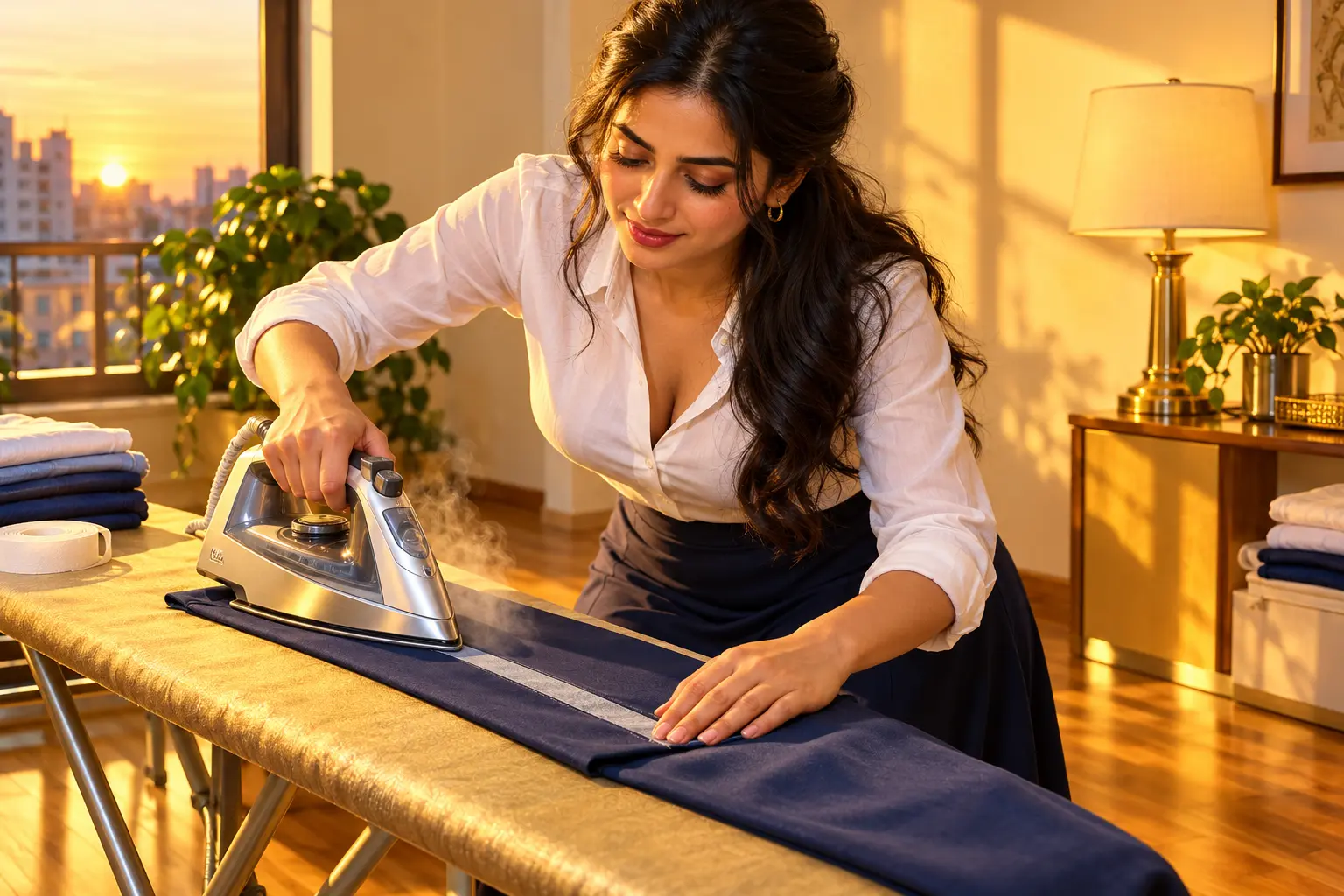
Iron-on hem tape is a strip of glue that melts under a dry iron and then hardens as it cools, so the fold stays without stitches. The seconds on the package matter more than a single rule of thumb, because two official HeatnBond pages do not share one press time.
Read the HeatnBond Hem instruction sheet that matches your roll, and check the HeatnBond Super Weight hem directions if that is the tape you bought. Follow the print packed with the roll in your hand when the two pages disagree.
| Tape | Cloth it is sold for | Heat and time | Care |
|---|---|---|---|
| HeatnBond Hem sheet for items 3719, 3722, and 3723 | Regular weight for lighter cloth such as cotton and linen; Super for heavier cloth such as denim and corduroy | Medium heat, no steam; hold 3 to 5 seconds; then 1 to 3 seconds from the right side | Delicate wash in cold water, tumble dry on low, do not dry-clean |
| HeatnBond Hem Super Weight, 3/4 inch by 8 yards, current product page | Heavy cotton, denim, suede, wool, and corduroy | Medium heat, no steam; 8 seconds on each section, slightly overlapping; then 3 more seconds from the right side | Sold as a permanent no-sew bond; item 3723 is on the sheet that bars dry-cleaning |
| Vilene Wonderweb 909, 20 mm by 10 m | Hems on skirts, trousers, dresses, and curtains | Hot dry iron through a damp cloth for at least 10 seconds, until the cloth is dry | Cool 10 minutes before you check; washable and dry-cleanable |
KEEP THE IRON OFF THE TAPE
- No liner: The Super Weight roll has no paper backing, so there is nothing to peel, and the glue has to sit fully inside the fold before you press.
- No steam: Both HeatnBond directions use medium heat and a dry iron, so leave the steam setting off.
- No stitching: This hem tape comes with a warning not to sew through it, because stitches through the glue can gum up a needle.
ThermOWeb’s own short video shows the tape going inside the fold and the iron staying on the cloth, which is the part that gets skipped when you are in a hurry.
If your roll has a paper liner, follow the picture on that package, and still keep the iron off any glue that is showing. A household iron, held flat, is the tool these directions mean. A curling iron or a hair straightener is the wrong shape, and it can scorch a stripe into the cloth.
- Prewash a washable skirt without fabric softener, and test a short piece of tape on a hidden seam before you do the whole hem.
- Press the marked fold with a dry iron on medium. On polyester or anything delicate, put a cotton cloth between the iron and the skirt.
- Cut the tape a little shorter than the hem so the ends do not peek out. On a curve, use short pieces instead of one long strip.
- Slide the tape inside the fold so cloth covers it on every side.
- Hold the iron still for the time in the table for your roll, then lift it and overlap the next section. Do not slide along the hem.
- Let the hem cool before you tug it. Turn the skirt right side out and press the outside for the shorter time on the same directions.
- Walk in the skirt before the first wash. Press any spot that lifts, once, while the tape can still take heat.
Fine cloth hides the old hem and the tape, while denim, corduroy, and wool can show that stack as a ridge. Unpick the old hem stitches and press a single layer flat before you tape those heavier skirts. That opens the old seam, and it does not cut the length off. If you would rather not unpick, take up less cloth, or shorten the skirt from the waist instead.
Vilene Wonderweb is a different iron-on tape, pressed through a damp cloth with a hot dry iron, and the Vilene Wonderweb 909 press steps say to let the hem cool before you test it. Choose it when you need a tape sold as dry-cleanable. The HeatnBond sheet tells you not to dry-clean that bond.
How to Glue a Skirt Hem Without Heat
Fabric glue is the no-sew hem that skips the iron, which helps when the care label bars heat or the iron is still in a moving box. You need open hours for it to cure, so it is the wrong pick when you are dressing for tonight.
Mark the fold the same way you would for tape. If the cloth can take a low iron, press the crease first. If it cannot, finger-press the fold and pin it. Test the glue on an inside seam or on a spot the hem will hide.
Prewash a washable skirt without fabric softener before you glue. Spread a thin, even coat on the inside of the fold, press the layers together, and pin them until the glue grabs. Wipe wet squeeze-out with a damp cloth. The full wait, the wash cycle, and the cloth list sit in the Aleene’s Fabric Fusion use steps.
| Stage | What Aleene’s Fabric Fusion specifies |
|---|---|
| Dry to the touch in the maker’s test | 24 to 30 minutes for a 3-millimeter coat at 70 to 73 degrees Fahrenheit; a thicker coat takes longer |
| Fully cured | 2 to 4 hours |
| Safe to wash | After 48 hours, inside out, on a gentle cycle, with low dryer heat |
Leave the skirt flat until the cure time has passed, then wear it. The maker lists cotton, denim, flannel, leather, jersey, ribbon, trims, sequins, and beads as the cloths this glue works best on. On a very thin skirt, look at the test spot in daylight before you glue the whole hem. Leather is on that list, and a hot iron can mark it, so a clear test spot is the reason to glue leather instead of pressing it.
Pins and Peel-Off Tape for One Night
A skirt you will wear once, give back, or maybe return should not get a bond that stays. Pins, clips, and peel-off tape hold a fold and then come off, which is the whole point of a one-night hem.
How to Pin a Skirt Hem on the Inside
- Fold the hem to the marked line on the inside of the skirt.
- Use small safety pins. Catch the folded edge and only a little of the skirt behind it, so the outside does not dimple.
- Close every pin. Space them so the fold does not sag between pins when you hold the skirt up by the waist.
- Turn the skirt right side out, then walk and sit. Move any pin that pokes or that you can see from a step away.
- Take every pin out before the skirt goes near water.
Straight pins you could sit on are a poor stand-in for safety pins. The closed lock is what keeps the point off your leg for the hours you are out.
When to Use Hem Clips on a Skirt
Hem clips, and even small binder clips, can hold a fold while you decide on a length in front of a mirror. Look at the hem from the back before you think about wearing them out. A clip that shows, or that you can feel when you sit, belongs in the fitting and not at the event.
CLIPS STAY HOME
Once the length looks right, move the fold to safety pins or peel-off tape before you leave the house. Count the clips when you take the skirt off so none of them rides along to the sidewalk in a back seam.
How to Stick Peel-Off Tape Inside a Hem
- Cut short strips so a curved hem does not buckle under one long piece.
- Stick each strip to the inside of the folded edge, then press that fold onto the skirt with your fingers.
- Keep every strip between two layers of cloth so the sticky side does not touch your skin.
- Peel all the strips off before the skirt goes in water.
This is the neat hem for a single evening. It will not stand in for a cured, washed bond, and it should not go through a machine.
How to Shorten a Long Skirt From the Waist
Some skirts are so long that a folded hem would be a wide, heavy band. Taking the length from the waist leaves the original hem where it was sewn, which is the cleaner move on a maxi.
How to Fold a Maxi Skirt Over a Belt
Put the skirt on and lift it at the waist until the hem hits the length you want. The extra cloth can roll over a belt, or tuck under the belt so the belt hides the roll.
- Stand in the shoes you will wear and set the hem where you want it to end.
- Slide a belt or a sash over the rolled waist so the roll cannot slip down as you walk.
- Check the front, back, and both sides. Lifting one hip more than the other makes the hem tilt.
- Sit once. If the roll pops out, pin it on the inside at the side seams.
A stiff waistband with a zipper does not roll flat. Pin a small tuck on the inside at each side seam instead of forcing that waistband over on itself.
How to Knot a Flowy Skirt Shorter
On a light, flowy skirt, pinch the side seam and tie one knot at the hip or just above the hem. The knot uses up length and reads as part of the outfit, which suits a casual maxi better than a taped office skirt.
Try the knot in the mirror before you settle the spot. A knot at the hem swings when you walk, and a knot at the hip shortens more of the front. A pencil skirt or stiff denim will not lie smooth in a knot, so those skirts belong with tape, glue, or the belt roll.
How to Fold a Very Long Skirt to the Waist
For a skirt that is still too long after a belt roll, fold the hem all the way up to the waist on the inside and pin that fold to the waistband. You end up wearing two layers, and the outside cloth is unchanged.
NOTHING IS CUT
Because the hem was only folded, you can take the pins out and drop the skirt back to its old length. Match the side seams when you fold so the inside layer does not hang lower than the outside one.
Use this when you want a very long skirt shorter for one event and full length again later. The inside layer can flash if you walk fast, so take one long step in front of a mirror before you go out.
Common Mistakes With a No-Sew Skirt Hem
The fold can be even and the hem can still let go on the first walk or the first wash. Heat, timing, and tape that was never fully covered are the checks that prevent that.
CHECK THE IRON AND THE WASH
- Dry iron: HeatnBond directions call for medium heat and no steam, so a steam burst is the wrong setting on that tape.
- Covered tape: A bare strip melts onto the iron and the board, which is why the glue has to be hidden in the fold first.
- Still iron: Hold the iron in place, then lift and overlap the next spot, because sliding shoves the tape out of line.
- Softener: Prewash without fabric softener, since softener left in the cloth blocks the bond on both iron-on tape and fabric glue.
- The wait: A glued hem that feels dry can still let go in the wash if you skip the 48 hours Aleene’s Fabric Fusion asks for.
- The cleaner: The HeatnBond Hem sheet says not to dry-clean, while Vilene Wonderweb is sold as washable and dry-cleanable, so follow the tape you actually used.
Walk the length of a room before you call the hem done. A spot that is already lifting can drop further while you move, and a loose edge is easy to step on. Press or pin that spot again, and do not head out with a hem you can peel up with your fingers.
Frequently Asked Questions
Can You Take Iron-On Hem Tape Off Later?
Iron-on hem tape from HeatnBond is sold as a permanent bond, and the instruction sheet does not include a removal step. Heating the hem again can soften some glue, but residue can stay in the cloth. If you might want the original length back, use pins or peel-off tape instead of an iron-on bond.
Will a No-Sew Hem Work on a Pleated Skirt?
Turning pleats up and pressing them flat makes a thick, lumpy edge. Shorten a pleated skirt with a belt roll at the waist, or with a few pins set between the pleats for one day. Save iron-on tape for a plain hem that can fold smoothly.
Can You Shorten a Skirt With No Iron and No Glue?
Yes. Safety pins, a belt roll, or a knot will shorten a skirt for the day without anything stuck to the cloth. Peel-off fashion tape is the smoother version of that idea when you want a clean hem and you will remove the strips before the skirt is washed.
What If the Skirt Is Borrowed or Still Returnable?
Leave heat and glue off any skirt you have to return or give back. Pins, a home fitting with clips, or peel-off tape come off the same day and leave the original hem alone. Once an iron or fabric glue has bonded the fold, a shop is much less likely to take the skirt back.
Does a No-Sew Hem Work on a Stretch Knit?
A firm iron-on tape can make a knit hem feel stiff and less stretchy, so test a hidden spot before you commit the whole edge. For one night, pins keep the drape you already have. If you want a glued hem, use a fabric glue whose label names jersey, and give it the full cure on the bottle before a wash.
Look at the hem from the side in the same shoes you used for the marks, after the glue has cured or the iron-on tape has cooled. An even line that stays put through a long step is the finish you were after. A single gap gets another press, or another pin, before that skirt sees a washing machine.

Greed Held After a $697 Million Crypto Long Flush

Fed Minutes Keep a Year-End Rate Hike Alive

A Nanny-Cam Tape Follows Tyreek Hill Into Free Agency

Star Wars Galactic Racer Makes a Crash End the Tour

Amazon Puts Apple’s June MacBook Prices Back on Sale

Sophia Wootten Turns the Miss Georgia Crown Toward Cleft Care

Georgia Beach Bacteria List Leaves Swim Areas Open

The iPhone 16 Pro Flipkart Cut Did Not Last

UltraTech’s Ultravolt Launch Puts Cable Multiples on Trial

IXI Autofocus Glasses Still Lack a European CE Mark
-
 ENTERTAINMENT5 months ago
Sophia Wootten Turns the Miss Georgia Crown Toward Cleft Care
-
 NEWS5 months ago
Georgia Beach Bacteria List Leaves Swim Areas Open
-
 NEWS1 year ago
The iPhone 16 Pro Flipkart Cut Did Not Last
-
 BUSINESS2 months ago
UltraTech’s Ultravolt Launch Puts Cable Multiples on Trial
-
 NEWS10 months ago
IXI Autofocus Glasses Still Lack a European CE Mark
-

 NEWS4 months ago
Little St. Simons Island Hatches Loggerheads at 72.4 Percent
-

 NEWS2 months ago
Microsoft Prints Azure’s $29.42 Billion Quarter and Shrinks the Map
-

 NEWS1 year ago
Capyfriends Cafe Routes Helen Tourists to Cleveland Capybaras