
BUSINESS
Qcells’ $1.45 Billion Loan Is a Bet on Georgia Ingots
A $1.45 billion Energy Department guarantee backed Qcells’ Cartersville stack. Cells are running, after a customs shock, under a rewritten 45X floor.

The Energy Department closed a $1.45 billion loan guarantee for Hanwha Qcells Georgia in December 2024, backing a Cartersville plant that now makes solar cells on U.S. soil. The bet was never only more panels. It was whether America could grow the silicon brick, slice the wafer, print the cell, and frame the module in one building.
Qcells, the U.S. solar arm of South Korea’s Hanwha Group, set full upstream output for the third quarter of 2026. Cells started in June. The tax law that made the stack pay has already been rewritten once.
A $1.45 Billion Guarantee Closed in December 2024
The Department of Energy’s Loan Programs Office closed a $1.45 billion loan guarantee to Hanwha Q Cells Georgia, Inc. on December 19, 2024. A conditional commitment had landed on August 8, 2024. The money moved through LPO’s Title 17 Clean Energy Financing program, which backs supply-chain projects as well as work on existing energy kit.
Qcells has put the Cartersville build at $2.5 billion. The federal guarantee is the debt backstop, not the whole check. Dalton, an hour north, already assembled modules after opening in 2019 and did that expansion without a federal loan.
Jigar Shah, then director of the Loan Programs Office, said the loan was special because the plant would make cells and wafers, along with finished modules, pulling more of the chain inside the United States. At closing, LPO counted about 1,200 construction jobs and about 1,650 full-time operations jobs in Cartersville. A Cartersville-Bartow County Department of Economic Development review, cited in the same notice, put indirect jobs at nearly 6,800 in Bartow and Whitfield Counties and potential sales output at more than $2 billion.
THE LOAN IN ONE LOOK
- Guarantee: $1.45 billion, issued December 2024, including principal and any capitalized interest.
- Borrower: Hanwha Q Cells Georgia, Inc., at Cartersville, Georgia.
- Jobs at close: About 1,200 construction roles and 1,650 operations jobs on the Cartersville site.
- Climate math: LPO tied the plant to more than 5 million tons of CO2e avoided per year and 6,830 GWh of generation.
LPO also said the factory would be the largest ingot and wafer plant ever built in the United States, and the first silicon panel plant of this kind constructed here since 2016. Qcells said it would cut larger-format wafers, which lower cost per watt if the saws and furnaces hold their yield.
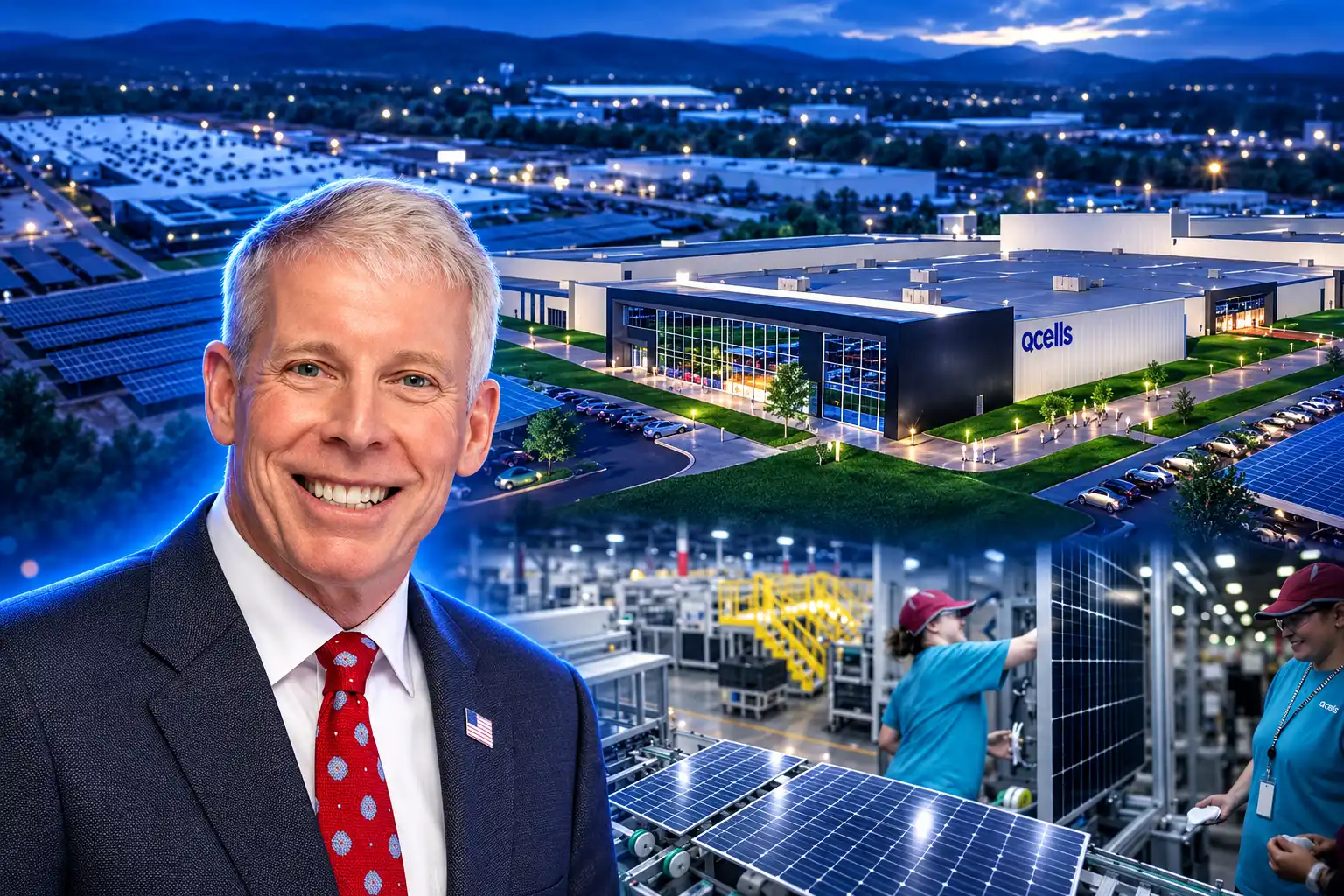
Ingots and Wafers Were the Gap China Still Owned
Module assembly is the easy room. An ingot is a cylinder of ultra-pure silicon grown from a melt. Wire saws then slice it into wafers about 170 micrometers thin. Those wafers are doped, coated, and printed into cells. Glass, film, and a frame turn the cells into a panel.
Until Cartersville, most U.S. “solar manufacturing” meant that last step, using cells shipped in. A 2024 national lab review found more than 98% of global ingot and wafer assets were Chinese owned, and the United States produced no PV wafers for export that year. DOE’s own solar office still describes the chain as global and dominated by products from China or firms tied to it.
Trade-group tallies in June 2026 put operating U.S. cell capacity at about 3.2 GW against about 70 GW of modules. Scott Moskowitz, Qcells vice president of market strategy and public affairs, had described the prior stretch as years with essentially no active cell lines. The two statements sit on different clocks: the empty years behind the loan, and a small cell base once Cartersville and a handful of other lines began to stir.
At the December 2024 close, LPO, citing an NREL tally, said more than 335 GW of solar-chain capacity had been announced since the Inflation Reduction Act, across 118 new plants or expansions, with more than 33,000 potential jobs and nearly $17 billion pledged. Announcements are not output. Ingots and wafers were the step that kept slipping.
The company has said Cartersville would take polysilicon refined in Washington state. That still leaves the melt, the saw, and the cell bath as the hard American work the loan was meant to fund.
Cell Lines Started in June, After a Customs Shock
Qcells first announced Cartersville in January 2023. Module lines went live in 2024. The furnaces and wet benches took longer. Canary-era company briefings later said the full four-step plant had been aimed at 2024 and missed that date while the harder tools were tuned.
In November 2025, before those cell lines were up, Qcells cut pay and hours for about 1,000 of its about 3,000 Georgia employees and dropped about 300 staffing-agency workers at Dalton and Cartersville. U.S. Customs and Border Protection had been holding imported parts, including cells and polysilicon sourced from places such as Malaysia and South Korea, under the Uyghur Forced Labor Prevention Act of 2021. Qcells said the chain was fully traceable and not Chinese. Marta Stoepker, the company’s head of communications, said operations were beginning to normalize but staffing still had to match lower volumes.
A module plant that waits on foreign cells can go quiet even when the building is finished. That idle payroll is the blunt case for putting the cell line in Bartow County, whatever speech is made about reshoring.
On March 6, 2026, Qcells said panel output was back to normal after the customs pause. On June 9, 2026, it started making solar cells in Cartersville, and said ingot and wafer work was already moving. Module assembly on that site, the company said then, was at full clip at 16,700 panels a day.
THE CARTERSVILLE CLOCK
- January 2023: Qcells announces the Cartersville stack and a $2.5 billion U.S. plan.
- January 8, 2024: Microsoft signs on for modules and construction services from the new plant.
- 2024: Cartersville module assembly starts; LPO posts a conditional guarantee in August and closes in December.
- November 2025: About 1,000 employees are furloughed and 300 agency jobs are cut after customs holds.
- March 6, 2026: Qcells says Georgia panel output is back to normal.
- June 9, 2026: Cell production starts; the company sets full 3.3 GW upstream and 3.5 GW of modules for the third quarter of 2026.
Qcells said that once the upstream lines reached nameplate, Cartersville would make 3.3 GW a year each of ingots, wafers, and cells, and 3.5 GW of modules. Dalton, which tripled to 5.1 GW of modules in late 2023, would bring Georgia module capacity to 8.6 GW, or about 47,000 panels a day, enough in the company’s math to cover roughly 1.3 million U.S. homes for a year. LPO, at close, had described Cartersville output as enough for half a million households. Those household counts rest on different bases and should not be added.
The company had not, by early October 2026, posted an independent confirmation that every line had hit that nameplate. The third-quarter target remains the last public mark.
We are making history, and solar cells, in the Peach State! 🍑☀️
Today, Qcells reinforces its commitment to American manufacturing by starting solar cell production at our Cartersville, GA facility.
Once fully ramped, it will be the ONLY U.S. facility producing the major solar… pic.twitter.com/Qu6iKwI4m8
— Qcells North America (@Qcells_NA) June 9, 2026
How the 45X Credit Pays Each Production Stage
The loan made the plant financeable. The per-unit credit is what pays the stack. Section 45X, written into the Inflation Reduction Act, pays cash-equivalent credits on U.S.-made parts. Qcells says no other U.S. solar maker can now claim that credit across ingot, wafer, cell, and module in one place.
SECTION 45X RATES ON SOLAR PARTS
| Part | Credit |
|---|---|
| Crystalline or thin-film photovoltaic cell | 4 cents per watt (dc) |
| Photovoltaic wafer | $12 per square meter |
| Solar-grade polysilicon | $3 per kilogram |
| Solar module | 7 cents per watt (dc) |
Those rates are in the statute. They are not a forecast of what Qcells will collect, because the credit rides on parts sold, and on rules about who buys them. A plant that melts, slices, prints, and frames under one roof is built so each step can qualify. That is the financial reason to spend $2.5 billion on furnaces instead of another module hall.
Panels from Cartersville are also meant to help project owners chase a 10% domestic-content bonus on the investment tax credit, because the major parts are made here. That bonus only has value while the underlying project credit still exists.
Microsoft Booked 12 Gigawatts From the Same Roof
LPO said the Shah office took comfort from contracts already signed. In January 2024 Qcells announced an eight-year, 12 gigawatt supply deal with Microsoft for modules and engineering, procurement, and construction services through 2032, including an earlier 2.5 GW slice. The companies put the annual flow at about 1.5 GW. Qcells said the Microsoft modules would come from Cartersville.
Bobby Hollis, Microsoft’s vice president of energy, said the expanded pact was designed to drive large-scale domestic production of solar modules for a U.S. supply chain. Hanwha Qcells USA also develops utility-scale solar and storage; LPO listed more than 2 GW built or developed and a pipeline above 10 GW.
Producing the first solar cells at Cartersville is a milestone for Qcells and for American manufacturing. As our ingot, wafer, and cell lines reach full capacity, we’ll be making the major components of a solar panel right here in Georgia.
Andy Park, Global CEO of Qcells, company statement, June 2026
Park tied that domestic stack to price, supply, and tariff certainty for buyers. The offtake is the other half of the bet: a factory this large needs buyers who will pay for U.S. content when imported panels are cheaper.
Bartow and Whitfield Carry the New Payroll
Cartersville sits about 43 miles from Atlanta. LPO placed the site near census tracts with low income and housing, transport, and health burdens on the Climate and Economic Justice Screening Tool. Qcells said the two Georgia campuses would employ nearly 4,000 people, about 3,800 of them direct jobs in Bartow and Whitfield Counties, once the stack was up. That 3,800 figure is both plants. It is not the 1,650 Cartersville operations jobs written into the 2024 closing sheet.
WHAT THE COMMUNITY PLAN PROMISED
- Local contractors: About 40 to 50 percent of construction work went to firms from Atlanta, Chattanooga, and nearby towns.
- School pipeline: The construction contractor partnered with Kennesaw State University to hire recent construction-management graduates.
- Training: Qcells Georgia planned job training and apprenticeships for Cartersville residents who face barriers to work.
- Labor terms: LPO required a Community Benefits Plan covering engagement, job quality, inclusion, and access.
Scott Bell of Qcells, walking visitors through the cell rooms, boiled the campus down to a handful of inputs: $2.5 billion, 3.5 million gallons of water, 90 megawatts of power, 60 tons of chemicals on site, and football fields of kit, all to produce a paper-thin blue cell. That is the physical scale sitting on Bartow County’s grid and water system.
The November 2025 furlough showed how fast that payroll can shrink when the docks freeze. The June 2026 cell start is the company’s answer: make the part here, and the line does not wait on a detained container.
The 2025 Law Rewrote the Floor Under the Bet
The One Big Beautiful Bill Act, P.L. 119-21, signed July 4, 2025, reformed the 45X manufacturing credit rather than erasing it for solar. Congressional Research Service notes say solar cells, wafers, modules, and polysilicon kept the original phaseout: full credit through 2029, then 75% in 2030, 50% in 2031, 25% in 2032, and nothing after that. Wind components were cut on a faster clock.
Two other changes matter more for Cartersville. The law tightened prohibited-foreign-entity rules, so a specified share of materials cannot come from barred producers. And for tax years beginning after December 31, 2026, a plant that folds a “primary” part into a “secondary” part in the same building may claim 45X on that second sale only if at least 65% of direct material costs are U.S. primary parts. The stack Qcells advertised is exactly that kind of in-house chain. Calendar 2027 is when that test lands if the firm’s tax year follows the calendar.
Project-side credits moved the other way. Sections 45Y and 48E for wind and solar were put on an early exit unless construction begins by July 4, 2026, or the project is placed in service before 2028. The 10% domestic-content kicker Qcells sold to developers lives on those credits. If fewer U.S. projects qualify, the factory’s home-content premium shrinks even if 45X on the production line still pays.
Section 201 cell and module tariffs ended in February 2026. Section 301 duties on Chinese polysilicon, wafers, cells, and modules had already been raised to 50% in 2024. New polysilicon tariffs and minimum import prices were queued for December 2026. Ben Damiani, chief technology officer at Atlanta developer Cherry Street Energy, said the hardest drag on moving the chain here has been the constant change in U.S. policy.
The original wager was that Title 17 debt plus stacked 45X plus a domestic-content bonus would let a Korean-owned plant undercut a China-heavy chain on U.S. soil. Part of that package is gone. What remains is a real cell line in Georgia, a customs lesson already paid in furloughs, and a 45X stack that still pays through 2029 if the 65% test and the foreign-entity rules can be met. The furnaces are the proof. The next tax year is the rest of the bet.

Greed Held After a $697 Million Crypto Long Flush

Fed Minutes Keep a Year-End Rate Hike Alive

A Nanny-Cam Tape Follows Tyreek Hill Into Free Agency

Star Wars Galactic Racer Makes a Crash End the Tour

Amazon Puts Apple’s June MacBook Prices Back on Sale

Sophia Wootten Turns the Miss Georgia Crown Toward Cleft Care

The iPhone 16 Pro Flipkart Cut Did Not Last

Georgia Beach Bacteria List Leaves Swim Areas Open

UltraTech’s Ultravolt Launch Puts Cable Multiples on Trial

IXI Autofocus Glasses Still Lack a European CE Mark
-
 ENTERTAINMENT4 months ago
Sophia Wootten Turns the Miss Georgia Crown Toward Cleft Care
-
 NEWS4 months ago
Georgia Beach Bacteria List Leaves Swim Areas Open
-
 NEWS1 year ago
The iPhone 16 Pro Flipkart Cut Did Not Last
-
 BUSINESS2 months ago
UltraTech’s Ultravolt Launch Puts Cable Multiples on Trial
-

 NEWS2 months ago
Microsoft Prints Azure’s $29.42 Billion Quarter and Shrinks the Map
-
 NEWS9 months ago
IXI Autofocus Glasses Still Lack a European CE Mark
-
 NEWS3 months ago
Little St. Simons Island Hatches Loggerheads at 72.4 Percent
-

 NEWS3 months ago
OnePlus Ends OxygenOS After Quitting US and Europe