
BUSINESS
Georgia’s First Commercial Bird Flu Cull Outlasted the Vaccine Bet
Georgia froze live-bird sales the day HHS awarded Moderna $590 million for a human bird-flu shot. The money was pulled, and commercial culls returned.

Georgia confirmed highly pathogenic avian influenza in a commercial flock of about 45,000 broiler breeders on January 17, 2025, and halted live-bird sales across the state. The same day, the U.S. Department of Health and Human Services awarded Moderna about $590 million to speed a human mRNA vaccine aimed at H5N1 and other pandemic influenza strains.
The freeze never stopped grocery chicken. The federal check never became a shot for the barns. By January 2026, Georgia was still depopulating commercial flocks, and HHS had already pulled the Moderna money.
The 48 Hours From Clinical Signs to Cull
The Georgia Department of Agriculture and USDA’s Animal and Plant Health Inspection Service confirmed the first commercial HPAI case in Georgia at an Elbert County broiler-breeder farm. It was the state’s fifth detection of the virus since the national outbreak began in February 2022, and the first in a commercial chicken operation.
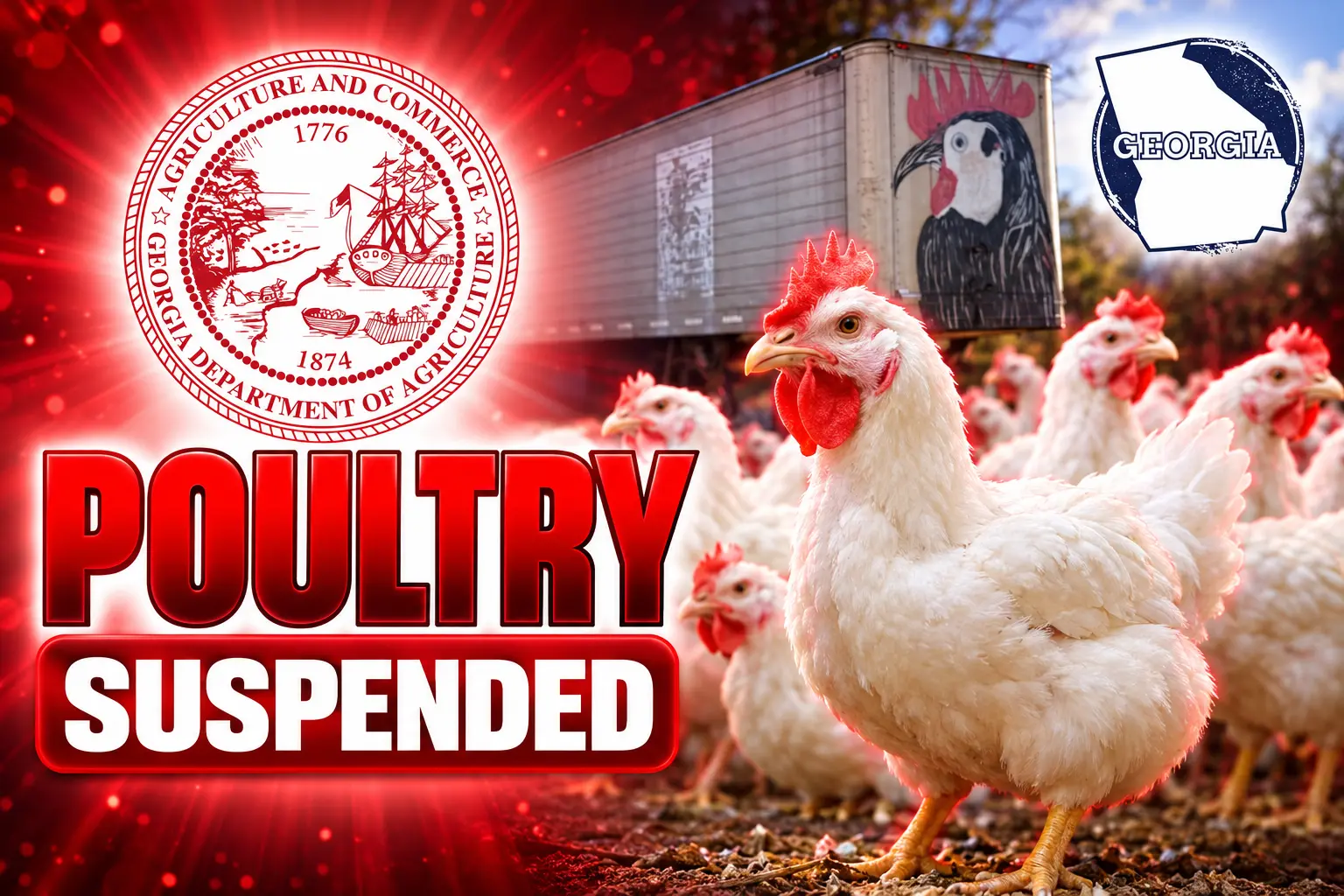
Agriculture Commissioner Tyler Harper called it a serious threat to Georgia’s No. 1 industry and to thousands of people who work in it. State veterinarian Dr. Janemarie Hennebelle ordered a halt to exhibitions, shows, swaps, meets, and sales at flea and auction markets until further notice.
THE ELBERT COUNTY CLOCK
- January 15, 2025: The producer sees clinical signs of avian influenza in the flock.
- January 16, 2025: Samples go to the Georgia Poultry Laboratory Network, which returns a positive result that afternoon.
- January 17, 2025: USDA’s National Veterinary Services Laboratory in Ames, Iowa, confirms the finding. Emergency Management and State Agricultural Response Teams start depopulation, cleaning, disinfection, and disposal of about 45,000 broiler breeders.
- January 17, 2025: All commercial poultry operations within 10 kilometers (6.2 miles) go under quarantine for at least two weeks of surveillance testing.
A second commercial premises, later called Elbert 02, sat about 210 yards away. GPLN flagged it on January 17, 2025, and NVSL confirmed it on January 21. That house held about 130,000 broilers. Teams already on Elbert 01 expanded onto the second farm.
This is a serious threat to Georgia’s #1 industry and the livelihoods of thousands of Georgians who make their living in our state’s poultry industry. We are working around the clock to mitigate any further spread of the disease and ensure that normal poultry activities in Georgia can resume as quickly as possible.
Tyler Harper, Georgia Agriculture Commissioner, January 17, 2025 department statement
Harper posted the same confirmation from his official account that evening.
Today, we confirmed the first positive case of HPAI in a commercial poultry operation in Elbert County. As a result, all poultry activities – exhibitions, shows, swaps, and sales – in Georgia are suspended until further notice. GDA staff are currently onsite at the affected… pic.twitter.com/BiBrvLF0jC
— Georgia Agriculture Commissioner Tyler Harper (@AgCommHarperGA) January 17, 2025
Swaps, Shows, and Flea Markets Went Dark
The order sounded total. It was not. The department suspended live-bird gatherings and live-bird sales. It did not close processing plants, and it did not pull chicken or eggs from stores.
Harper said every Georgian should have full confidence in poultry products offered for sale, and that no infected birds had entered the food supply. Properly cooked poultry and eggs remained safe, according to USDA guidance the department repeated. Private treaty sales between individuals were left out of the freeze.
Still, the phrase “all poultry activities” traveled as if Georgia had shut its broiler belt. The state produces a large share of U.S. chicken, so the misread implied empty meat cases and a fast jump in prices. Those cases stayed stocked. The people who lost weekends and lots were 4-H exhibitors, swap meet sellers, and auction consignors, not the plants packing trays for retail.
WHAT THE BAN COVERED
- Covered: In-state exhibitions, shows, swaps, meets, and live sales at flea markets and auction markets.
- Not covered: Retail meat and eggs, commercial production, and processing.
- Also open: Private treaty sales between individuals, which Harper’s department left outside the order.
- On the farms: Move outdoor birds indoors, keep a line of separation, watch for quiet birds, off feed, discolored combs, or sudden deaths, and call 770-766-6850 to report unexplained mortality.
On February 10, 2025, Harper lifted the suspension of poultry activities and released the Elbert control area after testing found no more virus there. The two infected premises stayed under quarantine. GPLN had run 4,541 tests on 49,951 chickens across hundreds of flocks. About 103 additional commercial operations had sat inside that 6.2-mile ring.
The freeze lasted 24 days. Harper said commercial producers in the control area and poultry enthusiasts across the state could return to normal operations, and that HPAI remained a threat to the No. 1 industry.
A $590 Million Check for a Human Shot
While GDA crews were on the Elbert farms, HHS announced it would provide about $590 million to accelerate mRNA flu vaccines at Moderna. The award ran through the Rapid Response Partnership Vehicle Consortium with money from the Biomedical Advanced Research and Development Authority. It was meant to speed an H5N1 mRNA candidate matched to strains then circulating in birds and dairy cows, plus an H7N9 candidate in a phase 3 study and up to four more pandemic influenza designs.
Assistant Secretary for Preparedness and Response Dawn O’Connell said the award was part of ASPR’s work on pandemic preparedness and mRNA platforms. The January package sat on top of $176 million HHS had already committed in July 2024. None of that money was a license to vaccinate Georgia chickens. It was a human preparedness bet, announced on the same calendar day the state’s first commercial flock went down.
On May 28, 2025, HHS terminated the awards. Moderna said it was notified that the department was ending funding for late-stage development and the right to purchase pre-pandemic influenza vaccines. The canceled total was $766 million. HHS communications director Andrew Nixon said that after a review, continued investment in Moderna’s H5N1 mRNA vaccine was “not scientifically or ethically justifiable.” Moderna CEO Stéphane Bancel said the cutoff added uncertainty, that a phase 1/2 study in about 300 adults had shown a strong immune response and safety profile, and that the company would look for other paths.
The pairing in January had looked like one flu response: cull the barn, fund the shot. By late May the human shot was unfunded, and the barns were still on a cull-and-clean protocol.
Why Winter Keeps Hitting Georgia Breeder Flocks
Harper declared Georgia HPAI-free in poultry on March 4, 2025, after the two Elbert farms. Under World Organisation for Animal Health rules, that status can be claimed once infected premises are cleared and 28 days pass with no new infection. Export buyers watch that clock. Grocery shoppers never had to.
The virus came back with migratory birds. On October 24, 2025, GDA and APHIS confirmed HPAI in a Gordon County commercial house of about 140,000 broilers, the third commercial chicken case in Georgia and, the department said that day, the fifth detection in the state that year. Harper again called it a serious threat to the No. 1 industry. On that date GDA put the U.S. toll at more than 182 million birds, including 340,000 in Georgia.
Gordon’s control area came off on November 17, 2025, after 1,790 tests on 10,690 chickens found no more positives. Harper restored HPAI-free status on December 2, 2025. The department then counted 345,530 birds affected in Georgia, across three commercial chicken flocks and one commercial waterfowl flock, against 184 million birds and 883 commercial flocks nationwide.
January 2026 opened the pattern again. Walker County lost about 71,264 broiler breeders, confirmed January 13, 2026, the fourth commercial poultry case in Georgia since February 2022. Premovement testing caught a second Walker flock of about 16,000 broiler breeders; depopulation there finished January 23, 2026, and the control area grew by five farms. Hart County followed late that month with about 39,600 broiler breeders, the sixth commercial chicken flock in the state during the outbreak.
GEORGIA COMMERCIAL CHICKEN DETECTIONS
| Premises | NVSL confirmation | Birds on site | Type |
|---|---|---|---|
| Elbert 01 | January 17, 2025 | About 45,000 | Broiler breeders |
| Elbert 02 | January 21, 2025 | About 130,000 | Broilers |
| Gordon 01 | October 24, 2025 | About 140,000 | Broilers |
| Walker 01 | January 13, 2026 | 71,264 | Broiler breeders |
| Walker 02 | January 23, 2026 | About 16,000 | Broiler breeders |
| Hart 01 | January 27, 2026 | About 39,600 | Broiler breeders |
Breeders keep showing up on that list because they sit in the pipeline longer than a meat flock. A broiler may live weeks; a breeder house is a longer target for wild-bird season, shared crews, and premovement tests. Elbert 02 was found on routine premovement sampling. Walker 02 was too. The surveillance ring works when it catches the next house before the birds move. It does not keep the next winter from arriving.
USDA Still Has Not Authorized a Farm Vaccine
APHIS, in its HPAI Poultry Innovation Grand Challenge materials last updated May 31, 2026, states that no HPAI vaccine has been authorized for use, except case by case in some endangered or zoo species. The agency is putting $100 million into prevention, therapeutics, vaccine research, transmission studies, and biosecurity. Recipients include vaccine makers, universities, and producer groups, chosen with HHS.
Georgia laboratories are on that list. Georgia Tech Applied Research Corp. is funded for an AI-designed live-bacteria poultry vaccine platform. The University of Georgia Research Foundation has awards for mass-vaccination-ready live virus vaccines, immunoprophylaxis, tannins, and nutrition work against avian influenza. Other teams are building oral and feed-delivered constructs, the kind of product a complex could use without injecting every bird.
That is not a product a Georgia integrator can legally use on a commercial house. Export markets have long treated vaccinated poultry as a problem, because shots can mask infection and complicate the tests trading partners demand. The Grand Challenge is an admission that culling alone has not ended an outbreak that began in February 2022. It is not permission to vaccinate the broiler belt.
The human program and the poultry program ran on separate tracks the whole time. January 17, 2025, made them look like one story. They were not. One was a BARDA contract for people. The other was a state field response built on depopulation, a 6.2-mile ring, and a hotline.
The 28-Day Export Clock After Every Cull
USDA’s National Agricultural Statistics Service, in its Poultry Production and Value summary issued April 30, 2026, put Georgia at 1.317 billion broilers in 2025, first in the country by head, with 8.17 billion pounds live weight and a production value of $5.85 billion. The U.S. produced 9.40 billion broilers worth $44.6 billion. Georgia’s share of that head count was 14 percent. North Carolina led on broiler value, at $5.92 billion.
University of Georgia Extension, in a circular updated September 23, 2026, still describes poultry as about 50 percent of the value of farm products in the state, with more than 4,000 family-owned poultry farms. Those farms, not the swap meets, are what WOAH status is built to protect. When Harper restores HPAI-free standing, the line he uses is that the designation allows exports and international trade of Georgia poultry products to resume.
That is the clock the January 2025 freeze was really serving, even when the public order landed on hobby flocks and auction birds. A 24-day ban on shows did not change the grocery case. A 28-day quiet period after cleaning a commercial house is what trading partners score. Elbert took that path in March 2025. Gordon took it in December 2025. Walker and Hart reset the same timer in early 2026.
Biosecurity is still the official defense Harper repeats after every confirmation: indoor birds, a hard line on the farm, fast reporting, Gold Standard protocols. The Georgia Avian Influenza hotline remains 770-766-6850. Wild-bird die-offs go to the Department of Natural Resources at 1-800-366-2661.
The first commercial case in Elbert County was supposed to be the break in a state that had spent three years watching the rest of the country burn flocks. It became a template instead: confirm, cull, freeze the live-bird circuit if needed, test the ring, wait 28 days, declare free, then meet the virus again when the ducks come through. The $590 million human vaccine award that landed on the same day as Elbert 01 is gone. The barns are still waiting on a shot they are not allowed to use.

Greed Held After a $697 Million Crypto Long Flush

Fed Minutes Keep a Year-End Rate Hike Alive

A Nanny-Cam Tape Follows Tyreek Hill Into Free Agency

Star Wars Galactic Racer Makes a Crash End the Tour

Amazon Puts Apple’s June MacBook Prices Back on Sale

Sophia Wootten Turns the Miss Georgia Crown Toward Cleft Care

The iPhone 16 Pro Flipkart Cut Did Not Last

Microsoft Prints Azure’s $29.42 Billion Quarter and Shrinks the Map

UltraTech’s Ultravolt Launch Puts Cable Multiples on Trial

IXI Autofocus Glasses Still Lack a European CE Mark
-
 NEWS1 year ago
The iPhone 16 Pro Flipkart Cut Did Not Last
-
 ENTERTAINMENT4 months ago
Sophia Wootten Turns the Miss Georgia Crown Toward Cleft Care
-
 BUSINESS1 month ago
UltraTech’s Ultravolt Launch Puts Cable Multiples on Trial
-
 NEWS1 month ago
Microsoft Prints Azure’s $29.42 Billion Quarter and Shrinks the Map
-
 NEWS9 months ago
IXI Autofocus Glasses Still Lack a European CE Mark
-
 NEWS3 months ago
Little St. Simons Island Hatches Loggerheads at 72.4 Percent
-

 NEWS4 months ago
Georgia Beach Bacteria List Leaves Swim Areas Open
-

 NEWS3 years ago
Eyal Waldman Keeps a Two-State Bet After Gaza