
TRAVEL
Georgia Safari Conservation Park: How to Visit Near Atlanta
Georgia Safari Conservation Park near Atlanta is a guided safari in Madison. The $35 truck tour skips the giraffe barn, which is a separate ticket from $100.

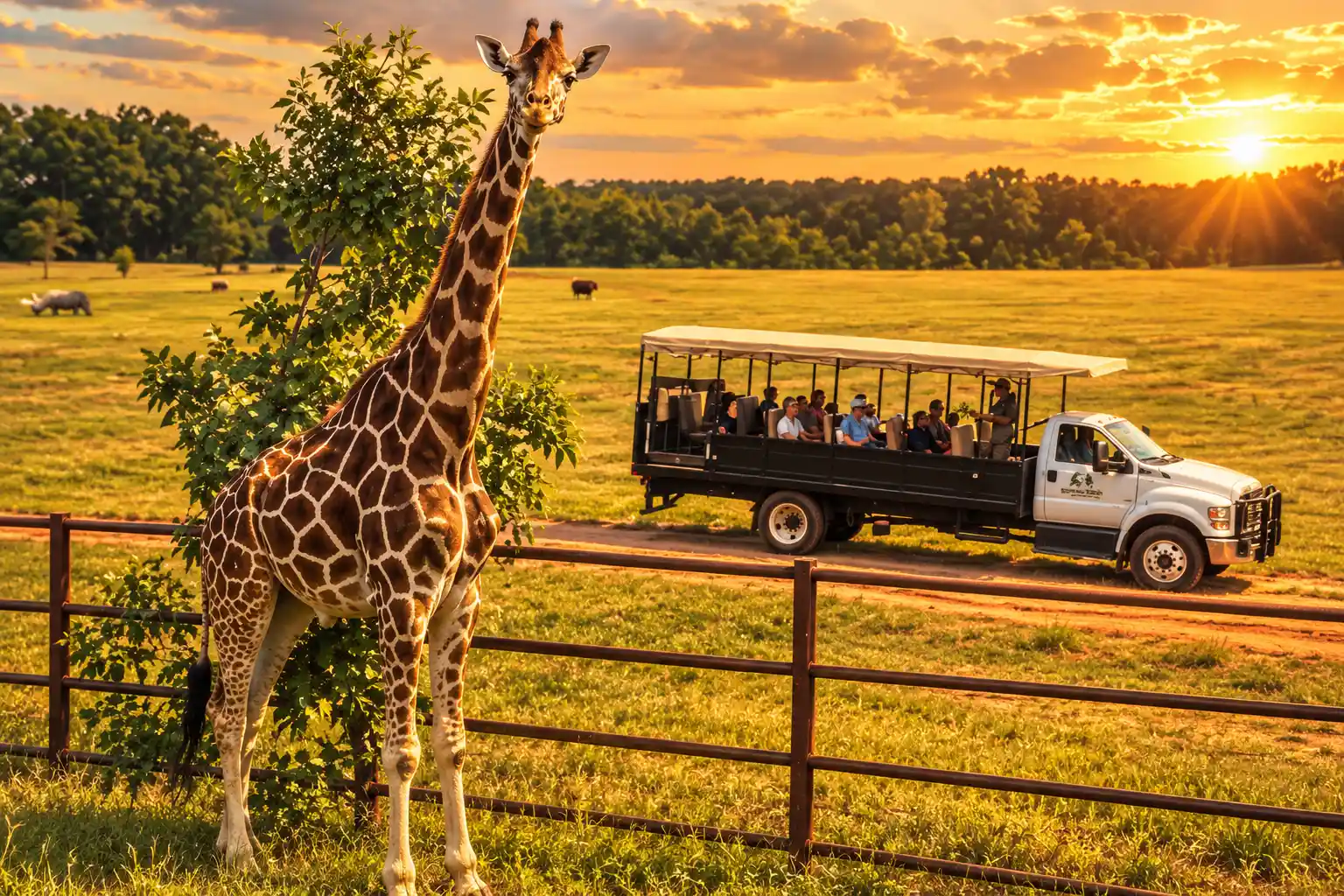
Georgia Safari Conservation Park puts giraffes, zebras, and rhinos on open pasture in Madison, about an hour east of Atlanta. You ride a staff-driven truck. Your own car stays in the lot.
The pasture ride and the giraffe barn are different tickets. A guided safari starts at $35 and never goes inside with the herd. Time with the reticulated giraffes and southern white rhinos starts on the barn tour, from $100, or on a longer ticket that includes both stops. This guide sorts the tours, the animals, the overnight rooms, and what the conservation label covers on a property whose animals came from other zoos.
Where the Madison Pastures Sit
The park stands at 1761 Monticello Road, Madison, GA 30650, six-tenths of a mile south of I-20 at exit 113. It opened in June 2024 on 530 acres, with 282 of those acres fenced as animal pasture, and the grounds are open every day from 8:30 a.m. to 5:00 p.m. except Thanksgiving Day and Christmas Day.
Staff drive every tour. The park bars personal vehicles because guests and animals share the same fields, and the rule is written for safety rather than for show. You stay in the truck or behind a fence. Walking out to a zebra for a photo is not allowed, on a day ticket or from an overnight deck.
That layout is the main split from a city zoo built around cages and sidewalks. Pasture animals move across large paddocks while guides talk, and the giraffe and rhino barn is a separate building of about 10,000 square feet where those two species eat, rest, and come inside. In September 2025 the property passed an American Humane Certified welfare audit. The same year it was named to TIME’s 2025 list of the World’s Greatest Places.
Which Ticket Includes the Giraffes?
People lose the afternoon they wanted when they buy the cheapest truck ride and expect a giraffe’s face at the rail. On the park’s posted tour comparison, the guided safari is a 1.25-hour pasture drive. It does not include the barn, and it does not include the ambassador-animal stop.
Prices below are the figures on that comparison chart. A plus sign on the chart means the listed number is a starting price, so a weekend, a holiday, or the busy season can sit higher. Discounts for children, seniors, military, and first responders apply to the guided safari, the safari encounter, and the barn tour. They do not apply to the sunset safari or the wild safari adventure.
| Tour | Length | Posted price | Pasture drive | Giraffe and rhino barn |
|---|---|---|---|---|
| Guided Safari Tour | 1.25 hours | From $35 | Yes | No |
| Safari Encounter Tour | 2 hours | From $109 | Yes | Yes |
| Barn Tour: Giraffe and Rhino | 1 hour | From $100 | No | Yes |
| Sunset Safari | 3 hours | $225 | Yes | Yes |
| Wild Safari Adventure | 2.75 hours | $250 | Yes | Yes |
The guided safari runs all year. In spring and summer the posted starts are 9:00, 9:30, 10:30, 12:30, 1:00, and 2:00. In fall and winter they are 10:30, 1:00, and 2:30. The encounter also runs all year, at 9:00 and 2:30 in spring and summer and at 9:30 and 2:30 in fall and winter, and that ticket adds the ambassador animals plus the barn. The barn tour itself is a 5:00 p.m. indoor visit with no pasture drive. Children age 2 and under are free on the barn tour.
MATCH THE TICKET TO THE ANIMAL
- Zebras on a budget: The guided safari is the pasture truck, and it does not enter the giraffe and rhino barn.
- Giraffes up close: Book the barn tour on its own, or any longer ticket that lists the barn as included.
- A full afternoon: The safari encounter adds the ambassador stop to the drive and the barn in about two hours.
The sunset safari is seasonal only, on Fridays and Saturdays from September 1 through October 31, departing at 4:30 p.m. The wild safari adventure runs from April through September at 2:30 p.m. Both include the drive, the ambassador animals, and the barn, and both can be booked as a private tour, as can the three year-round options. Group bookings often start at 15 tickets and need to be arranged ahead by phone.
Animals You Meet on the Truck and in the Barn
The park’s species index is a growing public list, not a promise that every animal will stand beside the truck on your hour. The visitor FAQ names the pasture regulars as addax, roan antelope, impala, zebra, ostrich, reticulated giraffe, and southern white rhino, with other hoofstock around them. Sightings still depend on where the animals are feeding that day.
Reticulated Giraffes You Can See Up Close
Reticulated giraffes are the only giraffe species on the property. You meet them indoors on a barn ticket, and overnight guests can watch the same tower through the windows of the Giraffe Suite. In cold weather, heavy rain, or lightning, staff may hold the giraffes inside, which can delay a tour even when the gates are open.
The herd grows by transfers, not by capture in Africa. On June 1, 2026, the park announced Frannie, a reticulated giraffe who arrived from Global Wildlife Center in Folsom, Louisiana. She was born on September 10, 2024, and the park listed her then at 10 feet 5 inches and 1,000 pounds. That same month the park announced a covered viewing and feeding platform measuring 12 by 16 feet, so guests could feed under staff direction from a raised spot instead of reaching in from a random fence.
Zebras, Antelope, and the Open Pasture
Two zebras appear on the species index, and they are not the same animal in a different light. Plains zebras, also called Grant’s zebras, share the fields with Hartmann’s mountain zebras. Guides also point out common eland, greater kudu, nyala, nile lechwe, nilgai, common waterbuck, ankole-watusi cattle, American bison, and Asian water buffalo, plus ostrich and emu.
- Addax and scimitar-horned oryx: Both are on the published species index and turn up in the pasture rotation with the antelope.
- Roan, impala, and waterbuck: These are the hoofstock the FAQ tells day guests to expect on a normal drive.
- Birds on the grass: Ostrich often walk up to the truck, and emu are on the same index.
A cheap ticket is built for this view. If zebras and antelope are the reason for the drive, the $35 tour is the one that matches the goal, and paying for the barn will not put you deeper into those fields.
Southern White Rhinos in the Barn
Southern white rhinos share the barn with the giraffes, which is why the one-hour barn tour sells the two species together. You see them in the building where they eat and rest, with a guide, and you do not walk the pasture to find them on your own. The encounter, sunset, and wild tickets fold that barn stop into the pasture drive. The guided safari does not.
Smaller animals sit on the same species index and mostly off the open truck route: a Linnaeus’s two-toed sloth, a fennec fox, a Brazilian three-banded armadillo, a pancake tortoise, an African spurred tortoise, a prehensile-tailed porcupine, a coati, a sugar glider, and several reptiles. The ambassador stop on the encounter, sunset, and wild tickets is the keeper-led visit that the $35 drive and the barn-only hour both leave out. The chart does not publish which of those smaller species appears on a given day.
What Does Conservation Mean on This Property?
Every animal at the park comes from another zoological facility. That line is in the park’s visitor FAQ, and it changes what the word conservation can honestly mean on a Saturday ticket. This is a managed herd under human care, with education on the truck and room to move on 282 acres of pasture. It is not a site where wild giraffe are released back onto African range.
The giraffes you are looking at still belong to a species with a hard wild account. The Giraffe Conservation Foundation status page puts the combined African population at about 140,000, up from the fewer than 100,000 listed when the IUCN Red List treated all giraffe as one Vulnerable species in 2016. On that 2016 list the reticulated giraffe, then classed as a subspecies, sat at Endangered. The foundation now treats giraffe as four species, and its expected 2025 Red List table places reticulated giraffe at Endangered, northern giraffe at Endangered, Masai giraffe at Vulnerable, and southern giraffe at Least Concern. New official assessments were still underway when that table was published, so those four labels are the foundation’s expected rankings, not a finished IUCN decision.
J.T. Cline, who works on the park’s animal care staff, puts the teaching goal in one line: “You can’t save a species you don’t know exists.” The visit can do that teaching. It does not move a wild reticulated giraffe from Kenya into a safer park, and the ticket price should not be read as a field donation to that work unless the park says so on the booking page you are using.
Rooms That Overlook the Giraffe Barn
Day tours end at the barn door. Overnight guests get the longer look, and the room you pick changes which tours are already paid for.
The Giraffe Suite is 828 square feet on the barn, with a king bed and a queen sleeper sofa, sleeping one to four people. Windows look into the giraffe space, and the room has a kitchenette, air conditioning, Wi-Fi, and a private deck. It is wheelchair accessible. The rate includes both the barn tour and the safari encounter.
Luxury safari tents are the other full-size option, and the park describes six of them overlooking habitat. The comparison chart lists a two-bedroom tent with a king and two extra-long twins, best for four people, with a fifth guest only if you pay an extra occupancy fee. That stay includes the safari encounter. The barn tour is an upgrade, not an automatic inclusion. A one-bedroom honeymoon hideaway sleeps up to three, includes the encounter, and has an outdoor tub and shower. It is not listed as wheelchair accessible. The accessible tent on the chart is 106 Eland.
Check-in is at 4:00 p.m. and checkout is at 11:00 a.m. Lodging backs onto the Veldt Pasture, a 20-acre-plus field the park says can hold antelope, giraffe, ostrich, and native wildlife. Binoculars are in the unit. Sightings are not guaranteed, lights on the animals after dark are prohibited, and loud noise after 10:00 p.m. is discouraged. There is no on-site restaurant. The Outpost and the Lodge sell snacks and drinks, and Madison’s restaurants are about a five-minute drive. A lodging date moved at your request carries a $200 transfer fee. Weather is not a reason for a refund. If the park cancels, the refund is full.
How to Plan the Drive and the Day
The useful order is ticket first, then the clock. A same-day walk-up is allowed at the Outpost and still not a plan, because the FAQ says a preferred time is not guaranteed without a reservation.
- Pick the animal, then the row. Zebras and antelope fit the guided safari. Giraffes or rhinos up close require a ticket that includes the barn.
- Reserve before you leave Atlanta. Book online or call (706) 342-4296. Private and group sales use (706) 752-5666.
- Exit I-20 at 113 and allow the last half mile. The gate is six-tenths of a mile south on Monticello Road, with free parking. Arrive at least 30 minutes before the tour time, because trucks leave on schedule.
- Pack for the truck, not a picnic. Cameras and binoculars are welcome. Water is fine. Outside food is generally not. Strollers may enter the Outpost or the Lodge and may not board a tour vehicle.
- Bring the right chaperone. On tours, guests under 18 need a chaperone who is at least 18, and one adult may cover up to 10 minors. In lodging, the chaperone must be at least 21, show an ID, and stay on site.
All tours are wheelchair accessible if you ask ahead, and public spaces are built for mobility devices. For a lodging stay that needs an accessible room, call at least 48 hours ahead. Uber and Lyft may come onto the property. There is no park shuttle. Pets are not allowed. A certified service animal can stay in lodging with notice and proof, must remain with the handler, and is not allowed on tours. Smoking and vaping are banned on tours and inside rooms, with designated outdoor spots for lodging guests only.
If the goal is a cheap drive in your own car, this is the wrong gate. Atlanta Safari Park in Commerce, about an hour northeast of Atlanta off I-85, is the drive-through. It opened in spring 2023 on 156 acres, posts adult admission at $17.99 for ages 13 to 64, and keeps giraffe feeding in a walk-through area after the drive. Georgia Safari Conservation Park will not let you roll your windows down in your own vehicle and hand an animal a pellet. Budget the Madison trip as a reserved truck tour, or pick Commerce and accept a different kind of visit.
Frequently Asked Questions
Is Food Sold at the Park?
There is no restaurant on the property. The Outpost and the Lodge sell snacks and drinks, and water-bottle filling stations sit at the Outpost and near the restrooms at the back of the park. A full meal means a short drive into Madison, which the park puts at about five minutes.
Can a Dog or a Service Animal Ride Along?
No pet rides the truck or stays in a room. A certified service animal is limited to lodging, needs proof and advance notice, and must stay with the handler the whole time. The same animal is not allowed on a tour, so a handler who needs the animal with them cannot use the pasture trucks.
What Happens if the Weather Turns?
Tours are sold as rain or shine, and a wet forecast is not an automatic cancellation. Heavy rain, lightning, or very cold air can keep giraffes indoors and can delay or move a departure. Lodging guests do not get a weather refund, though they can move the date for the $200 transfer fee.
Do Young Children Need a Full Ticket?
Children age 2 and under are free on the barn tour. Older children need a ticket, and the guided safari, the encounter, and the barn tour are the three products that list a child discount. One adult chaperone can cover up to 10 minors on a tour. There is no upper age limit, and guests of every age are welcome.
Can You Stay Overnight in an RV?
No overnight RV spots are on the property. The park points RV guests to Hard Labor Creek State Park and the Lake Oconee and Greensboro KOA Holiday for nearby campgrounds, then back to Madison for the morning tour. Holiday pricing still hits Spring Break, Memorial Day weekend, the Fourth of July, Labor Day, Thanksgiving weekend, December 23 through 26, and New Year’s Eve and New Year’s Day, even when you sleep off site.
Give the booking the same half hour you would give a flight. The truck for a 10:30 guided safari leaves at 10:30, the 5:00 p.m. barn tour is the only daily hour posted for that visit, and a $35 ticket never opens the door where Frannie and the rhinos stand.

Greed Held After a $697 Million Crypto Long Flush

Fed Minutes Keep a Year-End Rate Hike Alive

A Nanny-Cam Tape Follows Tyreek Hill Into Free Agency

Star Wars Galactic Racer Makes a Crash End the Tour

Amazon Puts Apple’s June MacBook Prices Back on Sale

Georgia Beach Bacteria List Leaves Swim Areas Open

Sophia Wootten Turns the Miss Georgia Crown Toward Cleft Care

IXI Autofocus Glasses Still Lack a European CE Mark

The iPhone 16 Pro Flipkart Cut Did Not Last

Microsoft Prints Azure’s $29.42 Billion Quarter and Shrinks the Map
-
 NEWS5 months ago
Georgia Beach Bacteria List Leaves Swim Areas Open
-
 ENTERTAINMENT5 months ago
Sophia Wootten Turns the Miss Georgia Crown Toward Cleft Care
-
 NEWS10 months ago
IXI Autofocus Glasses Still Lack a European CE Mark
-
 NEWS1 year ago
The iPhone 16 Pro Flipkart Cut Did Not Last
-

 BUSINESS2 months ago
UltraTech’s Ultravolt Launch Puts Cable Multiples on Trial
-
 NEWS2 months ago
Microsoft Prints Azure’s $29.42 Billion Quarter and Shrinks the Map
-
 NEWS4 months ago
Little St. Simons Island Hatches Loggerheads at 72.4 Percent
-
 NEWS2 years ago
Capyfriends Cafe Routes Helen Tourists to Cleveland Capybaras