
LIFESTYLE
How to Easily Invert Without an Inversion Table at Home
Invert without an inversion table on a wall, a counter, or a bar, with short holds, a slow return upright, and clear reasons to skip a head-down position.

Your lower back can feel packed down after a long day on your feet, and an inversion table is the tool most people picture. You can invert without an inversion table, using a wall, a counter, or a bar, and you do not have to hang fully upside down.
The part that changes the feel of your back is which way the spine is loaded, and for how long. Below, you will find the positions, the hold times, and the health reasons to skip a head-down pose.
What Does Inversion Do to the Lower Back?
When you stand or sit tall, gravity stacks your vertebrae and squeezes the discs between them. Inversion therapy turns that stack so gravity pulls the other way for a short time, which is meant to give the lower-back nerves more room and let the discs spread out a little.
On a table, you strap in, tip backward, and choose the angle, from a slight recline up to fully upside down. At home, without that padded deck and ankle locks, you borrow the same idea with your own body weight. Legs on a wall keep the spine level while the legs sit higher than the heart. A counter or a bar lets the torso drop so the shoulders and hands carry you and the low back gets a gentle length.
That is different from a stretch that only moves a stiff muscle. Child’s pose and cat-cow loosen joints and calm tight muscle. A real unload asks gravity to take some of the stacking pressure off the discs. Both can belong in the same session, and the floor stretch is the right first step if hanging makes you clench.
“The research is mixed,” says Haren Bodepudi, MD, a Cleveland Clinic pain specialist. “Some studies have found it can provide relief for some people, but others haven’t found any benefit.” Fans mention chronic low back pain, muscle spasms, compressed discs, sciatica, and scoliosis. Treat those as hopes people bring to the practice, not as promises a home hang can cash.
Which Home Inversion Fits Your Back
Match the position to the body you have today, not to the most dramatic picture online. A milder pose you can breathe through beats a full hang you have to fight.
| Your situation | Start here | First hold | Skip it when |
|---|---|---|---|
| Stiff after sitting, no pain down the leg | Legs up the wall, or calves on a chair | Up to two to three minutes | Glaucoma, uncontrolled high blood pressure, heart failure, kidney failure, or liver failure |
| New to this, or the back feels guarded | Child’s pose, then cat-cow | 30 to 60 seconds, then 10 to 15 rounds | The movement brings sharp pain, numbness, or tingling |
| You want a stronger length and your hands feel fine | Kitchen counter, then a pull-up bar | 20 to 30 seconds | Shoulder pain, a slipping grip, dizziness, or no safe way to stand back up |
| Pain runs down a leg | Floor poses only, after a clinician has seen you | Short and easy | Weakness, or any change in bladder or bowel control |
| Ankles, balance, or getting to the floor is hard | Calves on a chair seat | Same quiet minutes as the wall pose | You feel unsteady lying down or sitting back up |
An inversion chair is still equipment. It lets some people tip back from a seat when ankles or mobility make a table awkward, and it does not replace the floor work above. Gravity boots are a full ankle hang from a bar, with no shallow angle to grow into, so they are a poor stand-in for a first session at home.
How to Invert on the Floor Without a Table
Floor work keeps your neck and the back of your head supported. That is the reason to learn it before you ever hang. Clear a spot where you can roll to your side without bumping furniture, and keep a pillow within reach.
How to Do Legs up the Wall Pose
Legs up the wall, viparita karani, puts the legs above the heart while the trunk stays on the floor. It is a real inversion, and it is the one most people can enter without loading the neck. Follow these legs-up-the-wall pose instructions and use the steps below so the written version stands on its own.
- Lay a mat or folded blanket beside a clear wall, and add a thin pillow for your head if the floor feels hard.
- Sit sideways with one hip close to the wall, then roll onto your back and swing the legs up.
- Leave the tailbone on the floor and the hips a few inches out from the wall so the low back is not jammed.
- Rest the backs of the legs on the wall, knees soft, feet relaxed. You want a light stretch in the legs, not a pull that makes you hold your breath.
- Stay up to two to three minutes. You can stay longer only while you still feel calm and the legs are not buzzing, numb, or hot.
- Bend the knees, roll to one side, and sit for at least 30 seconds before you stand.
Once or twice a day is plenty, at the end of a short movement session or on its own after you get home. A Cleveland Clinic short shows the hip placement if you want a look before the first try.
“The advantage of legs up the wall compared to a headstand or shoulder stand is that you’re able to achieve the benefits of inversion without stressing or straining your neck and head.”
Robert Saper, MD, MPH, Chair of Wellness and Preventive Medicine, Cleveland Clinic
People with chronic neck pain or neck-spine disorders should stay off shoulder stands and headstands. The wall pose avoids that neck load, and it is still off limits in glaucoma, because this family of poses raises pressure inside the eye until you sit back up.
How to Unload Your Back on a Chair or a Bed
If the wall is awkward, lie on your back and rest your calves on the seat of a sturdy chair. The hips and knees bend, the low back can settle toward the floor, and you are not asking your hamstrings to hold a straight leg. Use the same quiet breathing and the same slow sit-up at the end.
A bed can do a similar job when the floor is not an option. Lie face up with the hips still supported by the mattress and let the knees bend so the weight of the lower legs hangs just off the side. The spine stays level, and the hanging legs add a small pull at the lower segments. Stop at the first pinch, numbness, or need to hold your breath.
TRY THE CHAIR FIRST
- The setup: Choose a chair that will not roll, and keep both hips even on the floor or the bed.
- The exit: Roll to your side and sit before you stand, the same way you leave the wall pose.
These shapes take the standing stack off the discs without dropping your head below your heart. They are the right home base if a bar hang makes your face pound or your hands fail before your back feels any change.
Gentle Floor Stretches Before You Invert
Use a minute of easy movement before a hang so the back is not cold. None of these is a full inversion, and each one should feel like length, not a jab.
- Child’s pose: Kneel, widen the knees, sit the hips toward the heels, and rest the torso between the thighs with the arms reaching forward for 30 to 60 seconds.
- Prayer stretch: From that kneel, keep the hips back and reach the arms farther forward to lengthen the mid back.
- Cat-cow: On hands and knees, exhale and round the spine up, then inhale and let the belly drop, for 10 to 15 easy cycles.
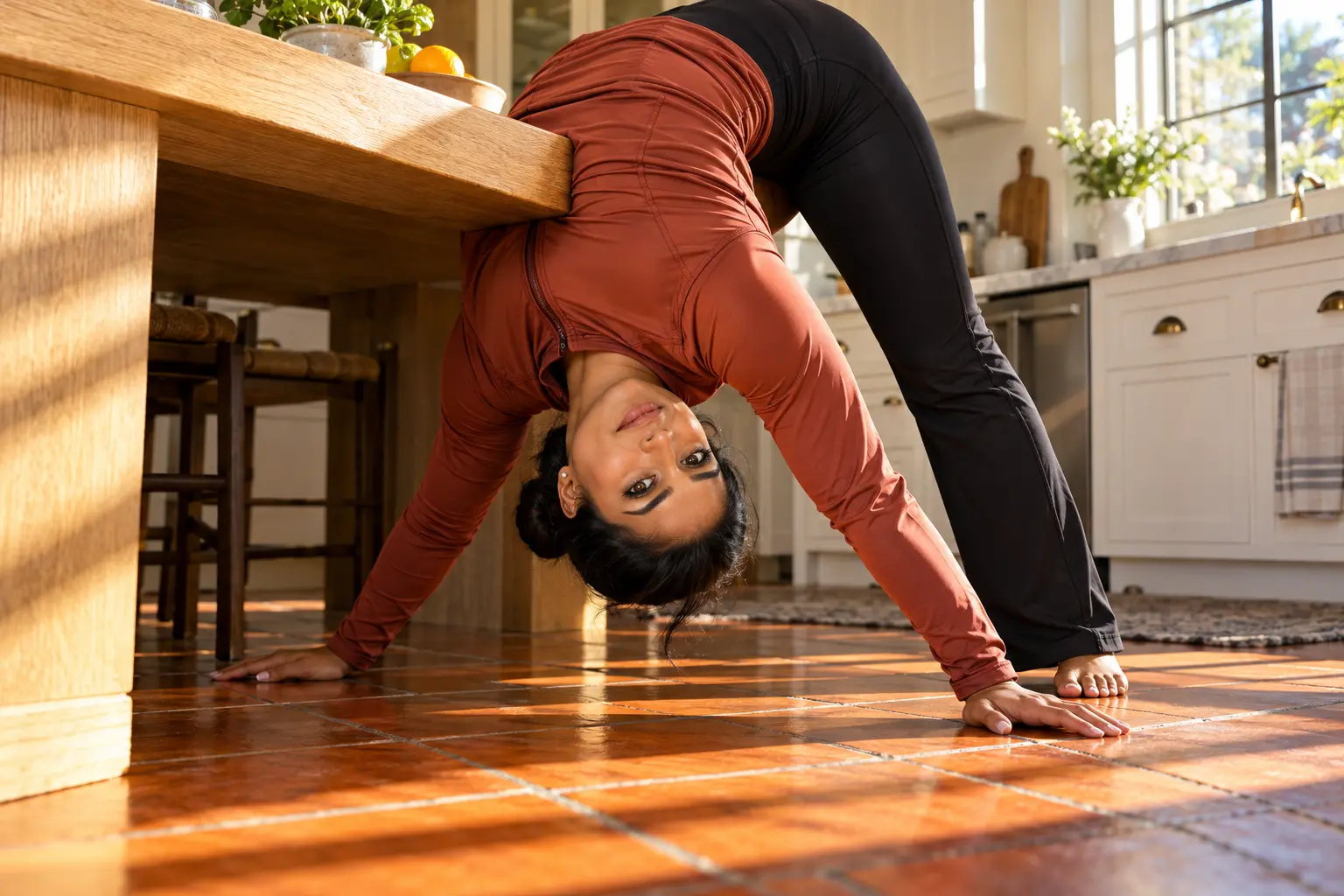
- Standing fold: Hinge at the hips and let the head hang, with the knees soft if the hamstrings grab, then stand by bending the knees.
A foam roller across the mid back can loosen muscle around the spine, and it does not invert you. Roll only on muscle, keep the head supported, and skip the roller if it sends pain down a leg. Downward-facing dog, hips lifted into an inverted V from hands and knees, is a stronger shape because the head drops below the heart, so the skip list for head-down work applies there too.
How to Hang From a Counter or a Bar
Hanging adds a real traction force because your body weight is the load. It also asks more of your grip, shoulders, and blood pressure. Learn the counter before the bar, and keep a chair nearby so you can put your feet down without a scramble.
How to Use a Kitchen Counter for Traction
- Face a sturdy counter or sink and place both hands on the edge, about shoulder width.
- Step the feet back until the arms are straight and the hips can hinge.
- Let the chest drop so the torso moves toward parallel with the floor, and soften the knees.
- Relax the neck so the head hangs between the arms, and keep a little brace through the belly if your back tends to sag.
- Hold 20 to 30 seconds while you breathe, then walk the feet in and stand up slowly.
You should feel a long line from the hands through the sides of the back. Sharp pain in the shoulder, a pinch in the low back, or tingling in the hands means the counter is the wrong tool today. A back-extension bench at a gym is a cousin of this idea: you hook the feet and let the torso hang face down, and the same stop rules apply.
How to Hang From a Pull-Up Bar
Use a bar that is fixed to a solid frame, not a doorway bar that twists in the trim. Grip it, let the shoulders settle away from the ears, and allow the body to hang while the back muscles stop clenching. If your feet still touch, bend the knees so the legs are not holding you up.
Hold 20 to 30 seconds, and repeat that short hang three or four times in the day rather than chasing one long dangle. Come down by bending the knees and landing softly, then stand still for a moment before you walk off. Dizziness, a pounding head, or pain that spreads into a leg ends the session.
- Grip: Wrap the thumb, and step down the moment the hands start to slip.
- Shoulders: Let them drop instead of hiking them toward the ears.
- Landing: Know where your feet will go before you leave the floor.
A full ankle hang, the gravity-boot version, removes the hand grip and also removes any chance to choose a small angle. Save that for a clinician who already knows your ankles, your eyes, and your blood pressure. A dead hang that only stretches can leave the back feeling loose for a short while and still unready to hold you up once you stand, so keep the strength work you were given.
How Long Should You Hold a Home Inversion?
Home poses and inversion tables do not share one clock. On a table, the studied dose that clinics point to is three minutes at a 60-degree tilt, and the way in is shorter than that. Beginners on a table are told to start with 30 to 45 seconds, and to add time only if they are not dizzy and the pain is not worse.
In an eight-week program of women with chronic low back pain, three-minute sets at a 60-degree tilt, three sets in a session, four days a week, reduced pain and improved lumbar flexibility and trunk extensor strength. Lying flatter and a shallower tilt were part of that same comparison, so the lesson for a kitchen is not “hang as far as the boots allow.” The lesson is that a partial angle, repeated in short sets, was the dose tied to those changes.
A wall pose cannot be set to 60 degrees with a strap, and a counter hang is a different force. Borrow the habit, not the hardware setting: short holds, a full rest between them, and a slow return upright so blood is not rushing back all at once. Bodepudi says longer-lasting benefit, when it shows up with daily table use, can take as much as eight weeks. That daily horizon is his clinical caution, separate from the four-day program in the angle study. Missing a day is not a failed week.
A pilot trial in disc surgery patients is the clearest look at inversion as an add-on. Among people already listed for single-level disc surgery, surgery was avoided in 10 patients (76.9%) who added inversion to physiotherapy, and in two patients (22.2%) who had physiotherapy alone. There was no clear gap on the pain and disability scores in that small trial, and the authors called for a larger study. Those numbers describe table inversion plus physiotherapy in people headed for an operation. They do not describe child’s pose, and they do not mean a bar hang replaces a surgeon’s advice.
Who Should Skip Home Inversion?
You should talk with your physician before you invert, because a sudden rise in pressure inside the skull can cause serious harm and, in severe cases, can be fatal. The same shift sends more blood toward the head and can raise pressure in the eyes. Come up slowly for that reason, even from the wall.
Skip head-down inversion, including a full bar hang, if you have any of these until a physician has cleared it:
- High or low blood pressure, heart disease, or postural orthostatic tachycardia syndrome (POTS)
- Glaucoma or another eye disease, including a past retinal detachment
- Acid reflux that flares when you tip, or a hiatal hernia
- Pregnancy
- A past stroke, brain injury, or brain bleed
- Osteoporosis, a spinal fracture, a spinal fusion, or an artificial disc
- Blood-thinning medicine, or a spinal infection or tumor in your history
Legs up the wall has its own stop list even though the neck stays on the floor. Do not do it with glaucoma. Skip it, or use it only with a physician’s guidance, if you have congestive heart failure, kidney failure, or liver failure or cirrhosis, because a large volume of fluid returning from the legs can strain the heart. Uncontrolled high blood pressure is a reason to wait. After your pressure is controlled, ask whether a short version is reasonable. There is no good evidence that the pose treats headaches or high blood pressure, despite claims you will see online.
GET HELP THE SAME DAY
- New weakness: A leg that gives way, or weakness that was not there this morning, needs urgent care rather than another hang.
- Bathroom changes: Loss of bladder or bowel control, or numbness in the groin, is an emergency.
- Pain after trauma: Back pain that follows a fall or a crash belongs with a clinician, even if a stretch dulls it.
- Pain that lingers: Pain that still limits daily life after three months needs a medical visit, not only a longer hold.
Leg pain has its own map. Learn how a herniated disc can press on a nerve before you treat a radiating ache as tight muscle. Inversion should sit beside the plan you were given, such as physical therapy, walking, and core work, and it should not be the only thing you do for the pain.
Common Mistakes When You Invert at Home
The fastest way to feel worse is to stand up in a hurry. Blood has shifted toward the head, and a quick pop to your feet is when dizziness and a spike of pain show up. Roll, sit, and wait.
Forcing the hips flush to the wall looks tidy and often jams a tight low back or a short hamstring. Leave a few inches, bend the knees, and let the tailbone stay heavy. Holding the breath turns a quiet pose into a strain, so if you cannot take a slow breath, the shape is too deep.
A white-knuckle bar hang with the shoulders shrugged loads the neck and the hands more than the low back. Set a short timer, land on purpose, and stop for the day when the grip fades. Doing the hang every time the ache returns, while skipping the strength work that holds the spine when you stand, is how a loose feeling turns into an unsteady one an hour later.
Full upside down is not a graduation prize. The angle tied to the eight-week change was a tilt, not a requirement to reach 180 degrees. If 20 seconds at the counter already feels like enough, stay there.
Frequently Asked Questions
Are Gravity Boots a Substitute for an Inversion Table?
Gravity boots are not a table-free shortcut, because they are their own device and they lock you into a full hang by the ankles. You cannot choose a shallow angle, and getting into and out of the hang is harder than rolling away from a wall. If your ankles, balance, or blood pressure are already a concern, a floor position is the safer place to start.
Does Legs up the Wall Pose Lower Blood Pressure?
Legs up the wall is not a treatment for high blood pressure, and there is no good evidence that the pose brings blood pressure down. People with uncontrolled high blood pressure are advised to skip it. Once a doctor has your pressure under control, you can ask whether a short, supported version is reasonable for you.
Can You Sleep While You Are Inverted?
You should not sleep upside down or stay in a full hang for a long stretch. Inversion sends more blood toward your head, and a rise in pressure inside the skull is the risk clinicians warn about. A restorative pose on the floor is a few quiet minutes, then you sit up and pause before you stand.
Should Home Inversion Replace Physical Therapy?
Home inversion should not replace physical therapy or the rest of a back-pain plan. A floor pose or a short hang can sit beside walking, strength work, and the exercises a clinician gives you. If leg pain, weakness, or a known disc problem is the reason you want to invert, get that plan first rather than building one from a bar in the garage.
What If a Home Inversion Makes Back Pain Worse?
Stop the position if your pain, dizziness, or leg symptoms increase, and do not push a deeper angle the next day to force a bigger stretch. Go back to the mildest floor pose that feels easy, or skip inversion until you have been checked. Pain after a fall, pain that keeps you from daily tasks for months, or any change in strength or bathroom control needs a clinician, not another hang.
The position you can breathe in is the one worth repeating tomorrow. Start on the floor, add the counter only after the wall pose feels ordinary, and leave a full hang for a day when a clinician has already said your heart, eyes, and blood pressure can handle a head-down load.
Disclaimer: This article is an educational guide to home positions that unload the back, and it is informational only. It is not medical advice, a diagnosis, or a treatment plan for back pain, sciatica, or any other condition. Talk with a qualified clinician, such as your physician or a physical therapist, before you invert, especially if you have blood pressure problems, eye disease, heart disease, or a spine condition. Times, angles, and safety limits here reflect the sources reviewed for this guide and can change as guidance is updated.

Greed Held After a $697 Million Crypto Long Flush

Fed Minutes Keep a Year-End Rate Hike Alive

A Nanny-Cam Tape Follows Tyreek Hill Into Free Agency

Star Wars Galactic Racer Makes a Crash End the Tour

Amazon Puts Apple’s June MacBook Prices Back on Sale

Sophia Wootten Turns the Miss Georgia Crown Toward Cleft Care

The iPhone 16 Pro Flipkart Cut Did Not Last

Georgia Beach Bacteria List Leaves Swim Areas Open

IXI Autofocus Glasses Still Lack a European CE Mark

UltraTech’s Ultravolt Launch Puts Cable Multiples on Trial
-
 ENTERTAINMENT5 months ago
Sophia Wootten Turns the Miss Georgia Crown Toward Cleft Care
-
 NEWS1 year ago
The iPhone 16 Pro Flipkart Cut Did Not Last
-
 NEWS5 months ago
Georgia Beach Bacteria List Leaves Swim Areas Open
-
 NEWS10 months ago
IXI Autofocus Glasses Still Lack a European CE Mark
-
 BUSINESS2 months ago
UltraTech’s Ultravolt Launch Puts Cable Multiples on Trial
-

 NEWS4 months ago
Little St. Simons Island Hatches Loggerheads at 72.4 Percent
-

 NEWS2 months ago
Microsoft Prints Azure’s $29.42 Billion Quarter and Shrinks the Map
-

 NEWS1 year ago
Capyfriends Cafe Routes Helen Tourists to Cleveland Capybaras