
BUSINESS
Westpac’s Pacific Stay Becomes a Three-Year Investment Bet
Three years after killing a Pacific sale, Westpac is funding its largest regional systems upgrade in a decade, without the public guarantee later given to ANZ.

Westpac will make its largest Pacific investment in more than a decade in the 2026 financial year, upgrading core systems in Fiji and Papua New Guinea. The spend lands two years after the bank ended a long attempt to sell both units, a process Papua New Guinea’s competition watchdog had already killed in 2021.
The stay is now a scored bet. Westpac is putting systems money into the two markets it could not exit, while Australia later underwrote ANZ’s wider island network with a public guarantee Westpac has not been named as receiving.
The $420 Million Sale PNG Refused to Allow
Westpac put Westpac Fiji and its 89.91% stake in Westpac Bank PNG Limited on the block on 7 December 2020. The chosen buyer was Kina Securities. The package was priced at $420 million (US$264 million), with $315 million due at completion, $60 million for the PNG stake paid over 18 months, and up to $45 million in Fiji earn-outs.
Papua New Guinea’s Independent Consumer and Competition Commission said no. ICCC commissioner and chief executive Paulus Ain issued a final determination in mid-September 2021 denying authorisation. Kina had offered to run the bought bank as a stand-alone brand, East West Commercial Bank. Ain said common ownership meant they would not be two banks. The deal would have cut PNG’s commercial banks to two, Kina and Bank South Pacific, in markets the commission already called highly concentrated.
The ICCC also said it was not satisfied the purchase would benefit the public, and that it would “limit national economic progress.” Kina’s book of about 165,000 customers would have jumped past 500,000 if the two banks had been combined. On 22 September 2021, Westpac and Kina terminated the Kina sale agreements. Westpac had already booked a $121 million loss on sale at its first-half 2021 result, covering write-downs, deal costs and separation provisions, some of which it expected to write back.
THE FAILED EXIT
- 7 December 2020: Westpac announces the sale of Westpac Fiji and 89.91% of Westpac Bank PNG to Kina Securities.
- 14 September 2021: The ICCC issues its final determination denying authorisation.
- 22 September 2021: Both sides terminate the sale contracts. Westpac says it will keep operating the banks while it looks at other exits.
- 4 October 2023: Westpac tells the ASX the sales process is over and it will keep both businesses.
Other names had already circled. France’s BRED-Banque Populaire bid, as did PNG’s NasFund and Credit Corporation. After the ICCC ruling, the Fiji National Provident Fund also entered talks. None of those paths closed. Then-chief executive Peter King had told the ICCC that without a sale to Kina, “our only remaining option would be to continue to progressively scale down the business and seek an exit whenever possible.”
Canberra Wanted Australian Banks to Stay Put
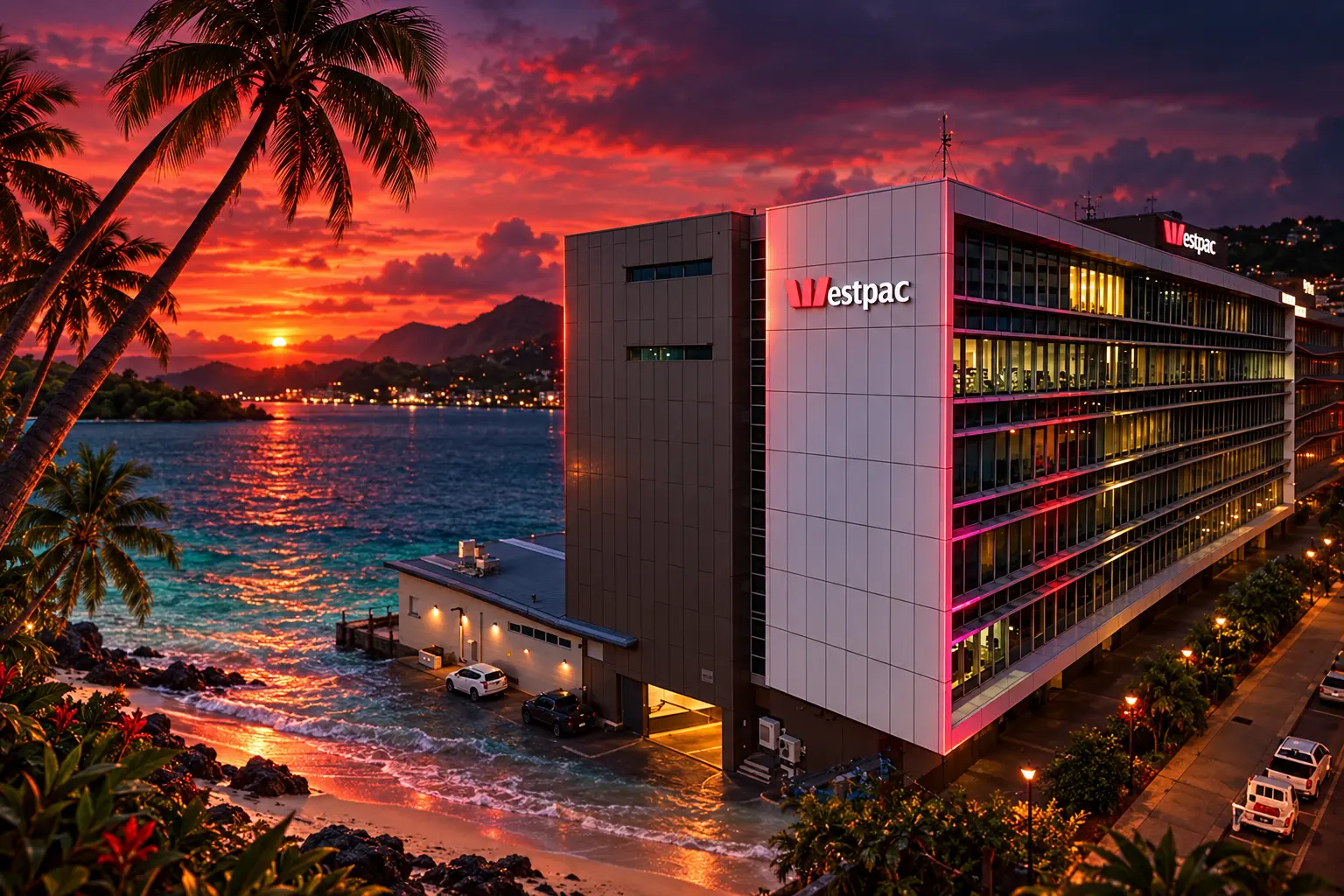
On 4 October 2023 Westpac concluded its Pacific sales process and said it would keep Westpac Fiji and Westpac Bank PNG Limited. The short ASX note promised support for local business, better digital service, and community programs in financial literacy. That was the same week the bank cancelled the Pacific business sale after two years of hunting for another buyer.
Staff heard a sharper version. Anthony Miller, then head of Westpac Institutional Bank, told them the bank now saw a commercial opening in PNG and Fiji, and that it would invest to grow Pacific banking, tighten risk controls, and run a new brand campaign in both countries.
Westpac has a great role to play in this very important region with our ability to be a strong, stable and trusted financial partner in the Pacific.
Anthony Miller, then Westpac Institutional Bank head, staff note, 4 October 2023
Treasurer Jim Chalmers welcomed “Westpac’s continued presence in Fiji and Papua New Guinea to promote competition and better banking services in the Pacific,” tying those services to trade, investment and remittance flows. Fiji’s then finance minister, Professor Biman Prasad, called the decision a vote of confidence after 123 years of Westpac operations in Fiji.
The Australian debate around the stay treated the banks as a China problem as much as a customer one. China signed a security agreement with Solomon Islands in 2022. Bank of China had opened a Port Moresby representative office in 2018, closed it in 2020, and reopened it in June 2023. In 2019, ten Pacific countries, including Fiji and PNG, signed an economic co-operation deal with China that backed Chinese-invested banks operating in the islands. Local papers in Port Moresby and Suva framed the same announcement as jobs and investment. Both readings can sit on the same set of facts. The ICCC had already locked Westpac in. Canberra then made staying the preferred outcome.
The 2015 Sales That Left Only Two Markets
PNG and Fiji were not Westpac’s whole Pacific story. On 29 January 2015 the bank agreed to sell five smaller island operations to Bank South Pacific for A$125 million, saying it wanted to concentrate on the larger PNG and Fiji books. Rob Whitfield, then chief executive of Westpac Institutional Bank, said those two markets were “closely tied to Asia, Australia and New Zealand.”
WHAT WESTPAC SOLD, AND WHAT IT KEPT
| Market | Outcome | Date |
|---|---|---|
| Samoa | Sold to BSP | July 2015 |
| Tonga | Sold to BSP | July 2015 |
| Cook Islands | Sold to BSP | July 2015 |
| Solomon Islands | Sold to BSP | October 2015 |
| Vanuatu | Sold to BSP | 1 July 2016 |
| Fiji | Kept as Westpac Fiji | Still owned |
| Papua New Guinea | Kept, 89.91% of Westpac Bank PNG | Still owned |
The first three sales, Samoa, Tonga and the Cook Islands, completed for A$91 million in July 2015. Cyclone Pam delayed Vanuatu; the Reserve Bank of Vanuatu approved the purchase on 11 November 2015 and it settled on 1 July 2016. Solomon Islands transferred in October 2015. By the time Westpac tried to sell PNG and Fiji in 2020, the Pacific franchise had already been cut to those two markets. The 2023 stay did not restore a seven-country network. It froze the last two names on the list.
Why ANZ Got a $2 Billion Guarantee and Westpac Did Not
ANZ kept the broader island map Westpac had already left. On 14 March 2025 it announced a 10-year AUD$2 billion guarantee from the Australian government (about US$1.26 billion) covering its current Pacific operations. Canberra rated the chance of a call as very low. ANZ pays an annual fee. The bank also pledged a further $50 million for Pacific systems and fee-free international transfers into the region on retail digital channels for the life of the deal.
ANZ PACIFIC BACKSTOP, MARCH 2025
- The cap: A limited 10-year guarantee with a maximum of AUD$2 billion.
- The extra spend: $50 million more into Pacific banking systems and digital service.
- The network: Fiji, Papua New Guinea, Samoa, Vanuatu, Tonga, Solomon Islands, Timor-Leste, Kiribati and the Cook Islands, with more than 1,200 staff.
- The prior outlay: About AUD$95 million on buildings, systems and technology over the previous five years.
Then-chief executive Shayne Elliott said the guarantee was “not material” at group level but would support “a more resilient and sustainable ANZ Pacific business.” ANZ had already told the market the Pacific branches were not profitable. The Pacific Banking Guarantee Bill was the law meant to switch the arrangement on in the second half of 2025, and it is written so other Australian deposit-takers in the Pacific can be assessed for similar cover. BSP, which is dual-listed and PNG-headquartered, told Parliament the capital relief helps Australian-parent banks and is not extended to it.
While doing business in the Pacific can be complex, we’re committed to our role in advancing economic development, critical infrastructure and payment networks across the region.
Shayne Elliott, then ANZ chief executive, 14 March 2025 media statement
Westpac’s 2023 stay came 17 months before that backstop, and Westpac has not been named as a recipient. That is the split inside the wager. PNG and Fiji are the two largest books. They are also the markets where a third Australian-owned bank still sits beside BSP and Kina without a published Commonwealth guarantee of the ANZ type. The smaller islands ANZ still serves are the ones Westpac sold in 2015, and those are the ones Canberra later chose to underwrite.
Westpac’s Largest Pacific Systems Spend in a Decade
Fiji’s Trade Ministry said in October 2025, after Trade Minister Manoa Kamikamica met Paul Fowler, Westpac’s group head of Business and Wealth, that the bank would make its largest Pacific investment in over a decade in the 2026 financial year. Core banking upgrades were planned over the following 12 to 18 months, aimed at customer service, efficiency and digital banking in Fiji and the wider region. The bank also talked up a “more profitable presence” in Fiji and PNG, and flagged interest in beef and dairy projects and Fiji’s pitch as a digital hub.
WHAT THE 2026 STAY LOOKS LIKE ON THE GROUND
- Core systems: The FY2026 program is described as the largest Pacific investment in more than a decade, with core banking work spread over 12 to 18 months from late 2025. No dollar figure has been published.
- People: The LEAD leadership program is being rolled out to 120 staff in PNG and Fiji. Maria Stefanac, Head of People, Pacific, called it a major investment in the local workforce.
- Deposits: On 9 October 2025 Westpac PNG lifted its Bonus Saver rate to 4.25% a year, with no dormancy fees above K1,000, a product chief executive Andrew Cairns tied to school fees and housing.
- The top job: Miller, by then Westpac Group chief executive, made his first visit in that role to Port Moresby and Lae in February 2026, repeating the 2023 line about a trusted financial partner in the Pacific.
Prime Minister James Marape welcomed Westpac’s group chief executive at Melanesian Haus on 10 March 2026. The meeting followed a Westpac PNG economic update. Marape pointed to Westpac’s century in the country, and to literacy programs and products aimed at agriculture and small firms. Miller’s 2023 staff note and his 2026 visits are the same bet, restated from a higher chair.
Westpac PNG still publishes the country forecasts that local officials like to quote. A July 2026 update put estimated 2025 GDP growth at 5.5% and 2026 growth at 4.6%, with the $14 billion Papua LNG project listed as the main medium-term driver, pending a final investment decision. Those notes do not break out Westpac’s own Pacific profit. The commercial case is being argued with systems spend, a leadership course, a savings rate and the presence of the group chief executive, not with a published return on equity for Suva and Port Moresby.
Port Moresby Still Runs on a Three-Bank Market
In PNG, Westpac still sits in a three-lender field with BSP and Kina, both listed in Australia as well. In 2023, Westpac’s own description of the market put BSP at around two-thirds of PNG deposits and loans. That is the structure the ICCC said it was protecting when it blocked Kina. Had the 2020 sale closed, the second and third banks would have become one owner. The watchdog’s “no” is why a Sydney-listed parent still has a Port Moresby licence at all.
Westpac PNG dates that licence to a Port Moresby opening in 1910 and now talks of more than 115 years in the country. Cairns used that history in 2026 when he described a “whole of bank” pitch to corporate clients, tying lending, foreign exchange, payments and digital tools to a single relationship manager. Damien MacRae ran Pacific as managing director at the 2023 stay; Shane Smith was Fiji chief executive and Brett Hooker held the PNG job. By 2025 the PNG seat had passed to Cairns. The names changed. The two-market map did not.
Bank of China’s Port Moresby representative office is the other piece of the 2023 China argument that is still visible. A full branch licence was being discussed in late 2024. It has not been confirmed as open. The competitive fact that can be stated without that licence is simpler. BSP runs the deposit lead, Kina is the local challenger the ICCC would not let swallow Westpac, and Westpac is the Australian parent that tried to leave and then funded a core-system refresh instead.
The wager is no longer whether Westpac can find a buyer. That door closed on 4 October 2023. It is whether PNG and Fiji can carry a foreign-owned bank on commercial terms while ANZ’s nine-country net sits on a Commonwealth guarantee, and while the systems work flagged for the 2026 financial year either earns the “more profitable presence” Fowler described or becomes another cost of staying put.
Frequently Asked Questions
Why did PNG’s ICCC block Kina’s purchase of Westpac PNG?
The commission said Kina and Westpac PNG would not be two independent banks under common ownership, even if the bought unit had been rebranded East West Commercial Bank, and that shrinking the field to Kina and BSP would raise barriers and was likely to lift prices and margins in already concentrated markets.
Which Pacific businesses did Westpac sell to Bank South Pacific?
Westpac sold its operations in Samoa, Tonga and the Cook Islands to BSP in July 2015 for A$91 million as the first slice of a five-country A$125 million package, then transferred Solomon Islands in October 2015 and Vanuatu on 1 July 2016 after Cyclone Pam delayed that last approval.
Does Westpac own all of Westpac Fiji?
Yes. The 2021 termination notice treated Westpac Fiji as a whole business being sold alongside an 89.91% stake in Westpac Bank PNG Limited, and the 4 October 2023 retain statement named both entities as remaining with the group, with no later split of the Fiji company disclosed.
What does Australia’s Pacific banking guarantee actually cover?
For ANZ it is a 10-year limited guarantee of up to AUD$2 billion on eligible Pacific liabilities, triggered only after specified loss events, which the bank told a Senate committee reduces the regulatory capital it must hold, in return for an annual fee, a $50 million systems spend, fee-free digital remittances, and a 10-year promise to keep face-to-face and payment services in nine Pacific markets.
When did Westpac start banking in Papua New Guinea?
Westpac PNG dates its Port Moresby presence to 1910, which is more than 115 years of continuous operations, while Fiji’s then finance minister put the Fiji franchise at 123 years as of October 2023, a separate clock that starts around the turn of the twentieth century.
Disclaimer: This article is news reporting and analysis of corporate and policy decisions about Westpac’s Pacific banks and related Australian government arrangements. It is informational only and is not investment, banking, legal or financial-product advice, and it does not recommend buying, selling or holding any security or account. Readers who are considering a banking, investment or policy decision should consult a licensed financial adviser, accountant or lawyer who can apply the facts to their own position. Figures, ownership stakes, guarantee terms and project timelines reflect the company, government and regulator sources cited as they stood on the dates given and may change.

Greed Held After a $697 Million Crypto Long Flush

Fed Minutes Keep a Year-End Rate Hike Alive

A Nanny-Cam Tape Follows Tyreek Hill Into Free Agency

Star Wars Galactic Racer Makes a Crash End the Tour

Amazon Puts Apple’s June MacBook Prices Back on Sale

Sophia Wootten Turns the Miss Georgia Crown Toward Cleft Care

The iPhone 16 Pro Flipkart Cut Did Not Last

Georgia Beach Bacteria List Leaves Swim Areas Open

Microsoft Prints Azure’s $29.42 Billion Quarter and Shrinks the Map

Little St. Simons Island Hatches Loggerheads at 72.4 Percent
-
 ENTERTAINMENT4 months ago
Sophia Wootten Turns the Miss Georgia Crown Toward Cleft Care
-
 NEWS1 year ago
The iPhone 16 Pro Flipkart Cut Did Not Last
-
 NEWS4 months ago
Georgia Beach Bacteria List Leaves Swim Areas Open
-
 NEWS3 months ago
Little St. Simons Island Hatches Loggerheads at 72.4 Percent
-
 NEWS2 months ago
Microsoft Prints Azure’s $29.42 Billion Quarter and Shrinks the Map
-

 NEWS10 months ago
IXI Autofocus Glasses Still Lack a European CE Mark
-

 BUSINESS2 months ago
UltraTech’s Ultravolt Launch Puts Cable Multiples on Trial
-

 NEWS3 years ago
Eyal Waldman Keeps a Two-State Bet After Gaza