
LIFESTYLE
The Rose Garden Lawn Now Serves as a Club Patio
Trump’s $1.9 million Rose Garden patio now hosts the Rose Garden Club, founder statues, and Easter fake grass on the old Kennedy lawn.

President Donald Trump replaced the White House Rose Garden lawn with a $1.9 million stone patio in August 2025. The white pavers sit on the diagonal, with Stars and Stripes drain grates and presidential seals at the corners. He said wet grass sent heels down four inches.
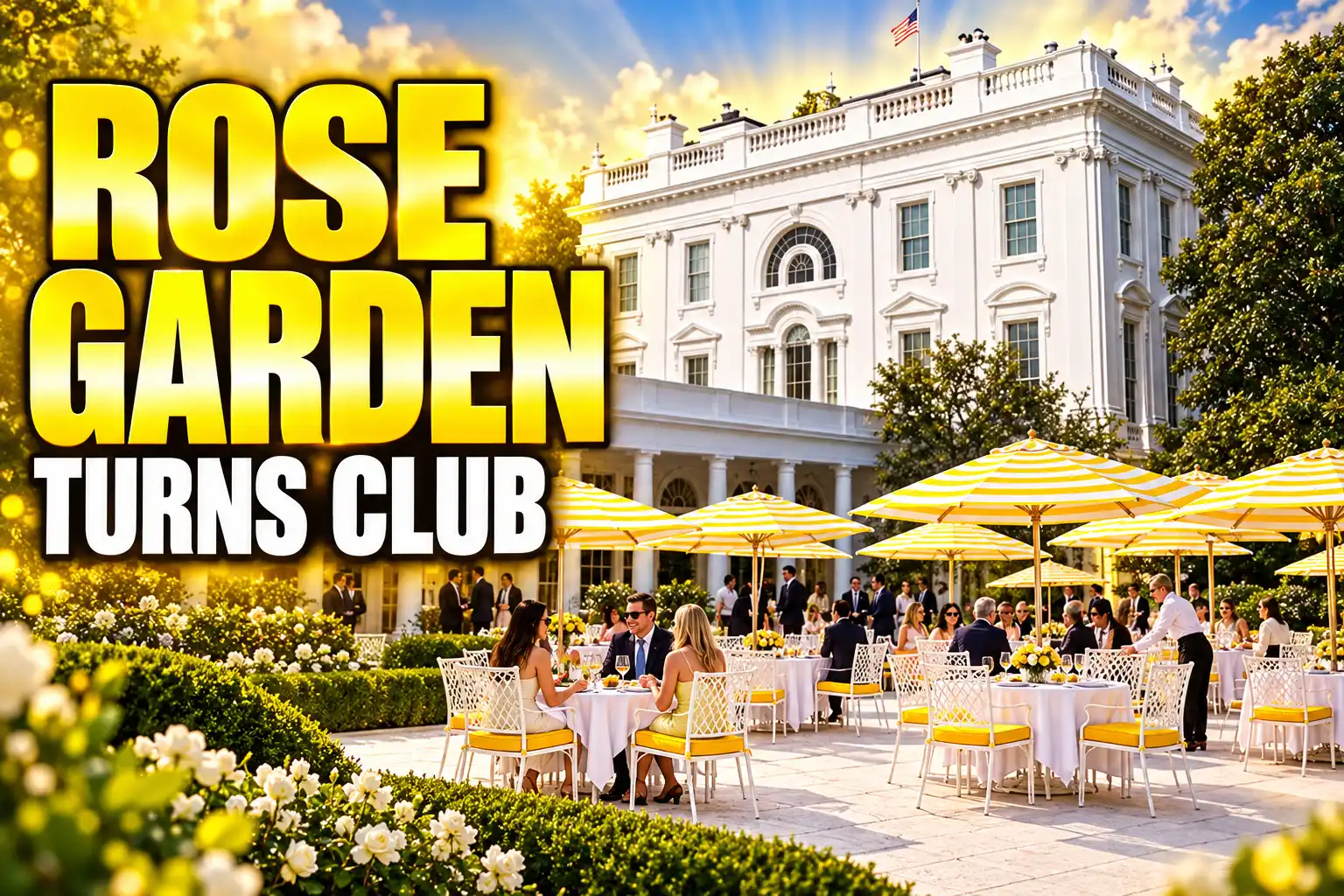
Fourteen months later that floor is on the official schedule as the Rose Garden Club, a hard outdoor room with striped umbrellas, an iPad-driven sound system, and bronze founders where a Kennedy-era lawn used to be.
The Lawn Became a Club Floor
Trump told guests at the first dinner on the new stone, in September 2025, “We call it the Rose Garden Club.” White House spokesperson Davis Ingle went further, calling it “the hottest place to be in Washington, or perhaps the world,” while touting a night with tech executives that rain then shoved indoors on September 4.
The furniture is the tell. Patio tables sit under yellow-and-white striped umbrellas at the Beach Club at Mar-a-Lago, Trump’s Palm Beach resort, and the same stripes now stand off the Oval Office. A speaker system, run from an iPad the way he DJs in Florida, was already blasting “Let It Be” in late August 2025 while crews finished the corners.
WHAT STANDS ON THE OLD LAWN
- The floor: White paving stones laid on the diagonal, with presidential seals set into the corners.
- The drains: New perimeter drainage covered by white grates in a Stars and Stripes motif.
- The kit: Cafe tables, chairs, yellow-and-white striped umbrellas, and a speaker system Trump runs from an iPad.
That kit is why the space works as a dining room in the rain’s aftermath, and why it reads as a resort terrace rather than a garden. Cafe tables on a hard floor under club stripes will look, to an unsympathetic eye, like a mall food court. The plates still come from the White House kitchen, and military social aides still walk the guests in.
The first formal dinner went ahead in September 2025 after the rained-out tech night. On October 21, 2025, Republican senators ate cheeseburgers, fries, and chocolates on the pavers while “YMCA” and “You Can’t Always Get What You Want” played, with ballroom construction noise in the background. Official entertaining of that kind can land on the public events budget even when the stone itself did not.
An Outdoor Room Built Around a Lawn
Stewart McLaurin, president of the White House Historical Association, has said the point of the Kennedy garden was never a museum lawn. “President Kennedy wanted an outdoor room,” he said. “He wanted a space where you could have outdoor meetings, receptions, events.”
The Park Service history of the Rose Garden runs longer than that room. Edith Roosevelt planted a colonial garden of daisies, jasmine, and wildflowers in 1902 and 1903, on ground that had held stables and a conservatory. In 1913, Ellen Wilson, working with landscape architect George Burnap, put roses beside the West Wing and gave the place its name. Frederick Law Olmsted Jr. opened the beds in the 1930s and tried to keep something in bloom all year.
John F. Kennedy and Jacqueline Kennedy came back from Europe in 1961 wanting a garden that could stand next to the ones that had hosted them. They asked friend and gardener Rachel Lambert “Bunny” Mellon to remake the West Garden. Mellon later called the request startling, then built Mellon’s 1962 design for President Kennedy: a defined central lawn, four corner magnolias inspired by trees at the Frick Collection, Katherine crabapples along the borders, and flower beds in a French parterre using American plants.
Staff called it an outdoor Oval Office. Foreign leaders asked to meet there instead of inside. The grass was the floor of that room, and Kennedy hated to see it trampled, which is the same complaint Trump now makes in a different register. Rachel Lambert Mellon’s garden legacy was a lawn you could assemble on, not a terrace you could hose down.
Melania’s Restoration Left the Grass in Place
By 2020 the roses had suffered from shade and poor drainage. Only 12 of the older bushes were still in the beds when Melania Trump oversaw a restoration funded, like the later patio, by private gifts to the Trust for the National Mall.
She added 200 roses and formal boxwood parterres, replaced irrigation, and poured a limestone walk around the lawn, including 36-inch paths meant for wheelchair access. The remaining crabapples came out and were moved elsewhere on the grounds. Critics called the new stone edge too stark and the crabapple loss an attack on Mellon’s bones. Melania’s team said the work followed a preservation-committee report on blight and wear, “in the spirit of the garden’s 1962 design.”
The grass stayed. That is the line the 2025 job crossed. A White House official, when crews tore into the lawn in June 2025, still called the new work a restoration that “preserves the beauty of the space and builds on the work done in 2020,” with the aim of “enhancing practical use and guest experience.” Photos from the first days of digging showed Melania’s limestone border pulled up in places as the sod came out.
What the $1.9 Million Patio Includes
National Park Service crews, who maintain the White House grounds, started the job in June 2025. A White House official, speaking then without name, said the work would take about two months and finish in the first half of August. Construction pictures from June 18 show the lawn open. By July 29 the pavers were largely down. Photographs from August 6 already show a finished white floor; Trump was walking the site with deputy chief of staff James Blair on July 15.
Trump’s case was practical, and he has not retired it. In a February 2025 interview he said, “The grass was wet. Their heels are going through the grass, like, four inches deep.” He has also said the white stone matches the house and throws heat back. Landscape architect Robert J. Bell has made the climate point in plainer terms: in the mid-Atlantic, high-traffic turf goes spongy, and pavement is a normal answer.
The Trust for the National Mall, a nonprofit partner of the Park Service, paid the $1.9 million through private donations. The same Trust underwrote Melania’s 2020 work. Donor names for the patio were not released. The flower beds were left in place; only the central grass came out.
HOW THE GARDEN CENTER CHANGED
| Version | Year | Center surface | What changed |
|---|---|---|---|
| Edith Roosevelt garden | 1902 | Flower beds | Colonial plantings on old stable ground |
| Ellen Wilson Rose Garden | 1913 | Roses, later a lawn | The space takes its name |
| Mellon-Kennedy garden | 1962 | Central lawn | Magnolias, crabapples, events floor |
| Melania restoration | 2020 | Lawn kept | 200 roses, limestone path, crabapples moved |
| Trump patio | 2025 | White stone | Diagonal pavers, drains, club furniture |
Heat gain is the open horticultural question the White House has not answered in public. White stone throws sunlight; it also stores it. The remaining roses still have to live beside a hard, reflective floor they were not planted against.
Easter Story Time Sat on Fake Turf
For a lawn replacement sold as more usable, the calendar’s oldest children’s event still wanted grass. On April 6, 2026, the White House rolled fake turf over the patio so guests could hear stories in the Rose Garden during the Easter Egg Roll, which is staged on the South Lawn. The stone had to dress up as the surface it replaced.
Use of the patio did not pause for that. Trump has kept hosting on the pavers, and he is still narrating the old grass as a trap. At a July 2026 lunch on the new stone, he told the room they were sitting on a replica of the White House color, then went back to the wetland story.
This was grass, and I love grass but, you know, the White House was built on a wetland, and the grass was always very wet. And if you were sitting here right now, your shoes would be destroyed. You would be extremely unhappy with me. You’d want to leave. The men wouldn’t like it, but the women would, with their beautiful, I won’t name the group, but you know who I’m talking about, those extremely high heels. They’d be sinking into I used to call it the quicksand.
President Donald Trump, Rose Garden lunch, July 6, 2026
FROM LAWN TO CLUB FLOOR
- June 18, 2025: Park Service crews open the Rose Garden lawn; a White House official calls the job a restoration building on 2020.
- July 29, 2025: White diagonal pavers are largely in place where the grass had been.
- August 2025: The patio is in use, with seals at the corners and music tested from an iPad.
- September 2025: Trump names it the Rose Garden Club at the first dinner; rain had already moved a tech gathering indoors on September 4.
- October 21, 2025: Senate Republicans lunch on the pavers under the new speakers.
- April 6, 2026: Fake grass goes down on the stone for Easter story time.
- July 6, 2026: Trump is still calling the old lawn quicksand while guests sit on the white stone.
Each of those dates is a use, not a planting. The garden’s public life is now scheduled around a floor that can take heels, speakers, and folding chairs without a grounds crew re-sodding overnight.
Five Founders Now Occupy the Stone
Once the lawn was gone, the empty rectangle invited objects. Trump did not add roses. He added sculpture, and by late July 2026 five pieces stood on the patio.
THE FIVE SCULPTURES ON THE STONE
- George Washington: Moved from display at the Washington Monument in October 2025; the White House said collector Harlan Crow supplied it on loan.
- Alexander Hamilton: Arrived in March 2026, on loan from Crow.
- Benjamin Franklin: Arrived with Hamilton in March 2026, also on loan from Crow.
- Freedom’s Charge: A sculpture honoring Revolutionary War soldiers, placed among the founders.
- Thomas Jefferson: A seated bronze of Jefferson with a draft of the Declaration, a gift from sculptor George Lundeen, installed in July 2026.
Lundeen, who kept the Jefferson figure at his Colorado ranch for years, said Trump called to thank him. “I just wanted to thank you. The sculpture looks really beautiful,” Trump told him. The piece was visible at a July 23, 2026, event honoring the Los Angeles Dodgers in the garden. Trump has walked visiting lawmakers and foreign guests past the group and called them “unbelievable statues.”
Art that sits on pavers reads as a courtyard collection. Art that sat on Mellon’s lawn would have had to share the floor with folding chairs and camera risers. The hard surface made the sculpture possible in a way the grass did not, which is the sleeper in the paving: the patio is not only easier to walk. It is a different kind of room, and the room has been filling.
Stewart McLaurin Says the House Is Not Frozen
McLaurin’s job is to document the house, not to freeze it. He said the patio “may be jarring,” then reached for the West Wing, the colonnades, and the porticos, all of them fights in their day. In a June 2025 essay he listed Jefferson’s colonnades, Truman’s balcony, and Nixon’s press room over FDR’s pool as changes that drew fire and then became the building people now picture.
It’s not frozen in time. It evolves and it changes. And different presidents and first ladies have different ideas.
Stewart McLaurin, president, White House Historical Association
He has also reminded listeners that Jackie Kennedy’s garden replaced someone else’s. Ellen Wilson’s roses replaced Edith Roosevelt’s colonial beds. Mellon’s lawn, the surface now treated as sacred, was itself a modern events floor laid in 1962. Some members of Congress at the time called Kennedy’s taste elitist while the Cold War ran.
That history cuts both ways. It means Trump is not the first occupant to treat the garden as a working set. It also means the 2025 job is the first time the center of Mellon’s room, the grass she designed as the gathering plane, has been taken out and replaced with stone that will not grow back when a new family unpacks. Melania’s limestone could be read as a path around a lawn. Trump’s pavers are the lawn.
He is still using the room he poured. The Club name is on the schedule. The umbrellas still match Florida. The statues have a hard floor to stand on, and at Easter the staff had to buy the look of grass by the roll.
Frequently Asked Questions
When Was the White House Rose Garden First Planted?
First lady Ellen Wilson planted roses beside the West Wing in 1913 with landscape architect George Burnap, which is when the space took the Rose Garden name. That work replaced Edith Roosevelt’s 1902 colonial garden of daisies, jasmine, and wildflowers, and in the 1930s Frederick Law Olmsted Jr. opened the beds further and tried to keep the plantings in bloom year-round.
What Happened to the Crabapple Trees From the Kennedy Design?
Melania Trump’s 2020 restoration took out the remaining crabapples that had lined Mellon’s borders and moved them elsewhere on the White House grounds, a step her advisers said would let more than 200 roses get light. Some of the relocated trees later died, and the 2025 paving did not put crabapples back; it left the 2020 rose beds and removed only the central grass.
Who Paid for the 2025 Patio, and Who Pays When Guests Eat There?
The Trust for the National Mall covered the $1.9 million patio with private donations, the same nonprofit that funded Melania’s 2020 restoration and, in Trump’s first term, a tennis pavilion, and it has not published the patio donors. Separate from that construction bill, Congress funds official White House entertaining, so a lunch for lawmakers on the new stone can still be a public cost even though the pavers were not.
Has the Rose Garden Hosted a White House Wedding?
Tricia Nixon married Edward Cox in the Rose Garden in 1971, the first outdoor wedding in White House history, with about 400 guests and vows under a gazebo threaded with white roses. Later presidents kept using the lawn for bill signings, press conferences, and the turkey pardon, which is the events load Trump now says the grass could not carry in wet weather.
Who Maintains the White House Grounds?
The National Park Service maintains the White House grounds, including the Rose Garden, and its crews did the 2025 demolition and paving. The Park Service partners with the Trust for the National Mall on privately funded projects, which is how both the 2020 planting and the 2025 patio were paid without a line in the construction budget for the stone itself.

Ukraine Hits the Fuel Hub That Feeds Moscow’s Airports

Gold Lost 3% After the Jobs Print It Usually Wants

XRP’s $31.87 Target Is a $2 Trillion Market Bet

Mortgage Rates at 7.28% Push Buyers Into Adjustable Loans

Six Ex-Bills Return as Patriots Open New Highmark

Microsoft Prints Azure’s $29.42 Billion Quarter and Shrinks the Map

UltraTech’s Ultravolt Launch Puts Cable Multiples on Trial

IXI Autofocus Glasses Still Lack a European CE Mark

The iPhone 16 Pro Flipkart Cut Did Not Last

Little St. Simons Island Hatches Loggerheads at 72.4 Percent
-
 NEWS1 month ago
Microsoft Prints Azure’s $29.42 Billion Quarter and Shrinks the Map
-
 BUSINESS1 month ago
UltraTech’s Ultravolt Launch Puts Cable Multiples on Trial
-
 NEWS9 months ago
IXI Autofocus Glasses Still Lack a European CE Mark
-
 NEWS1 year ago
The iPhone 16 Pro Flipkart Cut Did Not Last
-
 NEWS3 months ago
Little St. Simons Island Hatches Loggerheads at 72.4 Percent
-

 BUSINESS3 months ago
Georgia Furniture Mart Closes a Growing 40-Year Business
-

 NEWS4 months ago
Georgia Beach Bacteria List Leaves Swim Areas Open
-

 NEWS3 years ago
Eyal Waldman Keeps a Two-State Bet After Gaza