
LIFESTYLE
Georgia Martyrs Will Be Blessed in a Convention Hall
Five Franciscans killed in 1597 will be beatified in a Savannah hall on October 31, far from a closed mission island and a Guale succession fight.

Five Spanish Franciscans known as the Georgia Martyrs will be beatified on October 31, 2026, at the Savannah Convention Center. Cardinal Frank Leo of Toronto will preside as papal legate for Pope Leo XIV, in a free Mass the Diocese of Savannah expects to fill a hall that holds about 10,000 people.
The cathedral across the river cannot seat that crowd, and the coastal missions where the friars died are either lost or closed. So the first beatification on Georgia soil, which the diocese also calls the first in the American South, will happen in a trade-show hall on All Hallows Eve, 429 years after the killings.
A Convention Center Gets the First Southern Saints
The rite is set for 11 a.m. Saturday, October 31, 2026, at 1 International Drive on Hutchinson Island, across the Savannah River and the Talmadge Memorial Bridge. Doors open at 8 a.m. Seating is first come, first served, with no tickets and no seat-saving. Organizers still ask anyone coming on their own to register through October 15, so they can plan traffic and Communion, not assign pews.
A museum and art exhibit on the five friars will be open in the same building from 8 to 10:30 a.m. and again from 1 to 2:30 p.m. The Mass itself is expected to run about two hours. On Sunday, November 1, 2026, a Mass of Thanksgiving is set for 11:30 a.m. at the Cathedral Basilica of St. John the Baptist, the church that could not hold Saturday’s crowd.
THE OCTOBER 31 TIMETABLE
| When | What | Where |
|---|---|---|
| Saturday, 8 a.m. | Doors open; exhibit open until 10:30 a.m. | Savannah Convention Center |
| Saturday, 10:30 a.m. | Seating call | Savannah Convention Center |
| Saturday, 11 a.m. | Mass of Beatification, about two hours | Savannah Convention Center |
| Saturday, 1 to 2:30 p.m. | Exhibit reopens; doors close at 2:30 p.m. | Savannah Convention Center |
| Sunday, 11:30 a.m. | Mass of Thanksgiving | Cathedral Basilica of St. John the Baptist |
The Order of Friars Minor confirmed the hall in a September 26 statement. Bishop Stephen D. Parkes of Savannah has called the date one of great significance for his diocese and for the Archdiocese of Atlanta. The year is also the 800th anniversary of the death of St. Francis of Assisi in 1226, the founder whose cord the five men wore. EWTN will carry the Mass, and the diocese will stream it as well. Bishop Parkes has said Catholics from Spain, Italy, and Nigeria are expected beside Georgia pilgrims.
The Archdiocese of Atlanta is running a coach from its Smyrna chancery because, its evangelization office wrote, parking will be a serious challenge. That is not a throwaway line. The convention center has 1,500 parking spaces for a crowd the diocese puts as high as 10,000, which is why the local church is pushing the free Savannah Belles Ferry as hard as it is pushing prayer cards.
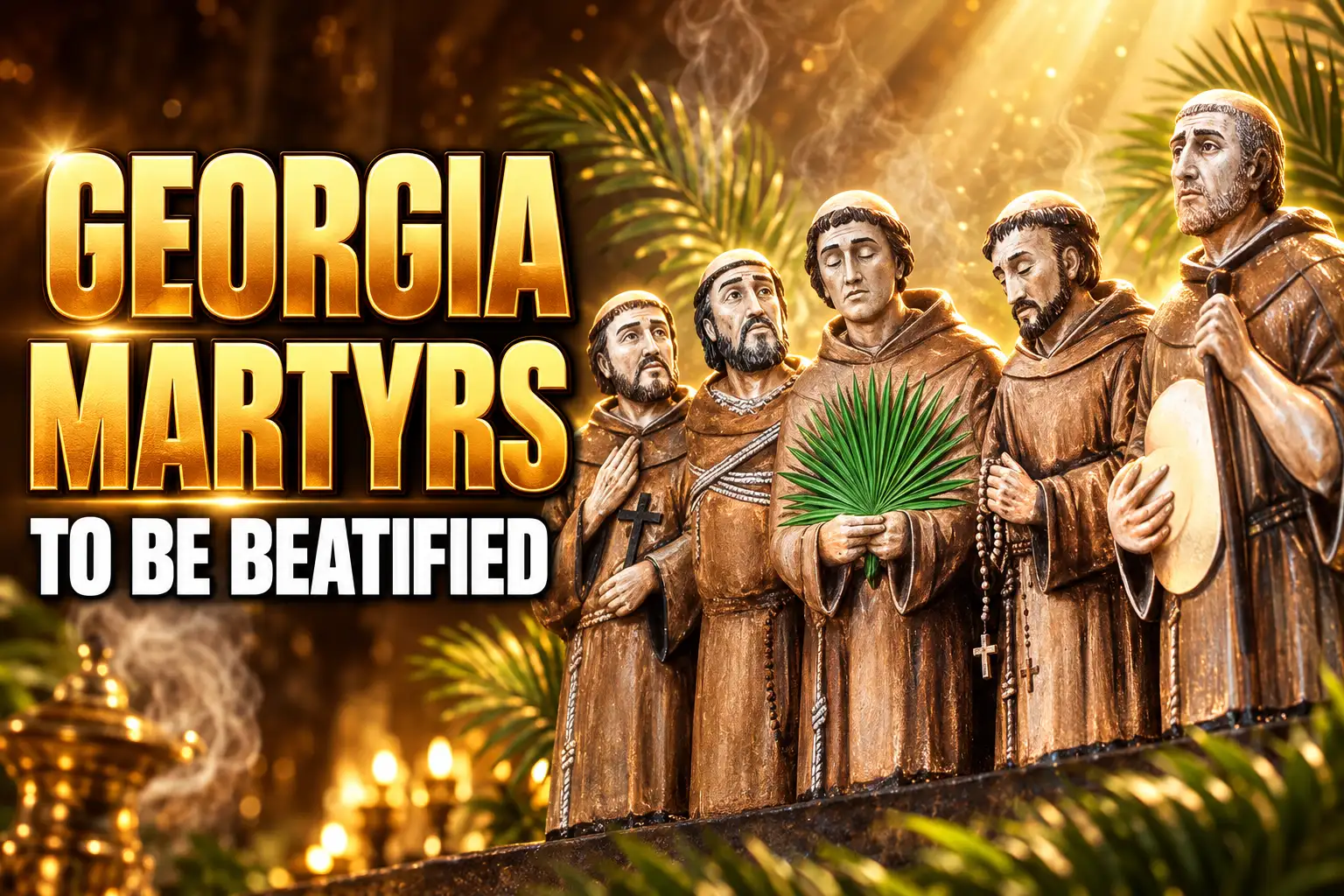
Five Friars Died Across Four September Days
The men to be named Blessed are Friar Pedro de Corpa, Friar Blas Rodríguez, Friar Miguel de Añón, Brother Antonio de Badajoz, and Friar Francisco de Veráscola. They were Spanish Franciscans working in Guale towns along the Georgia coast, then the northern edge of Spanish Florida. A sixth friar, Francisco de Ávila, was taken alive and held about 10 months until the governor in St. Augustine won his release.
Church accounts put the spark at Tolomato, the headquarters of the Guale chiefdom, on September 14, 1597. De Corpa, the resident friar, would not let don Juanillo, a baptized heir to the office of mico mayor, take a second wife under Guale custom. Juanillo killed him, then a war party moved down the missions. Rodríguez died at Tupiqui on September 16. Añón and Badajoz died on St. Catherines Island on September 17, a Franciscan feast of the stigmata. Veráscola, who had gone to St. Augustine for supplies, was ambushed as he came ashore, at Asao or Talaje, on a date the surviving papers do not fix with the same clarity.
THE WEEK THE MISSIONS FELL
- September 14, 1597: De Corpa is killed at Tolomato as he prepares for Sunday Mass.
- September 16, 1597: Rodríguez is killed at Tupiqui after being allowed to say Mass.
- September 17, 1597: Añón and Badajoz are killed at Santa Catalina de Guale on St. Catherines Island.
- November 6, 1597: Spanish forces burn the Guale towns of Asao and Talaje in reprisal.
- July 1598: Ávila is released after about 10 months in captivity; in the later trial he refuses to testify against his captors.
Pope Francis signed the decree of martyrdom on January 27, 2025, finding the five were killed in odium fidei, in hatred of the faith. That finding waives the miracle normally required for beatification. From that date until October 31 they have held the title Venerable. After the Savannah Mass they will be Blessed, which permits public veneration in the local church. Canonization, the last step, still needs a miracle attributed to their intercession.
Juanillo Lost the Office Before the Revolt
The marriage sermon is the version that will be preached in the hall. It is not the only paper trail. The Vatican’s own Dicastery for the Causes of Saints, recounting the case, said de Corpa did more than scold a second wife. He said he would oppose his succession as village chief if Juanillo kept the polygamous match. That is a political act inside a Native chiefdom, not only a sermon on vows.
Governor Gonzalo Méndez de Canzo later told King Philip III that friars de Corpa and Rodríguez had already removed Juanillo from the office of mico mayor and installed another Guale leader, don Francisco. Historians J. Michael Francis and Kathleen M. Kole, in a 2011 American Museum of Natural History study of newly translated Florida papers, wrote that the two questions that have dominated the story, who killed the five friars and why, cannot be answered with certainty. They treat 1597 as a window onto Spanish Florida, not as a closed morality play.
Archaeology on St. Catherines Island has pushed the same way. Work associated with David Hurst Thomas reads the rising as factional competition among Guale elites, not a simple anti-Catholic purge. Don Francisco, far from being a Spanish puppet, later allied with Juanillo. In October 1601 a war party raised by the mico of Asao, at Spanish urging, killed Juanillo, don Francisco, and about two dozen of their kin at Yfusinique. On November 27, 1601, Juanillo’s scalp was presented in St. Augustine.
May Venerable Friar Pedro de Corpa and Companions intercede for families everywhere, and inspire husbands and wives around the world to live out the sacrament of marriage with love, truth, and fidelity.
Bishop Stephen D. Parkes, Diocese of Savannah, January 27, 2025 statement
That is the prayer the local church wants the new Blesseds to carry. The Guale names in the file, Juanillo, don Francisco, don Domingo, the mico of Asao, will not have seats on Hutchinson Island. Their towns were burned, rebuilt, raided, and abandoned by the 1680s, when English pressure and slave raids emptied the Guale missions. The liturgy will remember five friars. The political crisis that killed them has no feast day.
St. Catherines Island Is Closed to Pilgrims
After the friars were killed, the missions and convents were burned. Mission work continued on the Georgia coast into the late 1600s, then collapsed. The diocese’s pilgrimage notes say that, to date, there are only two mission sites positively located: Santa Catalina de Guale on St. Catherines Island, and Santo Domingo de Talaje at Fort King George in Darien. The ruins at both places have been reburied.
Tolomato, where de Corpa died and where the Royal Spanish coat of arms hung in the council house, has not been found. Guesswork puts it at Harris Neck, Pine Harbor, or Sutherland Bluff. Tupiqui, where Rodríguez died, has not been found either. Veráscola’s Asao chapel is lost; Talaje is the site scholars tie to the later English fort in Darien.
WHERE THE FIVE DIED, AND WHAT A VISITOR CAN SEE
| Mission | Friar | What is known | Can you walk it |
|---|---|---|---|
| Tolomato | Pedro de Corpa | Not located; likely near Darien or Townsend | No; bronze at Nativity of Our Lady in Darien |
| Tupiqui | Blas Rodríguez | Not located; likely north of Eulonia | No |
| Santa Catalina de Guale | Miguel de Añón and Antonio de Badajoz | Found in 1981; church, friary, kitchen mapped, then reburied | No; private island, interior closed |
| Asao / Talaje | Francisco de Veráscola | Talaje linked to Fort King George | Yes; state historic site in Darien |
St. Catherines Island is a National Historic Landmark owned by the St. Catherines Island Foundation. Mission Santa Catalina was the northernmost outpost of Spanish Florida from 1587 to 1680, and for a time officials even talked of moving the colonial capital there from St. Augustine. Digs in the 1980s found two churches, a cemetery, a kitchen, two wells, and dwellings inside a palisade. The older church is the first Christian church built in Georgia. Researchers also lifted tens of thousands of beads, rosaries, crosses, and pieces of a bronze bell. Those objects now live in Atlanta at the Fernbank Museum of Natural History, not on the island.
The National Park Service says the interior of the island is not accessible to the public. The beach can be reached by private boat. A stand of palms marks the outline of the mission church, and Mass is said there only on rare, arranged days. Lightning wildfires in 2022 left those palms untouched, a detail the cause’s promoters like to tell. It does not open the gate. For the October 31 crowd, the actual church of the two friars who died there is a closed research station in the salt marsh.
Fort King George Is the One Open Door
Darien is the place that can still put a visitor on Guale ground. Nativity of Our Lady Church holds a life-size bronze of the five friars by sculptor Timothy Schmalz, blessed in 2021. A few minutes away, the reconstructed fort on the Altamaha River sits on the likely site of Talaje, with a museum, a Guale roundhouse replica, and a ranger tour the diocese now flags for the martyrs. On May 26, 2026, the National Eucharistic Pilgrimage walked that ground on its way north, a rehearsal in miniature for the October influx.
That is the hidden map under the convention-center Mass. Ten thousand people will pray on Hutchinson Island. The only confirmed martyrdom site is a private island. The headquarters town has not been found. The public bronze and the public fort are in a small coastal city most of the Saturday crowd will never reach if they are racing a 6 a.m. ferry.
From Fr. Habig’s 1950 File to Pope Francis
Fame for holiness around the five friars is old. The legal cause is not. Franciscan Fr. Marion Habig was named the first vice-postulator in 1950, 353 years after the killings. Between 1950 and 1983, Rome rewrote the rules for sainthood several times. Bishop Raymond W. Lessard, the twelfth bishop of Savannah, accepted the Franciscan petition and opened the diocesan investigation only in 1984. That phase closed on March 16, 2007, when the file went to Rome. The decree of martyrdom arrived 41 years after Lessard opened the books and 75 years after Habig’s appointment.
The official cause history blames the long silence on politics and geography. James Oglethorpe’s English Georgia, founded in 1733 as a buffer against Spanish Florida, had little interest in celebrating Spanish friars. English settlers wrote the state’s origin story around Savannah and charity, not around Guale council houses and wattle-and-daub churches. The beatification does not invent a Catholic Georgia. It puts a Roman rite on a Spanish layer that was already there, 10 years before Jamestown and more than a century before Oglethorpe.
Fr. Roger Lopez, a provincial councilor for the Order of Friars Minor, said the deaths of “our brothers” still speak to a church that meets force with a claim about peace. The mid-20th-century Franciscans who refused to let the file die are the other overlooked party. Without Habig’s 1950 appointment and Lessard’s 1984 tribunal, there is no Cardinal Leo on Hutchinson Island, and no Blessed names to paint on an exhibit wall.
What Halloween Weekend Demands of Visitors
Savannah already sells October 31 as a ghost-tour Saturday. The diocese is trying to run a two-hour canonization rite through the same streets, the same river, and the same hotel pool. The practical instructions on the martyrs’ site read like a city trying not to stall at the bridge.
THE RULES FOR OCTOBER 31
- Costumes: No Halloween costumes are allowed for adults or children; dress as for Sunday Mass.
- Seats: First come, first served; saving seats is forbidden; latecomers after 11 a.m. get ushers, not a claim.
- Parking: 1,500 on-site spaces, $10 in the surface lot and $20 in the garage; the diocese tells people to park elsewhere.
- Shuttles: Enmarket Arena Lot J on Stiles Avenue runs continuous shuttles from 8 a.m. to 3 p.m. for $15 a vehicle.
- Ferry: The free Savannah Belles Ferry leaves City Hall Landing from 6 a.m.; the crossing is 10 minutes, and planners say to budget one hour with lines.
- Food: Grab-and-go snacks only, and the building is cashless.
- Weather: The Mass is indoors; a hurricane call would come on Wednesday, October 28.
The costume ban is the clearest sign the local church knows what weekend it picked. All Hallows Eve is the vigil of All Saints, which is why the date is not random inside a Catholic calendar. It is still Halloween in a city whose visitor bureau is a partner on the lodging page. The ferry map and the Visit Savannah hotel block sit on the same official FAQ as the prayer to Pedro, Blas, Miguel, Antonio, and Francisco. Pilgrimage and tourism are sharing a river taxi.
Blessed on the Coast, Still Short of Saints
Leo’s appointment was announced in April by the Archdiocese of Toronto. He will represent Pope Leo XIV, who holds the chair Francis occupied when the martyrdom decree was signed. The names rhyme; the jobs do not. Francis judged the deaths. Leo of Toronto will read the formula that makes the five Blessed.
NEWS: Cardinal Frank Leo to Represent Pope Leo XIV at Beatification Rite of the Georgia Martyrs https://t.co/ldTsykQ0VV #catholicTO pic.twitter.com/ZDlzD3vt0I
— Archdiocese of Toronto (@archtoronto) April 14, 2026
The beatification of Friar Pedro de Corpa and his Companions is a powerful reminder that the Gospel of Christ has taken root in every land through the faithful witness of those willing to give everything for the Lord Jesus, including their very life.
Cardinal Frank Leo, Archbishop of Toronto, April 2026 statement
After November 1 the exhibit comes down, the shuttles stop, and the five names enter the diocesan calendar. Families can ask their intercession. A miracle file, if one ever comes, would reopen the last mile to sainthood. None of that moves the palms on St. Catherines Island, and none of it locates Tolomato. The hall on Hutchinson Island will have done the one thing a private island and a lost town cannot do. It will hold the crowd.

Ukraine Hits the Fuel Hub That Feeds Moscow’s Airports

Gold Lost 3% After the Jobs Print It Usually Wants

XRP’s $31.87 Target Is a $2 Trillion Market Bet

Mortgage Rates at 7.28% Push Buyers Into Adjustable Loans

Six Ex-Bills Return as Patriots Open New Highmark

Microsoft Prints Azure’s $29.42 Billion Quarter and Shrinks the Map

UltraTech’s Ultravolt Launch Puts Cable Multiples on Trial

IXI Autofocus Glasses Still Lack a European CE Mark

The iPhone 16 Pro Flipkart Cut Did Not Last

Little St. Simons Island Hatches Loggerheads at 72.4 Percent
-
 NEWS1 month ago
Microsoft Prints Azure’s $29.42 Billion Quarter and Shrinks the Map
-
 BUSINESS1 month ago
UltraTech’s Ultravolt Launch Puts Cable Multiples on Trial
-
 NEWS9 months ago
IXI Autofocus Glasses Still Lack a European CE Mark
-
 NEWS1 year ago
The iPhone 16 Pro Flipkart Cut Did Not Last
-
 NEWS3 months ago
Little St. Simons Island Hatches Loggerheads at 72.4 Percent
-

 BUSINESS3 months ago
Georgia Furniture Mart Closes a Growing 40-Year Business
-
 NEWS4 months ago
Georgia Beach Bacteria List Leaves Swim Areas Open
-
 NEWS3 years ago
Eyal Waldman Keeps a Two-State Bet After Gaza