
NEWS
Georgia’s Longest Snake Left a Rattlesnake Alive
A 4-foot eastern indigo in Long County threw up a living rattlesnake, kept a mouse in the rattler, and missed the 9-foot myth the species carries.

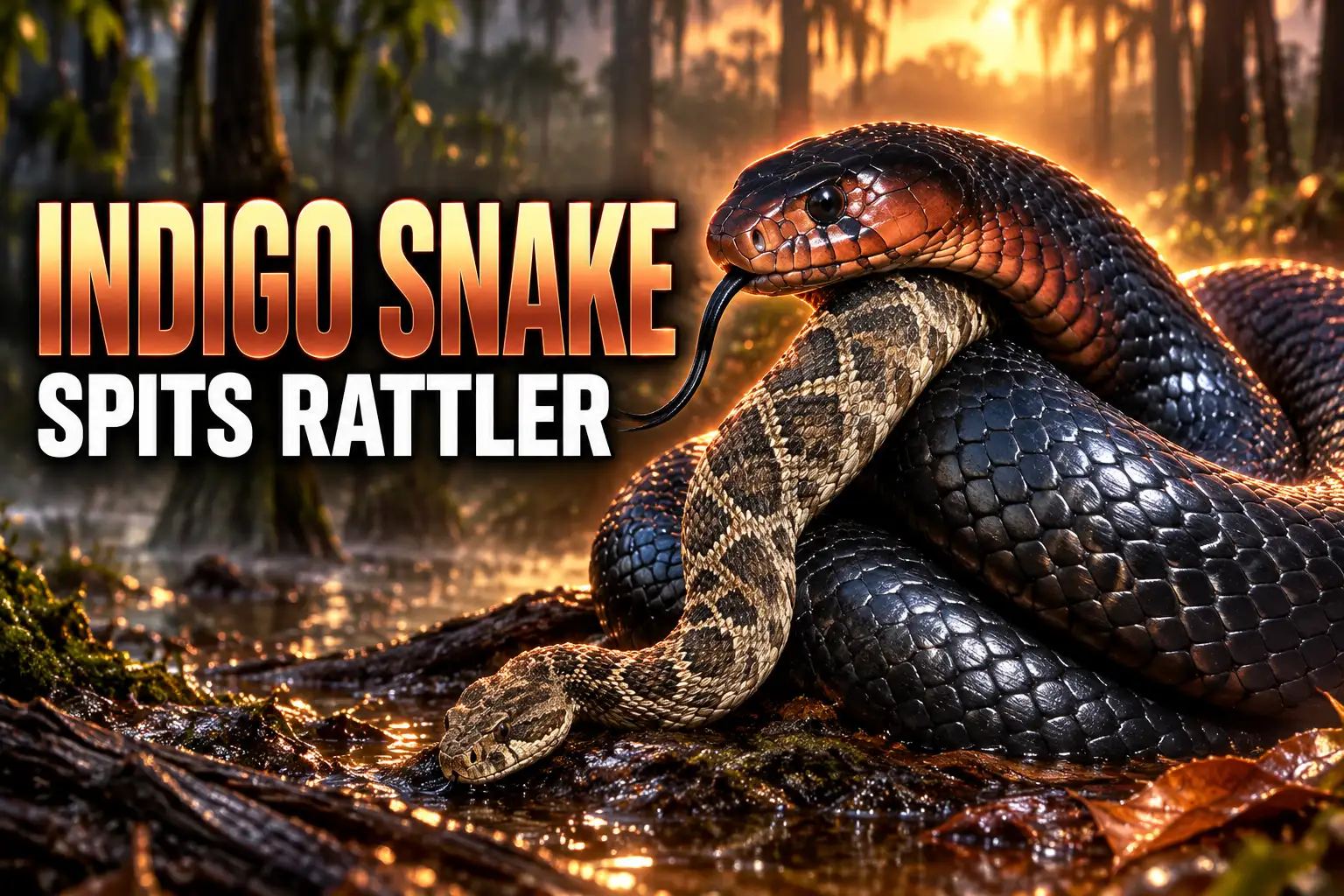
A 4-foot eastern indigo snake in Long County, Georgia, threw up a living rattlesnake during a November 2023 survey. Georgia DNR wildlife technician Matt Moore had bagged the snake to weigh it and opened the cloth on three animals instead of one.
The species is North America’s longest native snake, a hunter the U.S. Fish and Wildlife Service describes as growing up to 9 feet long, and it eats rattlers on purpose. This one left its meal alive.
One Bag, Then Three Snakes
Moore caught the indigo crossing a Long County field while surveying for the federally protected species, then slipped the stout animal into a cloth bag. Nothing looked off until he opened it. That was when, as he later put it, “things kinda got weird.”
It was filled to the brim with snakes.
Matt Moore, wildlife technician, Georgia Department of Natural Resources
Inside were a slimmer indigo, a young adult rat snake, and a juvenile eastern diamond-backed rattlesnake. The indigo, whose prey includes other snakes, had brought both meals back up. Georgia DNR recorded the hunter at 2.1 pounds with its prey still in and 1.7 pounds after, a 0.4-pound loss.
Both of the extra snakes looked dead. Moore had heard of indigos throwing up partly digested snakes, though never a venomous one, and he moved the rat snake and the 14- to 16-inch diamondback onto a table. Within minutes the rattler’s tail twitched. He took it for a leftover muscle jerk, bagged the remains, and finished processing the indigo.
An hour and a half later the diamondback was crawling.
The Famous 9-Foot Snake Measured 4 Feet
The U.S. Fish and Wildlife Service calls the eastern indigo the emperor of the forest. That reputation, and the snake’s standing as Georgia’s longest snake, rides on a species that can stretch toward 9 feet. The Long County animal was about 4 feet, a relatively small but heavy eater that had packed a quarter-pound of snake into a body that weighed 1.7 pounds empty.
The Orianne Society, which runs occupancy surveys that DNR’s mark-recapture work complements, puts typical large males at 6 feet 8 inches to 7 feet 6 inches and 7 to 10 pounds. Large females seldom top 6.5 feet. A 4-foot indigo sits well under that adult bulk, which is why Moore called this one small even as it looked stout in the grass.
THE LONG COUNTY INDIGO AGAINST ITS SPECIES
| Measure | Long County snake (Nov. 2023) | Typical large males | Species ceiling (FWS) |
|---|---|---|---|
| Length | about 4 feet | 6 ft 8 in to 7 ft 6 in | up to 9 feet |
| Weight | 1.7 lb empty; 2.1 lb with prey | 7 to 10 lb | n/a |
The clip that later traveled treated the bag as a monster meal. It was a survey snake, interrupted mid-hunt, and still short of the length that sells the species.
How an Indigo Is Supposed to Kill a Rattler
Indigos do not constrict. They pin prey with a body coil, chew the head until the animal cannot fight, and swallow it whole, head first. Moore said they crush the skull, then take the snake down. They also carry a high degree of immunity to the venom of native pit vipers, which is how a nonvenomous hunter can make a living on rattlesnakes.
Zoo Atlanta’s species account is blunt about the menu. Keepers there note that indigos overpower prey with muscular jaws and regularly eat rattlesnakes, cottonmouths and copperheads, along with insects, small turtles, and almost any vertebrate they can hold.
HOW AN INDIGO TAKES A SNAKE
- The head: The indigo goes straight for the skull and chews until the other snake is still.
- The coil: A body loop pins the prey to the ground while the jaws work.
- The swallow: Snake prey goes down head first, whole.
- The venom: If a rattler bites back, the indigo usually walks away from it.
This indigo did not finish. The skin on the rattler’s head was only slightly torn. Moore thinks he caught the hunter just after it ate the diamondback. The rat snake had been in longer, and it stayed dead.
The Rattlesnake Kept the Mouse
Moore was glad he had not been bitten by a rattler that had been playing dead. He released the revived snake at a gopher tortoise burrow, a winter refuge both species use. The diamondback crawled into the mouth of the hole, then came back out and basked in the grass. Moore had never seen a diamondback turn down a burrow like that.
A bulge in the rattler’s body showed it had already eaten a large mouse. “It managed to keep its meal down after being swallowed and regurgitated by the indigo,” Moore said. He later summed the whole chain as a story with “layers of unlikeliness.”
THE JONAH RATTLER’S CLOCK
- November 2023: Moore bags a stout 4-foot indigo crossing a Long County field and finds three snakes in the weigh bag.
- Minutes later: The 14- to 16-inch diamondback twitches its tail on the table.
- An hour and a half later: The rattlesnake is crawling.
- The same afternoon: Moore releases it at a gopher tortoise burrow; it exits and basks.
- About three weeks later: Someone photographs a live diamondback in the same area.
- Spring 2024: Moore matches the torn head and the dorsal diamond pattern “exactly” to his photos of the regurgitated rattler.
Staff had worried the head wound would still kill it. The photographs, taken about three weeks after the release, showed the same scar and the same pattern. Weeks after a second chance, DNR wrote, the Jonah rattlesnake was still alive and crawling.
They Share the Gopher Tortoise’s Burrow
In southern Georgia, eastern indigos spend the cool months on sandy longleaf ridges and go underground in tortoise burrows. The Orianne Society’s species account says northern indigos rely on gopher tortoise burrows for cool-season dens, and that those holes also matter when the snakes shed. Diamondbacks use the same architecture. So do hundreds of other animals. The Fish and Wildlife Service puts the count of species that depend on tortoise burrows at 350-plus.
That is why Moore chose the burrow as a release site, and why it was strange when the rattler refused to stay in. The field, the bag, the mouse, and the later photograph all sit on the same sandhill system: longleaf, tortoise, indigo, rattler, rat snake. Break the tortoise population and the winter housing goes with it. DNR has said indigos depend on those burrows more than any other vertebrate that uses them.
The survey itself exists because the indigo is scarce enough to tag. In fiscal 2023, DNR’s Wildlife Conservation Section marked 27 new indigos with PIT tags and recaptured 25 animals tagged in earlier years, work that sits beside Orianne occupancy routes on public and private land. Moore’s Long County stop was one more winter check on a snake that already had a full stomach.
Only the Indigo Has Federal Protection
The hunter in the bag is listed as threatened under the Endangered Species Act, a status the Fish and Wildlife Service assigned in 1978, and Georgia lists it as threatened too. Development and agriculture, the Service says, consumed 97 percent of the longleaf pine forests that once held the species across Florida, Georgia, Alabama, and Mississippi. Remaining indigos are concentrated in peninsular Florida and southeastern Georgia.
Georgia has put more than 90,000 acres under conservation easements that protect more than 60 gopher tortoise populations, and land managers have planted longleaf and burned acreage to keep the sandhills open. Michele Elmore, the Service’s eastern indigo snake recovery coordinator, has said the longleaf system is the path back.
The longleaf pine ecosystem is the path to the snake’s recovery.
Michele Elmore, eastern indigo snake recovery coordinator, U.S. Fish and Wildlife Service
The rattlesnake that crawled out of the indigo does not get that paper. Georgia’s species profile for the eastern diamond-backed rattlesnake lists no Georgia state protection and no U.S. federal protection. The 2025 State Wildlife Action Plan still flags it as a species of moderate conservation concern. Both snakes use tortoise burrows. Only one of them is illegal to take.
TWO SNAKES, TWO RULEBOOKS
| Rule | Eastern indigo | Eastern diamond-backed rattlesnake |
|---|---|---|
| Federal status | Threatened since 1978 | None |
| Georgia status | Threatened | None |
| SWAP 2025 tier | Highest Conservation Concern | Moderate Conservation Concern |
Chris Jenkins, CEO of the Orianne Society, has argued that protecting snakes and their habitat also protects hunting, fishing, hiking, and water quality. The Long County bag is a smaller point on that map: a 4-foot indigo, a 14- to 16-inch rattler, a mouse that stayed down, and a photograph three weeks later that said the prey outlasted the hunt.
Frequently Asked Questions
What is the longest snake in Georgia?
The eastern indigo is the state’s longest native snake, and the Fish and Wildlife Service describes the species as reaching up to 9 feet. Snakes in that record class are rare; the Orianne Society notes that most wild indigos measured at 7 feet 10 inches or longer have come from southern Florida, and the animal was first described in 1842 from a Wayne County, Georgia, specimen brought to James Edward Holbrook by J. H. Couper.
Are eastern indigo snakes venomous?
No. They are nonvenomous colubrids. When cornered they may flatten the head, hiss, and vibrate the tail, a bluff DNR says they rarely follow with a bite, which is why field crews can handle them with far less drama than a diamondback of the same length.
Do eastern indigo snakes eat rattlesnakes?
Yes, and not only rattlesnakes. Orianne biologists have documented an adult in southern Georgia that threw up a pigmy rattlesnake, a hatchling gopher tortoise, a southern hognose snake, and a southern toad in one load, and the snakes also take cottonmouths, copperheads, frogs, small mammals, and birds when they can pin them.
Why do eastern indigo snakes use gopher tortoise burrows?
In Georgia and northern Florida they need those deep holes as winter dens, and they also use them while shedding and, on rare documented nests, as places to lay eggs. Females deposit a single clutch of 4 to 14 eggs between April and June, often in open sandy spots tied to tortoise burrows, including abandoned ones.
Where do eastern indigo snakes live in Georgia?
Populations are fragmented in the southeastern Coastal Plain, with cool-season use concentrated on sand ridges along blackwater streams such as the Altamaha, Canoochee, Ohoopee, Alapaha, and Satilla. Males in Georgia can range across about 1,200 acres, and one documented animal moved 14 miles between populations, which is why a road through sandhill country cuts a home range in half.

Ukraine Hits the Fuel Hub That Feeds Moscow’s Airports

Gold Lost 3% After the Jobs Print It Usually Wants

XRP’s $31.87 Target Is a $2 Trillion Market Bet

Mortgage Rates at 7.28% Push Buyers Into Adjustable Loans

Six Ex-Bills Return as Patriots Open New Highmark

Microsoft Prints Azure’s $29.42 Billion Quarter and Shrinks the Map

UltraTech’s Ultravolt Launch Puts Cable Multiples on Trial

IXI Autofocus Glasses Still Lack a European CE Mark

The iPhone 16 Pro Flipkart Cut Did Not Last

Little St. Simons Island Hatches Loggerheads at 72.4 Percent
-
 NEWS1 month ago
Microsoft Prints Azure’s $29.42 Billion Quarter and Shrinks the Map
-
 BUSINESS1 month ago
UltraTech’s Ultravolt Launch Puts Cable Multiples on Trial
-
 NEWS9 months ago
IXI Autofocus Glasses Still Lack a European CE Mark
-
 NEWS1 year ago
The iPhone 16 Pro Flipkart Cut Did Not Last
-
 NEWS3 months ago
Little St. Simons Island Hatches Loggerheads at 72.4 Percent
-

 BUSINESS3 months ago
Georgia Furniture Mart Closes a Growing 40-Year Business
-

 NEWS4 months ago
Georgia Beach Bacteria List Leaves Swim Areas Open
-

 NEWS3 years ago
Eyal Waldman Keeps a Two-State Bet After Gaza