
NEWS
Samsung Bets the Galaxy S26 Ultra on Privacy Hardware
Samsung is staking its 67% Ultra mix in Southeast Asia and Oceania on a five-year Privacy Display that cheaper Galaxies still do not get.

Samsung still ships Privacy Display on one phone, the Galaxy S26 Ultra, seven months after Unpacked in San Francisco. The panel is the hardware reason to stay on the top model in a region that already chose Ultra for 67% of Galaxy S25 Series sales.
TM Roh, chief executive and head of Samsung’s Device eXperience Division, told Southeast Asia and Oceania media that buyers there want technology that makes daily life easier. The June reviewer roundup from those markets reads like proof. The commercial logic sits underneath it.
Samsung’s 67 Percent Ultra Mix in Southeast Asia
The mix that matters is older than the new screen. After Unpacked on February 25, 2026, Roh told regional reporters that 67% of Galaxy S25 Series sales in Southeast Asia and Oceania were the Galaxy S25 Ultra.
That is why the first sales wave for the S26 lineup went to Thailand, Australia, Vietnam, Malaysia, and Singapore. Those markets had already shown they would pay for the dear phone. Indonesia opened pre-orders the next day but was held out of that first group.
When global sales began on March 11, Samsung said the Ultra was chosen by more than 70% of pre-order customers worldwide. Counterpoint Research later found that in the second quarter of 2026 the S26 Ultra made up more than half of Galaxy S26 Series sales, and that it was the world’s best-selling Android phone in that quarter, sitting fourth overall behind three iPhone 17 models.
ULTRA’S SHARE OF THE SERIES
| Measure | Ultra share | What it covers |
|---|---|---|
| Galaxy S25 Series | 67% | Southeast Asia and Oceania, full cycle |
| Galaxy S26 pre-orders | more than 70% | Worldwide, at launch |
| Galaxy S26 Series sales | more than half | Worldwide, Q2 2026 |
Those three figures are not the same pie. The 67% is last year’s regional habit. The pre-order number is a worldwide snapshot at launch. The Q2 share is what actually sold once the phones were on shelves. All three point the same way. Buyers who enter the S series keep walking to Ultra.
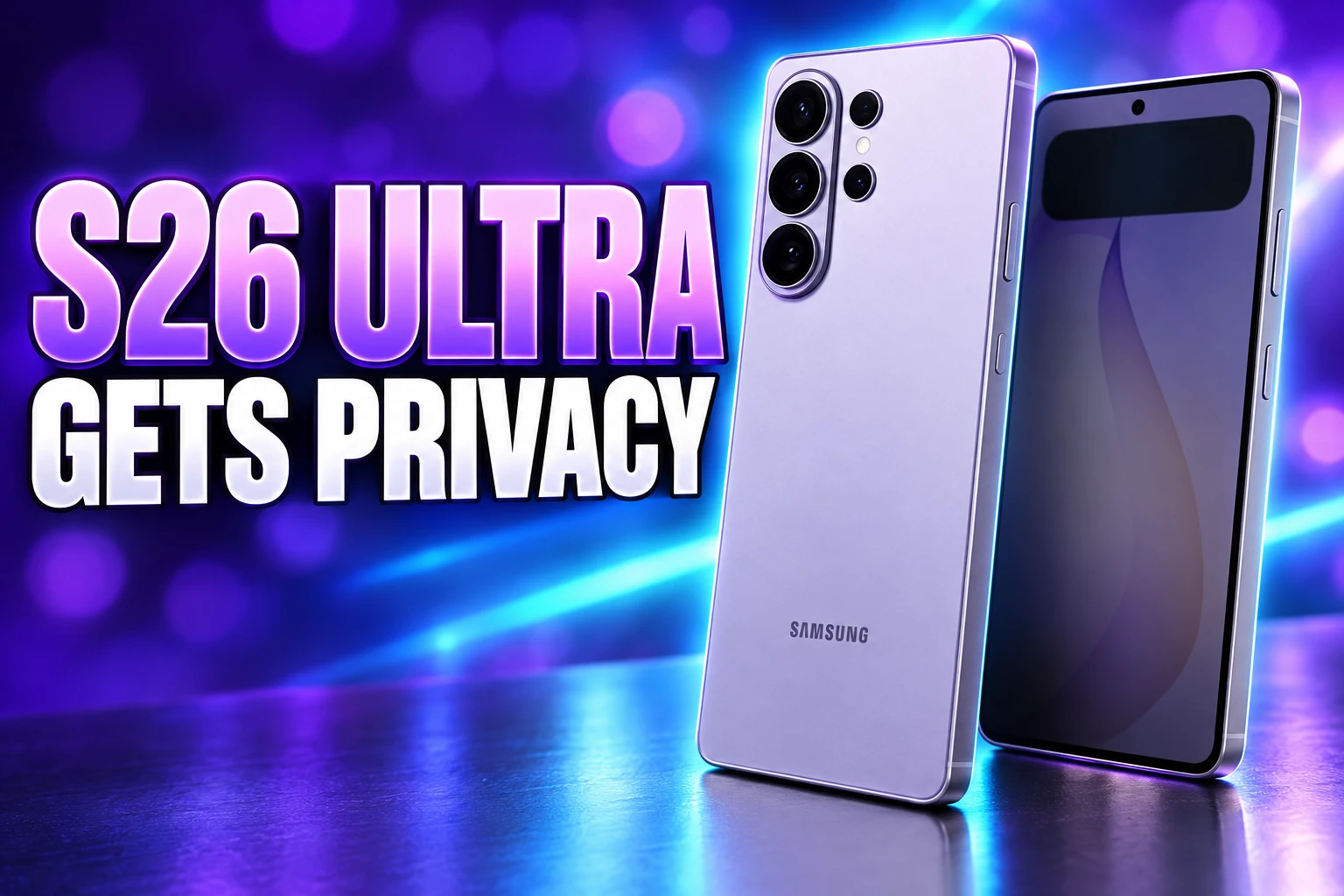
Only the Ultra Gets Samsung’s Privacy Panel
Privacy Display is the new reason not to step down. It is built into the 6.9-inch screen and is sold as the first privacy panel of its kind on a phone. The base Galaxy S26 and the S26+ do not have it. As of October 2, 2026, it was still missing from the S26 FE and from the Galaxy Z Fold 8 as well.
The feature can run on the whole screen or on a slice of it. It can wake for a PIN, a pattern, a password, a notification pop-up, or a chosen app. It can be mapped to a double-press of the side button. A Maximum Privacy Protection setting pushes the dimming harder for anyone standing off to the side.
THE BET, DATED
- 2024: Samsung Display unveiled Flex Magic Pixel at MWC as a panel that could hide a screen from the person in the next seat.
- February 25, 2026: Galaxy Unpacked in San Francisco puts that panel on the S26 Ultra only.
- March 2, 2026: Roh names the five first-wave countries and the 67% Ultra mix that justified them.
- March 11, 2026: Global sales start, with more than 70% of pre-orders on Ultra.
- June 24, 2026: Samsung’s Malaysia newsroom publishes months of regional hands-on quotes built around AI, camera, and the privacy screen.
The software extras travel across the S26 family. Now Nudge can surface a calendar clash inside a chat. Now Brief can stack a morning-to-late-night digest. The panel that physically narrows the view does not travel with them. If you want that, you buy Ultra.
How Flex Magic Pixel Hides the Screen
Samsung says Privacy Display is the product of more than five years of research, and that it blocks views from the sides, above, and below. The Ultra itself is 0.3 mm thinner than last year’s model and weighs 214 grams. The privacy trick lives in the glass, not in a film you stick on later.
The panel mixes two kinds of pixels. Wide pixels throw light out for a normal viewing angle. Narrow pixels, boxed by a multi-layer black matrix, send light mostly straight ahead. With the feature off, both sets run. With it on, the wide pixels drop and the narrow set keeps the image for the person holding the phone.
Samsung Display has filed about 150 patent applications since 2020 on the structures that make that switch possible. It brands the work Flex Magic Pixel, built on its polarizer-free LEAD process and sold as LEAD 2.0. UL Solutions checked a sample by tilting it 45 degrees and 60 degrees and spinning it through a full circle.
WHAT UL MEASURED OFF-AXIS
| Condition | Brightness left vs the front |
|---|---|
| FMP panel at 45 degrees | 3.5% |
| FMP panel at 60 degrees | 0.9% or lower |
| A typical phone panel off-axis | about 40% |
A UL official said the lab recorded a side-to-front brightness ratio of 3.5% at 45 degrees and 0.9% or lower at 60 degrees. Samsung Display puts that 3.5% at about one-thirtieth of front brightness, and the 60-degree reading at less than one-hundredth. A normal phone screen, it says, still holds about 40% of its front brightness from the side, which is why a stranger can read it on a train.
LEAD 2.0 is an innovative technology that maximizes security and privacy through all-around viewing angle control while simultaneously improving power efficiency, the most critical challenge in the era of on-device AI.
Hojung Lee, Executive Vice President, Head of Mobile Display Product Planning, Samsung Display
Samsung’s own footnote is drier. Some information may still be visible, it says, depending on angle and brightness. Caution is advised with sensitive content. The company is not claiming a brick wall. It is claiming a switchable funnel.
WHERE THE MODE CAN TURN ON
- Full screen: A Quick Settings toggle dims the whole panel from the side.
- Secrets only: PIN, pattern, and password fields can wake the narrow pixels by themselves.
- Chosen apps: Banking and messaging can be set to go private when they open.
- Alerts: Notification pop-ups can hide from a neighbor while the rest of the home screen stays wide.
- Maximum mode: A harder setting aims for a blank side view, not just a dim one.
A film you stick on the glass does this all day, including when you want to show someone a photo. The Ultra’s version is meant to drop away. That is the pitch that regional reviewers kept repeating after months on the phone.
Color Shift Survives Even When Privacy Is Off
The cost of that funnel does not clock out when the toggle does. Display analyst Ice Universe, posting on September 15, 2026, put an S26 Ultra next to an iQOO 16 with Privacy Display switched off and said skin tones went yellow and green as soon as the Samsung was tilted. At wider angles the face looked washed out, while the other panel held color.
Even if you never use Privacy Display at all, you still have to live with the side effects of this optical structure every single day.
Ice Universe, display analyst, on X
The complaint is not that the privacy mode fails when you stare at the phone straight on. Held square to the eye, the two screens in that clip look close. The tax shows up the moment the glass is not dead-on, which is how a lot of people actually read in bed, on a sofa, or over a shared table.
Samsung Display argues the old stick-on films dimmed the picture even when you did not want privacy. Flex Magic Pixel is supposed to give that dimming back. The structure that makes the narrow pixels possible is still in the glass at noon on a blank home screen. You can leave the feature off for weeks and still be looking through that optical stack.
That is the other half of the bet. Ultra buyers in Bangkok or Sydney get a four-way hide that no other Galaxy has. They also buy a panel whose wide-angle color is no longer the thing Samsung used to sell first.
A 15 Percent Drop That Still Paid for Flagships
The regional market around that bet got smaller. Counterpoint Research found Southeast Asia smartphone shipments fell 15% year on year in the second quarter of 2026, the steepest drop since the first quarter of 2023. Higher part costs and weak spending hit cheap phones hardest. Higher-priced models held up better.
Samsung was the largest brand in the region at a 24% share, up from 19% in the second quarter of 2025. Its shipments rose 6% year on year, the only gain among the five biggest vendors. Share points and shipment growth are different maths: the 24% share is a five-point jump, the 6% is how many more phones it moved.
SOUTHEAST ASIA SHARES IN Q2 2026
| Brand | Q2 2026 share | Q2 2025 share |
|---|---|---|
| Samsung | 24% | 19% |
| Xiaomi (with Redmi and Poco) | 18% | 18% |
| OPPO (with OnePlus and realme) | 17% | 22% |
| Transsion (with Infinix, Tecno, iTel) | 15% | 14% |
| Apple | 9% | 8% |
OPPO’s combined share fell five points. Apple’s share ticked up even as its shipments dipped about 2%. The volume market shrank. The brand that already owned the Ultra habit grew.
Roh’s line after Unpacked fits that chart. “Consumers in Southeast Asia and Oceania have high expectations for technology to make life better, and the Galaxy S26 Series will deliver next-level intelligent experiences,” he said. In a quarter when entry phones stalled, those expectations look like a willingness to spend up, not a request for a cheaper S26.
Regional Testers Took It on Commutes
Samsung’s June 24, 2026 newsroom package from Malaysia collected people who had lived with the phones, not launch-day hands. The quotes it chose still do useful work, because they show what the company wants the region to remember.
Adam Turner in Australia said Galaxy AI “tries to make life easier in all kinds of little ways” and that Now Nudge “surfaces useful information when you’re using messaging apps.” Effi, a Malaysia-based reviewer, used Now Brief as a four-part daybook, “a daily summary for morning, afternoon, evening and late night including a daily agenda, weather forecast, health summary and sleep pattern.”
The camera notes were physical, not lab charts. Lely Maulida, an Indonesian reviewer, shot after dusk in San Francisco’s Twin Peaks hills and said lamp detail on a tower still held. Ramon Lopez, a Philippines reviewer, used the 200-megapixel wide camera and the 50-megapixel 5x telephoto on fast sport and wrote that the S26 Ultra “passed with flying colors.”
Yonk, a Singapore reviewer, came back to the screen. “After extended use, the Privacy Display emerges as one of the S26 Ultra’s defining features, for being a quiet but powerful innovation that could set the standard for mobile privacy going forward.” A commuter quoted as Munk TV called the toggle the point: useful on a daily ride and for mobile banking, and easy to kill when you do not need it.
Vantu of Vatvo Studio in Vietnam stressed that Galaxy AI could follow Vietnamese usage without a third-party app or a monthly fee. That is a local pitch, not a spec. It is also software. The hardware exclusive in the same package is still the panel.
Side-Only Copies From Xiaomi and Huawei
By September the copycats had arrived, and they were narrower than Samsung’s version. Ice Universe and other testers putting a Xiaomi 18 Pro and 18 Pro Max against the S26 Ultra found the Chinese phones mainly cut the left and right view. The top and bottom stayed readable. Huawei’s take followed the same horizontal idea.
Samsung’s baffles are the more complete hide, which is why Geek Culture’s Yonk could still call the Ultra’s screen a standard-setter months after launch. Xiaomi’s trade was different. Some side-by-side clips showed its image holding together better with privacy switched on, while the Ultra’s four-way stack did more to the picture even in so-called normal mode.
On October 2, 2026, Privacy Display was still listed only on the Galaxy S26 Ultra. The cheaper Galaxies in the same series, and the Fold beside them, did not get the pixels. Chinese flagships got a partial version. The 67% Ultra habit in Southeast Asia and Oceania is the thing that panel is meant to keep in house, one commute at a time.

Greed Held After a $697 Million Crypto Long Flush

Fed Minutes Keep a Year-End Rate Hike Alive

A Nanny-Cam Tape Follows Tyreek Hill Into Free Agency

Star Wars Galactic Racer Makes a Crash End the Tour

Amazon Puts Apple’s June MacBook Prices Back on Sale

The iPhone 16 Pro Flipkart Cut Did Not Last

Sophia Wootten Turns the Miss Georgia Crown Toward Cleft Care

Microsoft Prints Azure’s $29.42 Billion Quarter and Shrinks the Map

UltraTech’s Ultravolt Launch Puts Cable Multiples on Trial

IXI Autofocus Glasses Still Lack a European CE Mark
-
 NEWS1 year ago
The iPhone 16 Pro Flipkart Cut Did Not Last
-
 ENTERTAINMENT4 months ago
Sophia Wootten Turns the Miss Georgia Crown Toward Cleft Care
-
 BUSINESS1 month ago
UltraTech’s Ultravolt Launch Puts Cable Multiples on Trial
-
 NEWS1 month ago
Microsoft Prints Azure’s $29.42 Billion Quarter and Shrinks the Map
-
 NEWS9 months ago
IXI Autofocus Glasses Still Lack a European CE Mark
-

 NEWS3 months ago
Little St. Simons Island Hatches Loggerheads at 72.4 Percent
-

 NEWS4 months ago
Georgia Beach Bacteria List Leaves Swim Areas Open
-

 NEWS3 years ago
Eyal Waldman Keeps a Two-State Bet After Gaza