
NEWS
FireCAD Replaced STARFIRE, Then Locked FDNY to Accenture
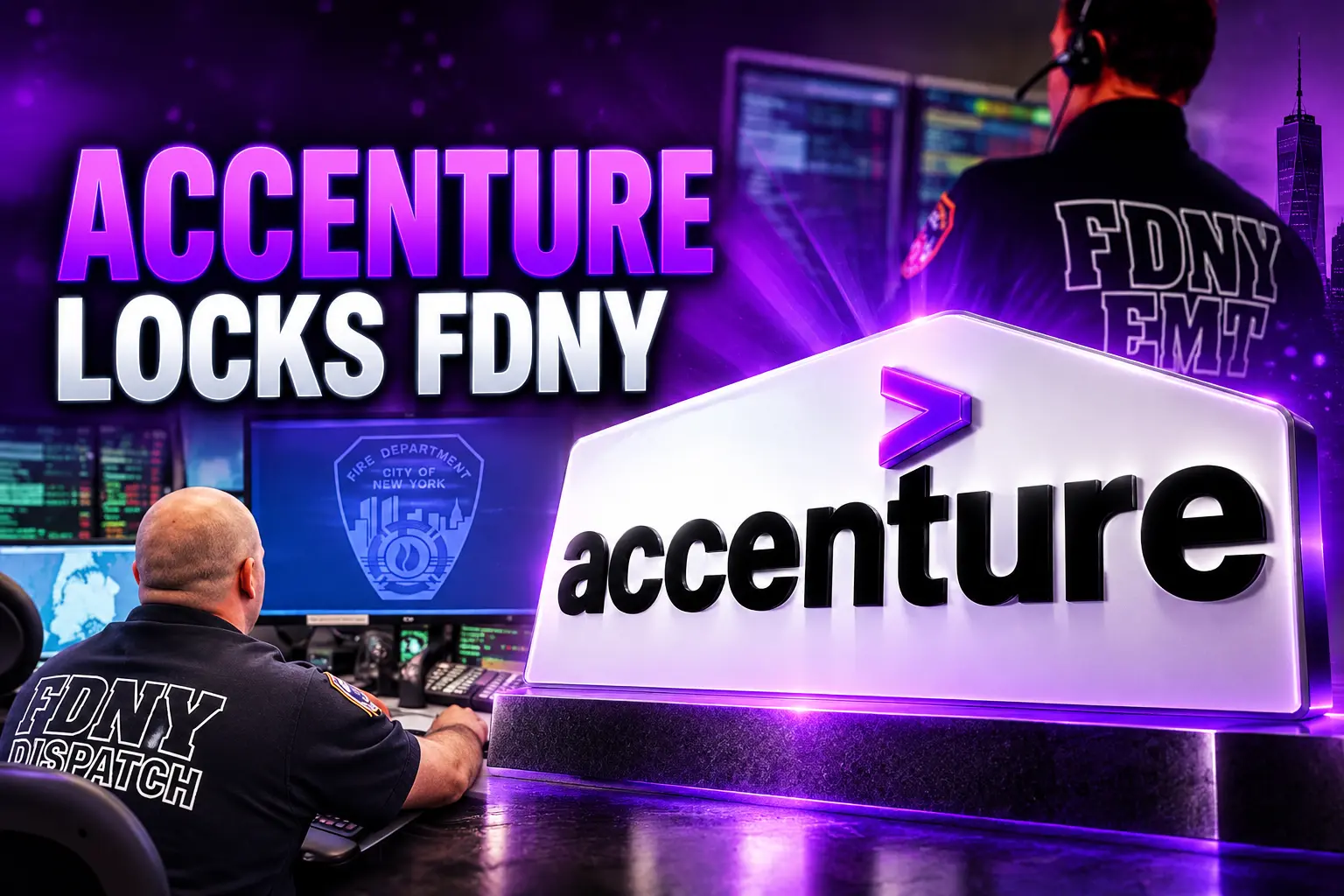
FireCAD retired FDNY’s 45-year STARFIRE system in 2021. By 2024 the city said only Accenture could maintain it, and EMS was next on that stack.

FDNY cut FireCAD live at 3:43 a.m. on Aug. 2, 2021, and retired STARFIRE, the dispatch system officials called 45 years old. Accenture had won a 2017 contest to custom-build the platform, and officials priced the four-year job at $22 million.
On Sept. 19, 2024, the City Record posted an $8,675,000 sole-source maintenance award to Accenture LLP, stating there was only one source available. The system built to end a long lock-in had become one.
FireCAD Went Live at 3:43 a.m. on a Monday
Deputy Commissioner Jon Paul Augier later said the department picked a Monday at 3:43 a.m. because call volume is usually low. FireCAD took over fire, rescue, and hazmat dispatch across the five boroughs, a 302-square-mile map with more than 8.5 million residents and more than 1.5 million 911 calls a year.
Accenture’s Aug. 5, 2021 release said the firm was selected in 2017 and then custom-built FireCAD’s platform through workshops with FDNY dispatchers and subject-matter experts, plus implementation, systems integration, and project management. Fire Commissioner Daniel Nigro said the work had to last.
Ensuring that our technology can meet the demands of an evolving city is essential to the safety of our members and the public they bravely serve. This is a significant step forward for technology for the department, and it has taken exceptional dedication from a team of technologists and fire alarm dispatchers. I know this new system will continue to support FDNY operations for a generation.
Daniel Nigro, New York City Fire Commissioner, August 2021 launch statement
Augier, then deputy commissioner for public safety technology and dispatch operations, said members needed high-speed processing, 24×7 availability, and an intuitive dispatcher interface, and he called FireCAD the most reliable system of its kind. The design target was 52 minutes of downtime a year, or 99.99% uptime, against STARFIRE’s 9 hours a year, or 99.9%.
NYSTEC, the New York State Technology Enterprise Corporation, later wrote that FDNY turned to a custom build after an initial product from an external vendor was deemed insufficient. The department used its own programmers and operations people and brought in a system integrator. NYSTEC independently checked cost, schedule, risk, and whether the integrator met FDNY’s requirements. That is how a city that could not buy a stock CAD ended up owning a one-off.
STARFIRE Began as a 1968 Plan
STARFIRE did not arrive as a weekend upgrade. Fire Engineering’s October 1980 archive piece described a $15 million network of 14 computers, 12 microcomputer systems, and 500 terminals tied to 16,000 alarm boxes, the end of a 12-year effort that started in 1968. Alarm volume had already tripled from 1968 to 473,000 in 1978, and the department then fielded more than 350 firefighting units.
In 1973 a formal spec went out for bids. The responses came in around $40 million, more than twice what the city had set aside, and the bids were rejected. FDNY rewrote the spec around a cheaper phased plan, with Brooklyn as the test. The Brooklyn testbed cut over on April 26, 1977, for daytime weekday hours, then went to continuous operation on Oct. 14, 1977. A technical audit from November 1977 to March 1979 found the system down 11.27 hours out of 12,384 hours, which the department treated as 99.9% availability.
The 1980 write-up said STARFIRE would be implemented for $25 million less, in 1973 dollars, than those first bids, and that it could pick units from live availability instead of a fixed assignment card. Average time from a citizen’s first contact to automatic notification of companies was put at 40 seconds. House watch desks got printouts and a status panel with 10-4 and 10-14 buttons so a company that could not roll triggered an automatic substitute.
That architecture is why STARFIRE lasted so long, and why replacing it felt like pulling a foundation. Augier later said the department could only bolt so much onto a 1977 application before it slowed, froze, or needed a warm start, and those stalls hit how fast emergencies got on the street.
FROM STARFIRE TO FIRECAD
- 1968: FDNY conceives STARFIRE to replace a 50-year-old communications setup as alarm volume climbs.
- 1973: Formal bids come back around $40 million and are rejected as more than twice the city’s appropriation.
- April 26, 1977: Brooklyn testbed cuts over on weekdays from 9 a.m. to 5 p.m.
- October 14, 1977: Brooklyn goes to continuous operation; a later audit logs 11.27 hours down out of 12,384.
- October 1980: Fire Engineering describes a $15 million citywide network and 40-second average dispatch.
- 2017: Accenture wins a competitive bid to design and custom-build a successor.
- August 2, 2021: FireCAD goes live at 3:43 a.m. and STARFIRE is retired.
- September 19, 2024: The City Record awards Accenture $8,675,000 in sole-source FireCAD maintenance.
Officials in 2021 still called STARFIRE 45 years old. The Brooklyn cutover was 44 years earlier, the 1980 citywide write-up was 41 years earlier, and the 1968 plan was 53 years earlier. The 45-year line was the department’s own, and it was the number they used to justify the swap.
Only Accenture Can Maintain FireCAD Now
The $22 million figure is what FDNY officials used at launch. NYC Checkbook, the city’s public contract ledger, lists a separate Fire Department systems-integration contract with Accenture LLP, CTA105720187205553, at $25.71 million current against a $23.89 million original, with $25.71 million spent. A second FDNY contract, CT105720228806565, is labelled FireCAD System work at $10.14 million, with $2.99 million spent on the snapshot that showed those rows.
Those Checkbook lines are not a restatement of the $22 million launch figure. They are registered contract amounts on named documents. The September 2024 City Record award is a fourth figure on a fourth document: $8,675,000 to Accenture for infrastructure outsourcing and application outsourcing support to FireCAD, PIN 05723S0004001, awarded as a sole source because the notice said that was the most competitive method that fit, since only one source was available.
ACCENTURE MONEY AROUND FIRECAD
| Item | Amount | Status |
|---|---|---|
| Launch figure used by FDNY officials | $22 million | August 2021 |
| STARFIRE network, 1980 dollars | $15 million | 14 computers, 500 terminals |
| Checkbook systems integration CTA105720187205553 | $25.71 million current | Original $23.89 million, spent $25.71 million |
| Checkbook FireCAD System CT105720228806565 | $10.14 million | $2.99 million spent |
| City Record sole-source PIN 05723S0004001 | $8,675,000 | Awarded Sept. 19, 2024 |
The 2024 notice describes FireCAD as the system that takes emergency calls by phone, fire alarm box, or other means other than EMS, then assigns firefighting units and feeds them information. It also says the department has linked FireCAD to the police dispatch system and the EMS system. Flexible architecture, in the 2021 talking points, meant room to grow. In the 2024 award it meant the builder was the only shop left to run production support.
Deborah Snyder, an Accenture managing director for New York State, said in 2021 the firm was proud to work side by side with FDNY on the dispatch system the city deserved, and that the design was meant to work with existing FDNY technology and to help plan, prioritize, and track crews. That interoperability line reads differently once the maintenance PIN names a single vendor.
Three Unexpected Outages in Six Months
Reliability was the requirement Augier kept putting first. FDNY officials later confirmed unexpected FireCAD outages on Oct. 4, 2021, Nov. 7, 2021, and Feb. 14, 2022. Combined downtime was 1 hour and 13 minutes, which is 73 minutes, 21 minutes over the 52-minute yearly design target, and that overage landed in the first six months. Officials said none of those outages produced a missed call or a loss of life or property. Dispatchers still had to work paper and pencil while the screens were dark.
The old EMS CAD, EMSCAD, had three unexpected outages in the same window and was offline 4 hours and 30 minutes, with the longest stretch on Sept. 18 lasting 3 hours. Union officials used that pairing to argue the new fire system had not yet beaten the antique medical one on raw uptime. FDNY said it was already working on an EMSCAD replacement, without a public go-live date.
In the first days after cutover, company members described house tickets that dropped first-due units and mobile terminals that would not take in-service or disposition codes, so status had to go through the dispatcher. Those are the bugs a custom CAD shows when the map, the roster, and the radio all have to agree at once. Augier told interviewers the system was working with a few minor bugs and that dispatcher involvement from before the 2017 bid was the reason it held.
On Oct. 12, 2022, an outside contractor in the basement of the downtown Brooklyn dispatch center pressed a glass-covered button marked EPO, for emergency power off, after taking it for a door release. Augier later told the City Council it was an egregious error and that it is very difficult to account for all levels of intelligence. FDNY said the fire CAD never went offline and that the EMS dispatch system was out about 90 minutes. Fire Alarm Dispatchers Benevolent Association president Faye Smyth said radios were down until 2:30 p.m. and mobile data terminals in the field were not fully up until 6 p.m., a longer restoration of radios and terminals than the CAD outage FDNY logged. She said the department was delivering facts with rose-colored glasses.
Dispatchers Helped Write the System They Run
The 2021 FireCAD launch with dispatchers was sold as a break from the usual handoff, in which requirements are gathered once and then thrown over a wall. Augier called it a CAD system that was for dispatchers, by dispatchers, and said the training unit stayed in the build for years instead of dropping a stack of specs on a business-analyst team. Smyth, in the launch statement, called it a big step, the first real enhancement to dispatch technology in decades, and the first time actual, active fire alarm dispatchers had been on the development team.
That seat at the table did not end the staffing grind. At a 2022 Council hearing on outages, Smyth testified that staffing had been short for so long that dispatchers were regularly ordered in on days off, and that her members had been working back-to-back tours since the start of Covid. “We power the city for fire engines, we care about our units in the field, we care about the public,” she said, “but my people have been doing back-to-back tours like this since the beginning of Covid.” Augier told the same hearing the department was budgeted for 207 dispatcher posts and had filled 197.
When Augier prepared to leave at the end of December 2023 after a 27-year career, he called deploying FireCAD with Accenture the crowning achievement of that run. He also said there had been a huge learning curve in how the fire department adopted new technology, and that the department was then cooking with gas. The early crashes and the EPO event sat in that same interview as proof that a CAD is only as good as the people and the power buttons around it.
Why EMS Kept a Separate CAD Through 2025
FireCAD was never the whole 911 stack. NYPD runs its own CAD. EMS stayed on EMSCAD, a decades-old system that Augier in 2022 said would get a rebuild with greater availability, more functions, and architecture compatible with next-generation 911, with development expected to start in early 2023. NYSTEC’s FireCAD write-up had already listed next-generation 911 compatibility as a FireCAD design point. The fire side moved. The ambulance side waited.
On March 14, 2025, Fire Commissioner Tucker told the City Council Committee on Fire and Emergency Management that the mayor had given the department the green light to build a new EMS computer-assisted dispatching platform, that the one in use was at the end of life and had been for a while, and that the department would build it on top of the FireCAD system. He said 50% of the runs engine companies make citywide are now medical. That is the operational reason to put fire and EMS on one assignment engine: half the engine work is already ambulance work by another name.
WHAT THE 2025 NOTICES SAY
- March 14: Fire Commissioner Tucker tells the City Council the mayor approved a new EMS CAD built on FireCAD, and that 50% of engine company runs citywide are medical.
- May 13: FDNY posts a sole-source notice, closing May 23, 2025, to negotiate with Accenture LLP for development and integration of an EMS CAD using existing FireCAD infrastructure.
- December 29: FDNY posts a notice of sole-source talks with Peraton Inc. to maintain the existing EMS CAD, PIN 05726Y0572, and invites any other vendor that can do the work to say so in PASSPort.
The May notice is an intent to negotiate, not a recorded award, so Accenture had not been posted as the EMS CAD winner in that filing. The December notice is the tell that the old EMS CAD was still the live system FDNY had to keep patched. Peraton was named as the incumbent for that maintenance. Two vendors, two CADs, and a plan to collapse the medical one onto the fire one that only Accenture was listed as able to support in 2024.
Nigro’s generation line assumed FireCAD would be the last cutover of its kind for a long while. STARFIRE had already proved a custom NYC CAD can run for four decades if nobody can replace it cheaply. FireCAD’s 2024 sole-source PIN and the 2025 plan to set EMS on the same base are that pattern starting over, with the integrator of 2017 now written in as the only source the City Record would name.

Greed Held After a $697 Million Crypto Long Flush

Fed Minutes Keep a Year-End Rate Hike Alive

A Nanny-Cam Tape Follows Tyreek Hill Into Free Agency

Star Wars Galactic Racer Makes a Crash End the Tour

Amazon Puts Apple’s June MacBook Prices Back on Sale

Sophia Wootten Turns the Miss Georgia Crown Toward Cleft Care

The iPhone 16 Pro Flipkart Cut Did Not Last

Georgia Beach Bacteria List Leaves Swim Areas Open

Microsoft Prints Azure’s $29.42 Billion Quarter and Shrinks the Map

Little St. Simons Island Hatches Loggerheads at 72.4 Percent
-
 ENTERTAINMENT4 months ago
Sophia Wootten Turns the Miss Georgia Crown Toward Cleft Care
-
 NEWS1 year ago
The iPhone 16 Pro Flipkart Cut Did Not Last
-
 NEWS4 months ago
Georgia Beach Bacteria List Leaves Swim Areas Open
-
 NEWS3 months ago
Little St. Simons Island Hatches Loggerheads at 72.4 Percent
-

 NEWS10 months ago
IXI Autofocus Glasses Still Lack a European CE Mark
-
 NEWS2 months ago
Microsoft Prints Azure’s $29.42 Billion Quarter and Shrinks the Map
-
 BUSINESS2 months ago
UltraTech’s Ultravolt Launch Puts Cable Multiples on Trial
-

 NEWS3 years ago
Eyal Waldman Keeps a Two-State Bet After Gaza