
NEWS
The Pinova Fire Closed Brunswick’s Century-Old Resin Plant
The April 2023 Pinova fire ended 112 years of Brunswick resin work, erased 213 jobs, and left Superfund neighbors still carrying toxaphene.

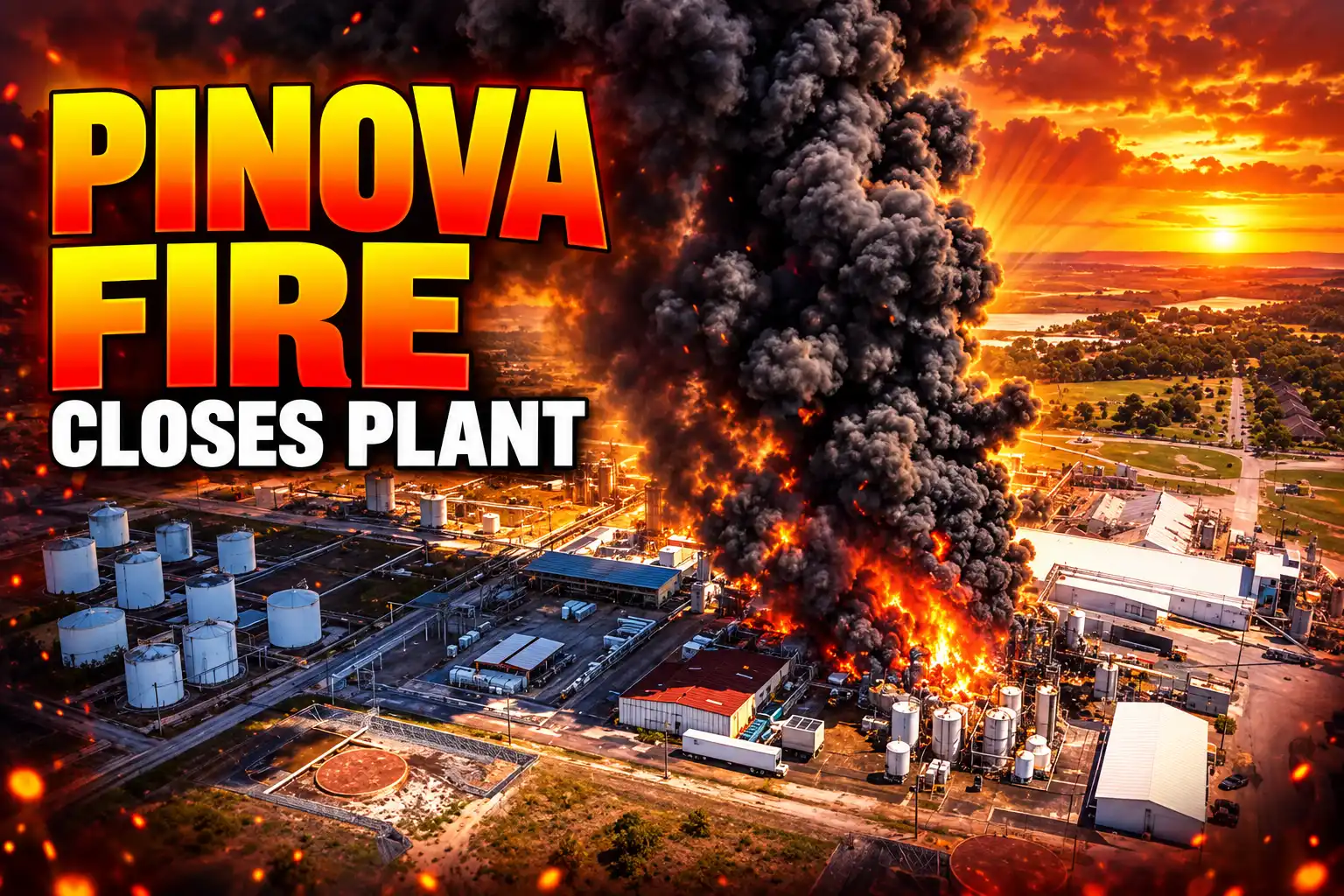
A terpene-unit fire on April 15, 2023, closed Pinova’s Brunswick resin plant for good and left 213 workers without that paycheck. The blaze at 2801 Cook Street sent thick black smoke over Interstate 95. Mayor Cosby Johnson put the whole city under shelter-in-place as the wind kept shifting.
Crews declared the fire out that night. The plant never shipped another batch of wood rosin. What the city is still paying for started long before that Saturday and did not end when the foam trucks left.
Two Fires in One Saturday
Pinova made wood rosins and polyterpene resins for adhesives at the Cook Street works, a few hundred yards from the mainland end of the F.J. Torras Causeway. The terpene unit caught fire about 7 a.m. Brunswick and Glynn County crews had it down by 10 a.m. Around 3 p.m. it came back.
Glynn County ordered people within a half-mile to shelter in place at 3:25 p.m., then widened that ring to a mile as the wind shifted. Johnson declared a local emergency at 6 p.m. and told the whole city to stay inside. He also asked anyone within a half-mile to leave if they could. A shelter opened at Howard Coffin Park. St. Simons Island north of the airport sat under the same stay-put order because the plume kept moving.
Because we did not know the extent to which we could contain this fire and we could not foresee where the wind would be moving, we thought it would be best for us to talk to our entire city, and not just one singular piece of it.
Cosby Johnson, mayor of Brunswick, April 15, 2023 briefing
Help came from Jacksonville, about 70 miles south, and from Savannah, Wayne, Camden, Chatham, Jekyll Island, and Effingham. Georgia Forestry dumped suppressant from the air. County officials later counted 13 fire and emergency agencies on the job. Chemical tanks on the lot stayed intact. Two people had minor burns. No one died.
THE SATURDAY THE PLANT BURNED TWICE
- April 15, 2023, about 7 a.m.: Fire starts in the terpene unit at 2801 Cook Street.
- About 10 a.m.: Crews contain the first blaze.
- About 3 p.m.: The fire reignites and burns into the night.
- 3:25 p.m.: Shelter-in-place covers a half-mile, then a mile, then the whole city at 6 p.m.
- 10:08 p.m.: Officials say the fire is out and lift the shelter and evacuation orders.
- April 16, 8 a.m.: The local emergency ends; about 30 people have spent the night with the Red Cross.
Ron Kurtz, Pinova’s senior director of operations, later told a town hall at First Jordan Grove Baptist Church that the plant’s suppression gear did what it was supposed to do on the first fire. The second one, he said, burned about eight hours because crews ran short of water and foam. The plant no longer kept an onsite fire brigade, so it waited on the city department once the sprinklers and foam system had done their first pass. A Georgia State Fire Marshal team walked the wreck. A definitive cause was never named.
Glynn County commissioners later accepted a Pinova check for $37,560.74 to replace ruined gear and a large hose. Kurtz said the company would also cover city overtime. In March 2024, Pinova handed the county a custom foam trailer. Leftover debris still burned: lightning hit a pile on the lot on April 21, 2024, and threw up another black cloud.
What Alpha Pinene Did in the Air
Pinova staff told federal responders that alpha-pinene as a flammable liquid was the chemical of concern in the terpene unit. NOAA describes it as a clear liquid with a turpentine odor and a flash point of 91 F. Vapors are heavier than air and can travel to an ignition source and flash back. That is a bad partner for a second fire on a windy Saturday.
Georgia’s Environmental Protection Division asked EPA for help. By the time federal crews set up, the flames were out and no plume was visible. EPA put air monitors at three named sites: Selden Park, the College of Coastal Georgia, and Brunswick police headquarters. The instruments looked for volatile organic compounds, oxygen, carbon monoxide, hydrogen sulfide, and lower explosive limit.
Alpha-pinene has no EPA Acute Exposure Guideline Level, so the team used a benzene emergency screening number as a stand-in. The terpene unit did not use benzene, and benzene was not treated as a breakdown product. Period averages stayed under the site-specific action levels that would have forced a further response. VOCs ran a little high for about four hours at the college, which EPA said could have come from nearby vehicles or humidity.
Kimberly Michele Edmond, who was told to stay inside, said she could smell the fire from her mother’s house about a mile away and felt lightheaded when she stepped out. Da’Quann Short, who watched the street fill with emergency lights, said people around him talked as if the city might blow up. Those were the hours the smoke was still up. The federal log is the record of what was in the air after it dropped.
The Plant Already Sat in High Priority Violation
The fire has not been tied to a permit breach. The plant’s paper trail was already ugly. EPA’s Enforcement and Compliance History Online listed Pinova in Brunswick as a High Priority Violation and out of compliance in 11 of the prior 12 quarters when the smoke was still in the news. The works counted as a major air source, the class of plant that can emit 10 tons a year of one hazardous air pollutant or 25 tons of a mix.
Georgia EPD had been through this plant before. Sara Lips, an EPD spokeswoman, said the recent compliance problems had not shown emissions above permit limits, though one consent order still had tests pending. She also said EPD would look again after the fire to see whether the Risk Management Plan had been followed.
AIR ORDERS ON THE BOOKS
| Date executed | EPD order | Penalty |
|---|---|---|
| April 28, 2022 | EPD-AQC-7176, Air Quality Act | $185,000 |
| December 8, 2022 | EPD-AQC-7226, Air Quality Act | $44,007 |
The April 2022 order covered failed reports, stale records, unrepaired leaks on valves and pumps, and instruments that had not been calibrated. The December order cited leaking parts, missed monitoring, and a bad wood plug. Those are the kinds of gaps that make self-reported air numbers hard to trust. Rachael Thompson, executive director of the Glynn Environmental Coalition, said the Pinova air fines were the highest in Glynn County over five years and that the penalties had not changed how the plant ran.
OSHA had its own file. In December 2021 the agency logged four serious violations, including inspections that were not done on a rosin tank, and proposed $44,861 in penalties. None of that names the spark on April 15. It does describe a works that kept showing up in the enforcement queue right up to the fire.
A Century of Pine Stumps and Toxaphene
The Cook Street lot is older than Pinova. A naval stores plant opened there in 1911 to pull rosin from pine stumps. Hercules took over in 1920 and ran the same pine-chemical trade, with a wartime sideline that earned the plant an Army-Navy E flag in 1944. By 1951 about 900 people worked there.
From 1948 through 1980 the same property made toxaphene, a chlorinated pesticide sold against boll weevils. Wastewater from that line ran through a ditch toward Dupree Creek and Terry Creek. Toxaphene production stopped in 1980. The 009 Landfill, where sludge from the process went, entered the federal Superfund program in 1984. Pinova bought the operating half of the plant in 2010. DRT America, the U.S. arm of France’s DRT, took over Pinova in 2016.
Hercules still holds the cleanup on three pieces of this map, under EPA and Georgia EPD. The company says it has spent more than $86 million on cleanup over 30 years at the plant, the 009 Landfill, and Terry Creek, and that it sent more than $250,000 in technical assistance grants to the Glynn Environmental Coalition.
THREE SITES, TWO AGENCIES
- 009 Landfill: A Superfund cell for toxaphene sludge; Hercules says the cap is in place and part of the ground is leased to a car dealer.
- Brunswick plant: State hazardous-waste permit and a 2022 corrective action plan; not on the Superfund list, cleaned under a Superfund-style alternative.
- Terry Creek: Still on the Superfund list; Hercules capped the old outfall ditch and built a new storm channel, with that interim step finished in July 2025.
Glynn County holds four of Georgia’s 23 Superfund sites. LCP Chemicals, the old chlor-alkali works on the waterfront, is the one most people name first. The Hercules ground is the one that shared a fence line with Pinova’s stills. A fire in the terpene unit did not create that map. It did shut the last factory still running on it.
Two Hundred Thirteen Paychecks Stopped
Pinova told the workforce on June 28, 2023, that the Brunswick site would not reopen. Kurtz said the fire had destroyed core production gear, and that rebuilding would take too much demolition, money, and time. Layoffs were to roll in stages so tanks could be emptied and the site shut under its permits. Full wind-down was put at about 18 months.
THE PAYROLL THE FIRE ERASED
- Head count: Pinova employed 213 people when it said the plant would stay closed.
- Local spend: Kurtz told Glynn County commissioners the plant had kept about $60 million a year inside a 30-mile radius.
- Crew left behind: The on-site staff fell to 18 people while tanks were emptied and buildings came down.
- Acreage: Kurtz described a roughly 300-acre industrial tract that the company wanted ready for a new owner.
The Golden Isles Development Authority and the Brunswick-Golden Isles Chamber of Commerce helped stage job fairs. Ryan Moore, the authority’s CEO, called the workers some of Brunswick’s best and said the closure was a blow the county did not choose. Kurtz, who lives in Brunswick, wrote a community letter that fall saying most of the 213 had already found a path, whether a new job, retirement, or school.
That $60 million figure was Kurtz’s own estimate, not an audited county series. Even as a round number it names the hole. The plant had greeted drivers on Highway 17 for generations. Steam and the smell of pine chemicals were part of the causeway. After June 28, that payroll was gone and the skyline was a demolition schedule.
Blood Tests Found Toxaphene in Glynn County
The smoke on April 15 was alpha-pinene and soot. The chemical neighbors keep naming is older. Emory University’s Rollins School of Public Health drew blood from 97 Glynn County residents in 2023 and published a peer-reviewed blood study of 97 residents in 2025. Twenty percent of those samples had more toxaphene than the national average. Forty percent ran high for a toxicant tied to the defunct LCP plant, a different chemical from a different works.
Around 60 people came to the Glynn Brunswick Library on October 16, 2025, for a Hercules update. Contractors talked about samples and future tenants. Anita Collins, a longtime resident who had given blood for the Emory work, pushed the microphone the other way.
Some of us in this room have toxaphene in our bodies. So when is that conversation going to be had? Because, I mean, you’re talking about redevelopment, and every time I hear you say redevelopment, it hurts, and it hurts because there are people who died because of problems from these sites, and that’s not even in the equation.
Anita Collins, Brunswick resident, Glynn Brunswick Library meeting, October 16, 2025
Marty Crook, a geologist with Geosyntec, said the company was carrying out a corrective action plan under Georgia EPD and also getting the ground ready for reuse. Hercules told the room that data around the site did not show a known unacceptable risk to offsite property, without saying when those samples were last taken. The human health risk work then on the table used an industrial standard, which allows more leftover contamination than a residential one. Officials said they would run a residential assessment if they had to. They also said an updated human risk assessment was due in December 2025.
In June 2026, Emory received a five-year, $15 million National Institutes of Health grant to study how Superfund contamination in Glynn County moves into bodies, marshes, and storms. That money is the next round of the 2023 pilot, not a verdict on the Pinova smoke. The fire is one day on a much longer exposure clock.
Cleared Ground Awaits the Next Tenant
Hercules’ own timeline says demolition on both the Hercules and Pinova sides finished in March 2025. Stump piles, water towers, and process buildings came down. Two office buildings were the last structures left in an earlier groundwater report. Environmental covenants recorded in June 2025 require any new project to keep the cleanup controls and use limits. In July 2025 the company finished capping the old Terry Creek outfall and hauled more than 2,000 tons of affected soil from the Marsh Wood Storage Yard.
WHAT LEFT THE GROUND IN 2025
- Soil moved: Contractors told the October meeting they had taken 135,000 tons of soil off the tract.
- Samples logged: More than 2,700 groundwater samples and 5,400 sediment and soil samples sit in the file.
- Water treatment: Hercules said systems near Highway 17 cut target chemicals by more than 90 percent in 2024 and then lengthened a treatment wall.
- Reuse terms: Covenants now bind whoever buys the dirt; Hercules and Pinova still own the vacant ground.
Cynthia Draper, an environmental engineer with Wood PLC, told the library crowd she could not name the next developer or the exact future use. She could describe the pitch being made to the kind of industry allowed on a lot with those covenants. That is the industrial standard again. Homes would need a different test.
The Saturday fire is over. The terpene stills are scrap. Alpha-pinene is no longer in the air over Selden Park. What remains is a cleared tract on Cook Street, four Superfund names in one county, and a blood study that did not wait for a buyer.
Frequently Asked Questions
What Did the Pinova Plant in Brunswick Make?
Pinova ran wood rosins, polyterpene resins, and terpene oils used in adhesives, chewing gum, soft drinks, and building supplies. It was a unit of DRT America, the U.S. arm of France’s DRT, which bought Pinova in 2016 and held the Cook Street lines from that sale until the 2023 fire.
Did EPA Find Dangerous Air After the Pinova Fire?
Readings stayed below the action levels EPA set for that response. The agency also sampled surface water and issued an ecological memo in May 2023; those water results sit in the same public case file as the air sheets, under National Response Center number 1364852.
When Did Pinova Close the Brunswick Plant for Good?
Pinova announced the permanent shutdown on June 28, 2023, after concluding that the burned terpene unit and wrecked infrastructure were not worth rebuilding. Decommissioning of the burned terpene building started in September 2023, and the company told commissioners that December that the rest of the takedown should finish by December 2024.
Why Do Glynn County Residents Still Talk About Toxaphene?
Hercules made the pesticide on the same property from 1948 through 1980 and sent wastewater toward Terry Creek. EPA classifies toxaphene as a probable human carcinogen, and U.S. production was banned in 1990. Fish-consumption advisories on nearby creeks were eased in 2007 and again in 2018 after sediment work, which is a separate record from the 2023 smoke.
How Many Superfund Sites Does Glynn County Have?
Four of Georgia’s 23. Besides the Hercules 009 Landfill and the Terry Creek dredge-spoil site, the list includes LCP Chemicals on the waterfront and the Brunswick Wood Preserving Co. tract, an 84-acre former wood-treatment works that EPA listed in 1997.
Draper still could not name a buyer in that October room. The covenants filed in June 2025 will follow whoever shows up. The next tenant inherits a lot that is cleaner than it was, and a county that has learned not to confuse an empty skyline with a finished story.
Disclaimer: This article is news reporting and analysis of a 2023 industrial fire, later plant closure, and related environmental records. It is for information only and is not medical, legal, or environmental-health advice. It does not tell anyone whether air, soil, water, or blood-test results are safe for a given household, and it is not a substitute for care from a licensed physician or for guidance from a qualified environmental-health professional. Readers with concerns about chemical exposure should talk with a doctor and, for property or cleanup questions, with the relevant EPA or Georgia EPD project staff, because figures and site status in the underlying records can change.

Greed Held After a $697 Million Crypto Long Flush

Fed Minutes Keep a Year-End Rate Hike Alive

A Nanny-Cam Tape Follows Tyreek Hill Into Free Agency

Star Wars Galactic Racer Makes a Crash End the Tour

Amazon Puts Apple’s June MacBook Prices Back on Sale

Sophia Wootten Turns the Miss Georgia Crown Toward Cleft Care

The iPhone 16 Pro Flipkart Cut Did Not Last

Microsoft Prints Azure’s $29.42 Billion Quarter and Shrinks the Map

UltraTech’s Ultravolt Launch Puts Cable Multiples on Trial

IXI Autofocus Glasses Still Lack a European CE Mark
-
 NEWS1 year ago
The iPhone 16 Pro Flipkart Cut Did Not Last
-
 ENTERTAINMENT4 months ago
Sophia Wootten Turns the Miss Georgia Crown Toward Cleft Care
-
 BUSINESS1 month ago
UltraTech’s Ultravolt Launch Puts Cable Multiples on Trial
-
 NEWS1 month ago
Microsoft Prints Azure’s $29.42 Billion Quarter and Shrinks the Map
-
 NEWS9 months ago
IXI Autofocus Glasses Still Lack a European CE Mark
-

 NEWS3 months ago
Little St. Simons Island Hatches Loggerheads at 72.4 Percent
-

 NEWS4 months ago
Georgia Beach Bacteria List Leaves Swim Areas Open
-

 NEWS3 years ago
Eyal Waldman Keeps a Two-State Bet After Gaza