
NEWS
Local Utilities Police the Water Georgia Data Centers Want
Georgia asked data centers to cut water in a drought, yet most campuses tap city pipes and skip state permits, leaving utilities to refuse them.

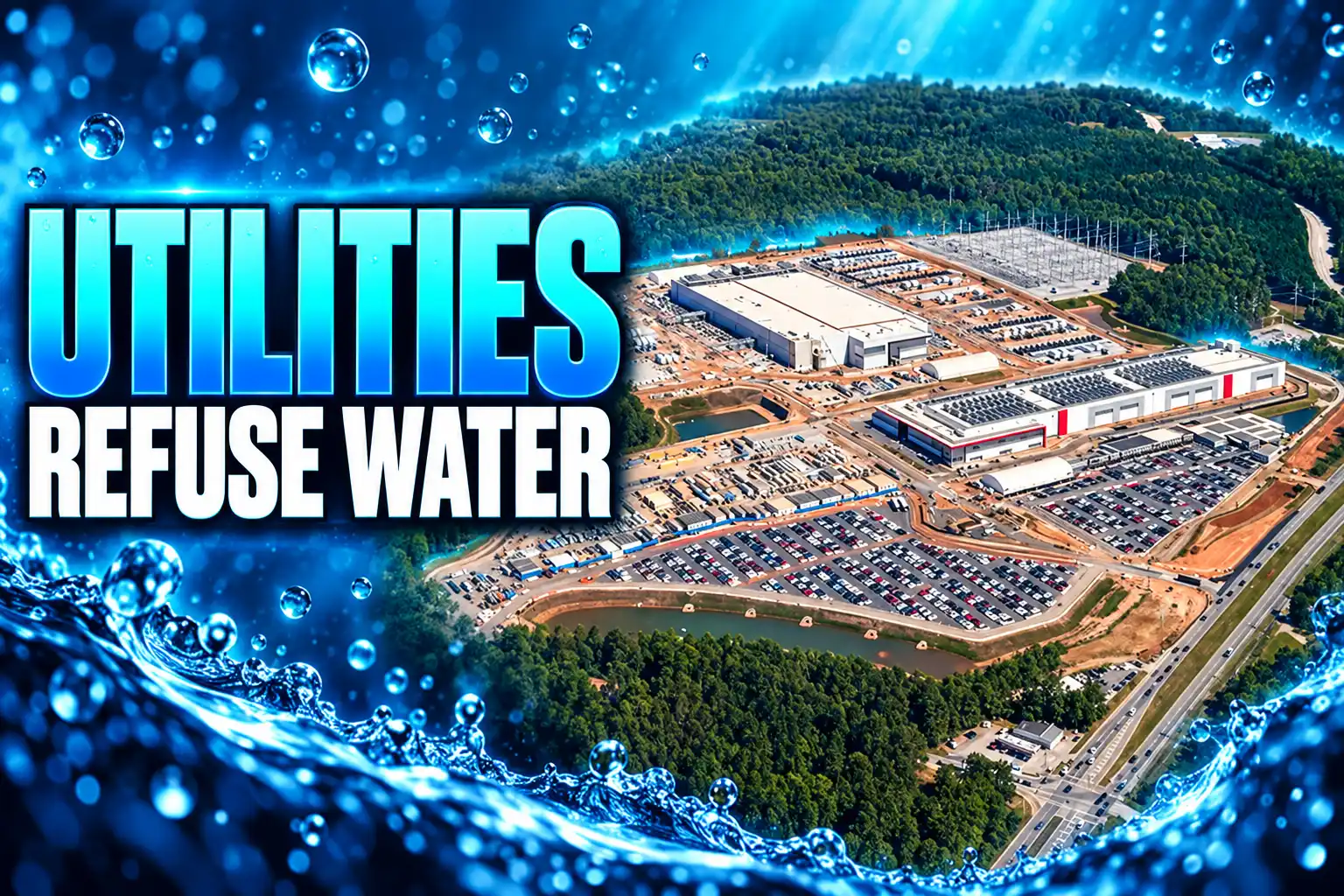
Metro Atlanta data-center water requests now run from 5,000 gallons a day to 9 million, Atlanta Regional Commission planner Celine Benoit told a Washington conference on June 22. Local utilities have started refusing the high end, she said, because they do not have millions of gallons a day to sell.
That refusal is doing more work than Georgia’s drought order. The state asked the public to conserve. It never put a statewide cap on a server campus.
Atlanta Planners Asked Developers to Cut Water Use
Benoit, who also plans for the Metropolitan North Georgia Water Planning District, spoke at the American Water Works Association’s annual meeting. She was describing a region that CBRE’s first-half 2026 figures put at 2,882 megawatts under construction, up 52.3% from a year earlier, first among North American markets. Existing Atlanta inventory sat at 1,803.2 megawatts, still well behind Northern Virginia’s 4,496.5 megawatts of inventory.
There’s no easy answer for how much water data centers are requesting.
Celine Benoit, principal planner, Atlanta Regional Commission, American Water Works Association conference
A slide deck she prepared with colleague Danny Johnson for local governments puts the spread in plain numbers. Evaporative cooling, which can lose up to 80% of its water to the air, has been proposed at as much as 9 million gallons a day. Closed-loop systems, which circulate a water-glycol mix in a sealed circuit, typically land between 5,000 and 50,000 gallons a day.
One speculative metro proposal came in at 9 million gallons a day on evaporative gear, then returned at 390,000 gallons a day after a closed-loop switch, about 4% of the first ask. Benoit told the Washington audience that at least one developer was willing to make that change after community talks. She compared even the fat requests with DC Water, which moves up to 180 million gallons a day for an entire capital city.
The planners’ other warning is about jobs. A typical headquarters or factory of similar bulk might hire 200 to 1,000 people. A typical data center, they said, staffs 5 to 30 in IT, security, cleaning, and maintenance. Counties are being asked to spare river water for a tax base that does not hire like a plant.
The Municipal Hookup That Skips a State Permit
Georgia’s Environmental Protection Division declared a statewide Drought Response Level 1 on April 27 for public systems that use surface water or groundwater. Director Jeffrey W. Cown kept that order in place in mid-August. Level 1 is a notice campaign. It is not a shutoff for industry.
WHAT LEVEL 1 ACTUALLY DOES
- The campaign: Systems must push drought notices through ads, bills, social posts, or libraries.
- Yard watering: Outdoor use remains legal from 4 p.m. to 10 a.m., the same window as the rest of the year.
- Local extra rules: A city cannot tighten outdoor limits beyond the state schedule unless EPD grants a variance.
- Campus cutoffs: The order does not name data centers, and no county had imposed a drought curtailment on one as of late September.
The deeper gap is older than the drought. Georgia requires an EPD withdrawal permit only when a user itself takes more than 100,000 gallons per day from a river, reservoir, or well. A campus that taps a city or county pipe is treated as an ordinary customer. The utility holds the permit. The state does not review how many gallons that one customer was promised.
None of the 30 AI data-center projects planned in the Ocmulgee River basin had applied for a state withdrawal permit as of March. Most expected to drink from municipal systems. Those asks sit against a Middle Ocmulgee regional plan that budgeted only 4 million gallons a day of new industrial water through 2060. Coweta County’s Project Sail has been described at 6 million gallons a day, against a local authority that supplies about 10.5 million gallons a day to everyone else.
EPD has said it does not pick a utility’s customers. In a drought, the system manager decides who is cut. That is the hidden veto: a county water director, not a state water permit.
29 Million Gallons Left the Meters Dark
Fayette County learned how that arrangement fails in practice. A Quality Technology Services campus in Fayetteville drew more than 29 million gallons through two industrial hookups the utility had not billed, a volume the county later compared with 44 Olympic-size pools. One connection had been installed without the utility’s knowledge. The other was not tied to the company’s account.
Neighbors in Annelise Park noticed the pressure drop first. The county had been asking households to ease off outdoor watering. A May 15, 2025 letter later billed QTS $147,474. The company paid. The county issued no fine. Water system director Vanessa Tigert said the campus is the largest customer and that the county has to be partners.
That choice is the political tell. A utility that needs the tax roll will treat an unmetered draw as a paperwork problem. Fayetteville’s city council then banned new data centers in every zoning district. Construction water, not the closed-loop brochure, was what the meters missed.
Newton County has a quieter version of the same fight. Families living near a Meta campus have said well water turned brown and taps failed after construction. County officials have faced a stack of new applications, some seeking as much as 6 million gallons a day, more than the county uses. Water rates there have been headed for a 33% jump while the authority races a recycling upgrade priced above $250 million.
Who Gets Cut When the Reservoir Drops?
About 71% of metro Atlanta’s drinking water starts in Lake Lanier and the Chattahoochee River. Groundwater is less than 1% of the district’s supply. The same reservoirs also serve hydropower, downstream towns, farms, and the Apalachicola Bay fisheries that Florida has spent decades litigating over.
Chris Manganiello, water policy director at Chattahoochee Riverkeeper, told a legislative subcommittee that two dozen large proposals, if built, could withdraw about 31 million gallons a day and consume about 19 million gallons a day after returns, on the order of 7 billion gallons a year. He has said nothing in the basin uses water and power the way these campuses do. Google’s Douglas County site, in his tally, takes about 1.2 million gallons a day of potable input and consumes about 965,000.
The Developments of Regional Impact process is the closest thing Georgia has to a statewide water review for these sites. In November 2025 the state added a “Technological Facility” category, with a 300,000-square-foot trigger in urban Atlanta Regional Commission territory and 500,000 square feet elsewhere. The filing must list water and power demand. The finding is advisory. A county commission can still say yes.
A transparency bill, SB 421, would have barred local governments from hiding electricity and water use behind nondisclosure deals. It died when the session ended on April 2. The sales-and-use tax break for qualifying data-center equipment still runs through December 31, 2031. Repeal bills died with it.
Cooling Switches Do Not Empty the River
On-site plumbing is where the public argument usually stops, because that is the number on a site plan. The larger draw is often somewhere else.
WHERE THE GALLONS GO
| Setup | Daily water | Where it goes |
|---|---|---|
| Evaporative cooling, high-end metro ask | Up to 9 million gallons | Up to 80% lost to the air |
| Closed-loop, typical metro range | 5,000 to 50,000 gallons | Sealed circuit, makeup and maintenance |
| One revised Atlanta-area proposal | 9 million, then 390,000 gallons | Developer switched cooling methods |
| OpenAI Effingham, on-site operations | 30,000 gallons for sinks and cleaning | Dry coolers, initial fill still unfinalized |
| OpenAI Effingham, power-plant water | 11 million to 22 million gallons | Evaporation at generating stations |
OpenAI’s Project Camellia, a 3.2-gigawatt campus in Effingham County, lists 30,000 gallons a day for workplaces on its public FAQ, about 100 homes. Spokesman Aaron McLear said the design rejects heat with dry coolers, like a car radiator, and will not use evaporative towers. County Manager Tim Callanan has said each building holds multiple loops of about a million gallons, so the first fill could run into the tens of millions. The company has not locked that figure.
Kelly T. Sanders, a University of Southern California civil engineering professor, ran the off-site math for that load at 80% runtime and put power-plant water at 4 billion to 8 billion gallons a year, which is 11 million to 22 million gallons a day. “There’s no free lunch here, and there’s always going to be trade-offs,” she said. Fans replace evaporation at the campus, then the grid evaporates water at the plant.
Georgia Power and Southern Nuclear already hold permits to withdraw more than 1.1 billion gallons a day statewide, including 277 million gallons a day from the Savannah River. Tonya Bonitatibus, the Savannah Riverkeeper, calls energy the state’s top water user. Southern Effingham is a Floridan aquifer “red zone,” so the campus cannot drill new drinking-water wells. New surface treatment on the Savannah is being built with $160 million in state money and a matching cheap loan, aimed at 2032.
Akanksha Menon, who runs Georgia Tech’s Water-Energy Research Lab, has warned that dry coolers can fail to dump a full heat load on a hot, humid day and may need a wet assist. Closed-loop, she wrote, does not mean zero water. Columbus, Ohio, has been looking at sewer mining and extra reservoirs for the same reason Atlanta is bargaining over cooling towers: the on-site number is the easy one to put in a hearing packet.
After the Tax Fight, Counties Wrote Their Own Rules
Georgia Tech’s ordinance tracker counted 39 local moratoriums between September 2025 and July 2026. Nine had already expired by midsummer. The pattern is the same even when the legal tool differs. A city pauses, studies water and power, then either bans the use, demands closed-loop cooling, or lets a megaproject through anyway.
THE YEAR THE ASK GOT LOCAL
- April 27, 2026: EPD imposes Level 1 drought response, a public-information duty with no new industrial cutoff.
- April 2, 2026: The session ends with the data-center tax break intact and the water-transparency bill dead.
- June 22, 2026: Benoit tells national water managers that Atlanta utilities are refusing million-gallon cooling asks and steering developers to closed-loop gear.
- August 14, 2026: EPD tells permit holders the director is maintaining Level 1.
- September 2026: CBRE’s midyear tally places Atlanta first in construction; OpenAI’s Effingham water math goes public; former Atlanta mayor Keisha Lance Bottoms, the Democratic nominee for governor, calls for a statewide pause to study bills, water, and local impact.
Coweta still approved the $17 billion Project Sail campus in April after months of packed hearings. Douglas County later denied a 4.4-million-square-foot rezoning near Villa Rica. Forsyth pulled a conditional-use permit it had granted in 2024. The map is not a moratorium state. It is a patchwork of county-by-county bargains, which is what you get when the state will not put a gallon cap on a municipal customer.
Lake Lanier Keeps Falling
The Lake Lanier Association’s fall update put June rainfall at 55% of normal and August at 49%. Over 25 months the Gainesville gauge ran about 19 inches dry. By early October, association figures showed inflows averaging 338 cubic feet per second against required discharges of 1,230, a daily hole of 892 cfs. The Corps was already talking about composite storage sliding toward Zone 3 around November 1, the trigger for drought operations on the Apalachicola-Chattahoochee-Flint basin dashboard.
That is the basin that already splits Georgia, Alabama, and Florida. A closed-loop campus in Fayette or Effingham does not add a new EPD permit to that fight. It adds a city water contract, a power-plant evaporative load, and a county official who has to explain low pressure to the people who vote.
Benoit’s ask still stands because it is the only lever planners actually have: talk the developer down from 9 million gallons a day before the utility has to be the one that says no.

Greed Held After a $697 Million Crypto Long Flush

Fed Minutes Keep a Year-End Rate Hike Alive

A Nanny-Cam Tape Follows Tyreek Hill Into Free Agency

Star Wars Galactic Racer Makes a Crash End the Tour

Amazon Puts Apple’s June MacBook Prices Back on Sale

The iPhone 16 Pro Flipkart Cut Did Not Last

Sophia Wootten Turns the Miss Georgia Crown Toward Cleft Care

Georgia Beach Bacteria List Leaves Swim Areas Open

Microsoft Prints Azure’s $29.42 Billion Quarter and Shrinks the Map

UltraTech’s Ultravolt Launch Puts Cable Multiples on Trial
-
 NEWS1 year ago
The iPhone 16 Pro Flipkart Cut Did Not Last
-
 ENTERTAINMENT4 months ago
Sophia Wootten Turns the Miss Georgia Crown Toward Cleft Care
-
 NEWS4 months ago
Georgia Beach Bacteria List Leaves Swim Areas Open
-
 BUSINESS1 month ago
UltraTech’s Ultravolt Launch Puts Cable Multiples on Trial
-
 NEWS1 month ago
Microsoft Prints Azure’s $29.42 Billion Quarter and Shrinks the Map
-

 NEWS9 months ago
IXI Autofocus Glasses Still Lack a European CE Mark
-

 NEWS3 months ago
Little St. Simons Island Hatches Loggerheads at 72.4 Percent
-

 BUSINESS3 months ago
Georgia Furniture Mart Closes a Growing 40-Year Business