
NEWS
WashU Rebuilt the Busiest Greenway Crossing for $12.3 Million
WashU spent $12.3 million to replace an 8½-foot Forest Park Parkway span with an 18-foot split-lane bridge, a privately paid fix the region now copies.

Washington University in St. Louis spent $12.3 million in 2018 to replace the Forest Park Parkway pedestrian bridge, then the busiest crossing in the Great Rivers Greenway system. Tear-down started May 21, 2018. An 18-foot deck with split lanes for walkers and cyclists fully reopened Nov. 2.
James Kolker, associate vice chancellor and university architect, had told the campus the old 8½-foot path was hard to share with fast bikes. In that design year, 600,000 trips are made annually across the span, according to the university and Great Rivers Greenway.
An 8½-Foot Path on the Busiest Greenway Crossing
The old deck sat on the Centennial Greenway, the trail that runs from Forest Park through the Danforth Campus and north into University City. Great Rivers Greenway still describes that campus piece as a 1.35-mile paved trail through campus that crosses Forest Park Parkway on the pedestrian bridge, then continues toward the Delmar Loop and Ackert Walkway.
Eight and a half feet is a tight shared path on a route that also clears MetroLink tracks. The university said the old width was less than half the recommended figure for a joint bike-and-walk way. Federal highway guidance is more specific, and a little less dramatic: a typical shared-use path is 10 feet, 8 feet only for low use, and 12-14 ft for heavy mixed use.
On either reading, 8½ feet sat under the common 10-foot mark. Strollers, wheelchairs, and commuter bikes were sharing one ribbon over a parkway and a rail line.
THE SPAN IN FIGURES
- Annual trips: About 600,000 in the 2018 design year, called the most traveled section of the Great Rivers Greenway system.
- Old width: 8½ feet on a shared path, below the 10-foot figure federal guidance treats as typical.
- New deck: 18 feet across, more than twice the old path, with separate marked lanes.
- Project cost: $12.3 million, listed by contractor Tarlton as the project size.
Kolker said people with strollers had already complained that fast cyclists made the old layout hard to share. He also said earlier tries to slow bikes had not worked, which is why the new plan split the users instead of asking them to behave.
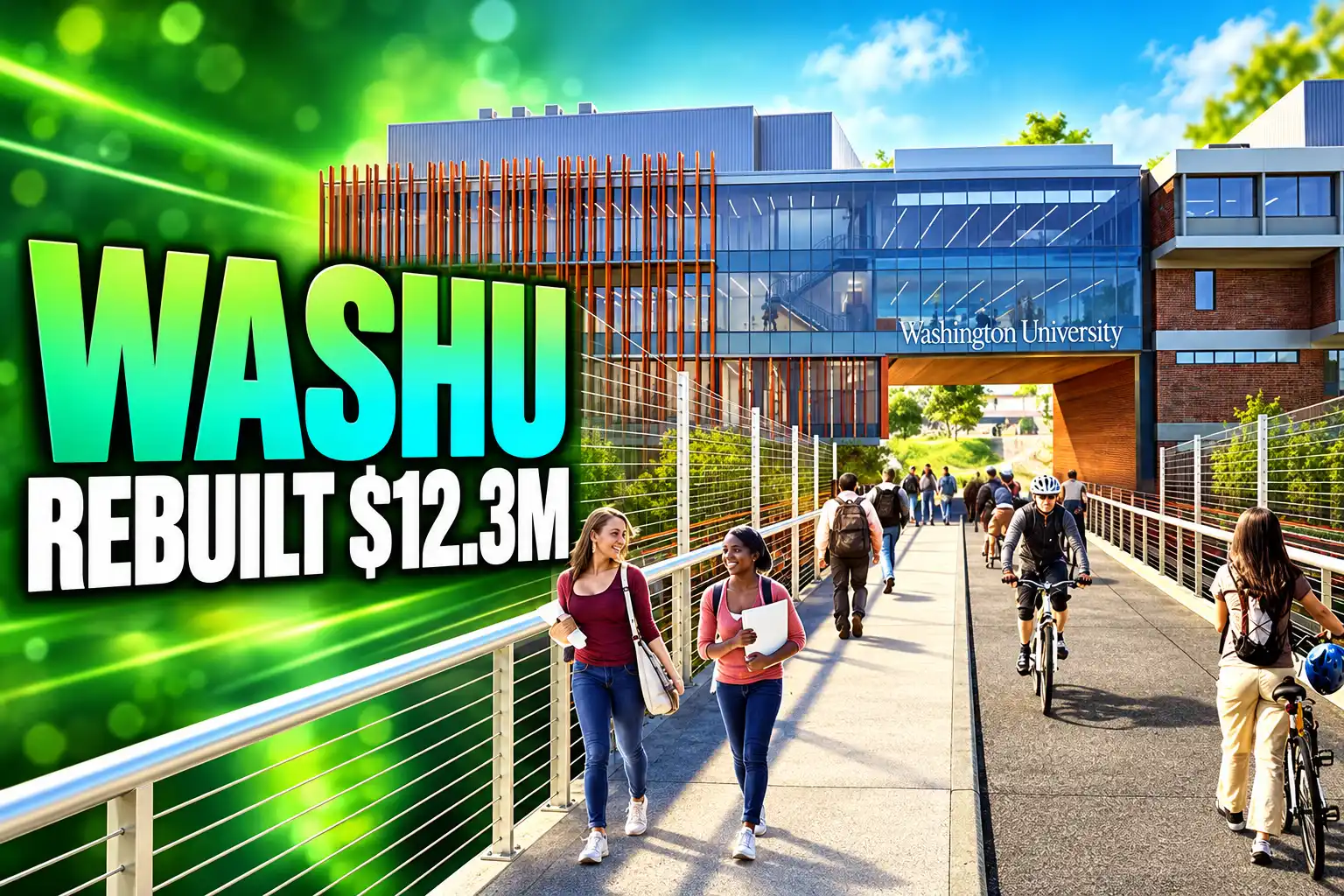
WashU Wrote a $12.3 Million Check for the Span
The university paid for the replacement and ran it through Campus Next, the same east-end building program that rebuilt Bryan Hall and Millstone Plaza. Millstone Plaza, finished in 2017, already tied inner campus to the Parkway bridge. The new span was the missing northern piece: a gateway over Forest Park Parkway and MetroLink into the Danforth Campus.
This bridge is both an important gateway to the Washington University campus and an integral part of the Centennial Greenway. We have heard from many pedestrians, including those with strollers, that the current narrow configuration of the bridge can be challenging to share with cyclists who may be traveling at high speeds.
James Kolker, associate vice chancellor and university architect, Washington University in St. Louis
The new layout doubled the walking surface and split it. Northbound cyclists leave on a switchback ramp meant to cut speed on the descent. Bike troughs on the stairs north of Bryan Hall give another way onto Throop Drive. Walkers and people with mobility needs were promised a straighter, wider line into campus, including through Millstone Plaza.
Tarlton, the construction manager, listed the job at $12.3 million and described two new 21-foot-wide steel bridge spans each nearly 90 feet long and more than 50 tons. Those 21-foot steel boxes carry an 18-foot walking deck, so the structure is wider than the path on top of it. Oates Associates designed light-gage framing for decorative metal panels under the deck, a finish meant to match nearby campus work.
WashU said it was coordinating with University City, St. Louis County, and Metro. Lanes on Forest Park Parkway and MetroLink would close in pieces, including a full weekend in August 2018 when the steel went in.
Parkview Neighbors Cut the Tree Plan Down
The hard part was not hanging steel over a rail line. It was the north ramp, which had to land on University City parkland and tie into Ackert Walkway, a 0.34-mile linear park between Delmar Boulevard and Vernon Avenue.
In 2012, University City and the university planned to take down 55 to 60 large sweet gum trees along that walkway and plant 80 new ones. Residents in Parkview and Ames Place hired their own arborist and threatened a lawsuit. That plan died.
The university came back on Jan. 23, 2017, with a smaller ask. It still wanted an 18-foot bridge and ramp, with an elbow shape to slow bikes, but it dropped a widening of Ackert Walkway and cut the tree take-down to 16, mostly large sweet gums. Rose Windmiller, associate vice chancellor for government and community relations, told council members the existing bridge and ramp were in poor shape.
Opponents kept coming. In April 2017 they argued the 18-foot ramp and the remaining tree cuts were still too much, and they questioned whether an elbow ramp would actually slow bikes. They floated a split: keep the old bridge for walkers and add a second, smaller bike bridge to the west. Parkview resident Eliot Porter Jr. wore a “Save Our Shade” sign to city meetings.
The dual-bridge idea did not win. Construction started in May 2018 on the university’s scaled plan, which means University City granted the easement the north ramp required. Sixteen trees still came down. The regional trail kept a single crossing, just a wider one with painted lanes.
Two 50-Ton Spans Landed in a Single Weekend
Tarlton did not smash the old bridge. Crews picked off precast side panels, then beams, then piers, a sequence the firm later said was required because the work sat over a busy arterial and MetroLink. New steel columns sit on three existing pier caps and on 24 new drilled piers north of the rail line. After the boxes landed, crews poured an 8-inch structural deck, a topping slab, and curbs, then hung cable guardrails and a lighted handrail on hundreds of anchor bolts.
The public bill for that precision was a dead parkway and a dead rail line. Forest Park Parkway closed through the first weekend of August 2018 from the Skinker area to Big Bend. Trains serving Forsyth, University City-Big Bend, Skinker, and Forest Park-DeBaliviere went to buses until 6:30 p.m. on Aug. 4, when MetroLink returned earlier than planned. Another overnight parkway close ran from 9 p.m. on Aug. 21 to 5 a.m. the next morning. St. Louis County’s transportation account posted that one in real time.
A campus with a $12.3 million check can buy a weekend of a regional arterial. A public trail agency usually cannot. That is the part of the job that never fit a “campus summer project” label.
FROM THE TREE FIGHT TO OPENING DAY
- 2012: University City and WashU plan to cut 55 to 60 large sweet gum trees along Ackert Walkway; neighbors threaten a lawsuit and the plan dies.
- January 23, 2017: The university takes a scaled 18-foot bridge and a 16-tree cut to a University City council study session.
- May 21, 2018: Demolition begins on the old Centennial Greenway span; walkers are sent to Skinker or Big Bend, cyclists west on University Drive to Big Bend, then south to Forsyth.
- August 4, 2018: After a weekend parkway shutdown, MetroLink trains resume at 6:30 p.m. at Forsyth, University City-Big Bend, Skinker, and Forest Park-DeBaliviere.
- October 8, 2018: Half the new width opens; cyclists are told to walk bikes until the rest of the deck is ready.
- November 2, 2018: The bridge fully reopens, with stairs to the Academy Building and University Drive opening the same day.
Great Rivers Greenway posted the half-open note itself, which is how a regional trail agency talks when a university has just rebuilt its busiest link.
Greenway Alert: The Centennial Greenway bicycle & pedestrian bridge over Forest Park Parkway @WUSTL has reopened! People riding bikes are asked to walk their bikes over bridge until the full width of the bridge opens in late Oct. https://t.co/9CRkGCPB4t pic.twitter.com/oxDhpWZ712
— GreatRivers Greenway (@GreatRiversSTL) October 8, 2018
The sidewalk under the bridge on the south side of Forest Park Parkway, closed between Throop and Hoyt drives during the job, was due back no later than Nov. 12, 2018. Throop Drive itself stayed open. Finish work on architectural cladding ran through the rest of that month. In 2019 the Associated General Contractors of Missouri gave Tarlton a Construction Keystone Award for the sequence over live traffic and rail.
Why the New Deck Splits Walkers From Cyclists
The design argument was simple. A shared 8½-foot ribbon cannot hold 600,000 mixed trips. Paint and a switchback can, if the deck is wide enough that a bike and a stroller are not in the same slot.
Federal guidance already points that way. At high volume, the Federal Highway Administration says to think about separating “heels and wheels” onto two paths. Iowa’s AASHTO-based notes put a segregated section at about 15 feet, 10 for two-way bikes and 5 for walkers. WashU’s 18-foot deck sits in that band. The 21-foot steel spans give the extra structure for railings, curbs, and the metal skin underneath.
OLD PATH AND NEW DECK
| Measure | Before May 2018 | After Nov. 2, 2018 |
|---|---|---|
| Walking surface | 8½ feet, shared | 18-foot deck, marked lanes |
| Steel structure | Prior span over parkway and rail | Two 21-foot-wide spans, nearly 90 feet, more than 50 tons each |
| Cyclist north exit | Straight descent | Switchback ramp to cut speed |
| Lighting and rails | Older narrow section | Cable guardrail, lighted handrail, underside metal panels |
| Cost | Existing structure | $12.3 million, WashU-funded |
Ben Hur Construction, which handled steel on the job, put the superstructure at about 260 tons and the cable railing at about a half mile. The north end, the firm said, was the complicated switchback. That matches Kolker’s bet: geometry would do what signs had not.
Whether riders actually brake on that ramp is a user-behavior question the university did not publish numbers for. What it did publish is the layout. Walkers got a dedicated strip. Cyclists got their own, plus a dogleg instead of a straight shot down toward Ackert Walkway.
Great Rivers Greenway Has Its Biggest Bridge Year
The WashU span is still the Centennial Greenway’s jump over Forest Park Parkway and MetroLink. What changed around it is the rest of the network. Great Rivers Greenway counted more than three million trips on its trails in 2024, a 50 percent rise from before 2020. The system is about 140 miles. Voters created the agency on Nov. 7, 2000, with Proposition C; they extended the money in 2013 with Proposition P. The average resident still puts in less than 50 cents a month, under $6 a year.
In November 2025 the agency said it had 8+ greenway bridge projects in 2026, the most in its 25-year history. The first three were set to start construction in 2026. Mark Perkins, the agency’s CEO, said the new bridges cross rivers, creeks, and highways, and also the political lines that usually stop a trail.
BRIDGES QUEUED AROUND THE REGION
- Dardenne Creek, St. Peters: A greenway bridge and wetland boardwalk, with federal grant money, among the first three to start in 2026.
- Meramec River, Eureka: A rebuild of the Route 66 State Park crossing, with Missouri State Parks, also in that first construction group.
- Dardenne Creek, O’Fallon: A second Dardenne bridge in design with O’Fallon, Dardenne Prairie, and St. Charles County.
- Brickline at I-64: A Spring Street crossing between the eastbound and westbound interstate decks in St. Louis, aimed at 2027 and 2028, on a route meant to tie Forest Park toward Gateway Arch National Park.
None of those jobs is a copy of the WashU deck. They are the same class of problem: a trail that dies at a barrier until someone pays for a wide, grade-separated fix. In 2018 the someone was a university that needed a northern campus gate and could close a parkway for a weekend. In 2026 the someone is a three-county agency with sales-tax money, federal grants, and a 25-year clock.
The Forest Park Parkway pedestrian bridge is still that gate. It is 18 feet across. It still splits walkers from cyclists. It still sits over MetroLink. And it is still the crossing a private campus bought for a public trail, years before the region started counting greenway bridges by the job lot.
Frequently Asked Questions
How wide is the Forest Park Parkway pedestrian bridge at WashU?
The walking surface is an 18-foot deck on two 21-foot-wide steel spans, with an 8-inch structural slab, cable guardrails, a lighted handrail, and decorative metal panels on the underside. That is more than twice the old 8½-foot shared path.
When did the WashU Forest Park Parkway bridge reopen?
Half the width opened Oct. 8, 2018, with cyclists asked to walk bikes. The full deck opened Nov. 2, 2018, the same day stairs to the Academy Building and University Drive came back; the sidewalk under the bridge along Forest Park Parkway was due no later than Nov. 12, 2018.
Why did Washington University replace the Forest Park Parkway bridge?
Kolker said earlier attempts to slow bikes had failed, and that people with strollers found the old 8½-foot shared path hard to use next to high-speed cyclists. The new deck uses separate marked lanes and a northbound switchback instead of relying on courtesy.
How much did the Forest Park Parkway pedestrian bridge cost?
Tarlton listed the project size at $12.3 million, paid by Washington University rather than bid as a Great Rivers Greenway construction job. Closures were coordinated with University City, St. Louis County, and Metro because the span crosses both Forest Park Parkway and the MetroLink line.
Who built the WashU Forest Park Parkway pedestrian bridge?
Tarlton was construction manager. Oates Associates designed the light-gage framing that holds the underside metal panels. Ben Hur Construction put the steel at about 260 tons and the cable railing at about a half mile, with the north switchback as the hardest geometry.

Greed Held After a $697 Million Crypto Long Flush

Fed Minutes Keep a Year-End Rate Hike Alive

A Nanny-Cam Tape Follows Tyreek Hill Into Free Agency

Star Wars Galactic Racer Makes a Crash End the Tour

Amazon Puts Apple’s June MacBook Prices Back on Sale

Sophia Wootten Turns the Miss Georgia Crown Toward Cleft Care

The iPhone 16 Pro Flipkart Cut Did Not Last

Microsoft Prints Azure’s $29.42 Billion Quarter and Shrinks the Map

UltraTech’s Ultravolt Launch Puts Cable Multiples on Trial

IXI Autofocus Glasses Still Lack a European CE Mark
-
 NEWS1 year ago
The iPhone 16 Pro Flipkart Cut Did Not Last
-
 ENTERTAINMENT4 months ago
Sophia Wootten Turns the Miss Georgia Crown Toward Cleft Care
-
 BUSINESS1 month ago
UltraTech’s Ultravolt Launch Puts Cable Multiples on Trial
-
 NEWS1 month ago
Microsoft Prints Azure’s $29.42 Billion Quarter and Shrinks the Map
-
 NEWS9 months ago
IXI Autofocus Glasses Still Lack a European CE Mark
-

 NEWS3 months ago
Little St. Simons Island Hatches Loggerheads at 72.4 Percent
-

 NEWS4 months ago
Georgia Beach Bacteria List Leaves Swim Areas Open
-

 NEWS3 years ago
Eyal Waldman Keeps a Two-State Bet After Gaza