
NEWS
Georgia’s Chinese Uranium Arrest Fits a 20-Year Pattern
Georgia detained three Chinese nationals over a $400,000 uranium deal in Tbilisi, the latest in two decades of similar handshake arrests with missing isotopes.

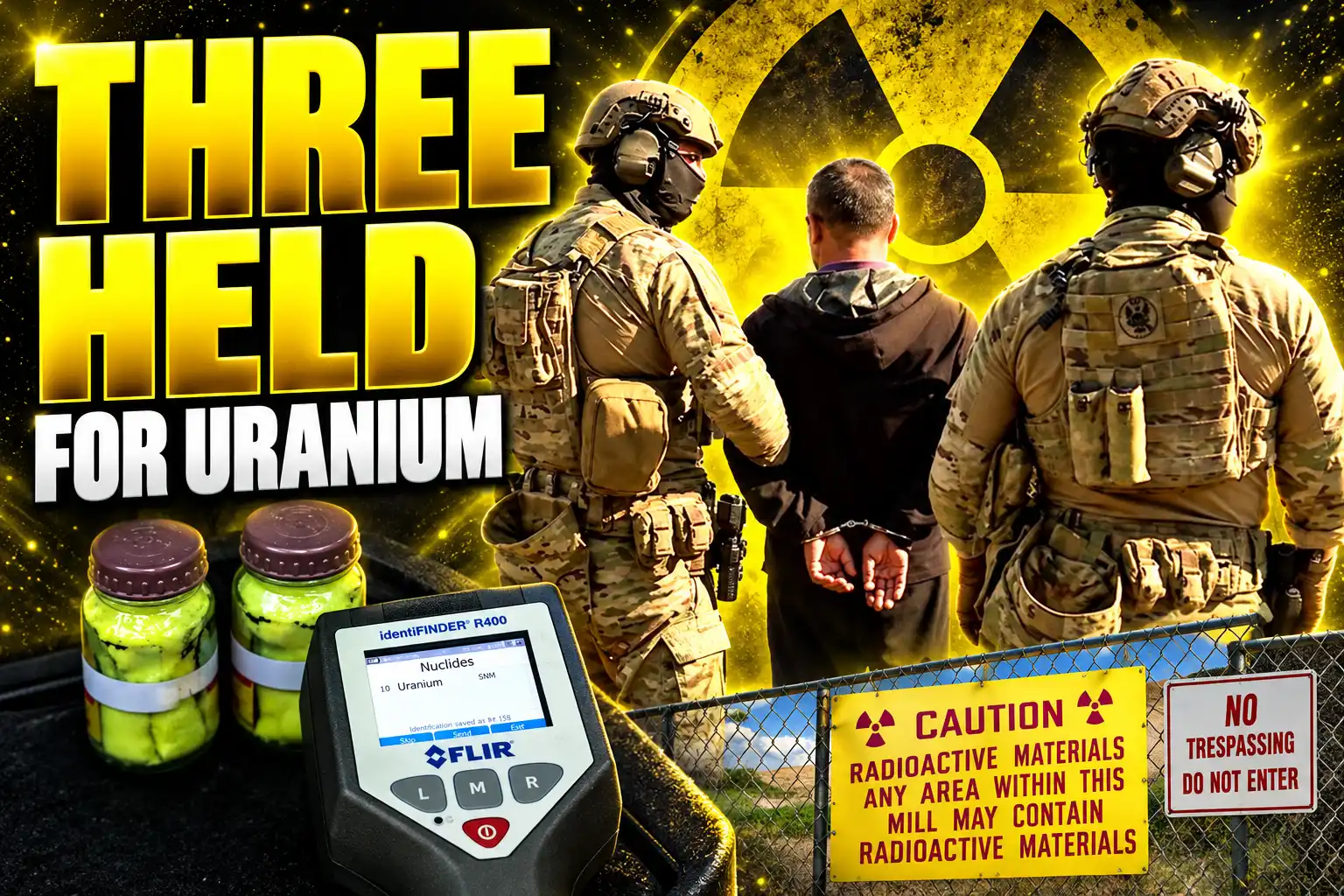
Georgia detained three Chinese nationals in Tbilisi on October 25, 2025, during a deal for 2 kilograms of uranium priced at $400,000. Lasha Maghradze, first deputy chief of the State Security Service of Georgia, said the group meant to move the material to China through Russia. The jars, the round price, and the mid-deal raid follow a script Tbilisi has used for 20 years.
Three Chinese Nationals, Two Jars, $400,000
Maghradze told reporters that officers from the Counter-Intelligence and Special Operations departments stopped the three in the capital while they were still talking through the buy. One of them had been living in Georgia in breach of visa rules and had brought in people he described as experts, then gone looking for nuclear material across the country. Other members of the group, he said, were directing the work from China.
The members of the criminal group planned to purchase the radioactive substance for USD 400,000 and then transport it to China through the territory of the Russian Federation.
Lasha Maghradze, first deputy chief, State Security Service of Georgia briefing
The service released video of armed officers stopping two men and one woman beside a road. In the boot of a car sat two glass jars of a yellow substance. Tests, the service said, identified the contents as uranium. A detector was shown on the jars. Homes used by the detainees in Tbilisi and Batumi were searched. Names were not released. The three pleaded not guilty and were held in custody.
That is the entire public file on the powder itself. Maghradze did not say which isotope was in the jars, how enriched it was, where it had been stored, or who had offered it for sale. The published plan was to transport it to China through Russia. The charge is Article 230 of Georgia’s Criminal Code, illegal handling of nuclear material, which carries five to ten years in prison.
Georgia Has Used This Script for 20 Years
A reader who only saw the China headline missed the calendar. One hundred days earlier, on July 17, 2025, the same service announced that a Georgian citizen and a Turkish citizen had been stopped in Batumi over uranium priced at $3 million. The mass was not published. The enrichment level was not published. The agency declined to add those details when asked, and the International Atomic Energy Agency did not comment on that case.
The dollar figures on Georgian uranium cases run in clean round numbers. The masses, when they appear at all, often do not.
GEORGIA’S URANIUM DEALS ON THE RECORD
| Date | Place | People detained | Material disclosed | Asking price |
|---|---|---|---|---|
| October 25, 2025 | Tbilisi | 3 Chinese citizens | 2 kg uranium, isotope not published | $400,000 |
| July 17, 2025 | Batumi | 1 Georgian, 1 Turkish | Uranium, mass not published | $3 million |
| May 1, 2023 | Near Poti | Ilia Belkania, 52 | Uranium in a small glass bottle | $2 million |
| 2019 | Georgia | 2 people | Uranium-238 | $2.8 million |
| April 2016 | Tbilisi | 3 Armenians, 3 Georgians | Uranium-238 | $200 million |
| Late April 2016 | Black Sea coast | 5 Georgian men | 1.6 g uranium-238 and a fraction of uranium-235 | $3 million |
The April 2016 pair of operations, run in the same month, is the template. In the first, officers said six people were trying to sell uranium-238 for $200 million and had a container ready for the move. In the second, five men were accused of offering 1.6 grams of uranium-238 and a scrap of uranium-235 to an undercover agent for $3 million. Those are not the same kind of product at the same kind of price. They were briefed as if they were.
Ilia Belkania, arrested on May 1, 2023 near the port of Poti, was living on social benefits and carrying uranium in a tiny glass bottle that the service said he hoped to sell for $2 million. Alexander Kupatadze, who interviewed Georgian smugglers and the investigators who chase them, wrote that the trade in Georgia is built by opportunist smugglers and amateurs, not by lasting crime syndicates or terrorist cells. His court sample, running from 2002, counted 13 cases and 27 people, most of them Georgian, in one-off partnerships.
Why Officials Never Named the Isotope
$400,000 for 2 kilograms is $200 a gram. In 2006, Oleg Khintsagov, a Russian trader caught in a Tbilisi sting that also drew in the FBI and the CIA, talked about selling 2 to 3 kilograms of highly enriched uranium for $30 million. He told a court he had paid $10,000 in Novosibirsk for 80 grams of “black powder” that a man named Rashid said was used in printing. The sample seized in that case was about 100 grams of uranium enriched to roughly 90 percent, bomb-usable material.
Put those numbers next to each other and the 2025 jars look like a different market. Weapons-usable highly enriched uranium has historically been sold, when it is sold at all, in gram lots at prices that run into the thousands of dollars a gram. Natural uranium, depleted uranium, and yellowcake are another category: bulky, weakly radiating, useless as a bomb core without a vast enrichment plant. Maghradze’s briefing used the word uranium and stopped. Tests “identified” the yellow powder. The isotope was left blank.
That blank is not new. In the Batumi case 100 days earlier, officers said alpha and gamma readings meant the material could be used in explosive devices, then refused to say how enriched it was. In 2016, military commentator Irakli Aladashvili noted that uranium-238 seized in Tbilisi was a poor fit even for a dirty bomb because the radiation was so low. The 2025 Chinese case arrived with 2 kilograms on the scale, which is a large figure if the powder is highly enriched and a modest one if it is not. Without the isotope, the number does not tell you which.
The Seller Never Appeared at the Briefing
The security service said it moved on “operational information” gathered while the Chinese suspects were negotiating with potential sellers. It did not name those sellers. It did not say whether an officer was sitting across the table. Earlier Georgian uranium cases were built that way on purpose.
In 2006, an undercover officer posed as a Turkish-speaking middleman in the Gldani market and waited for Khintsagov’s group to bring the sample. In 2010, Sumbat Tonoyan, a retired physicist, and Hrant Ohanyan, a failed businessman, rode a train from Yerevan to Tbilisi with about 18 grams of highly enriched uranium hidden in a Marlboro pack lined with lead. They thought they were selling to a man from “a significant organisation.” He was an undercover officer. Commandoes came through the door on a code word.
Kupatadze found little evidence of a standing transnational ring. The people in the dock were often friends from legal trades, former soldiers, or men who had moved other contraband and then tried one radioactive deal. Professional crime bosses, he argued, stay out because the market is unreliable and an arrest wrecks the shops and protection rackets that actually pay. A buyer who shows up in Tbilisi asking around for uranium is walking onto ground the security service has been mining for a generation.
WHAT WE KNOW
- The buy: Three Chinese citizens were detained in Tbilisi on October 25, 2025, over a deal for 2 kilograms of uranium at $400,000.
- The route: Maghradze said the group planned to move the material to China through Russia, with other members coordinating from China.
- The footage: The service’s video shows two men and one woman stopped by the road and two glass jars of yellow powder in a car boot.
- The charge: Article 230, illegal handling of nuclear material, punishable by 5 to 10 years.
WHAT IS UNCONFIRMED
- The isotope: Officials have not said whether the jars held highly enriched uranium, uranium-238, yellowcake, or something else.
- The seller: No supplier was named, and the service has not said whether the other side of the deal was an undercover officer.
- The verdict: Names were never published, and no public conviction or acquittal has been issued.
A $400,000 offer for 2 kilograms only looks like a bargain if the powder is the scarce kind. If it is the common kind, the buyers overpaid. Either way, the missing seller is the part of the briefing that does the most work. In this line of cases, the person with the jar is often an amateur, and the person with the cash is often already known to the people making the arrest.
Loose Nuclear Material After the Soviet Collapse
Georgia inherited research sites, orphan sources, and slack accounting when the Soviet Union dissolved in 1991. A research reactor at Mtskheta, just outside Tbilisi, had its uranium fuel removed with United States help in the late 1990s. In late 2015 the IAEA arranged the legal shipment of 1.83 kilograms of highly enriched uranium from the Breeder-1 neutron source at Tbilisi National University to a secure store in Russia. That official removal is almost the same mass as the 2 kilograms in the 2025 jars, which is why the unpublished isotope in those jars still matters.
The serious Georgian seizures of bomb-usable material sit in a short list. In 2003, Garik Dadayan was stopped at Sadakhlo on the Armenian border with 170 grams of highly enriched uranium. In 2006 came Khintsagov’s 100 grams. In 2010 came the 18 grams in the cigarette pack. Those were gram quantities, and even then the origin was usually a Russian facility years earlier, not a Georgian warhead stockpile. Kupatadze noted that weapons-usable material is hard to steal without help from insiders. Most of what Georgia actually catches is the other stuff: cesium-137, americium-241, yellowcake, depleted uranium, and powders sold as uranium to people who cannot test them.
THE IAEA LEDGER
- The count: The agency’s Incident and Trafficking Database holds 4,626 incidents recorded from 1993 to 2025.
- The 2025 year: 236 incidents were reported by 34 of 145 participating states, up from 147 in 2024, a rise the agency blamed on late filings rather than a sudden wave.
- The HEU file: Confirmed Group I cases across that whole period include 13 involving highly enriched uranium, most of them in gram quantities, with only a few in kilograms.
- The scam line: The same database logs sales of harmless powder passed off as nuclear material.
Elena Buglova, director of the IAEA’s Division of Nuclear Security, said nuclear and other radioactive material “remains vulnerable to security threats during transport.” About 55 percent of the 730 thefts in the database happened during authorised transport, and in more than 59 percent of those transport cases the material was not recovered. Georgia is one participating state on a long list. Its public cases are frequent because the security service briefs them, with video, every time the jars come out of a car.
The Arrest Tape Got a New Caption
By late September 2026 the Tbilisi video was circulating again with a new story attached to it. Posts described the three people in the road as Israeli tourists moving uranium into Europe. The tape is the October 25, 2025 Georgian operation. The service filmed its own raid. There is no public record of Israeli arrests in that case, and Maghradze’s briefing named Chinese citizens and a China route through Russia. The isotope was not identified as uranium-235 in that briefing either.
The reuse is a measure of how little the original file contained. A clip of officers, a detector, and two yellow jars can be captioned as anyone’s plot once the names, the isotope, and the seller are missing. The same gap is why $400,000 for 2 kilograms travelled so well as a headline and so poorly as a nuclear fact.
The three Chinese citizens were held after they pleaded not guilty. Georgian authorities have not published a verdict, and they have not published the laboratory result that would tell a reader whether those jars were a bomb problem, a scam, or loose Soviet leftovers changing hands on a Tbilisi roadside. Until that result is on the record, the case sits where so many of Georgia’s uranium briefs sit: a completed raid, a round price, and a powder that still does not have a name.

Greed Held After a $697 Million Crypto Long Flush

Fed Minutes Keep a Year-End Rate Hike Alive

A Nanny-Cam Tape Follows Tyreek Hill Into Free Agency

Star Wars Galactic Racer Makes a Crash End the Tour

Amazon Puts Apple’s June MacBook Prices Back on Sale

Sophia Wootten Turns the Miss Georgia Crown Toward Cleft Care

The iPhone 16 Pro Flipkart Cut Did Not Last

Microsoft Prints Azure’s $29.42 Billion Quarter and Shrinks the Map

UltraTech’s Ultravolt Launch Puts Cable Multiples on Trial

IXI Autofocus Glasses Still Lack a European CE Mark
-
 NEWS1 year ago
The iPhone 16 Pro Flipkart Cut Did Not Last
-
 ENTERTAINMENT4 months ago
Sophia Wootten Turns the Miss Georgia Crown Toward Cleft Care
-
 BUSINESS1 month ago
UltraTech’s Ultravolt Launch Puts Cable Multiples on Trial
-
 NEWS1 month ago
Microsoft Prints Azure’s $29.42 Billion Quarter and Shrinks the Map
-
 NEWS9 months ago
IXI Autofocus Glasses Still Lack a European CE Mark
-

 NEWS3 months ago
Little St. Simons Island Hatches Loggerheads at 72.4 Percent
-

 NEWS4 months ago
Georgia Beach Bacteria List Leaves Swim Areas Open
-

 NEWS3 years ago
Eyal Waldman Keeps a Two-State Bet After Gaza