
NEWS
The Macon McDonald’s Alligator Waited Days for a Trapper
A 12-foot alligator sat by a Macon McDonald’s from Friday through Sunday while one county officer and a slow trapper call left civilians taping its mouth.

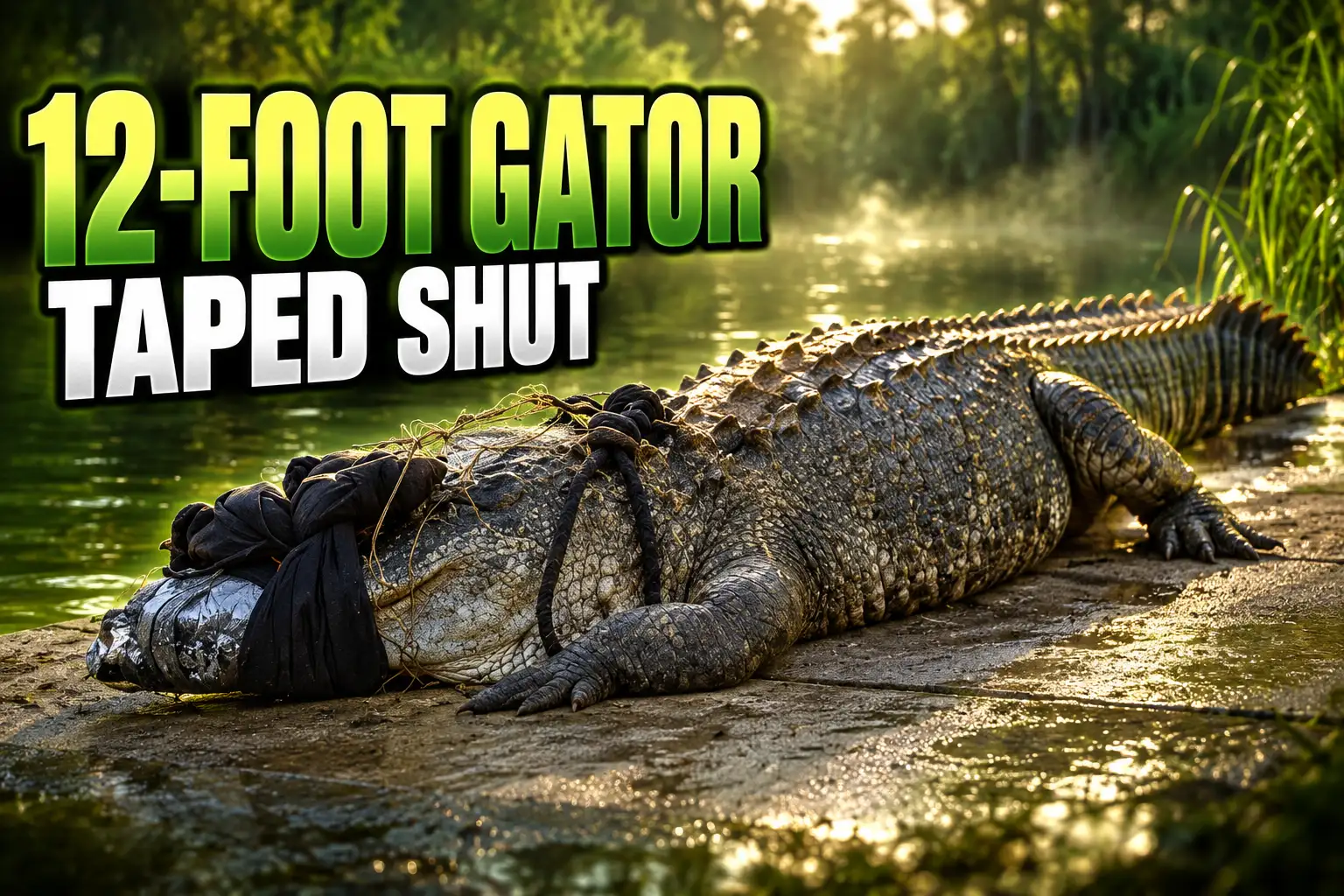
A licensed trapper pulled a 12-foot alligator from a south Macon McDonald’s lot after 8:30 p.m. on Sunday, September 28, 2025. The animal had been seen near the drive-thru at 1450 Rocky Creek Road since Friday, and a 911 call at 4:38 p.m. Sunday brought deputies, firefighters, and state wildlife officers to a crowd that had already taped its mouth shut.
No one was hurt. The sheriff’s office said the alligator posed no threat. What the photos did not show was why a 12-foot animal spent a weekend in a busy parking lot, and why the first people to put hands on it were not the ones Georgia licenses for the job.
A 12-Foot Alligator Spent the Weekend at the Drive-Thru
The restaurant sits in Macon’s Bloomfield area, on a commercial strip where Rocky Creek, a narrow waterway in the brush, still cuts through the plaza. Mandy Jackson, who works at the McDonald’s, said she saw the alligator on multiple shifts. “We have an alligator that has been here for two days,” she said. “It’s not going to be the first alligator, and it’s not going to be the last. But I think the alligator is hungry.”
Macon-Bibb County Coroner Leon Jones posted a public warning Sunday afternoon telling people to stay away from that McDonald’s. They did the opposite. Videos and stills moved on Facebook, more cars pulled in, and a group of bystanders moved on the animal with duct tape, a shoestring, jackets, and a slipknot.
THE WEEKEND ON ROCKY CREEK ROAD
- Friday, September 26, 2025: The alligator is first reported near the drive-thru, according to the Bibb County Sheriff’s Office.
- Saturday, September 27, 2025: Animal control answers a call, but the animal has gone back into the water by the time officers arrive.
- Sunday, September 28, 2025, 4:38 p.m.: A 911 call reaches Macon-Bibb E911. Civilians have already taped the snout and tied the animal. Deputies, the fire department, and a DNR-authorized trapper respond.
- Sunday, September 28, 2025, about 8:30 p.m.: A licensed trapper takes custody. Crime scene tape is up. Public safety workers hold a rope on the animal’s neck.
- Monday, September 29, 2025: DNR Law Enforcement is investigating the civilian capture. Wildlife Resources Division says it has no information on a release.
Sgt. Christopher Williams of the sheriff’s office said the alligator posed no threat and that no humans were injured. Capt. Linda Howard, the office’s public information officer, put the same point in plainer terms. “At that time, the alligator was not a threat to anyone, and if it was left alone, it would have gone back into the swamp,” she said. Animal control, she added, was already on the phone with DNR trying to get help taking it out.
The County’s One-Person Wildlife Desk
Howard’s next sentence is the part that does not fit on a Facebook still. “We had a trapper that we were trying to get in contact with because our animal control cannot handle this one gator by herself, because you know we have one person that usually does the wildlife.”
That one person is the county’s wildlife capacity on a Sunday. A 12-foot alligator is not a dog call. It is not a raccoon in a dumpster. Bibb County Animal Enforcement can tape a smaller animal. It cannot, by its own account, take a 12-footer without a licensed trapper, and the trapper has to be found.
The wait was not a one-off summer. Rebecca Galeazzo, lead animal enforcement officer for Bibb County, spent the months before this call pulling alligators out of yards and business lots. In one stretch she logged 11 removals in a month. Looking back at another year around the same season, she said she stopped counting at 50. On May 31, 2025, officers took another 12-foot alligator off a business on Joe Tamplin Industrial Boulevard after it crawled up overnight and, the sheriff’s office said, put up a fight.
Galeazzo’s explanation was land, not luck. “You’ve got all of the industrial things being built right off the swamp. You’ve got the interstate being built, that’s driving them out on the east side.” Mating season moves them. Pavement moves them farther. The McDonald’s lot is what you get when those two meet a creek that never left.
What Georgia Does With Nuisance Alligators Over 4 Feet
Georgia does not treat every alligator the same, and the split is a tape measure. Animals under 4 feet can be relocated. Animals 4 feet and longer go to licensed agent-trappers, at no cost to the landowner. The Wildlife Resources Division says those about 170 alligators in the state come out of the nuisance program each year. A 12-foot animal is three times the length that puts it on that list.
GEORGIA’S TWO TRACKS FOR A NUISANCE ALLIGATOR
| Size | Who takes it | Who pays | Where it usually ends |
|---|---|---|---|
| Under 4 feet | DNR if staff are free, or a hired control operator | The landowner, if DNR cannot come | Moved to habitat and released |
| 4 feet and longer | A licensed agent-trapper on a DNR complaint permit | No charge to the landowner | May be sold live, or killed for hide and meat |
The operating rule for those trappers is blunter than the relocation language that came out of the parking lot. An agent-trapper gets a permit for a specific complaint, may not keep a live alligator more than 48 hours unless DNR directs it, and the animals shall be humanely killed. A hide tag has to go on within 24 hours. Meat can be eaten by the trapper’s family or sold under separate labeling rules. Firearms, except a bang stick, need extra DNR say-so.
The state’s alligator management plan uses a softer verb for the same size class. Animals longer than 4 feet, it says, may be sold alive or slaughtered for products. Those two documents are not the same promise. One is a kill-and-tag rule. The other allows a live sale. Neither is a public promise that a 12-foot alligator taped in a McDonald’s lot will be carried to a quiet pond and left alone.
Bibb County Animal Control said this one was moved to a private pond in Laurens County, on a DNR-approved site, in part so it would not be hunted. Melissa Cummings, communications and outreach specialist for the Wildlife Resources Division, said the next afternoon that a private agent alligator trapper authorized by DNR had taken the animal and that the division had no information on the release. DNR Law Enforcement was investigating the civilian capture. Those accounts can all be true at once only if “relocated” is a county description, not a state chain of custody.
Rocky Creek Still Runs Behind the Plaza
The surprise in the photos is the restaurant. The habitat is the ditch. Rocky Creek still runs through the brush beside the shopping plaza, and south Macon sits on the fall line, the old geologic break that Georgia’s wildlife agency uses as a shorthand for alligator country, a line from Columbus through Macon to Augusta.
Six miles south of the city is Bond Swamp National Wildlife Refuge, 6,500 acres of Ocmulgee River floodplain set aside in 1989. The refuge is mixed hardwood and pine, bottomland, tupelo swamp, creeks, beaver ponds, and oxbow lakes. Alligators live there. A Fish and Wildlife Service brochure has documented animals up to 10 feet on the refuge and notes that Bond Swamp sits on the northern edge of their range. Warm days bring them onto banks. Wet years bring them farther.
Kara Nitschke, the Wildlife Resources Division’s state alligator biologist, has said it is normal to see alligators moving and basking in rivers, ponds, and lakes in the southern part of the state. “Alligators are native to Georgia and are critical to the health and balance of our ecosystems, so being GatorWise means we know how to modify our behavior to minimize any potential conflict,” she said. The McDonald’s call was not an animal out of range. It was an animal on the edge of range, using a creek that development did not erase.
A DNR history of the hunt puts the statewide population at 200,000 to 250,000 individuals, up from 29,954 in 1973 and 101,644 in 1982. The species was listed as endangered in 1967 and downlisted in 1987. The nuisance trapper program started in 1989. Recreational hunting followed in 2003. Bibb County sits in Zone 05 of that hunt map. The parking lot on Rocky Creek Road is downstream of a conservation success story, not a freak visit from Florida.
They Walked It Like a Pit Bull
By Sunday afternoon the official path had not produced a trapper in the lot, and the people who had been watching decided they were done waiting. Among them was Lord D’Andre, a Macon musician, along with Alexus Sparks and Acacia Rene, who ran a Facebook Live that pulled more onlookers into the plaza. Nick Farley posted a photo of men with the taped animal and wrote, “Only in Macon do we unite to catch an Alligator and then do a photoshoot onsite!”
I threw my jacket over it, he put the slipknot over his neck and then I grabbed the back of the string and walked him like a pit bull.
Lord D’Andre, Macon musician, at the Rocky Creek Road lot
In another telling he described a man pulling up with duct tape and a shoestring, taunting the alligator, and the group deciding it was their time. “We finna get this thing. I start yanking him back, walking him like a pitbull.” He said he stood outside about an hour and a half and that five, six, seven people came up calling him the Alligator Man. Rene called the afternoon wholesome. D’Andre said the city had come together for something positive, and the group asked for faster official help on the next wildlife call.
The clip that left Macon showed a taped snout, a string, and a circle of phones. The sharper problem in that footage is not a surprise bite in the drive-thru. It is a 12-foot animal being crowded, taped, and walked across asphalt while people treated the capture as a show. Viewers who lingered on the video kept returning to the same unease: the alligator was the one in trouble, and a taped 12-footer is still fast enough to ruin a Sunday. Howard said she had not seen a reaction like this, with people so curious they tried to capture a gator themselves and put themselves in harm’s way so they could tape its mouth and take selfies.
The trapper still had to finish the job. Deputies strung crime scene tape. Firefighters held the rope. Sometime after 8:30 p.m. the licensed agent left with the animal. The civilians had filled a gap. They had also done the one thing the state’s own alligator advice says not to do.
The State Tells You Not to Touch It
Wildlife Resources Division’s GatorWise campaign is built for weekends like this one, and its first rule is distance. Alligators can live in any water body in their range. They hide. They show up after storms in places no one has seen them. The campaign’s other rules are just as plain, and they run directly against the Rocky Creek Road photos.
WHAT GATORWISE TELLS THE PUBLIC TO DO
- Assume they are there: Treat any pond, creek, or ditch in range as occupied, and keep back.
- Do not feed them: Feeding, on purpose or by tossing fish scraps, is illegal in Georgia because it teaches alligators to link people with food.
- Do not handle them: The campaign’s line is to never harass, capture or handle an alligator; watch and photograph from a distance.
- Watch children and pets: Alligators do not sort dogs from prey. Leash pets and keep small children away from the waterline.
- Call, do not crowd: A nuisance animal is a job for local law enforcement or DNR, which assigns a licensed trapper when the animal is 4 feet or longer.
Ordinary nuisance-wildlife permits in Georgia allow live catch of alligators under 4 feet only. Animals 4 feet or longer are not authorized on those permits. The men with the shoestring had no complaint permit, no hide tag, and no assignment from DNR. They had a jacket and an audience. Jackson, on her side of the counter, had already watched the same animal through a weekend of shifts and had already said it would not be the last one.
The trapper’s truck left Rocky Creek Road with a 12-foot alligator that county officials described as bound for a private pond in Laurens County. DNR, the next afternoon, still could not say where it went. The creek behind the plaza did not move.
Frequently Asked Questions
What Should You Do If You See an Alligator in Georgia?
Stay back, keep children and pets with you, and do not throw food or fish scraps in the water, which is illegal because it trains alligators to approach people. Call local law enforcement or a DNR regional game management office rather than trying to move the animal; only a licensed agent-trapper with a written complaint permit is supposed to take an alligator 4 feet or longer.
Why Do Alligators Show Up Around Macon?
Macon sits on the fall line that Georgia wildlife staff use as the northern shorthand for alligator range, and Bond Swamp’s 6,500 acres of Ocmulgee floodplain six miles south of the city hold documented alligators up to 10 feet. Creeks, industrial fill, and road work at the swamp’s edge push animals into lots and yards that still drain to the same water.
Can a Private Person Legally Catch a Nuisance Alligator?
No, not as a volunteer project. Georgia’s nuisance-wildlife control permits allow live catch by hand of alligators under 4 feet only, and they bar taking animals 4 feet or longer. Agent-trappers work from a DNR permit tied to a specific complaint, and they are the only private operators assigned those larger animals.
What Happens to an Alligator Smaller Than 4 Feet?
DNR staff will capture and move it at no charge if they are available; if they are not, the landowner can hire a licensed control operator or agent-trapper and pay the bill. Those smaller animals are the ones the management plan says should be released into suitable habitat, which is the track that does not involve a hide tag.

Greed Held After a $697 Million Crypto Long Flush

Fed Minutes Keep a Year-End Rate Hike Alive

A Nanny-Cam Tape Follows Tyreek Hill Into Free Agency

Star Wars Galactic Racer Makes a Crash End the Tour

Amazon Puts Apple’s June MacBook Prices Back on Sale

Sophia Wootten Turns the Miss Georgia Crown Toward Cleft Care

The iPhone 16 Pro Flipkart Cut Did Not Last

Microsoft Prints Azure’s $29.42 Billion Quarter and Shrinks the Map

UltraTech’s Ultravolt Launch Puts Cable Multiples on Trial

IXI Autofocus Glasses Still Lack a European CE Mark
-
 NEWS1 year ago
The iPhone 16 Pro Flipkart Cut Did Not Last
-
 ENTERTAINMENT4 months ago
Sophia Wootten Turns the Miss Georgia Crown Toward Cleft Care
-
 BUSINESS1 month ago
UltraTech’s Ultravolt Launch Puts Cable Multiples on Trial
-
 NEWS1 month ago
Microsoft Prints Azure’s $29.42 Billion Quarter and Shrinks the Map
-
 NEWS9 months ago
IXI Autofocus Glasses Still Lack a European CE Mark
-
 NEWS3 months ago
Little St. Simons Island Hatches Loggerheads at 72.4 Percent
-

 NEWS4 months ago
Georgia Beach Bacteria List Leaves Swim Areas Open
-

 NEWS3 years ago
Eyal Waldman Keeps a Two-State Bet After Gaza