
LIFESTYLE
Dog Bite Rabies Vaccine: When You Also Need Immunoglobulin
A dog bite rabies vaccine visit still starts with a long soap-and-water wash, then rabies immunoglobulin in the wound when the bite breaks the skin.

A dog bite that breaks the skin is a reason to act the same day, even when the dog still looks well. A dog bite rabies vaccine visit has three parts, and the vaccine is only one of them.
Wash the wound with soap and running water before you do anything else, then get to a clinic. The clinician decides whether you also need rabies immunoglobulin in the wound. That call depends on the depth of the contact and on any rabies vaccine you have already finished.
You will find the wash, the three exposure groups, the schedules used by the World Health Organization and in the United States, and the mistakes that leave a gap after the first shot.
What Rabies Post-Exposure Prophylaxis Includes
Post-exposure prophylaxis, often shortened to PEP, is the emergency plan that stops rabies virus before it reaches the brain. The plan is timed to the bite, not to feeling sick, because the illness is fatal once symptoms start.
The WHO fact sheet on rabies exposure care names the same three steps for every real exposure: a thorough wash, a course of human rabies vaccine, and, when the exposure calls for it, rabies immunoglobulin or monoclonal antibodies placed in the wound.
THE THREE PARTS OF PEP
- The wash: Soap and a lot of water, started as soon as you can, flush virus out of the wound before it settles in nearby tissue.
- The vaccine: A series of shots trains your own immune system, which needs several days to make protective antibody.
- The immunoglobulin: Ready-made antibody, given once, covers those days on the bites that need it, and it has to go into the wound itself.
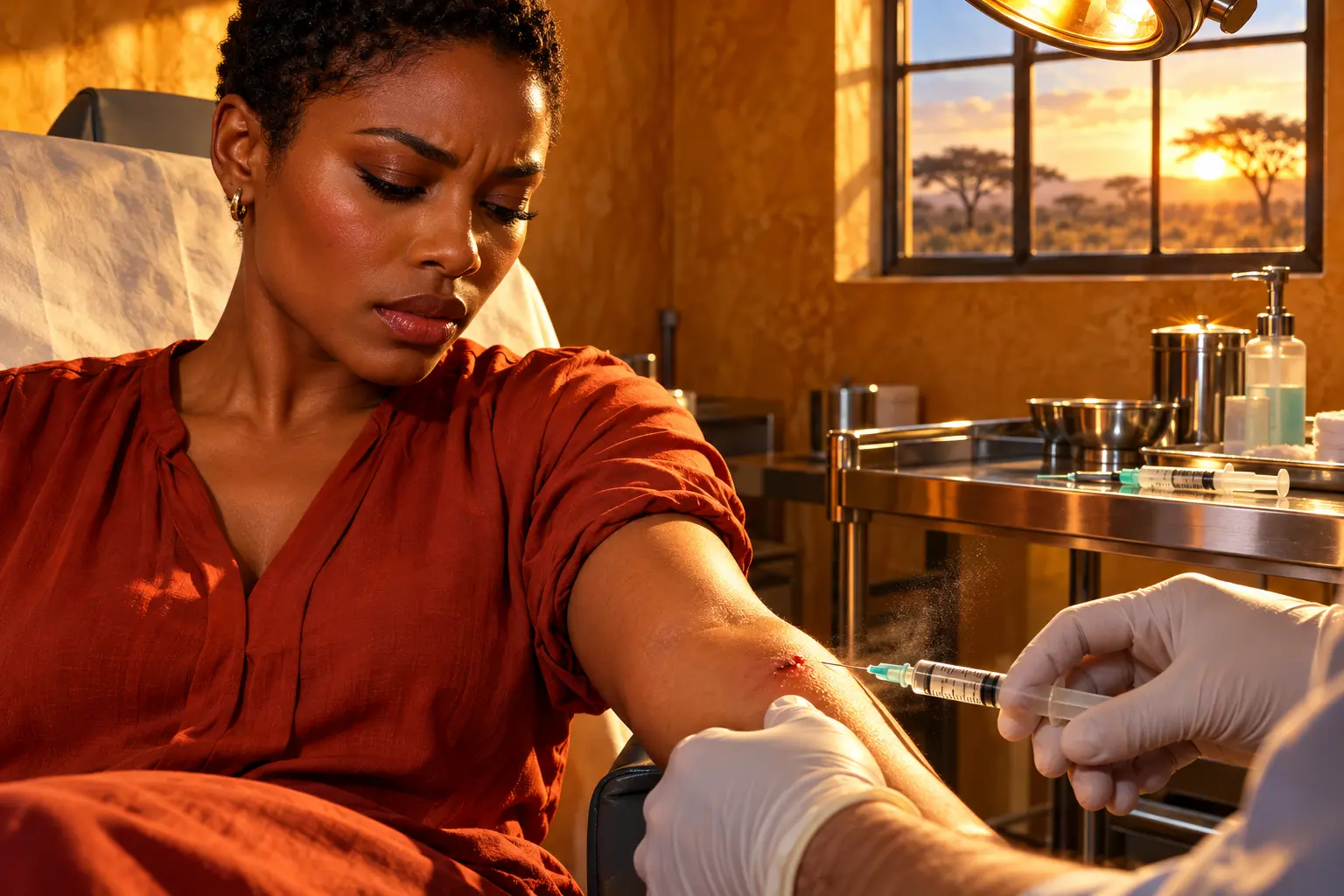
A shot in the arm does not stand in for the wash, and it does not stand in for immunoglobulin on a severe bite. If the clinic has no immunoglobulin that day, a prompt wash plus the full vaccine course is still effective prevention, so you should not wait at home for a perfectly stocked visit.
How to Wash a Dog Bite Before You Reach a Clinic
Do this at the nearest tap, before a kitchen paste, oil, alcohol, or a tight bandage. Anything smeared on the bite first uses up the minutes that belong to soap and water, and it does not replace the clinic.
- Hold the wound under running water and wash with soap for at least 15 minutes, flushing every part of the bite, including punctures you open gently with the stream.
- A detergent is fine if that is what you have. With no soap at all, keep flushing with water rather than waiting to buy supplies.
- After the wash, apply povidone-iodine or another antiseptic that kills virus, if you already have it. Then cover the bite loosely and leave the closure to the clinic.
- If blood is pouring, press a clean cloth on the wound while you arrange a ride, then return to washing once the flow slows.
Do not stitch, glue, or tape the bite shut yourself. When a clinician has to close it, immunoglobulin goes into the wound first, the closure waits several hours if that is possible, and any stitches stay loose. Shutting the skin before that step can seal virus inside.
Which Dog Bite Needs Rabies Immunoglobulin?
Immunoglobulin is not automatic for every nip. Contact is sorted into three groups, and only the severe group adds immunoglobulin or a monoclonal antibody on top of vaccine.
| WHO group | What the contact looks like | What you need |
|---|---|---|
| Category I | Touching or feeding the animal, or a lick on intact skin | Wash the skin. No vaccine and no immunoglobulin |
| Category II | Nibbling on bare skin, or a minor scratch or abrasion with no bleeding | Wash, then start vaccine. Immunoglobulin is not part of this WHO plan |
| Category III | Bites or scratches through the skin, saliva on broken skin or on the eyes, nose, or mouth, or any direct bat contact | Wash, start vaccine, and put immunoglobulin or a monoclonal antibody into the wound |
A bite that bleeds through the skin is category III. A scratch that never bleeds sits in category II, which still needs vaccine and does not include immunoglobulin under that split. Saliva in the eye or mouth is category III even when you cannot find a tooth mark.
Clinics in the United States follow a wider rule. CDC post-exposure prophylaxis guidance pairs human rabies immune globulin with vaccine for anyone who needs PEP and has never been vaccinated, whether the exposure was a bite or not. Seen in the United States, you should not talk yourself out of immunoglobulin because a scratch looked minor.
| Product | Dose | Where it goes |
|---|---|---|
| Human rabies immune globulin | 20 IU/kg of body weight, all ages | As much as possible into and around every wound; any remainder in a muscle away from the vaccine |
The product is given once, with the first vaccine dose or later through day 7, and it is not used after that, because antibody from the vaccine is expected by then. Ask to watch it go into the bite, not only into the opposite arm. The same syringe or the same spot as the first vaccine dose can cancel that vaccine, and the vaccine dose then has to be repeated somewhere else. On a finger, the full volume may not fit safely, so the clinician uses what the tissue can take and puts the rest in a muscle.
How Does the Rabies Vaccine Schedule Work?
Day 0 is the day of the first vaccine dose, not the calendar day of the bite, though you should start as soon as you can. In adults the muscle dose goes into the deltoid of the arm. In small children the outer front of the thigh is acceptable. A dose placed in the buttock does not count and has to be repeated.
Three schedules cover someone who has never been vaccinated, and any of them can be used for category II or category III. The one-week intradermal schedule WHO recommends is the dose-sparing option in the table, and it cuts the volume of vaccine and the cost by 60 to 80 percent without giving up protection. As of 2024, the prequalified human vaccines behind these schedules are RABIVAX-S from Serum Institute of India, VaxiRab N from Zydus Lifesciences, and VERORAB from Sanofi Pasteur.
| Schedule | Who it is for | What you receive |
|---|---|---|
| Two-site intradermal, WHO | Never vaccinated | 0.1 mL at each of two sites on days 0, 3, and 7 |
| One-site intramuscular, WHO | Never vaccinated | One dose on days 0, 3, and 7, plus one dose between day 14 and day 28 |
| Zagreb intramuscular, WHO | Never vaccinated | Two sites on day 0, then one site on day 7 and on day 21 |
| United States, healthy | Never vaccinated | 1.0 mL in the arm on days 0, 3, 7, and 14 |
| United States, weakened immunity | Never vaccinated | Those four doses plus a fifth on day 28, still with immunoglobulin |
| Already vaccinated | A documented modern series | Days 0 and 3 only, and no immunoglobulin |
In the United States, a healthy person who has never been vaccinated gets the four-dose arm series in that table. Someone with a weakened immune system stays on the longer series and still receives immunoglobulin. A change of brand, or a change between intradermal and intramuscular injection, is acceptable when that is the only way to finish the course.
A short CDC training video shows the clinic order: the wash, immunoglobulin into the wound, and the vaccine in the arm, never mixed in one syringe.
Your own dates still come from the table if you never play it. A slip of a few days on one visit is not a reason to restart the series. A gap of weeks is a different problem, so keep the spacing you were given, and do not drop the last dose because the dog looked fine that morning.
Rabies Shots When You Were Vaccinated Before
A finished modern series, from a job, a trip, or an earlier bite, changes both products. You do not receive immunoglobulin, and you only need the two-dose booster in the table. Shots you had before the bite do not cancel the visit. Any new exposure still needs that short course, and you should bring the card if you still have it.
With no record, the clinic treats you as never vaccinated and uses the full plan, including immunoglobulin when the bite calls for it. Older nerve-tissue vaccines, including series people remember as a ring of shots around the belly, are not the same record as a modern cell-culture course.
A new bite within 3 months of finishing PEP is the exception under WHO guidance: another vaccine course is not recommended if you are otherwise healthy. A clinic in the United States may still offer the two-dose booster. Say so if your immune system is weakened, because that three-month window does not clear you in the same way, and the full plan may be used again.
What Should You Do About the Dog That Bit You?
A dog, cat, or ferret that a trained person finds healthy can be watched for 10 days. If that animal is still well 10 days after the bite, it was not shedding rabies when it bit you, and the vaccine course can be stopped. Other animals do not share that 10-day rule.
Do not sit out those 10 days before the first visit if you are in a place where rabies in dogs still occurs, or if the animal was a stray you cannot find. Try to note the owner and any vaccine tag without getting bitten again. If testing is planned, avoid a blow to the head, because the lab needs that tissue. Where dog rabies is mostly under control in the Americas, bats are the main source of human cases, and direct bat contact is treated as category III even with no obvious wound.
WHAT TO TELL THE CLINIC
- The animal: Name the species, and say whether it can be watched or tested.
- The skin: Say whether the bite bled, and mention saliva in the eye or mouth.
- Your record: Bring any rabies vaccine card, including shots for work or travel.
- Your health: Mention pregnancy, a baby as the patient, and any medicine that weakens immunity.
Those details are what move you between a wash only, vaccine only, and vaccine plus immunoglobulin. A missing card is treated as no prior vaccine. Wild mammals such as foxes, raccoons, and skunks are assessed the same day even though deaths after those bites are uncommon.
Mistakes That Leave a Gap in Rabies Care
When modern cell-culture vaccines are given as directed, PEP failures in people with a normal immune system have not been seen in the United States. Failures described elsewhere have followed a course that was not completed, or immunoglobulin that never reached the wound.
WHERE RABIES PEP GOES WRONG
- Arm-only immunoglobulin: Antibody left only in a distant muscle does not neutralize virus sitting in the bite.
- Same spot as the vaccine: Immunoglobulin and the first vaccine dose in one syringe or one site can cancel the vaccine, so that dose is repeated elsewhere.
- A buttock shot: Vaccine in the buttock is unreliable, and that dose has to be repeated in the arm or the thigh.
- Stitches first: Closing the wound before immunoglobulin goes in can trap virus under the skin.
- Stopping early: One shot is not a course. Finish the visits unless a clinician stops them because the watched animal stayed healthy.
- Waiting on a blood test: No approved test can show that you are free of rabies before symptoms. The decision uses the bite and the animal.
Point out every scratch, not only the one that hurts. A small puncture on a hand or the face is easy to skip and, on a category III contact, it needs immunoglobulin too. If your immune system is weakened, say so before the series ends, because you may need the extra dose and a later check that the vaccine produced antibody.
When to Get Help After a Dog Bite
Go to urgent or emergency care the same day for a bite or scratch that breaks the skin, saliva in the eye or mouth, a wound on the face, neck, or hands, or a bat in a room with a child, a sleeping person, or anyone who cannot say whether they were bitten. Heavy bleeding, a wound that keeps opening, or spreading redness and fever from ordinary infection also belong in emergency care, alongside the rabies steps rather than instead of them.
Get emergency care now if the wound later tingles, prickles, or burns, or if fever arrives with confusion, fear of water, fear of air on the skin, or weakness that starts at the bite. Furious rabies adds agitation and hallucinations, and death can follow in a few days from heart and breathing failure. The paralytic form is quieter, with weakness that begins at the wound and spreads, which is why it gets missed. Once those symptoms are present, rabies is fatal, and the care that remains is comfort, not a first vaccine dose arranged from home.
Pregnancy, infancy, and a weakened immune system are not reasons to withhold PEP. Vaccine, and immunoglobulin when the bite calls for it, can be given to pregnant people and to babies. The same visit should also look at tetanus cover and at whether the bite needs an antibiotic. Those are ordinary wound decisions, and they do not replace the rabies steps.
Frequently Asked Questions
How Late Can Rabies Shots Start After a Dog Bite?
Start as soon as you can, and still go if days or weeks have passed, as long as you have no symptoms of rabies. Incubation is typically 2 to 3 months and can run from one week to one year, so a delayed bite is not a reason to skip care. If fever, tingling at the wound, fear of water, or confusion has already started, you need emergency care rather than a first dose arranged from home.
Does a Rat or Squirrel Bite Need Rabies Shots?
Bites from rodents are not known to transmit rabies, so a rat, mouse, or squirrel nip is not managed like a dog bite through the skin. Wash the spot and watch for ordinary infection. If you are not sure the animal was a rodent, or it was a bat or another wild mammal, get the same-day rabies assessment a dog bite would get.
What If Rabies Shots Started in Another Country?
If the course you started is one the World Health Organization recognizes, finishing those doses is enough, so bring the dates, the product name, and whether the shots were intradermal or intramuscular. If the schedule is not a recognized one, or you could not finish it, a clinic may check your antibody level and add doses. A result at or above 0.5 IU/mL, from blood drawn two to four weeks after the series, measures your response to the vaccine rather than whether the bite infected you, and no extra doses are added when that level is met.
Who Gets Rabies Immunoglobulin When Supply Is Short?
Scarce immunoglobulin should go first to people with several bites, deep wounds, bites on the head, neck, or hands, severe immune problems, a biting animal that is confirmed or probably rabid, and anyone exposed to a bat. If you are not in that group, you should still wash the wound and start the full vaccine course the same day. Waiting at home while a clinic searches for immunoglobulin is the wrong trade when vaccine is already on the shelf.
Leave the clinic with the remaining dates written down, the vaccine brand noted, and a clear yes or no on whether immunoglobulin went into the wound. Keep those dates even if the dog looks well the next morning, unless the clinic stops the series because a watched dog, cat, or ferret is still healthy at 10 days.
Disclaimer: This guide is educational and explains rabies care after an animal bite. It is not a diagnosis, a prescription, or a substitute for an in-person assessment by a doctor, an emergency clinician, or a public health service. Whether you need vaccine, immunoglobulin, tetanus care, or an antibiotic depends on the wound, the animal, your vaccine record, and the products stocked where you are, so get that assessment before you skip or stop a dose. Schedules and product rules here reflect World Health Organization and CDC sources reviewed for this page and can change.

Greed Held After a $697 Million Crypto Long Flush

Fed Minutes Keep a Year-End Rate Hike Alive

A Nanny-Cam Tape Follows Tyreek Hill Into Free Agency

Star Wars Galactic Racer Makes a Crash End the Tour

Amazon Puts Apple’s June MacBook Prices Back on Sale

Georgia Beach Bacteria List Leaves Swim Areas Open

Sophia Wootten Turns the Miss Georgia Crown Toward Cleft Care

IXI Autofocus Glasses Still Lack a European CE Mark

The iPhone 16 Pro Flipkart Cut Did Not Last

Microsoft Prints Azure’s $29.42 Billion Quarter and Shrinks the Map
-
 NEWS5 months ago
Georgia Beach Bacteria List Leaves Swim Areas Open
-
 ENTERTAINMENT5 months ago
Sophia Wootten Turns the Miss Georgia Crown Toward Cleft Care
-
 NEWS10 months ago
IXI Autofocus Glasses Still Lack a European CE Mark
-
 NEWS1 year ago
The iPhone 16 Pro Flipkart Cut Did Not Last
-

 BUSINESS2 months ago
UltraTech’s Ultravolt Launch Puts Cable Multiples on Trial
-
 NEWS2 months ago
Microsoft Prints Azure’s $29.42 Billion Quarter and Shrinks the Map
-

 NEWS4 months ago
Little St. Simons Island Hatches Loggerheads at 72.4 Percent
-

 NEWS2 years ago
Capyfriends Cafe Routes Helen Tourists to Cleveland Capybaras