
SCIENCE
What Is the Difference Between a Corpak and NG Tube?
The difference between a Corpak and NG tube is the label you are reading: Corpak is a small feeding tube, and NG means the tip sits in the stomach.

The difference between a Corpak and NG tube starts with the kind of word on the chart you are holding. Corpak is the brand on a small feeding tube, and NG means the tip of a tube sits in the stomach after it enters through the nose.
A Corpak whose tip is in the stomach is an NG feeding tube, and the same brand advanced into the small intestine is no longer an NG tube. The wider tube many wards call an NG is a suction tube such as a Salem sump, not a Corpak, so the sections below sort the names, what each port is for, and the check that comes before formula.
Corpak, NG, and the Name on the Chart
An NG tube is a nasogastric tube. It enters at the nostril, passes the esophagus, and ends in the stomach. Teams use a nose tube when the feeding plan should last less than four to six weeks, or when they want to see whether formula will be tolerated before any bigger step. The same nostril route can end earlier in the small intestine, and those tubes are called ND or NJ instead of NG.
On a ward, Corpak almost always means a CORFLO tube from Corpak MedSystems, the line a children’s hospital guide labels Avanos CORFLO. It is a soft polyurethane tube with one main channel, made for formula and medicines rather than for emptying the stomach. If the brand itself is the only open question, a closer look at what a Corpak feeding tube is stays with that product alone.
The outside end is the part you handle. The pieces are few, and knowing them keeps a flush out of the wrong hole.
- Guidewire: A thin wire inside the tube during placement, taken out before the first feed on a standard CORFLO.
- ENFit ports: A main port and a side port, where a syringe or a feeding set locks on.
- Exit port: The opening near the inner end, where formula leaves the tube.
- Weighted tip: A heavier end past the exit port on some tubes, and absent on others.
Centimeter marks run along the tube so you can see whether it has slid. The number sitting at the nostril should match the number written in the care plan, and a shift is a reason to pause the feed.
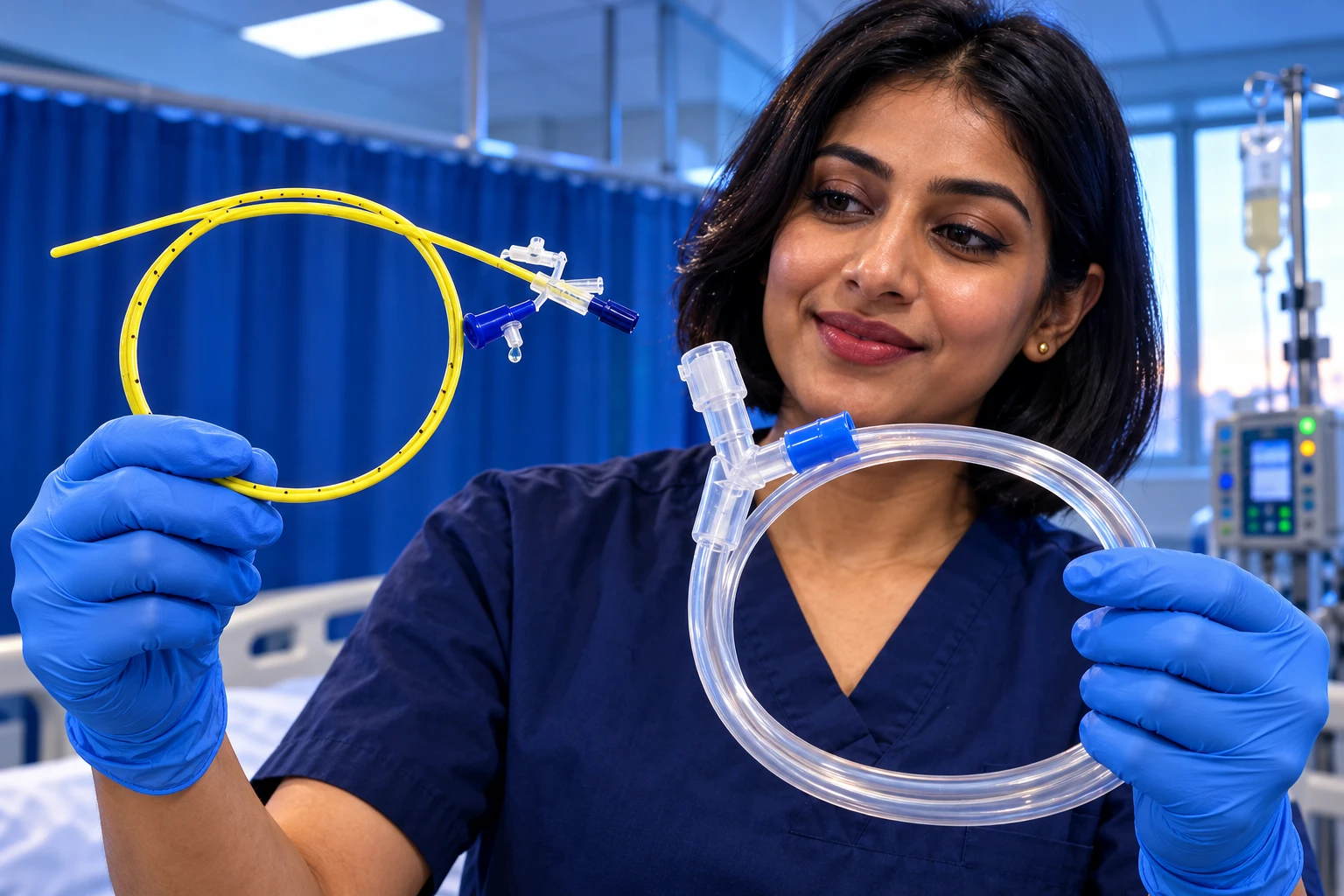
Reading the Difference Between a Corpak and NG Tube
Read each word as a job, not as a rival brand. One order can carry both words when a CORFLO tip has been confirmed in the stomach. The sizes in the chart are examples, not every length the maker sells.
| Name on the order | What the word names | Where the tip sits | Example from the records |
|---|---|---|---|
| Corpak or CORFLO | A brand of small feeding tube | Stomach, or farther into the small intestine | The 10 French CORFLO tube on file is 3.3 mm across and 36 inches (91 cm), with a 3 gm weight and a stylet |
| NG | The nose-to-stomach route | Stomach | No single size; the word only fixes the tip |
| ND | The nose-to-duodenum route | First part of the small intestine | Longer than a tube that only has to reach the stomach |
| NJ | The nose-to-jejunum route | Next part of the small intestine | Longer still, so the tip can pass the duodenum |
| Salem sump | A dual-lumen tube built to empty the stomach | Stomach | A wider suction tube with a separate air vent |
| Dobhoff | A different small feeding tube | Stomach or past the stomach | A narrow tube, classically made with a weight |
| CORTRAK | A guidance system plus its matching tubes | Stomach or small intestine | 8, 10, or 12 French; 92 cm to the stomach; 109 cm or 140 cm when the goal is past the stomach |
Three chart lines show how the words combine. “Corpak, confirmed in the stomach” is a small feeding tube and an NG tube at the same time. “Corpak, tip past the stomach, X-ray done” is still a Corpak, and it is not an NG tube. “Salem sump to suction” is an NG tube, and it is not a Corpak.
Salem Sump, Dobhoff, and CORTRAK Tubes
Three more names sit on the same order sheet. Each one tells you about a port, a weight, or a screen, and mixing them up changes what you are allowed to put in your hand.
A Salem Sump Tube and Its Two Ports
A Salem sump is the tube people picture when they say a surgical NG. It has two lumens. The main lumen can pull stomach contents out. The second lumen is an air vent, called a blue pigtail, so the tube does not suck itself onto the stomach lining. Wall suction does not go on that vent.
A 2021 paper on Salem sump tubes used for feeds describes a channel no larger than a 12 French feeding tube inside a 16 French tube. Medicine and feeding formula were among the blockages in that series. If a team does order formula through a Salem sump, it still goes in the main lumen. A Corpak is the tube built for the feed.
- Main lumen: Suction, plus any feed or medicine the team has ordered through this tube.
- Air vent: Lets air in during suction, and it is not a second feeding port.
The suction tube is the stiffer one that makes placement unpleasant. The feeding tube is the soft one that blocks when the wrong medicine goes down it. Swapping the nicknames swaps those problems.
A Dobhoff Tube Next to a Corpak
A Dobhoff is a small-bore feeding tube named for physicians Dobbie and Hoffmeister. It is not a Corpak with a different sticker. Classic Dobhoff tubes carry a weight near the tip, meant to help the tube move onward with stomach motion. A CORFLO can be weighted or plain, so a weight by itself does not separate the brands.
On an order, the practical difference is which package is in the room. Both are soft single-channel tubes for formula and medicines. Neither one is a Salem sump, and neither name tells you the tip location until someone checks it.
AN ORDER LINE
“Dobhoff to feed, Salem to suction” is two tubes with two jobs. “Corpak NG” is one feeding tube whose tip should be in the stomach.
If the package in the room does not match the nickname on the chart, stop and ask before you connect a pump. The connector may fit either way. The job does not.
CORTRAK Placement Beside a Plain Feeding Tube
CORTRAK is not a third tube you flush at home. It is a bedside guidance setup that has to be used with its own tubes. The CORTRAK 2 enteral access system follows a transmitting wire and draws a track on a screen while the tube advances. The display is the path of that wire relative to a receiver on the chest.
A NICE briefing updated December 9, 2016, is the source of the French sizes and lengths in the chart above. That briefing also says a trained operator may clean the transmitting wire and pass it back down the same tube later to recheck position. That step belongs to this system. It is a different wire from the guidewire packed with an ordinary CORFLO.
- Monitor: Shows the track of the wire tip in more than one view.
- Tube and wire: A polyurethane tube with a preloaded transmitting stylet.
- Receiver: Sits at the lower sternum and picks up the signal.
A clean track does not close the case. The briefing says the final check still follows hospital protocol, which can include an X-ray. A safety alert makes the same demand after feeds reached the lung when a placement device was trusted on its own.
Tip Location, Feeding Rate, and Suction
With the object in the nose identified, the tip decides the feed. A stomach can take a larger amount at a meal time, called a bolus, because holding food is what the stomach does. The small intestine is not built for a meal-sized volume, so a tube that ends in the duodenum or the jejunum runs as a slow continuous feed.
Your team may have you sit at a 45-degree angle during a feed and for a few hours afterward. The point of that posture is to keep formula from slipping into the airway and causing a lung infection. A suction tube and a feeding tube can share one admission, one emptying the stomach and the other delivering formula, and they are not backups for each other.
Wall suction belongs on a tube built with a vent, and only through the main lumen. A soft Corpak or Dobhoff connects to a pump, a syringe, or a gravity bag. Putting wall suction on that soft tube is the wrong job for the plastic, even before comfort enters the conversation.
Checking Placement of a Nasal Feeding Tube
A feed waits for proof of the tip. NICE guidance on adult nutrition support treats an aspirate at pH 5.5 or below as a stomach reading, using proper pH paper, after placement and before each use. An X-ray is the next step when aspirate cannot be obtained or the reading is not clearly gastric. For a tube meant to sit past the stomach, that guidance calls for an X-ray every time unless the tube was placed under live fluoroscopy.
If you cannot get aspirate from a fine tube, the next step is the X-ray the team orders. A missing aspirate is not proof the tube is in the lung, and it is not permission to start formula. A new cough, trouble breathing, or a placement that felt wrong on the way down is a stop.
BEFORE YOU START A FEED
- The proof: pH paper or an X-ray has cleared this placement, including the first check after a guidance system.
- The port: Formula meets the feed connector, and the air vent on a sump stays empty of formula.
- The mark: The centimeter number at the nostril matches the number in the care plan.
- The posture: You are sitting up the way the team showed you for this tube.
A placement screen does not retire that list. Protocol still closes the check, because a track of a wire and a picture of the body are different documents.
Day-to-Day Care of a Corpak Feeding Tube
The calendar for moving off a nose tube is a separate decision from the day this piece of plastic gets changed. For an Avanos CORFLO used with children at home, the change is due every 4 weeks in that guidance, and the guide is dated August 6, 2025. Adult hospitals set their own change date, so the number on your plan wins over a schedule written for another unit.
The wire rule depends on which wire you have. On a plain CORFLO, the guidewire comes out once placement is confirmed, after a water flush through the side port has activated an inner lubricant. That children’s guide allows the same tube to be used again only if it has come all the way out, has been checked for damage, and is rewired in the hand, and the lubricant will not activate on the next pass. A CORTRAK transmitting wire is the exception already described: a trained operator may pass that wire again while the tube is still in place.
Between changes, flush with water on the schedule your team writes, including before and after medicines and whenever a feed is paused. Tape or a securing device should leave the nostril itself clear, and the skin under the tape needs a daily look for redness, pain, or a sore. Formula that will not flow, a new leak at the connector, or a kink you can see is a reason to stop and call rather than to force a syringe.
From a Nose Tube to a Belly Tube
When the nose has finished the short job, the next tube does not pass through a nostril. A gastrostomy, or G-tube, goes through the abdominal wall into the stomach. A jejunostomy, or J-tube, goes into the jejunum. A GJ-tube uses one opening with two ports, one that can vent or medicate the stomach and one that feeds the jejunum.
Those tubes are placed with a scope, with X-ray guidance, or in surgery, either open or laparoscopic. The bedside pass through the nostril that placed a Corpak does not get repeated for them. What carries over is the tip rule. A tube ending in the stomach can take meal-time amounts, and a tube ending in the small intestine still runs slowly.
A Corpak label and an NG label stop being the right question once nothing is taped to the cheek. The chart will name a G-tube, a J-tube, or a GJ-tube, and the port you use for formula is the one the dietitian assigned.
When to Call About a Feeding Tube
Stop the feed and get urgent help if breathing changes, if a new cough starts during formula, if the nose will not stop bleeding, or if the person on the tube becomes hard to rouse. Those signs can mean formula in the airway or a tube that has left the path it was on. They are not a home repair.
Call the team that manages the tube for a clog a proper flush will not clear, a centimeter mark that no longer matches the plan, vomiting that is new, a leak at the connector, or skin under the tape that is newly red, warm, or painful. Have the brand, the French size printed on the tube, and the time of the last confirmed check ready when you call.
Do not push the tube farther in to chase a mark that has crept outward, and do not cut a nasal tube to make the loose end shorter. A tube lying completely out on the bed is its own problem, covered below, and it is a call unless home replacement is already a skill your plan teaches.
Frequently Asked Questions
Can You Drink Water With a Nasal Feeding Tube In?
You can sip water, and sometimes take other food by mouth, when the person who checked your swallow says that is safe. The tube does not ban drinking on its own. Keep carbonated drinks out of the tube. They are not a flush, and they are not formula.
Can Crushed Pills Go Through a Corpak Tube?
Ask the pharmacy for a liquid before a tablet is crushed for a Corpak. Powder from a crushed pill can pack a narrow channel and block the next feed. The water used when the wire comes out, a flush of up to 10 mL or a minimum of 2 mL if fluids are restricted, loosens that wire. It is not a plunger for pill paste.
Can a Corpak Feeding Tube Go Into an MRI Scanner?
Do not take a Corpak into an MRI room on a guess. A CORFLO model in the FDA device record has labeling that does not contain MRI safety information, and that gap is not a clearance to scan. Tell the imaging staff the brand and whether any wire is still inside, and wait for them to approve the tube.
Do You Stay Awake for Nasal Tube Placement?
You stay awake for a routine nasal placement at the bedside. The clinician uses lubricant and a numbing agent and can ask you to sip water so a swallow carries the tube down. A belly tube is a separate procedure. You fast for at least eight hours beforehand because that one uses sedation.
What If a Home Feeding Tube Comes All the Way Out?
Call the team that manages the tube unless your written plan already teaches you to replace it at home. One children’s program allows the same CORFLO to be used again only after it is completely out, inspected for damage, and rewired in the hand, and the inner coating will not activate on that second pass. If your plan does not say this, leave the wire alone and do not push the tube back in yourself.
The label on the chart and the mark at the nostril are the two things you can check without an X-ray. If that mark has moved from the number your team wrote down, pause the feed before you trust yesterday’s name for the tip.
Disclaimer: This article is an educational guide to the names and jobs of nasal feeding tubes and is informational only. It does not constitute medical advice, a feeding prescription, or instructions to place, advance, or replace a tube. Talk with the clinician or dietitian who manages the tube before you change a feed, a medicine, or a care step. Sizes, check methods, and replacement timing reflect the sources described here and can differ by hospital and by the tube in front of you.

Greed Held After a $697 Million Crypto Long Flush

Fed Minutes Keep a Year-End Rate Hike Alive

A Nanny-Cam Tape Follows Tyreek Hill Into Free Agency

Star Wars Galactic Racer Makes a Crash End the Tour

Amazon Puts Apple’s June MacBook Prices Back on Sale

Sophia Wootten Turns the Miss Georgia Crown Toward Cleft Care

The iPhone 16 Pro Flipkart Cut Did Not Last

Georgia Beach Bacteria List Leaves Swim Areas Open

Little St. Simons Island Hatches Loggerheads at 72.4 Percent

IXI Autofocus Glasses Still Lack a European CE Mark
-
 ENTERTAINMENT4 months ago
Sophia Wootten Turns the Miss Georgia Crown Toward Cleft Care
-
 NEWS1 year ago
The iPhone 16 Pro Flipkart Cut Did Not Last
-
 NEWS4 months ago
Georgia Beach Bacteria List Leaves Swim Areas Open
-
 NEWS4 months ago
Little St. Simons Island Hatches Loggerheads at 72.4 Percent
-
 NEWS10 months ago
IXI Autofocus Glasses Still Lack a European CE Mark
-

 BUSINESS2 months ago
UltraTech’s Ultravolt Launch Puts Cable Multiples on Trial
-

 NEWS2 months ago
Microsoft Prints Azure’s $29.42 Billion Quarter and Shrinks the Map
-

 NEWS4 months ago
OnePlus Ends OxygenOS After Quitting US and Europe