
BUSINESS
RoslinCT’s Public Grant Unlocks a Much Larger Digital Rebuild
RoslinCT’s £7.25 million Scottish Enterprise award is the public slice of a larger digital cell therapy rebuild, aimed at cost and data, not more suites.

RoslinCT said on 6 October 2026 that Scottish Enterprise had awarded it an up to £7.25 million R&D grant ($9.6 million) to digitise cell therapy manufacturing in Scotland. The Edinburgh contract development and manufacturing organization already runs 22 purpose-built cGMP suites with a sister plant in Hopkinton, Massachusetts. The new money is for software, data links and AI, not for another clean room.
That split is the story. Scottish Enterprise’s published rules for large companies working alone cover 25% to 40% of eligible project costs. On that band, a grant of up to £7.25 million implies eligible spend of about £18 million to £29 million, unless this award used a different rate. Neither the company nor the agency published the match figure or a job target.
Scottish Enterprise Wrote a Cheque That Covers Only Part of the Bill
Dealroom, the deal-data firm, ranks the award in the top 3% by size among more than 2,000 UK health grants on record. The agency’s own R&D product is built for that scale. It looks for projects with at least £1 million of company spend and will not consider a grant below £250,000. Large firms can get 25% to 40% of eligible costs; smaller firms can get 35% to 50%.
RoslinCT lists more than 500 staff across two continents, which puts it in the large-company band if those published rates apply. The arithmetic is simple, and it is still an inference. Divide £7.25 million by 0.25 and the eligible pot is £29 million. Divide by 0.40 and it is £18.125 million. The press notice only confirms a grant of up to £7.25 million inside a multi-year “digital expansion plan.”
WHAT A LARGE-COMPANY RATE IMPLIES
| Published rate | Implied eligible spend |
|---|---|
| 25% (large company, independent) | £29 million |
| 40% (large company, independent) | £18.125 million |
Peter Coleman, RoslinCT’s chief executive, tied the money to speed, consistency and scale, and to keeping Scotland in the advanced-therapy manufacturing business.
This support from Scottish Enterprise represents an important investment in the future of advanced therapy manufacturing in Scotland. Digital technologies are transforming how cell therapies are developed and manufactured, enabling greater efficiency, consistency and scalability while maintaining the highest quality standards.
Peter Coleman, Chief Executive Officer, RoslinCT, 6 October 2026 announcement
Adrian Gillespie, chief executive of Scottish Enterprise, called the project a prime example of agency support that “can enable innovation at scale and strengthen competitiveness in global markets.” Tom Arthur, minister for business and fair work, called it good news for Edinburgh and for therapies “improving and saving lives across the world.” None of them put a headcount or a go-live date on the record.
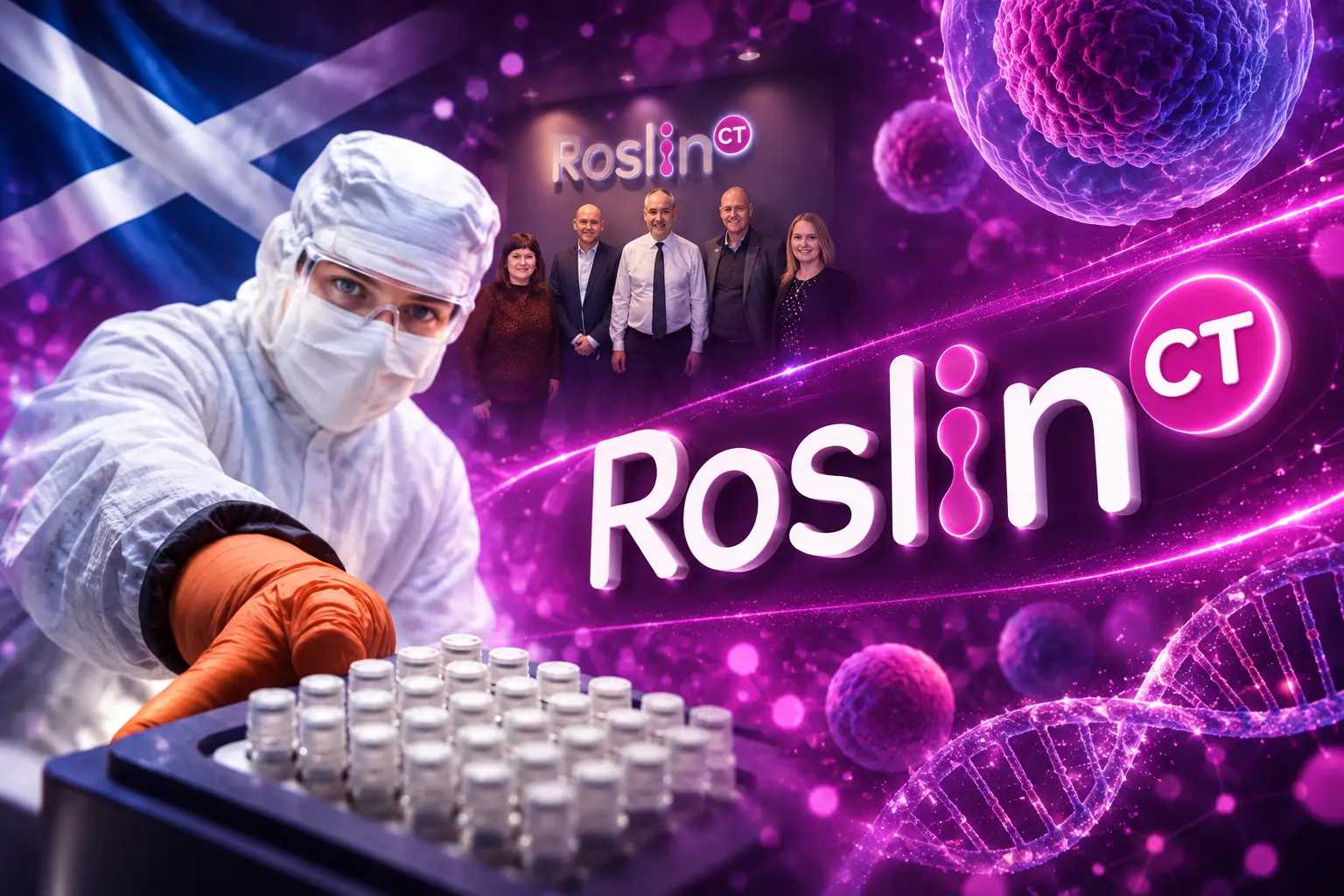
22 Suites Will Not Cut the Cost of a One-Patient Batch
RoslinCT’s own site lists 22 cGMP suites, more than 500 employees, more than 500 cGMP batches, and experience with more than 20 cell types. Those rooms already handle autologous work, where each patient is a batch of one, and allogeneic work, where one starting bank can serve many patients. The grant is aimed at the first problem.
THE PLANT THE GRANT IS MEANT TO WIRE
- Suites: 22 purpose-built cGMP cell therapy rooms in Edinburgh and Hopkinton.
- People: More than 500 staff across the UK and the United States.
- Output: More than 500 cGMP batches already produced for a range of indications.
- Range: More than 20 cell types on autologous and allogeneic processes.
A 2024 McKinsey estimate, cited in CDMO trade analysis, put autologous cost of goods in a band of $150,000 to $250,000 a dose, with almost no drop as volume rises, because you cannot pool ten patients into one run. Labour, single-use kits, release tests and vein-to-vein logistics stay attached to each person. Digital batch records, better data links and AI process control are the tools manufacturers now use to attack that flat cost curve.
RoslinCT is not starting from paper. The company already has a head of digital operations, Rebecca Street, and has sat on industry panels about digitising cell and gene therapy plants since at least 2024. Its public site already advertises “integration of best-in-class cell therapy software solutions.” The Scottish Enterprise money is meant to push that layer through the Scottish rooms, and to do it as a formal R&D project the agency can fund.
How Casgevy Is Made One Patient at a Time
The product that makes the bottleneck concrete is CASGEVY (exagamglogene autotemcel, or exa-cel), Vertex Pharmaceuticals’ CRISPR-edited cell therapy for sickle cell disease and transfusion-dependent beta thalassemia. RoslinCT says it helped take the therapy from early process work through commercial supply, and it announced in December 2023 that it would manufacture the first FDA-approved CRISPR-based gene therapy. The UK medicines regulator authorised the treatment on 15 November 2023. The US Food and Drug Administration followed on 8 December 2023 for sickle cell disease in patients 12 and older with recurrent vaso-occlusive crises.
Coleman has described a one-patient flow. Blood is drawn and sent to Scotland. Over six to seven days the plant extracts the patient’s bone marrow stem cells. The faulty genes are edited. The product is frozen, then held for weeks of testing before it goes back to the clinic. Each batch is unique. A missed data point, a broken chain of identity, or a slow quality review is not a paperwork nuisance. It is a delayed dose for one named person.
THE PATIENT-SPECIFIC RUN
- Collection: The patient’s blood is drawn and shipped to the manufacturing site.
- Extract: Bone marrow stem cells are taken off over six to seven days.
- Edit: CRISPR/Cas9 is used at the erythroid enhancer of the BCL11A gene so fetal haemoglobin rises.
- Hold: Vials are frozen and then tested for several weeks before release.
The European medicines file lists manufacture at Roslin Cell Therapies’ BioCube 2 in Edinburgh and at a Charles River site in Memphis, Tennessee, so Scotland is one node in Vertex’s network, not the only one. The MHRA licence for Roslin Cell Therapies Limited names three Edinburgh sites on its manufacturing licence: BioCube 2 at 11 Little France Road, a Shawfair site in Danderhall, and the GMP cellular therapy facility at the Institute for Regeneration and Repair North. The company says it now makes commercial products at both the Scottish and Massachusetts plants. Wiring those rooms so batch data moves with the cells is the job the new programme describes.
GHO Capital Already Owns the U.S. Half of the Plant
The owner behind the Scottish bid is GHO Capital, the London healthcare private-equity firm. GHO invested in RoslinCT on 11 January 2022 to fund capacity, customers and a wider product mix. On 4 August 2022 it backed a combination with Lykan Bioscience, a Hopkinton CDMO with a 64,000-square-foot plant and 16 cGMP suites due to run by the end of that year. The two brands were folded into one RoslinCT name on 5 June 2023. The combined group now cites 22 suites.
Public money is therefore landing on a PE-backed transatlantic manufacturer, and only on the Scottish side of it. The announcement is explicit: the grant is to accelerate digital transformation of manufacturing operations in Scotland. Hopkinton does not appear in the funding line. For GHO, a state-backed digital layer in Edinburgh is a way to make the original UK plant keep pace with the US rooms it already paid to acquire, without putting the whole bill on the fund.
FROM DOLLY TO A TWO-SITE CDMO
- 1996: Dolly the Sheep is cloned at the Roslin Institute, the scientific inheritance the company still cites.
- 2005: Roslin Cells is founded by the institute to make new human embryonic stem cell lines.
- 2015: RoslinCT is established from that business to develop and manufacture cell and gene therapies.
- 11 January 2022: GHO Capital invests, with Scottish Enterprise already on the company’s origin story.
- 4 August 2022: Combination with Lykan Bioscience adds the Hopkinton plant.
- 5 June 2023: The group integrates under the RoslinCT brand.
- 15 November 2023: The MHRA authorises Casgevy in the UK; the FDA follows on 8 December 2023.
- 6 October 2026: Scottish Enterprise awards an R&D grant of up to £7.25 million for the digital programme.
The agency has written smaller cheques to this company before. In 2021 it put £100,000 toward a cell and gene training academy. This award is a different order of magnitude, and it is aimed at plant software rather than a teaching room.
BlueRock, BOOST and a Second Omisirge Indication
The digital plan sits on a client book that has been filling through late 2025 and 2026, which is why a multi-year data project now has something to connect. Developers do not pay CDMO rates for a prettier dashboard. They pay for fewer failed lots, faster release and a plant that can take a process from trial supply to commercial without rebuilding the paperwork.
RECENT WORK THE SOFTWARE WILL HAVE TO CARRY
- Ayrmid, 16 December 2025: The partnership expands so RoslinCT will manufacture Omisirge (omidubicel-onlv) for a second FDA-approved use in severe aplastic anemia.
- BOOST Pharma, 7 January 2026: Process transfer into Edinburgh for BT-101, a cell therapy for infants with osteogenesis imperfecta, with an eye on Phase III and later commercial supply.
- BlueRock Therapeutics, 8 July 2026: A deal to widen access to clinical-grade pluripotent cell lines for other therapy developers.
Those programmes span autologous gene-edited blood cells, donor-derived products and iPSC starting material. Each has a different data trail. A digitally integrated plant is how a CDMO argues it can run that mix in the same suite block without mixing up chain of identity. Coleman’s line about supporting clients “throughout the product lifecycle” is the commercial pitch underneath the grant language about AI and connectivity.
The Grant Comes With Living Wage and Net Zero Strings
Scottish Enterprise does not describe this product as a gift. Applicants must show the project is new for the company, that it has a commercial path, and that it cannot go ahead, or would go ahead slower or smaller, without the grant. Work that has already started, or that is only a routine upgrade, is outside the scheme. Funding is discretionary even when the tests are met. Some or all of a grant can be repayable.
Every award also has to meet the Scottish Government’s Fair Work and net zero tests. That is the part of the bargain the announcement left in the small print of the agency’s grant page, and it is where public money attaches conditions a private digital budget would not.
CONDITIONS ATTACHED TO AN R&D AWARD
- Pay: The Real Living Wage for all staff over 16, including apprentices.
- Voice: Channels for an effective workforce voice, including trade union recognition.
- Contracts: No misuse of zero-hours deals, and no fire-and-rehire.
- Climate: A credible plan to cut operational greenhouse gases to net zero by 2045.
The agency also scores R&D jobs that pay the Real Living Wage, links to other local firms, and the global market the project is chasing. RoslinCT and Scottish Enterprise still have not said how many of those jobs this programme will create or protect. Until that number appears, the public case rests on a competitiveness claim and on a heritage line that runs from Dolly to Casgevy.
The rooms are already there. The US plant is already there. The bet funded on 6 October is whether a digitally integrated Scottish factory can take the cost and time out of one-patient batches fast enough for the clients now in the queue, and whether a grant of up to £7.25 million is enough of a nudge to make a PE-owned CDMO put the rest of the money in.
Disclaimer: This article is news reporting and analysis of a public grant and a manufacturing programme. It is for information only. It is not medical advice, not investment advice, and not a view on any cell or gene therapy, including CASGEVY, Omisirge or BT-101, nor on GHO Capital or RoslinCT as an investment. Readers who are patients, carers or clinicians should speak to a qualified doctor before making treatment decisions, and readers who are considering a financial position should speak to a suitably authorised financial adviser. Figures, grant terms and programme status reflect the company and agency statements available on 6 October 2026 and may change as the multi-year plan is defined.

Greed Held After a $697 Million Crypto Long Flush

Fed Minutes Keep a Year-End Rate Hike Alive

A Nanny-Cam Tape Follows Tyreek Hill Into Free Agency

Star Wars Galactic Racer Makes a Crash End the Tour

Amazon Puts Apple’s June MacBook Prices Back on Sale

The iPhone 16 Pro Flipkart Cut Did Not Last

Microsoft Prints Azure’s $29.42 Billion Quarter and Shrinks the Map

UltraTech’s Ultravolt Launch Puts Cable Multiples on Trial

IXI Autofocus Glasses Still Lack a European CE Mark

Little St. Simons Island Hatches Loggerheads at 72.4 Percent
-
 NEWS1 year ago
The iPhone 16 Pro Flipkart Cut Did Not Last
-
 NEWS1 month ago
Microsoft Prints Azure’s $29.42 Billion Quarter and Shrinks the Map
-
 BUSINESS1 month ago
UltraTech’s Ultravolt Launch Puts Cable Multiples on Trial
-
 NEWS9 months ago
IXI Autofocus Glasses Still Lack a European CE Mark
-
 NEWS3 months ago
Little St. Simons Island Hatches Loggerheads at 72.4 Percent
-

 NEWS4 months ago
Georgia Beach Bacteria List Leaves Swim Areas Open
-

 ENTERTAINMENT4 months ago
Sophia Wootten Turns the Miss Georgia Crown Toward Cleft Care
-

 NEWS3 years ago
Eyal Waldman Keeps a Two-State Bet After Gaza