
NEWS
Norway Pauses AI Smart Glasses in Parks and Schools
Norway will pause camera-equipped AI glasses in parks, schools and gyms while an expert group writes lasting rules, a decade after bars first banned Glass.

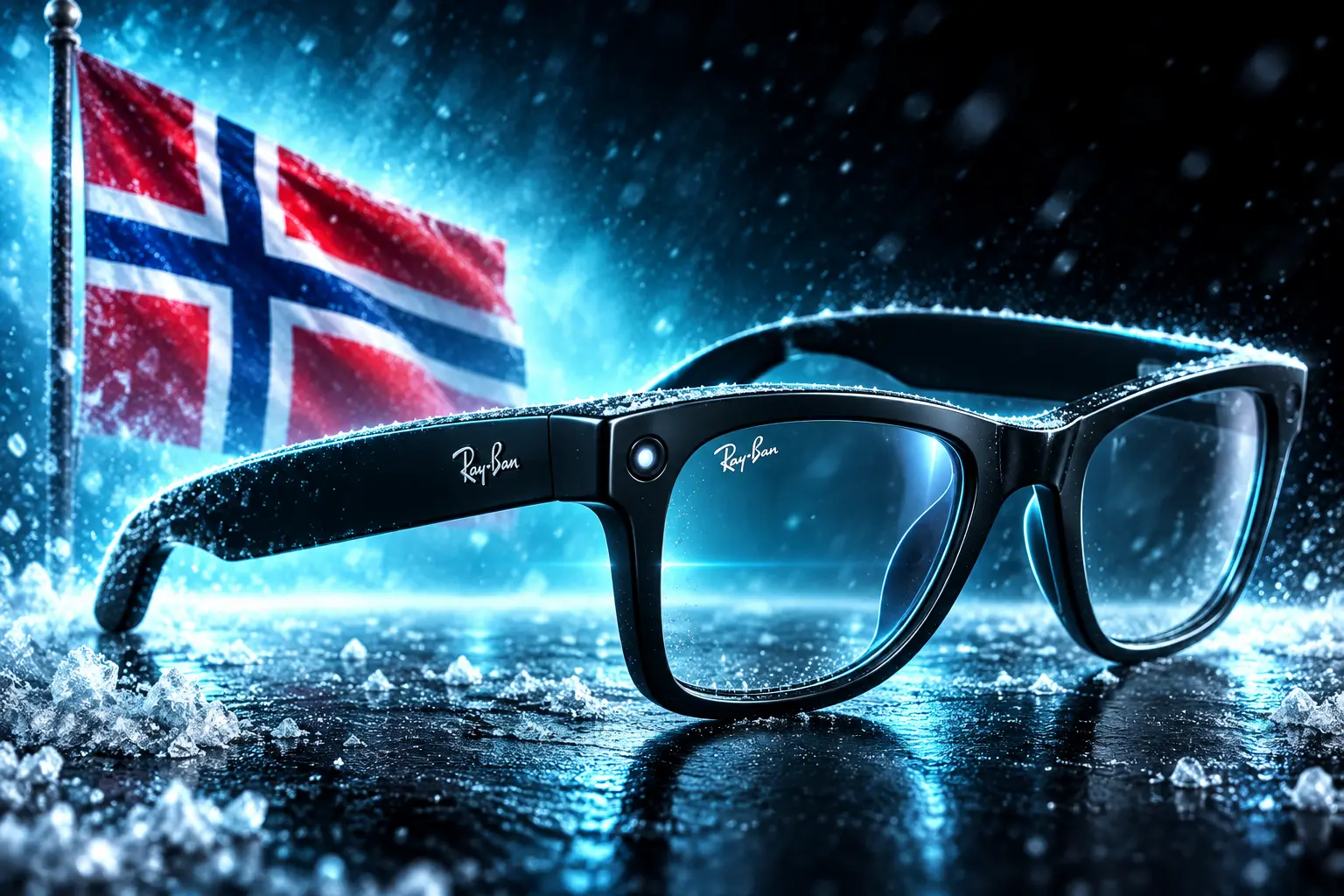
Norway will seek a temporary ban on AI smart glasses in selected public places, Digitalisation Minister Torgeir Micaelsen said on October 5. The freeze is meant to buy time for an expert group to write lasting rules, not to outlaw the gadgets at home.
Thirteen years after Seattle bars barred Google Glass, a national government is now trying to freeze the same category in parks, schools and changing rooms.
Norway Wants a Pause, Not a Total Ban
Micaelsen, who holds the digitalisation and public governance brief in the Labour-led minority government, said new face-worn cameras let people photograph, film or record audio without anyone nearby knowing. He wants a pause in chosen places while officials study body-worn tech and send a bill to the Storting as soon as they can draft one.
I am worried that new, powerful technology is being introduced where people risk being photographed, filmed or audio-recorded without knowing it.
Torgeir Micaelsen, Minister of Digitalisation and Public Governance, October 5 statement
The ministry’s temporary ban on AI glasses is framed as time for a thorough study and a public debate, not as a product recall. Private use would stay legal, as would use where other people are not at risk of being filmed without consent. Exceptions would be written for vulnerable groups and for socially beneficial use in limited cases.
He put the social cost in plain terms. People who think a stranger’s glasses might be recording them will start to leave the places they now treat as ordinary, he said, and a society built on that worry will feel unsafe.
Schools, Beaches, Gyms, and Changing Rooms
The map is still a shortlist. Exact sites have not been locked, and universities and colleges are only under review. The ministry grouped the rest into three kinds of place: sites the public uses all the time, sites where children gather, and sites where privacy is already treated as a given.
WHERE THE TEMPORARY BAN COULD APPLY
| Kind of place | Examples named so far | How firm |
|---|---|---|
| Everyday public sites | Parks, bathing beaches, museums, shopping centres, amusement parks, sports, music and cultural events | On the shortlist |
| Children’s sites | Schools, kindergartens, playgrounds, leisure clubs | Priority |
| High-privacy sites | Health clinics, hospitals, gyms with lockers and showers | Priority |
| Campuses | Universities and other higher-education sites | Still being weighed |
That list is the whole argument in spatial form. A beach and a locker room are not the same legally, yet both are places where a raised phone still looks like an act and a pair of glasses does not. Enforcement in a park is the practical hole, because a ranger cannot frisk every frame the way a bar can stop someone at the door.
Why a Tiny Light Failed as Consent
Meta’s answer has been a small white capture LED that flashes for a still and blinks for video, with no off switch, plus software that now kills the camera if that light is covered or drilled out. France’s data protector has already said a lamp on the frame does not do the legal job, because bystanders still cannot tell they are in shot and a light is not consent.
HOW MANY PAIRS ARE ALREADY OUT THERE
- 2025 sales: EssilorLuxottica chief Francesco Milleri said the company sold more than 7 million units of AI glasses that year.
- The two years before: About 2 million pairs were sold across 2023 and 2024 combined, so 2025 more than tripled that baseline.
- French survey: 67% of 2,128 adults in a CNIL poll run from 22 to 29 January 2026 called smart glasses a privacy risk.
- LED tampering: Meta said it disabled cameras on fewer than 1 in 1,000 of all its glasses after users covered or destroyed the light, a tally in the thousands of devices.
A July update refused to start recording if the LED was blocked. On August 27 the company went further and made the camera stop if the light was covered mid-recording, closing a trick where a wearer started a clip and then put tape over the lamp. Users who only stuck a sticker on the light can get the camera back; users who drilled the LED out keep Bluetooth audio and lose the lens for good.
Technical devices to inform people of a recording (e.g. activation of a light) have only a limited range and therefore appear insufficient, and are even absent for certain uses.
CNIL, “Smart glasses: the CNIL calls for vigilance,” 29 June 2026
The same warning lights have only a limited range problem shows up when the glasses talk to an AI about a scene rather than save a clip, because the lamp often stays dark for those looks. A raised phone is still a visible act. An eye-level camera is not, and that is the gap a blinking diode does not close.
The CNIL’s own poll cut both ways. Some 78% of those 2,128 adults still saw the glasses as useful help for some disabilities, even as 67% called them a privacy risk, 9% had ever tried a pair, and 1% said they owned one.
Google Glass Walked Into This Fight First
The objection is old. France’s privacy lab titled its own history note what was old is new again, pointing at Time magazine’s 2012 inventions list and at the “Glasshole” years that followed. Google Glass launched toward a tiny Explorer crowd at about $1,500. Bars did not wait for a statute.
FROM A SEATTLE BAR TO THE STORTING
- March 2013: Seattle’s 5 Point Cafe bans Google Glass before retail sale, with owner Dave Meinert saying people go there to be unknown and do not want to be filmed.
- November 2013: Lost Lake Cafe and Lounge, also in Seattle, asks a customer to leave after he will not take the headset off.
- October 30, 2014: The MPAA and National Association of Theatre Owners update their anti-theft policy so wearable recording devices must be turned off and put away at show time.
- 2025: EssilorLuxottica sells more than 7 million AI glasses in one year.
- January 22 to 29, 2026: The CNIL surveys 2,128 French adults on connected glasses.
- June 29, 2026: The CNIL publishes its vigilance note and says a recording light is not enough.
- July to August 27, 2026: Meta ships two LED-tamper software fixes, then disables cameras on thousands of altered pairs.
- August 2026: UK pubs, clubs, restaurants and theatres start barring the glasses.
- September 30, 2026: California Gov. Gavin Newsom vetoes SB 1130, a bill that would have made some covert wearable recording a misdemeanor.
- October 5, 2026: Micaelsen announces Norway’s planned pause and an expert group for lasting rules.
Meinert’s 2013 point still does the work. Pulling out a camera gives people a chance to step away; a headset on a face does not. Theaters later folded “wearable intelligent devices” into the same zero-tolerance camcording rule they already used for phones. Glass then shrank into a niche enterprise product. The legal freeze never came, because the installed base never got large enough to force a parliament to write one.
House Rules From Wetherspoons to Hans Anders
This time the door policies arrived first, and a ministry is following them. UK hospitality spent August telling guests to take the frames off, using house rules that already banned filming staff and other customers, while a large Dutch optician later stopped selling the product rather than wait for a statute.
WHO ALREADY BARRED THE GLASSES
- Wetherspoons: Chief executive Tim Martin said the chain’s 800-plus pubs already bar filming without permission, and that the glasses enable surreptitious surveillance, so the instinct is to turn the cameras off.
- Jeremy King: The London restaurateur behind Simpsons in the Strand, Arlington and The Park said he would not knowingly allow any invasion of guest privacy other than with the eyes people were born with.
- Soho House: The members’ club said filming is not allowed and the glasses are no exception.
- ATG Theatres: Guests wearing them during shows are asked to remove them.
- UK Cinema Association: Many operators are writing policies to prohibit or restrict camera-enabled smart glasses, while still flagging access uses such as bespoke subtitles.
- Hans Anders: The Dutch optical chain has stopped selling Ray-Ban Meta glasses in the Netherlands and Belgium while the political fight over the product continues.
Martin put it as common sense rather than a tech manifesto. The same week, the Dutch consumer group Consumentenbond sent Meta a summons dated September 29, arguing the recording light is too hard for bystanders to see and can be hidden, and giving the company two weeks to change the glasses and their default settings. The Dutch data authority had already warned that video of identifiable people made with smart glasses generally cannot be shared without permission. Norway is now trying to write into statute what those doors already enforce.
Newsom’s Veto Left the California Rule Unchanged
Five days before Oslo spoke, California went the other way. Gov. Gavin Newsom vetoed SB 1130, written by state Sen. Eloise Gómez Reyes, on September 30. The bill would have made it a misdemeanor to use a wearable recording device to capture sound or video of another person in a business area where privacy is reasonably expected, including changing rooms and doctors’ offices, with fines of up to $1,500 and possible jail time. From 2028, makers would have had to ship a light or similar signal, and gear designed to hide that signal would have been illegal, with fines of up to $2,500 per violation.
Newsom wrote that the bill defined a wearable recording device too broadly or imprecisely and that California already bars people from recording someone without consent in spaces generally considered private. Tech and business groups had warned the text could sweep in smartwatches, earpieces and headsets used on shop floors. Norway is fencing places. California tried to criminalise an act and mandate a lamp, then left both on the cutting-room floor.
Which Gadgets the Ban Would Cover
The hardest line in Oslo is still unwritten. Officials said they must decide whether the pause covers glasses with a camera and microphone, glasses with a camera and AI features, or a wider set of body-worn kit with a camera, audio recording, AI, or some mix of the three. That choice decides whether a camera-free audio pair is legal in a gym, and whether a translation tool for a deaf student is treated as a spy camera.
Meta is already selling into that split. Ray-Ban Meta Gen 3 camera glasses started at $449 on September 23. A camera-free Ray-Ban Meta Audio pair, priced from $349, is due to ship on October 13. A place-based camera ban would leave the audio frames untouched and still catch the flagship. Research groups are also trying to rebuild the product rather than ban it; one recent paper, MIRAGE, lays out full-body bystander privacy for smart glasses with consent-based restoration, a technical path the Norwegian expert group will have to weigh against a simple no.
WHAT WE KNOW
- The ask: A time-limited ban in selected places, plus an expert group to advise on lasting national rules for body-worn tech.
- Home use: Still allowed, along with use where other people are not at risk of being filmed without consent.
- Exceptions: Vulnerable groups can be carved out, and socially beneficial use can be allowed in limited cases.
WHAT IS UNCONFIRMED
- The map: Exact sites, including whether universities are in, have not been decided.
- The gadget: Camera-plus-mic glasses, camera-plus-AI glasses, or a wider wearable class is still an open drafting choice.
- The clock: The ministry will send a bill “as soon as possible,” with no sitting date named.
Until the Storting sees a text, the glasses stay legal in Norwegian parks and the list of banned doorways stays a press release. The expert group will be writing against a product that already looks like ordinary eyewear, which is the same reason a Seattle bar owner stopped waiting for Congress in 2013.

Greed Held After a $697 Million Crypto Long Flush

Fed Minutes Keep a Year-End Rate Hike Alive

A Nanny-Cam Tape Follows Tyreek Hill Into Free Agency

Star Wars Galactic Racer Makes a Crash End the Tour

Amazon Puts Apple’s June MacBook Prices Back on Sale

The iPhone 16 Pro Flipkart Cut Did Not Last

Microsoft Prints Azure’s $29.42 Billion Quarter and Shrinks the Map

UltraTech’s Ultravolt Launch Puts Cable Multiples on Trial

IXI Autofocus Glasses Still Lack a European CE Mark

Little St. Simons Island Hatches Loggerheads at 72.4 Percent
-
 NEWS1 year ago
The iPhone 16 Pro Flipkart Cut Did Not Last
-
 NEWS1 month ago
Microsoft Prints Azure’s $29.42 Billion Quarter and Shrinks the Map
-
 BUSINESS1 month ago
UltraTech’s Ultravolt Launch Puts Cable Multiples on Trial
-
 NEWS9 months ago
IXI Autofocus Glasses Still Lack a European CE Mark
-
 NEWS3 months ago
Little St. Simons Island Hatches Loggerheads at 72.4 Percent
-

 NEWS4 months ago
Georgia Beach Bacteria List Leaves Swim Areas Open
-

 ENTERTAINMENT4 months ago
Sophia Wootten Turns the Miss Georgia Crown Toward Cleft Care
-

 NEWS3 years ago
Eyal Waldman Keeps a Two-State Bet After Gaza