
SCIENCE
What Do Cows Hate?
What do cows hate includes sudden movement, isolation, slippery floors, dark doorways, and shouts, and a cow remembers both the handler and the place.

A cow that stops dead at a shadow, or spins when you step behind her, is reading a threat you walked past. What do cows hate comes down to four fears: fast predator-like movement, separation from the herd, a slippery floor, and restraint with no way out.
A dangling chain, a shirt on a post, a shout, or a dark doorway can halt the whole group just as fast. She files the place, and often the person, so the same chute or the same worker can set her off on a later day. The rest of this page matches each reaction to a fix you can use on the next working day.
Dairy cows in a lane, beef cattle on pasture, and a mixed group at home run into the same triggers. What changes is how close you can stand before she moves off, and that distance shrinks when handling stays calm and grows again after a rough morning.
Common Cattle Fears in the Yard and Chute
Cattle still carry prey instincts, so they bunch with the herd and watch for anything that looks like a chase. The fears that stop a working day are specific, and you can see them before anyone raises a voice.
FOUR FEARS THAT STOP CATTLE
- Predator-like movement: Fast steps, a swinging stick, a dog rushing the group, or a shout read as a chase.
- Separation: A cow pulled off the herd looks for a way back, and she can run a fence or a person to get there.
- A fall: Slippery concrete, deep mud, or a chute floor with no grip makes the next step feel unsafe.
- Restraint with no exit: A crowd pen packed tight, or a crush with someone deep in her space, can push her from flight toward a fight.
Heat, cold, mud, hunger, sickness, hauling, weaning, and a new group sit on the same stress list as handling. A cow that is already lame or overheated will balk for reasons no amount of quiet stockmanship can erase, so check her body before you blame the alley. The small visual stops, covered farther down, sit right beside these four fears and fool handlers who only watch for a kick.
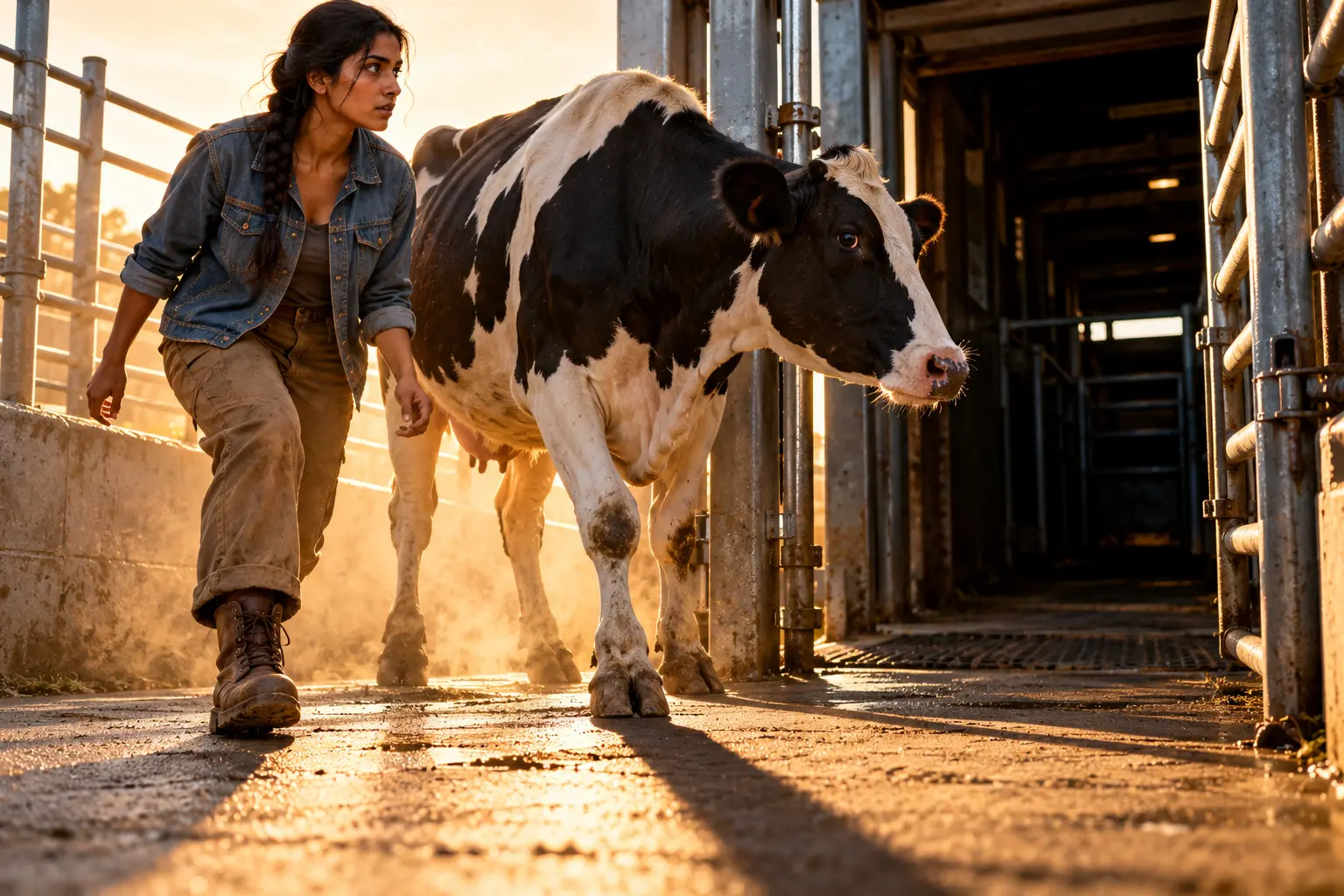
Cattle Vision, Hearing, Smell, and Touch
The cattle vision and hearing ranges published by Ohio State University Extension show why a shadow or a shout lands harder on a cow than on you. Her senses are built to notice a predator early, not to inspect a gate latch the way a person does.
| Sense | What she brings to the alley | What sets her off |
|---|---|---|
| Sight | Vision in excess of 300 degrees, a blind spot directly behind, and about 60 degrees of vertical vision, against about 140 degrees up and down for a person | Sharp shadows, a jump from bright light into dark, and any floor change she has not put her head down to judge |
| Hearing | From 23 Hz to 35 kHz, sharpest at 8000 Hz; people hear best from 1000 to 3000 Hz and top out near 20 kHz. She places a sound only to about 30 degrees; a person can place it within 5 degrees | Yelling, gates banging, a hydraulic chute motor, and other high, sudden noise |
| Smell | Used to know other cattle and for heat and breeding; once she is scared she leans on eyes and ears | Odors she has already paired with a bad event |
Side Vision and the Blind Spot Behind a Cow
Eyes on the side of the head give her that wraparound view, and the tradeoff is weak depth perception up close. She cannot snap focus the way you can, so a change in footing needs a lowered head before she will step on it. A lead cow that pauses with her nose near the ground is checking the next step, not refusing the job.
Movement at the edge of that wide view is what pulls her attention. A waving arm, a jacket flapping on a post, or a person shifting beside an open-sided alley will stop her even when the path ahead is clear. Solid sides on a race cut that side view and keep her pointed forward.
Sounds That Startle Cattle in the Yard
Hearing gives cattle an early warning, then they have to find the source with their eyes. That is why a noise you would talk over can swing a whole line of heads.
- A yell: High and sudden, in the range cattle hear more keenly than a speaking voice.
- Metal: Gates clashing, a loose chain, and the motor on a hydraulic chute.
- Air and plastic: Hissing lines and a bag snapping in the wind.
- A sound she cannot place: She turns to search for it, because her ears give a direction rather than a pinpoint.
Cattle with badly damaged sight lean even harder on those sounds and may whirl to investigate. Keep the alley quiet for them in particular, and do not assume a calm herd will ignore a horn, a slammed gate, or a shout from the lane.
Smell, Firm Touch, and a Nearby Herdmate
Cattle use smell to tell herdmates apart and to follow breeding. Once a cow is scared, vision and hearing take over and smell drops into the background. The odors that bother her are the ones she learned to pair with a bad session, so a chute that still carries that morning can make the next group hesitate.
TOUCH THAT CALMS
- Firm strokes: Steady contact calms cattle and cuts struggling in a squeeze chute.
- A pat: It can be read as a hit, so skip the patting.
- Light touches: They tickle or scare, and they do not belong in a handling session.
- A herdmate: Another animal within three feet is a comfort when she has to stand still.
Violent or nagging touches get stored the same way a bad place does. If the only contact she knows from people is a poke, she will treat the next person as the same problem.
What Do Cows Hate in a Working Alley?
The stop is usually something in front of her nose. A coffee cup in the alley, a piece of plastic, a shirt hung on the fence, a sun stripe from a post, or a chain end that swings will make cattle refuse a race that was fine yesterday. Handlers who only watch the rear of the group miss the object the lead cow is staring at.
Clear the distractions that stop animals in a race before you add pressure: shadows and sunbeams, a dangling rope, a shirt, and a little chain that moves. Cattle also hesitate to walk from bright daylight into a dark building. Moving them into a trailer or a barn is harder by day than at night, because the contrast is the problem, not a sudden dislike of the doorway. Give the leader time to put her head down and cross; the others follow her feet.
The short lecture below shows those stops on a real facility, from a high-contrast stripe on the ground to a chute that opens into darkness.
Painted lines, a metal strip, a drain grate, and a change from dirt to shiny concrete belong on the same list. If she stops at the same board every time, that board is the lesson, and prodding her over it teaches the next cow to fear the spot.
Yelling, Dogs, and a Rough Hand
Shouting and hitting are among the handling acts cattle learn to avoid the fastest. Dairy cows have moved more slowly down a race the next time when that race led to a person who was shouting. They can tell a yell from the ordinary clang of equipment, and the yell is the one that sticks.
Dogs bother cattle when they rush, bark, or nip heels, because that reads as a predator. A dog the herd already knows, working wide and quiet, does not carry the same threat. Sticks used as weapons, arm-waving, and people running the group fall in the same category as the rushing dog.
An electric prod is a last resort, not the tool in your hand for the whole morning. Use it only when a single animal has somewhere to go and still will not move, then put it down, and keep it off the eyes, rectum, udder, and genitals. When the whole group balks, the prod is the wrong response, because something ahead of them is wrong. Never prod an animal that has no place to step.
Isolation, Slippery Floors, and Tight Restraint
A cow on her own is looking for the herd, and she can run a fence, a gate, or a person to get back to it. Take a companion with any animal that has to leave the group, and leave stragglers alone so the herd’s movement draws them back. Highly strung cattle are the ones most likely to turn on a handler once they are penned alone.
Pack the crowd pen only half full so cattle can turn and see a way through. Bring the next small bunch in when the single-file race is almost empty, and treat the pen as a pass-through rather than a waiting room. In a round tub, pushing with the crowd gate is a common way to jam them and start the fight.
Slipping frightens cattle, and an animal that has lost her footing will hesitate at the next slick spot. Put sand, a mat, or another non-slip surface on concrete, on the chute exit, and anywhere you saw a foot slide. Fix the floor before you ask the group to walk it again.
The flight zone is the personal space around her, and it grows when she is excited or when you walk straight at her head. A person who stands inside that zone while cattle wait in a single-file race is a common reason they rear and shuffle. Step back out of it and they settle, because the pressure left with you. Tame cattle that have no flight zone at all should be led, not driven.
A Cow’s Memory of a Handler and a Place
Cattle remember places where something bad happened, and if they have a choice they avoid going back. They also remember people who handled them roughly, which is why one cow blows up for one member of the crew and walks quietly for everyone else. The first sessions matter, because a fear memory tied to a person or to a piece of equipment can last.
A farm-animal review of how cows tell people apart by clothes finds the cue is often the shirt. Different colors are easier for them to separate than matching outfits, and a change of color can change the reaction. If the only difference between a rough morning and a calm one was who walked in the alley, keep that person’s role, and the crew’s clothing, steady on purpose.
Bulls that took a knock from a headgate have balked at the same chute a month later. Cattle that spent a long, painful session in a race, such as being palpated by a crowd of students, have refused to re-enter it at all. Look at the equipment before you decide the animal is sour: a headgate that bangs, a nose tongs memory, or a chain at eye level will replay the old day.
Let new cattle investigate a fresh pen, a new person, or a strange object before you ask them to pass it at speed. Curiosity is the useful side of the same attention that makes them balk. A quiet walk-through, with no job attached, shrinks the flight zone over time.
How to Move Cattle Without Setting Off Fear
Match the picture in front of you to one cause, and fix that cause before you add pressure. The flight zone and point of balance then tell you where to stand so she can leave in the direction you want.
| What you see | What it means | What to try |
|---|---|---|
| Head down at a dark patch | A shadow or a color change looks like a hole | Let the lead cow inspect it, then let the others follow |
| Refuses a barn or trailer by day | Bright-to-dark looks like a dead end | Light the inside, or move that job when the contrast drops |
| Spins or kicks as you come up behind | You stepped into the blind spot | Approach from the side so she can see you |
| The bunch runs after one shout or a bang | High, sudden noise, and fear jumps through the group | Go quiet and let cattle and people settle |
| Blows up for one worker only | She remembers that person, often by clothing color | Change who works her, and keep clothes and habits steady |
| Will not re-enter a familiar chute | A bad experience is tied to that place | Check for a chain, a shadow, or a headgate that hit her |
| One animal crashes fences | Isolation | Take a companion, and do not chase her |
| Feet slip, then she will not walk | Fear of falling | Fix the footing before the next step |
Use the row that matches the animal in front of you, then change that one thing. Pushing harder after she has already shown you the problem is how a stop turns into cattle running a gate or a person.
- Find the edge: Walk up until she lifts her head and faces you, then stop. If the group is facing you, you are still outside the flight zone.
- Use the shoulder: In a chute, walk past the point of balance at the shoulder from head toward tail and she moves forward. Stand in front of that line and she stops or backs.
- Adjust on pasture: In an open pen the balance point can sit a little behind the eye, so watch whether she moves off as you pass the eye rather than the shoulder.
- Pressure, then release: Step in to start the herd, and step back out as soon as they walk the right way. Staying on them makes them run. On pasture, walking against their direction speeds them up, and walking with them slows them down.
- If she rears: Back away from a single-file race. She is trying to get distance, and a hit from you makes the next entry worse.
- If the group is already hot: Quit for 20 to 30 minutes. Low-stress handling does not work while that rush is still in them, and fear spreads from cow to cow and into the people as well.
Temple Grandin, writing for handlers at Colorado State University, puts that calm-down window in plain terms:
Calm cattle are easier to move. If cattle become excited, it takes 20 to 30 minutes for them to calm back down. People should be quiet when moving animals. Yelling and loud noise is very stressful. High pitched noises are especially stressful.
Temple Grandin, Department of Animal Science, Colorado State University, flight zone guide updated March 2022
Flags, plastic paddles, and a stick with a streamer can turn an animal by blocking vision on one side, which is a different use from hitting. In the chute, prod only the animal that has stopped, and leave the line alone if it is already walking. Deep in a blind spot behind the hips, you disappear, and she will turn to find you.
Handler Safety Around Frightened Cattle
A cow with a new calf will treat you as a threat to that calf, no matter how quiet your record with the herd has been. A bull may take feed from your hand in his own pen and still defend his place once he is out with the cows. Even a halter-broke animal can injure you when she is surprised, taken off feed, or moved away from a familiar pasture.
FEAR SIGNS IN CATTLE
- Tail: Fast swishing that is about more than flies.
- Eye: The white shows.
- Head: Held up, with ears locked on whatever worries her.
- Body: Loose manure, quivering skin, and faster breathing.
Those signs mean she is afraid and looking for a way out. Back off, give her the calm-down time, and do not ask for movement until the head drops and the breathing slows.
AGGRESSION SIGNS IN CATTLE
- Feet: Pawing the ground, or a sudden turn broadside.
- Ears: Pinned back.
- Nose: A snort.
- Head: A swing toward you, which is more dangerous with horns.
An animal showing those signs can butt, kick, or run you over, and a calf is heavy enough to do real harm. Mature cows tend to kick forward, around to the side, and then back. Calves tend to kick a little out to the side and then back, or straight back. Leave room for that arc, and do not stand where she cannot see you.
A beef cattle behavior and handling guide from Mississippi State University Extension notes that nearly half of cattle handling injuries involve gates and other barriers people get pushed into, or that get pushed into them. Do not stand in the swing of a gate, between a gate and a fence, or in front of a headgate. Cattle in a squeeze chute can still sling the head, stomp, and crush a hand.
Plan an escape route before you enter the pen, work with a second person when you can, and keep a phone where you can reach it. Wear long pants and closed shoes with grip, and never tie a lead rope to your own body. Distraction is a common partner in these injuries, so finish the conversation after the cattle are back where they belong.
Frequently Asked Questions
Do Cows Hate the Color Red?
Cattle do not hate red cloth. They have only two kinds of color cells, tuned to blue and green, so red comes across as brown or gray, and they follow the movement of the cloth. Any flapping object in the alley, whatever its color, is enough to make the next cow stop.
What Smells Do Cows Dislike?
There is no one smell that every cow hates. Cattle use scent to recognize herdmates and to track breeding, and a frightened cow leans on her eyes and ears more than her nose. A smell becomes a problem after she pairs it with a bad event, so a strange odor left in the chute can make the following animals hesitate.
Will Slow Music Calm a Dairy Herd?
Slow, quiet music can settle a dairy herd when it stays under 70 dB and at 70 to 100 beats a minute. A 2024 paper on sensory enrichment for dairy cattle points to that range for lower stress and higher milk yield. Mirrors, photos, and colored lights are still unsettled in that paper, so they do not replace a calm routine.
Do Cows Hate the Milking Parlor Itself?
Cows learn a steady milking path and walk it when the people and the timing stay the same. Stress shows up when a rough handler is part of that picture. In one milking study, residual milk, the milk left in the udder, rose by 70% while a handler who had treated the cows roughly stood nearby. Keep the crew, the order, and the voice steady so the parlor stays a known routine.
Before the next group comes up the alley, walk it yourself and pick up the chain, the cup, and the shirt. Then watch the lead cow. Once she puts her head down, checks the shadow, and steps through, the animals behind her have a path they are willing to take.
Disclaimer: This article is an educational guide to cattle behavior and low-stress handling, and it is informational only. It is not hands-on stockmanship training, veterinary advice, or a safety plan for your farm. A cow with a calf, a bull, or any animal that is already frightened can injure or kill a handler, so work with an experienced stockperson or your veterinarian before you change how you handle cattle. Figures and handling points here reflect the extension guides and studies named above at the time of review, and they can change.

Greed Held After a $697 Million Crypto Long Flush

Fed Minutes Keep a Year-End Rate Hike Alive

A Nanny-Cam Tape Follows Tyreek Hill Into Free Agency

Star Wars Galactic Racer Makes a Crash End the Tour

Amazon Puts Apple’s June MacBook Prices Back on Sale

Sophia Wootten Turns the Miss Georgia Crown Toward Cleft Care

The iPhone 16 Pro Flipkart Cut Did Not Last

Georgia Beach Bacteria List Leaves Swim Areas Open

Microsoft Prints Azure’s $29.42 Billion Quarter and Shrinks the Map

UltraTech’s Ultravolt Launch Puts Cable Multiples on Trial
-
 ENTERTAINMENT4 months ago
Sophia Wootten Turns the Miss Georgia Crown Toward Cleft Care
-
 NEWS1 year ago
The iPhone 16 Pro Flipkart Cut Did Not Last
-
 NEWS4 months ago
Georgia Beach Bacteria List Leaves Swim Areas Open
-
 BUSINESS2 months ago
UltraTech’s Ultravolt Launch Puts Cable Multiples on Trial
-

 NEWS10 months ago
IXI Autofocus Glasses Still Lack a European CE Mark
-
 NEWS2 months ago
Microsoft Prints Azure’s $29.42 Billion Quarter and Shrinks the Map
-

 NEWS4 months ago
Little St. Simons Island Hatches Loggerheads at 72.4 Percent
-

 NEWS4 months ago
OnePlus Ends OxygenOS After Quitting US and Europe