
BUSINESS
A Barber Returned $128,514 Brink’s Left on an ATM
A Lewisville barber returned $128,514 Brink’s left on a Bank of America ATM, exposing a cash-in-transit miss the bank then recovered.

A Lewisville barber found $128,514 sitting on a Bank of America ATM on Aug. 3, 2026, and took the bags to police. Brink’s, the bank’s cash vendor, had left them on the machine after a service stop.
The 37-year-old man, who asked not to be named, was at the West Main Street ATM with a 42-year-old woman about 10 a.m. Lewisville sits about 30 miles north of Dallas. A second bag held 19 checks.
The 10 a.m. Find on West Main Street
They had gone to withdraw money. The bags were on top of the machine, in daylight, on a street where anyone walking up to the keypad could have taken them. Information on one bag pointed to a Chick-fil-A down the road, so he drove there first.
A manager said the cash was not the restaurant’s. He called 911 from the scene, with Chick-fil-A staff standing there, and waited for officers to take the bags. He did not ask police for a reward and did not want his name in public.
THE MORNING OF AUG. 3
- About 10 a.m.: The 37-year-old barber and a 42-year-old woman spot two bags on a Bank of America ATM on West Main Street.
- Minutes later: He drives the bags to a nearby Chick-fil-A after markings on one bag point to the restaurant.
- After the manager declines them: He calls 911 from the restaurant and stays until officers secure the cash and the 19 checks.
- At the property room: An officer counts the cash twice, then runs it through a digital currency counter. The total matches a bank receipt inside the bag: $128,514.
Not a dollar was missing. Detectives later found no sign the drop was a robbery, a bait bag, or any other crime. The receipt and the count lined up, which is the dull fact that makes the rest of the morning hard to wave off as folklore.
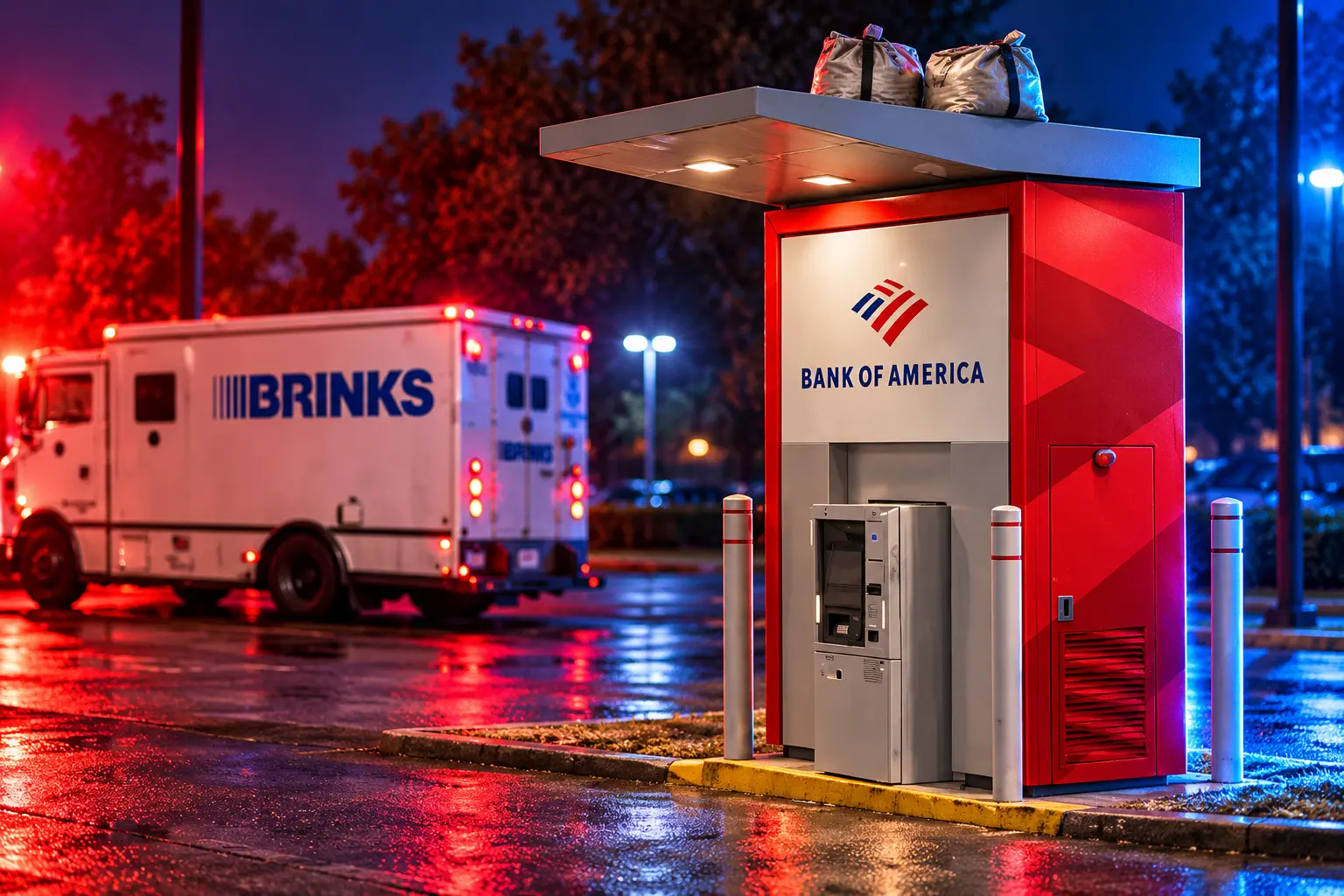
Brink’s Left the Load on a Public Machine
Police reports say the cash belonged to Bank of America and was in the hands of Brink’s, the vendor that moves and restocks ATM money. Investigators said a Brink’s technician serviced the machine, was supposed to take the funds, and left them on top of the ATM instead.
The bag was just sitting there. There was no indication of a crime occurring. It looked like it was just left there by accident.
Gina Miller, Lewisville police detective
Brink’s declined to discuss this stop. In a statement, the company said it does not, as a general practice, comment on law enforcement matters involving the safety of its employees or others. Bank of America later recovered the money and said it had thanked the man who brought it in.
That is the part of the case that does not fit on a feel-good poster. An armored-car run is built so a six-figure bag never sits on a public fascia at 10 a.m. When banks stop counting ATM cash themselves, the shortfall risk is supposed to move with the contract. Brink’s own ATM-managed-services guidance says liability for counting errors and cash-in-transit misses transfers to the vendor once notes are no longer handled in-house, which is why the unexamined service stop sits at the center of this story.
HOW THE LOAD IS SUPPOSED TO MOVE
- Cassette swap: Crews pull the existing cash cassettes and replace them with filled, verified ones rather than mixing new notes into old.
- Sealed units: Sealed, pre-counted cash cassettes are meant to cut manual counting at the machine and make a miss easier to spot.
- Idle cash: Parking extra bills in a machine raises the payout if someone tampers with it, so load size is supposed to track expected withdrawals.
- Audit trail: Third-party contracts are supposed to spell out who eats a discrepancy and how the paper trail is kept.
None of that describes a canvas bag left on the roof of the terminal. The barber became the control that the route did not have: a person who saw the load, did not keep it, and called the police before the next customer did something else with it.
Keeping $128,514 Would Have Been a Felony
Lewisville police said failing to return the cash could have been a felony-level theft. They did not file a charge, because he handed the bags over. The dollar figure still maps onto a specific rung of Texas law.
Under the Texas theft statute’s value ladder, taking property worth $30,000 or more but less than $150,000 is a third-degree felony. That band carries 2 to 10 years in prison and a fine of up to $10,000. $128,514 sits in that band by value. Felony theft in Texas starts much lower, at $2,500.
WHERE $128,514 SITS ON THE LADDER
| Value of the property | Grade | Prison or jail |
|---|---|---|
| $2,500 to under $30,000 | State jail felony | 180 days to 2 years |
| $30,000 to under $150,000 | Third-degree felony | 2 to 10 years |
| $150,000 to under $300,000 | Second-degree felony | 2 to 20 years |
| ATM or its contents, value under $300,000 | Second-degree felony | 2 to 20 years |
A separate clause, added when the Legislature raised the penalty for theft of an ATM or its contents, can make that taking a second-degree felony when the value is under $300,000. Police did not say they would have used that ATM clause here. The cash was on top of the machine after a service stop, not pried out of a cassette in a ram raid, and the department described the exposure only as felony-level theft.
Miller, who has taken in wallets and IDs from people who found them, said there is no “Finders keepers, losers weepers.” People have to do due diligence to return what they find, she said, or they can end up in trouble with the law. Texas theft still requires intent to deprive the owner. Walking off with a labeled bank bag, a receipt, and 19 checks is the fact pattern that makes that intent easy to argue.
Why the Bags Pointed to Chick-fil-A
The detour is the detail that keeps this from reading like a man who already knew the money was the bank’s. Markings on one bag sent him to a restaurant, not a branch. He put the load in a car, drove it, and offered it to a manager who had no claim on it.
Based on some of the contents of the bag, the citizen believed that it belonged to a Chick-fil-A down the road. So he took it to that Chick-fil-A in hopes of returning it to the rightful owner. It did not belong to that Chick-fil-A, so the citizen, with Chick-fil-A standing there, they went ahead and called 911 to have officers come and secure the money.
Brook Rollins, Lewisville police chief
Only after that stop did investigators tie the cash to Bank of America and Brink’s. Lewisville Police Chief Brook Rollins, appointed Feb. 1, 2024, said the man did not pause on the next step.
“This person didn’t blink. They took it directly to where they thought it was supposed to be,” Rollins said. He added that the man “just thinks it’s the right thing to do and doesn’t think it goes beyond that.”
A cash bag on an ATM at midmorning is also the kind of scene people treat as a camera test. The machine is built to record faces. The vendor’s crew is supposed to be on a logged route. Police still found no crime in the drop itself. The sting reading is a guess about incentives. The felony statute is the part that is written down.
Bank of America Recovered Every Dollar
By the time a detective picked up the report, Rollins said, the bank had already reached out, knew police had the cash, and was working to take it back. Bank of America recovered the $128,514. The department said the bank expressed its gratitude to the man who returned it.
Police did not pay him. He did not seek public credit. That gap is what a lot of the argument after the local interviews reduced the case to, as if the only open question were a thank-you check. The open operational question is still the one Brink’s would not answer: how a technician leaves a receipted load on the machine and drives away.
WHAT WE KNOW
- The owner: The cash belonged to Bank of America and was being handled by Brink’s.
- The count: The receipt, a hand count done twice, and a digital currency counter all read $128,514.
- The checks: A second bag held 19 checks and was secured with the cash.
- The crime screen: Police found no indication the drop was tied to a robbery or another offense.
WHAT IS UNCONFIRMED
- The technician: Police have not named the Brink’s worker or said what, if anything, the vendor did internally.
- The bag markings: Officials have not published the label that sent the finder to Chick-fil-A.
- A bank reward: Beyond thanks, Bank of America has not described any payment to the man.
Rollins also used the case to talk about the split in ordinary police work. “We are one half of the equation, the police; the other half is the community,” he said. He called a find of this size, unconnected to a crime, very unusual.
Lewisville Wants a Quiet Ceremony
The department wants to recognize him. He told interviewers he would attend a private ceremony if police honor him, and he still does not want his identity published. No date has been announced.
Miller put the scale in the only comparison she had. “I’ve never had a case like this before, ever,” she said. She has taken in wallets, IDs, and other found property. “But in the case of $128,000, I’ve never had somebody turn in that kind of money before.”
Rollins framed it as a wider habit, not a one-off saint. “There’s a lot of good people out there that really do want to do good. There’s more people than just this one person,” he said. The man still has not collected a public prize for proving that, and Brink’s still has not explained the stop that made the proof necessary.
The bags sat on a Bank of America ATM in Lewisville long enough for a barber to find them, drive them to a chicken restaurant, and call 911. Every counted dollar went back. The vendor that was supposed to be holding the load has had nothing public to add.
Frequently Asked Questions
Is Keeping Found ATM Cash a Crime in Texas?
It can be, if you mean to keep it from the owner. Texas has no statute titled finders keepers. Theft is the unlawful taking of property with intent to deprive the owner, and Detective Gina Miller said people who find property have to make a real effort to return it or they can face a charge. A labeled bank bag with a receipt is not anonymous park-bench cash.
What Felony Fits Theft of $128,514 in Texas?
By dollar value alone, $128,514 falls in the third-degree band of $30,000 to under $150,000, which is 2 to 10 years and a fine of up to $10,000. A different subsection can treat theft of an automated teller machine, or its contents or components, as a second-degree felony when the value is under $300,000. Lewisville police described the risk in this case only as a felony-level theft charge, and they filed none because the cash was turned in.
Who Bears the Loss When an ATM Bag Is Left Behind?
Once a bank outsources restocking, shortfalls are supposed to sit with the cash-in-transit firm under the contract, including counting errors and route mistakes. Brink’s publishes that transfer as a reason banks hire vendors, and it promotes cassette swaps so crews are not counting loose notes at the curb. In Lewisville, Bank of America still had to rely on a customer and the police property room to get $128,514 back.
Does Calling 911 Wipe Out a Theft Case for Found Cash?
Intent is the element prosecutors have to prove, and staying on the scene with restaurant staff while officers collect the bags is the opposite of hiding the property. Police said this caller was the person who dialed 911, and they treated the event as an accident by a vendor, not as a theft. Turning the money in does not create a reward right under the penal code; it keeps the finder off the value ladder.
Disclaimer: This article is news reporting on a completed Lewisville police case and on publicly available Texas theft law. It is for information only and is not legal advice, a prediction of how a prosecutor would charge a similar set of facts, or guidance on what to do if you find cash or checks. Readers who need advice about found property, a possible theft allegation, or a dispute with a bank or cash vendor should consult a licensed Texas attorney before acting. Dollar amounts, charge ranges, and case details reflect the police account and the statute text available when this was reported and can change with new filings or amendments.

Greed Held After a $697 Million Crypto Long Flush

Fed Minutes Keep a Year-End Rate Hike Alive

A Nanny-Cam Tape Follows Tyreek Hill Into Free Agency

Star Wars Galactic Racer Makes a Crash End the Tour

Amazon Puts Apple’s June MacBook Prices Back on Sale

Sophia Wootten Turns the Miss Georgia Crown Toward Cleft Care

The iPhone 16 Pro Flipkart Cut Did Not Last

Georgia Beach Bacteria List Leaves Swim Areas Open

Microsoft Prints Azure’s $29.42 Billion Quarter and Shrinks the Map

Little St. Simons Island Hatches Loggerheads at 72.4 Percent
-
 ENTERTAINMENT4 months ago
Sophia Wootten Turns the Miss Georgia Crown Toward Cleft Care
-
 NEWS1 year ago
The iPhone 16 Pro Flipkart Cut Did Not Last
-
 NEWS4 months ago
Georgia Beach Bacteria List Leaves Swim Areas Open
-

 BUSINESS2 months ago
UltraTech’s Ultravolt Launch Puts Cable Multiples on Trial
-
 NEWS3 months ago
Little St. Simons Island Hatches Loggerheads at 72.4 Percent
-
 NEWS2 months ago
Microsoft Prints Azure’s $29.42 Billion Quarter and Shrinks the Map
-

 NEWS10 months ago
IXI Autofocus Glasses Still Lack a European CE Mark
-

 NEWS3 years ago
Eyal Waldman Keeps a Two-State Bet After Gaza