
BUSINESS
Georgia’s 2025 Peach Crop Missed the 15 Percent Jump
Growers billed 2025 as a 15 percent Georgia peach rebound. USDA counted 35,700 tons, a lower price, and more fruit left unsold.

Georgia growers picked 35,700 tons of peaches in 2025, a crop that matched 2024 and missed the 15 percent jump they had sold in April. USDA’s May 2026 summary put utilized volume at 31,310 tons and the crop’s value at $52.149 million, down from $66.975 million the year before.
The fruit still reached East Coast stores. The check did not match the pitch.
The 15 Percent Jump Never Reached the Bin
In April 2025, Will McGehee of Genuine Georgia told buyers the winter had done its job. “It was cold enough through the winter for the trees to get proper dormancy, and the bloom in March was gorgeous. It’s been textbook peach growing weather,” he said, after a 2023 freeze that left the state with only 4,930 tons.
New orchards planted over five years were supposed to be in full production, and McGehee said yields would rise 15 percent from the year before. “We’re finally seeing the return on years of investment in new acreage,” he said. Hand-thinning crews spent April pulling two-thirds of the olive-sized fruit so the rest could size up, and harvest was booked to start around May 7 or 8, about a week early, with fruit aimed at store shelves within 36 hours.
That spring forecast of a bigger 2025 crop was the story growers took to retailers. USDA later counted a second solid year, not a bigger one, and the money moved the wrong way.
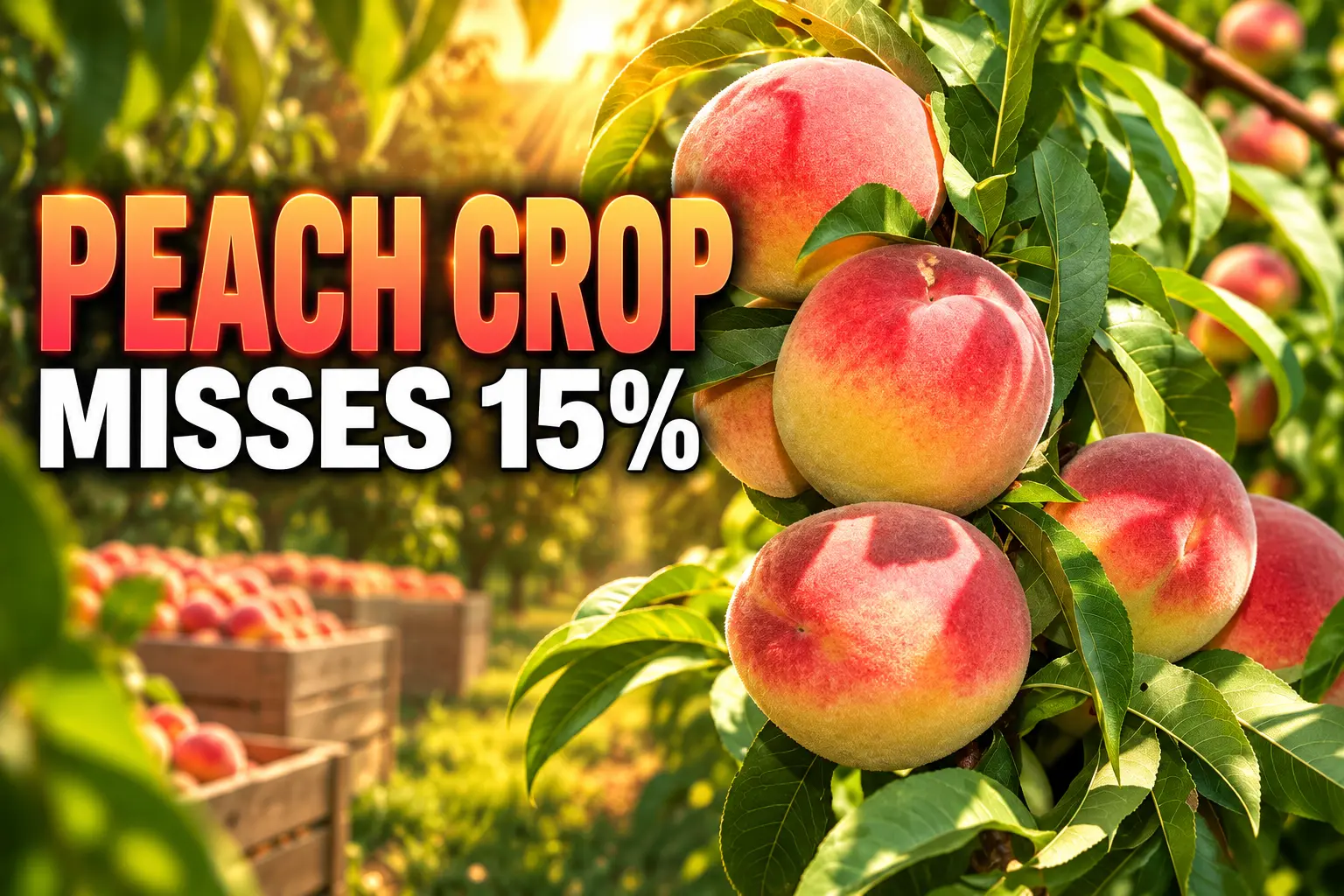
USDA Counted 35,700 Tons in 2025
The National Agricultural Statistics Service’s Noncitrus Fruits and Nuts 2025 Summary, issued in May 2026, is the closing book on that harvest. Bearing acreage slipped from 7,300 acres in 2024 to 7,000. Yield did rise, from 4.90 tons an acre to 5.10, a 4 percent gain that is a long walk from 15 percent. Production landed at 35,700 tons beside 35,800 the year before.
The state overview drawn from the same survey lists 35,700 tons of peaches in 2025 at $1,670 a ton. Utilized production, the fruit that actually sold, fell from 33,050 tons to 31,310. Fruit harvested and not sold rose from 2,750 tons to 4,390 tons.
GEORGIA PEACH TALLY, 2023 TO 2025
| Year | Bearing acres | Production (tons) | Utilized (tons) | Not sold (tons) | Price per ton | Crop value |
|---|---|---|---|---|---|---|
| 2023 | 7,700 | 4,930 | 4,790 | 140 | $2,200 | $10,534,000 |
| 2024 | 7,300 | 35,800 | 33,050 | 2,750 | $2,030 | $66,975,000 |
| 2025 | 7,000 | 35,700 | 31,310 | 4,390 | $1,670 | $52,149,000 |
The 2023 row is the freeze year everyone was trying to leave behind. The 2025 row is the year that was supposed to pay for the new trees. Value fell $14.826 million, or 22 percent, even though the bins were almost as full as in 2024.
South Carolina Still Ships More Than Twice as Much
The Peach State nickname still does marketing work that the orchards cannot. California produced 532,000 tons in 2025, split as 212,000 tons of clingstone and 320,000 tons of freestone. South Carolina, the East’s volume leader, produced 78,500 tons from 15,100 bearing acres, more than twice Georgia’s 35,700 tons from 7,000 acres.
South Carolina’s utilized crop was 64,760 tons, valued at $131.263 million, at $2,030 a ton. Georgia’s utilized crop was 31,310 tons at $1,670 a ton. Same fruit, same USDA table, a $360 gap per ton. South Carolina also left 13,740 tons harvested and unsold, so the Southeast had more peaches looking for a home than the April talking points implied.
Georgia does lead the country in pecans, a ranking the USDA overview makes obvious next to the peach line. The peach identity is older than the volume ranking, and it still sells a bag. It does not move 78,500 tons.
Why the 2025 Crop Paid $1,670 a Ton
Grower price slid from $2,030 a ton in 2024 to $1,670 in 2025, and the utilized crop shrank by 1,740 tons while 4,390 tons never sold. A bigger advertised harvest met a market that would not take all of it at the prior year’s money.
McGehee had already named the product he wanted on the shelf. “A juicy, sweet peach is what brings customers back,” he said, and he put freshness, not bulk, at the center of the Genuine Georgia pitch. About 30 percent of the 2025 crop was expected to move in pouch bags instead of bulk packs, a shift he said gave the state a place for branding and handling tips. Bags help a shopper grab fruit. They do not, by themselves, lift a $1,670 average.
Bearing acres also kept drifting down, from 7,700 in 2023 to 7,000 in 2025, even as the cooperative said planted acres had risen 35 percent over five seasons. Young trees and pulled blocks can both be true. USDA’s bearing count is the one that shows up in the bin.
Mexico Took 42,000 Pounds After 27 Years
The load that did change the map was small enough to count in pounds. On June 20, 2025, Georgia Agriculture Commissioner Tyler J. Harper said growers had shipped 42,000 pounds of Georgia peaches to Mexico, the first shipment in 27 years. Mexico has restricted southeastern peaches since 1994 over pest concerns. The fruit went through Reveam’s treatment plant in McAllen, Texas, which uses electron beams to kill pests without heat or chemicals, a USDA-approved process branded Electronic Cold-Pasteurization.
Forty-two thousand pounds is 21 tons. Set beside 31,310 tons sold at home, it is a market test, not a second crop. Harper called the partnership with Genuine Georgia and Reveam a way to open reliable markets. Chip Starns, Reveam’s co-founder and chief regulatory officer, said the process lets growers meet strict import rules without giving up flavor. Harper has pushed for a similar plant near the Port of Savannah; that site remained a long-term plan, not an open dock.
There are a lot of peach eaters in Mexico, and a lot of them would love to have those Georgia peaches. To give you a perspective of how many potential peach eaters are down there, you’ve got 22 million people in Mexico City and the surrounding areas. All of a sudden, we’re now bringing on another 20-plus million customers.
Duke Lane, president of the Georgia Peach Council, Georgia Department of Agriculture release
Lane’s customer math is the bet. Twenty-one tons will not fill Mexico City. A repeatable certificate might, if the next freeze leaves enough fruit to treat.
Fort Valley Hit 27 Degrees in March
The next freeze did not wait long. Jeff Cook, University of Georgia Cooperative Extension agent for Peach and Taylor counties, said a warm February and early March had the bloom about 10 days ahead when cold arrived. The UGA Weather Network recorded 83 degrees in Fort Valley on March 11, 2026, then 27 degrees on March 18.
“What I saw initially, it’s going to be an impact on some early stuff. It really depends on where you were and how low you got,” Cook said in late March. Trees that had already bloomed took the hit. He was still seeing sprayers in the rows, a contrast with 2023, when he said it was hard to find a peach sprayer running because there was nothing left to protect.
FREEZE YEARS THAT CUT THE CROP
- 2017: A spring freeze cuts about 80 percent of Georgia’s peach crop, according to Dario Chavez, a University of Georgia horticulture professor.
- 2023: After a warm winter and March freezes, USDA records 4,930 tons, a 0.64-ton yield on 7,700 acres, with growers talking about 90 percent or greater losses.
- April 2025: McGehee calls the winter textbook and forecasts a 15 percent yield increase; harvest is set for about May 7 or 8.
- June 20, 2025: Harper announces the 42,000-pound Mexico shipment through Reveam’s McAllen plant.
- March 18, 2026: Fort Valley falls to 27 degrees after an 83-degree reading a week earlier, and early varieties go sporadic.
- July 2, 2026: Cook says packing sheds are moving at a normal pace, with seven refrigerated trucks at one dock, after a sluggish, smaller early set.
By early July, Cook said crews had to search for early fruit and that size was off, then the midseason volume filled in. “I feel like we’re rolling about like normal now,” he said. He expected picking to run through the end of July into the first week of August.
Robert Dickey, co-owner of Dickey Farms in Crawford County, said the March frost hurt a lot of early fruit, then the mid and late varieties came in loaded. The farm, which times about 30 varieties across the summer, wrapped its season in late July, about 10 days early. “I’m proud of the quality,” Dickey said of the fruit that made it.
WHAT WE KNOW
- Early fruit: The mid-March 2026 cold cut early varieties and left quality and size uneven at the start of harvest.
- Midseason pace: Cook reported a normal packing tempo by July 2, 2026, with volume high enough to put seven trucks at a shed.
- Not 2023: Sprayers kept running in April 2026, and Dickey still had a full mid and late crop to pick.
WHAT IS UNCONFIRMED
- 2026 tonnage: USDA’s Georgia overview posted on October 3, 2026, still carries 2025 peach totals; no official 2026 production figure is in that table.
- Bag share: The 30 percent pouch-bag target was an April 2025 expectation, not a closing packout number from USDA.
Rain after the freeze added a quieter tax. Through summer 2026, orchard notes kept returning to bacterial spot, anthracnose, and phony peach disease, the kind of wet-weather problems that nibble a crop after a cold night has already taken the early fruit. Trucks still met buyers as far as Florida in July, so the season existed. It was a shorter, messier one than the 2025 brochure.
Four Farms Still Betting on Bags and a Brand
Genuine Georgia formed in 2015 so family operations that used to bid against each other could sell as one. McGehee said the group got stronger with every major retailer it added. The cooperative says it has a working relationship with all four commercial peach farms in Georgia, a small map for a state nickname.
THE FOUR FARMS BEHIND GENUINE GEORGIA
- Pearson Farm: Fort Valley, in the historic middle-Georgia belt, among the families that built the co-op’s peach brands.
- Lane Southern Orchards: Fort Valley, tied to Duke Lane, who also speaks as president of the Georgia Peach Council.
- Dickey Farms: Musella, in Crawford County, where Robert Dickey packed the 2026 mid and late fruit that survived March.
- Fitzgerald Fruit Farms: Woodbury, the fourth commercial partner on the cooperative’s own farms list.
Those four names are the industry the 15 percent forecast was built on. They pack for East Coast chains, they paid for Reveam’s Mexican test, and they still thin by hand. When the bloom is clean, they can fill seven trucks. When Fort Valley hits 27 degrees, they wait to see which variety is still a peach.
Dickey’s last 2026 picks came off about 10 days early, with the late fruit he called some of the farm’s best. USDA has not yet written a 2026 tonnage next to the 35,700 tons it logged for 2025, the year that was supposed to be the juicy one.

Gold Lost 3% After the Jobs Print It Usually Wants

XRP’s $31.87 Target Is a $2 Trillion Market Bet

Mortgage Rates at 7.28% Push Buyers Into Adjustable Loans

Six Ex-Bills Return as Patriots Open New Highmark

Gulf Oil Recovered by Skipping the Strait of Hormuz

Microsoft Prints Azure’s $29.42 Billion Quarter and Shrinks the Map

UltraTech’s Ultravolt Launch Puts Cable Multiples on Trial

IXI Autofocus Glasses Still Lack a European CE Mark

The iPhone 16 Pro Flipkart Cut Did Not Last

Little St. Simons Island Hatches Loggerheads at 72.4 Percent
-
 NEWS1 month ago
Microsoft Prints Azure’s $29.42 Billion Quarter and Shrinks the Map
-
 BUSINESS1 month ago
UltraTech’s Ultravolt Launch Puts Cable Multiples on Trial
-
 NEWS9 months ago
IXI Autofocus Glasses Still Lack a European CE Mark
-
 NEWS1 year ago
The iPhone 16 Pro Flipkart Cut Did Not Last
-
 NEWS3 months ago
Little St. Simons Island Hatches Loggerheads at 72.4 Percent
-

 BUSINESS3 months ago
Georgia Furniture Mart Closes a Growing 40-Year Business
-
 LIFESTYLE3 years ago
What is a Corpak Feeding Tube: A Comprehensive Guide
-

 NEWS3 years ago
Eyal Waldman Keeps a Two-State Bet After Gaza