
NEWS
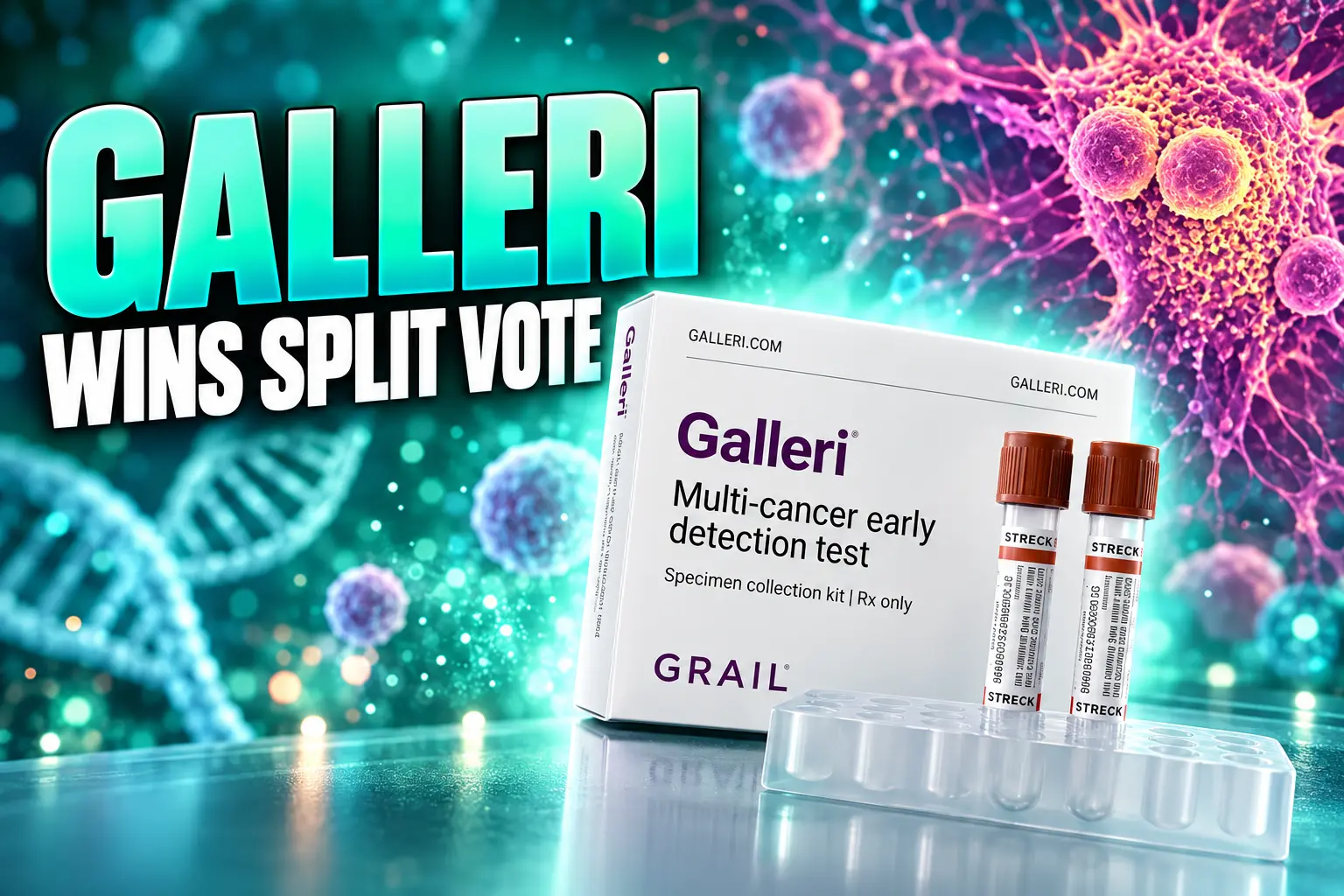
Galleri Wins a Split FDA Vote, Not a Death Record
Advisers split 6-4 on whether Galleri works, while a 2028 Medicare path is already law and a UK trial missed its late-stage cancer goal.

GRAIL’s Galleri multi-cancer blood test won a split endorsement from FDA advisers on September 23, 2026, the first panel vote on a blood test meant to screen adults 50 and older for many cancers at once.
The vote is advice, not approval. It still moves a $949 prescription test that missed most cancers in two large studies closer to everyday screening, and closer to a Medicare benefit Congress already set to open in 2028.
A 6-4 Vote on Whether the Test Works
The Molecular and Clinical Genetics Panel of the Medical Devices Advisory Committee met in a hybrid session from 9 a.m. to 6 p.m. ET. Ten members voted. GRAIL, based in Sunnyvale, Calif., had filed a premarket approval application on January 29, 2026, for a prescription-only next-generation sequencing test that reads cancer-linked methylation patterns on DNA in blood and names a likely organ of origin when a signal appears.
The FDA asked three questions. Is there reasonable assurance the test is safe in the proposed group? Is there reasonable assurance it is effective? Do the benefits outweigh the risks?
THE THREE PANEL TALLIES
| Question | Yes | No | Abstain |
|---|---|---|---|
| Reasonable assurance of safety | 10 | 0 | 0 |
| Reasonable assurance of effectiveness | 6 | 4 | 0 |
| Benefits outweigh risks | 7 | 2 | 1 |
Josh Ofman, GRAIL’s chief executive, said after the September 23 advisory committee meeting that the vote “reinforces the strength of Galleri’s clinical evidence” and that the company would keep working with the agency on what it called the first PMA for a multi-cancer test. He also said more than 200 physicians, nurses, societies, patients, and advocates had written in support. The FDA designated Galleri a Breakthrough Device in 2018. It is not bound by the panel.
Stanley Lipkowitz, a senior investigator at the National Institutes of Health, voted no on effectiveness.
we don’t have that data.
Stanley Lipkowitz, senior investigator, National Institutes of Health, on patient outcomes
He warned that clearing the test without outcome proof would set a bar for every similar product that follows.
What PATHFINDER 2 Measured in 32,007 Adults
The day before the vote, investigators published the North American PATHFINDER 2 study in Nature Medicine. They enrolled 35,878 adults 50 and older with no suspected cancer between December 8, 2021, and July 10, 2024 (NCT05155605). Performance was judged in 32,007 people with a completed 12-month cancer check. Safety was judged in 35,335.
Among those 32,007, 287 people (0.9%) got a cancer-signal result and 173 of them were diagnosed with cancer in the next year, a 60.3% positive predictive value. That leaves 114 people whose alarm did not become a cancer diagnosis in 12 months. Specificity was 99.64%. Negative predictive value was 99.2%. The cancer detection rate was 0.54%. The number needed to screen to find one cancer was 185.
Twelve-month episode sensitivity, the share of cancers diagnosed in that year that the first blood draw had flagged, was 39.3% for all cancers and 69.8% in a preset group of 12 cancers that cause about two-thirds of U.S. cancer deaths. In plain terms, the published study missed about 61% of cancers that showed up within a year. The test named the right region of the body in 91.3% of true-positive cases.
Of first new primary cancers the test found, 80 of 151 (53.0%) were stage I or II and 107 of 151 (70.9%) were stage I to III. Investigators reported that 72.8% of detected cancers were types without U.S. Preventive Services Task Force grade A or B screening. In the United States, only 14% of cancers are found by guideline screens, and more than 70% of cancer deaths come from cancers that have no such test.
On safety, 213 people (0.6%) had an invasive procedure after a positive result, and 90.5% of those procedures were not surgery. No serious study-related adverse events were on the books at the analysis lock. Nima Nabavizadeh, a radiation oncologist at Oregon Health & Science University who worked on the study, said a positive Galleri result means “at least a 60% chance a cancer will be found.”
FDA staff did not vote on that published paper alone. GRAIL’s commercial Galleri assay was run later on stored samples from PATHFINDER 2 and from the English trial. That retest, which the panel actually reviewed for effectiveness, produced different figures: 35.0% 12-month sensitivity, 99.85% specificity, 77.0% positive predictive value, and 94.3% origin accuracy in PATHFINDER 2, and 31.6% sensitivity, 99.74% specificity, 66.2% positive predictive value, and 91.9% origin accuracy in NHS-Galleri. Those are separate analyses of a later assay, not a second reading of the same table.
PUBLISHED STUDY VS FDA RETEST PACKAGE
| Metric | PATHFINDER 2, published study | NHS-Galleri, FDA briefing |
|---|---|---|
| 12-month episode sensitivity | 39.3% | 31.6% |
| Specificity | 99.64% | 99.74% |
| Positive predictive value | 60.3% | 66.2% |
| Cancer signal origin accuracy | 91.3% | 91.9% |
Galleri is already sold in the United States as a lab-developed test, without FDA approval, at a $949 list price. A $799 self-pay rate is the discounted cash price GRAIL offers when the bill goes to the patient. The company says the test should sit beside mammograms, colon screening, cervical tests, and lung scans, not replace them, and that a negative result does not rule out cancer.
The NHS Trial That Missed Its Main Goal
The harder evidence problem sat in England. NHS-Galleri (NCT05611632), funded by GRAIL, assigned 71,122 people ages 50 to 77 to have their blood tested and 71,128 to a control arm whose blood was stored, a randomized trial of more than 142,000 adults with up to three yearly draws. The primary end point was stage III or IV cancer among 12 preset types after three rounds.
In this trial, we did not observe a lower incidence rate of stage III or IV cancers across 12 prespecified cancers after three screening rounds with multicancer early-detection testing plus usual care than with usual care alone.
NHS-Galleri investigators, New England Journal of Medicine, September 22, 2026
The incidence rate ratio was 1.03 (0.92 to 1.14, P=0.63). Counts in that 12-cancer group were 706 stage III or IV cancers in the tested arm and 688 in control. A key secondary end point, stage IV in the same 12 types, had an incidence rate ratio of 0.86 (0.74 to 1.00), about 14% lower after three rounds. GRAIL’s fact sheet for the trial put the stage IV drop at 26% in the third round for those 12 cancers. Stage I and II cancers in the group were 16% higher (647 versus 559). GRAIL has also said adding the test quadrupled screen-detected cancers against usual care in England.
Richard Houlston, head of cancer genomics at the Institute of Cancer Research, said the trial “failed its primary endpoint since late stage cancer rates were essentially the same with or without the test,” and that it “missed most early cancers.” A missed late-stage target can sit next to a later-round drop in stage IV. Both can be true, and neither is a count of deaths avoided. The trial reported trial-related adverse events in less than 1% of people, none serious. Mortality results are still to come, about two years after the primary analysis.
FDA staff told the panel the 31.6% 12-month sensitivity in NHS-Galleri meant the test did not flag about two of every three cancers diagnosed in the following year. Sensitivity rose by stage, from 13.6% to 21.4% for stage I up to 60.0% for stage IV. That pattern is why several advisers balked at calling the product an early-detection test even as they voted yes on other questions.
A Positive Result Starts Imaging and Biopsies
A “Cancer Signal Detected” result is not a diagnosis. It is a reason to hunt, guided by the predicted origin, through scans, specialist visits, and sometimes tissue sampling. In PATHFINDER 2, most follow-up tests were not invasive, and origin guidance was used in 87.6% of evaluations after a positive. Four people labeled false-positive at first later had cancer in the 12-month window.
WHAT FOLLOWS A POSITIVE GALLERI RESULT
- Imaging first: Doctors typically start with scans aimed at the predicted organ, then widen the search if those are clean.
- Tissue next: 0.6% of people in the safety set had an invasive procedure after a positive, most of them nonsurgical.
- Time in limbo: Cancer was confirmed in 60.3% of positives in the published study, so about 4 in 10 positives had no cancer found in a year.
- A negative is not a pass: The proposed label says a negative result does not rule out cancer, and standard screens still apply.
- Cost beyond the draw: The $949 list price does not cover the scans, visits, or biopsies that a positive can trigger.
Colin Pritchard, a professor and cancer researcher at the University of Washington, said the test may help people at high risk, including those with a strong family history, and that false positives in people at low risk can lead to costly imaging and biopsies. He called for more work on who should be offered the test and on rules for what happens after a positive.
Ajay Goel, professor and chair of molecular diagnostics and experimental therapeutics at City of Hope, called the vote “an encouraging step rather than the final word on the clinical value of this type of testing.” He said the aim is not only to find more cancers but to find them early enough to change what happens to the patient, and that longer evidence is still needed on fewer advanced cancers and fewer deaths. If the FDA clears Galleri, he said, it should be an extra tool, not a stand-in for established screening.
False reassurance is the other risk FDA staff put on the table. People who treat a negative Galleri result as a full-body all-clear may skip a mammogram or a colonoscopy. Panelists also flagged consumer ads and overuse in older patients, who already face more incidental findings on scans.
The 2028 Medicare Clock and the Age-68 Limit
The commercial prize is not a one-time panel vote. It is who pays. Traditional Medicare does not cover Galleri now. Some Medicare Advantage plans have begun to offer it as an extra, with copays. TRICARE has covered the test for some eligible people 50 and older at higher cancer risk.
On February 3, 2026, the Nancy Gardner Sewell Medicare Multi-Cancer Early Detection Screening Coverage Act became law as part of the Consolidated Appropriations Act, 2026. The statute creates a Medicare benefit category for a multi-cancer blood test that is FDA cleared or approved and that CMS finds appropriate. Coverage may begin with Medicare coverage on or after January 1, 2028. In 2028 the age specified is 68, then it rises by one year each year after that, and a person may not have had the same kind of test in the previous 11 months.
That age cap matters because GRAIL’s proposed FDA use is adults 50 and older. A clearance for 50+ would still leave a gap of many Medicare years before the statutory age even opens, and CMS still has to write coverage terms. The law was named for Nancy Gardner Sewell, the mother of Rep. Terri Sewell of Alabama, who died of pancreatic cancer in June 2021, the kind of cancer that has no routine population screen.
Price will sit in that fight. GRAIL’s list is $949. Rival multi-cancer products are already shopping different cash rates, including Exact Sciences’ Cancerguard at $689. Without FDA approval, most commercial plans still do not pay. With approval, the next argument is whether finding extra cancers, many of them types that lack a screen, is “reasonable and necessary” when a UK randomized trial did not cut combined stage III and IV disease.
Why Panelists Questioned the Word Early
Support on the panel clustered around cancers that have no mammogram equivalent: pancreas, ovary, liver, and other hard-to-screen sites. Several members who voted yes still said they had reservations. They asked the agency to keep the product an add-on, to write plain-language labels, to train clinicians, and to demand post-approval studies on deaths, on whether false results change adherence to old screens, and on how the test behaves in subgroups.
The word “early” became a drafting problem. FDA staff noted that Galleri found 13.6% to 21.4% of stage I cancers and did better as stage rose. Panelists said “early” means different things in different tumors, and that a test which is more sensitive in late disease should not wear that word as a slogan. Discussion at the meeting included dropping or hedging “early detection” in the indication, even if the product still screens for many cancers at once.
Ofman said Galleri was built “to improve the effectiveness and efficiency of our national cancer screening program by adding multi-cancer early detection to recommended screening,” and to find more cancers “when they may be easier and less costly to treat.” GRAIL also says studies have found about four to seven times more cancers than standard screening alone, with a low false-positive rate. Those detection claims are the company’s case. They are not the same as a drop in cancer deaths.
The FDA Still Holds the Final Decision
THE PATH TO A YES OR A NO
- 2018: FDA grants Galleri Breakthrough Device designation.
- 2021: GRAIL begins selling the test as a lab-developed product without FDA approval.
- December 8, 2021: PATHFINDER 2 enrolls its first participant.
- January 29, 2026: GRAIL files the premarket approval application.
- February 3, 2026: Congress creates a Medicare MCED benefit that cannot start before 2028.
- February 19, 2026: GRAIL reports that NHS-Galleri did not hit its stage III/IV primary end point.
- September 22, 2026: PATHFINDER 2 and the NHS-Galleri trial appear in the medical literature.
- September 23, 2026: The advisory panel records its three votes.
GRAIL said the FDA is expected to decide in the coming months. Device law does not require a mortality trial before approval, which is why advisers who wanted death data still had to vote on safety, effectiveness, and benefit-risk as written. Post-market studies are the usual place that gap goes if the agency says yes.
A clearance would not, by itself, put Galleri on every 50-year-old’s lab slip. It would change the test from a cash product with a $949 list price into something insurers, including Medicare after 2028 and after an age-68 phase-in, would have to take seriously. Primary-care clinics would then have to explain a 39.3% published sensitivity, a 60.3% chance that a positive is cancer in a year, and a UK trial that did not lower combined late-stage diagnoses. The PMA file is still open. CMS has not written coverage. The death counts are not in.
Disclaimer: This article is news reporting on an FDA advisory vote, published trials, and a Medicare statute. It is informational only and is not medical advice, a screening recommendation, or a judgment on whether any person should buy, skip, or wait for the Galleri test. Readers should talk with a licensed physician, oncologist, or other qualified clinician who knows their history before ordering a multi-cancer blood test or changing usual cancer screening. Vote tallies, study figures, prices, and coverage rules are those given by GRAIL, the FDA, trial papers, and the statute cited here, and they can change as the agency finishes its review and as CMS later writes payment policy.

Gold Lost 3% After the Jobs Print It Usually Wants

XRP’s $31.87 Target Is a $2 Trillion Market Bet

Mortgage Rates at 7.28% Push Buyers Into Adjustable Loans

Six Ex-Bills Return as Patriots Open New Highmark

Gulf Oil Recovered by Skipping the Strait of Hormuz

Microsoft Prints Azure’s $29.42 Billion Quarter and Shrinks the Map

UltraTech’s Ultravolt Launch Puts Cable Multiples on Trial

IXI Autofocus Glasses Still Lack a European CE Mark

The iPhone 16 Pro Flipkart Cut Did Not Last

Little St. Simons Island Hatches Loggerheads at 72.4 Percent
-
 NEWS1 month ago
Microsoft Prints Azure’s $29.42 Billion Quarter and Shrinks the Map
-
 BUSINESS1 month ago
UltraTech’s Ultravolt Launch Puts Cable Multiples on Trial
-
 NEWS9 months ago
IXI Autofocus Glasses Still Lack a European CE Mark
-
 NEWS1 year ago
The iPhone 16 Pro Flipkart Cut Did Not Last
-
 NEWS3 months ago
Little St. Simons Island Hatches Loggerheads at 72.4 Percent
-

 NEWS3 years ago
Eyal Waldman Keeps a Two-State Bet After Gaza
-

 BUSINESS3 months ago
Georgia Furniture Mart Closes a Growing 40-Year Business
-
 LIFESTYLE3 years ago
What is a Corpak Feeding Tube: A Comprehensive Guide