
BUSINESS
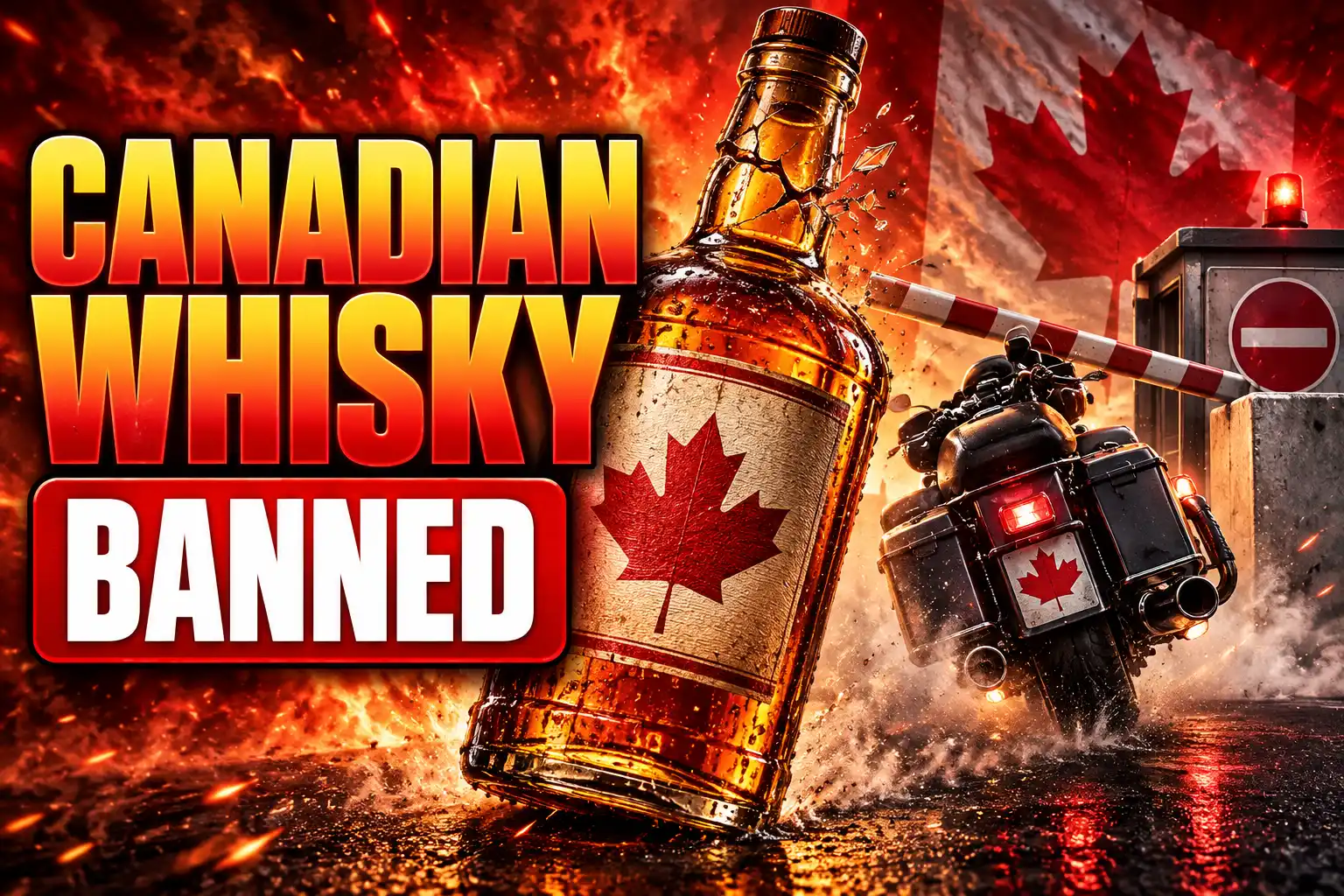
Washington Turns Canadian Whisky and Bikes Away at the Border
US import bans on Canadian whisky, beer and motorcycles start September 29, locking out a thin slice of trade while federal buying and Ottawa’s pivot cut deeper.

President Donald Trump signed five orders on September 8 that will bar many Canadian alcoholic drinks, motorcycles and whey from the US market on September 29. The lockout landed hours after Canada’s matching tariffs on about $20 billion of American goods took effect, and after Prime Minister Mark Carney told the country a pivot away from its largest customer would come at a cost.
Both capitals still say they want a deal. No new talks are on the calendar, and the orders do more than raise a duty. They shut selected Canadian goods out of the US market, then tell federal buyers to drop Canadian-origin products from long-term schedules.
Five Proclamations Turn a Tariff Fight Into a Lockout
The White House posted five proclamations under Section 338 of the Tariff Act of 1930. Three convert some of the 50 percent duties imposed in July into outright import bans. Two rewrite the remaining duty list, pulling off goods such as rock salt and cement and putting on others, from all-terrain vehicles to more cheese.
The bans take effect at 12:01 a.m. eastern time on September 29. The duty swaps take effect at 12:01 a.m. on September 15. Covered goods face the extra 50 percent even if they qualify under the US-Mexico-Canada Agreement, and the extra duty stacks on top of Section 232 metals and auto tariffs.
A senior administration official said the bans were sized to a trade flow in the single-digit billions of dollars, and that the $20 billion pool already under the July duties stays about the same after the swaps. That is a thin slice of bilateral trade. The legal change is not. A 50 percent duty still lets a shipment clear if the buyer will pay. A ban does not.
HOW THE NEW ORDERS SPLIT THE LIST
| Action | Starts | What it covers |
|---|---|---|
| Import ban | Sept. 29, 12:01 a.m. ET | Beer, wine, cider, whiskies and other spirits, motorcycles, whey, molasses, non-alcoholic beer |
| 50% duty added | Sept. 15, 12:01 a.m. ET | ATVs, more cheese and dairy lines, motorboats, golf carts, some furniture and mattresses, some aluminum and iron |
| 50% duty removed | Sept. 15, 12:01 a.m. ET | Rock salt, cement, toilet paper, fishing rod parts |
The White House said it chose items where Canada has low import penetration in the United States, or where US plants and other suppliers can fill the gap. That is why a ban can look small in the trade accounts and still wipe out a given exporter’s US book.
Provincial Liquor Boards Closed the Door First
Washington is not inventing a new tool so much as copying one Canadian provinces have used for 18 months. Beginning in March 2025, provincial liquor boards stopped buying, stocking or selling US beer, wine and spirits. Alberta and Saskatchewan later put US bottles back on the shelf. Ontario’s LCBO, one of the world’s largest alcohol buyers, did not. Quebec’s SAQ kept its boycott too.
A White House fact sheet in July said Canadian imports of US alcoholic drinks fell about 81 percent, or $582 million, from March 2025 through February 2026, dropping from about $718 million to about $137 million. Shipments from other countries rose by about $170 million over the same stretch. The provinces did not apply the same halt to bottles from Europe, Australia or anywhere else.
That unequal treatment is the finding the alcohol proclamations rest on. Saskatchewan, one of the two provinces that still sold US liquor, then added a 50 percent levy on American alcohol effective September 8. The new US alcohol order cites Premier Scott Moe’s levy by date as proof that Canada “maintained the discrimination and announced additional retaliation.”
THE DATES THAT GOT BOTH SIDES HERE
- March 4, 2025: The LCBO stops buying US alcohol and pulls it from stores; Quebec asks the SAQ to do the same.
- July 20, 2026: Trump signs three Section 338 proclamations setting a 50 percent duty on about $20 billion of Canadian goods, about 5 percent of US imports from Canada.
- August 18, 2026: A three-day pause holds the duties after Canada signals it will move on the cited barriers.
- August 21, 2026: Talks collapse. Carney suspends negotiations, saying last-minute US terms were “unfair, uneconomic, and called into question the reliability of any deal.”
- August 22, 2026: The pause lapses. The 50 percent duties take effect. USTR Jamieson Greer says Canada “declined to finalize the trade deal” despite an offer of “the best treatment of any major exporter to our market.”
- September 8, 2026: Canada’s 15 to 50 percent duties on about $20 billion of US goods take effect. Carney records a pivot address. Trump signs the five new orders that evening.
A senior official briefing reporters after the signing put the choice in one line: Canada had already banned US bottles, so Washington would ban Canadian ones.
Canada set this precedent of banning things.
Senior Trump administration official, White House briefing, September 8, 2026
The same official grouped Canada with China as the only two countries that answered Trump’s tariff campaign with bans rather than a deal. That is the White House’s ledger, not a court finding. It is also the logic of the new orders: once a neighbor treats a product as contraband, a duty starts to look like a half measure.
What the Ban Hits, and What Still Faces 50%
The lockout is narrower than the July duty lists, which ran to 52 dairy tariff lines, 63 alcohol and related lines, and 439 motor-vehicle-linked lines. Whey, cane and invert molasses, and non-alcoholic beer are excluded from importation on September 29. Cheese is not banned. It is being added to the 50 percent list. Early posts that said “all dairy” overran the annexes.
GOODS THE US WILL REFUSE AT THE BORDER
- Malt beer and cider: Canadian beer made from malt, plus cider, cannot enter on or after September 29.
- Wine and sake: Still and sparkling wine, plus sake, sit on the exclusion list with the spirits.
- Whiskies and white spirits: Whiskies, rum, gin, vodka, brandy, tequila and mezcal of Canadian origin are barred.
- Motorcycles and mopeds: Two-wheel and moped lines move from a 50 percent duty to a ban.
- Whey and molasses: Whey products and cane or invert molasses are pulled off the dairy duty list and shut out.
- Non-alcoholic beer: The zero-alcohol line is banned alongside the malt beer it mimics.
Furniture, mattresses, paper, some aluminum and iron, motorboats, golf carts and switchboards stay in the taxed column, some of them newly so. The administration is not trying to embargo Canada. It is picking products whose US buyers can switch, then using the exclusion power the 1930 statute gives when a foreign government “maintains or increases” the cited discrimination.
Crown Royal and the Export That Has Nowhere Else to Go
Spirits are where a “modest” headline meets a concentrated industry. Statistics Canada recorded $945 million of Canadian spirits shipments to the United States in 2025, about half of the country’s $2 billion in liquor output. Whisky was $311 million of that. Liqueurs and cordials were $545 million. Gin, rum and vodka were much smaller. Cal Bricker, chief executive of Spirits Canada, called the July 50 percent duty an “existential threat” when it was announced, and said that if any North American trade still looked like free trade, it was spirits.
Diageo’s Crown Royal, distilled in Gimli, Manitoba, is the brand most exposed. More of it is sold in Texas than in all of Canada, a split the trade group has used for years as proof that the US shelf is the business. A 50 percent duty already priced those bottles up. A ban takes them off the shelf. US bars and retailers that built lists around Canadian rye lose the product, not just a margin.
Canadian motorcycle plants sit in the same bind. BRP’s Can-Am three-wheelers and electric bikes are the Canadian machines Americans actually buy. The company had already cut its expected US tariff hit to C$200 million for the fiscal year after earlier metals duties. An import ban on motorcycles is a different problem from a metals tax on a Sea-Doo. The US has Harley-Davidson and a deep used-bike market. Can-Am does not have a second United States.
THE ALCOHOL CHANNEL IN ONE PASS
- US bottles into Canada: Down about 81 percent, or $582 million, in the first year of the provincial halt.
- Canadian spirits into the US: $945 million in 2025, about half of national output.
- Saskatchewan still selling US liquor: Sales down about 40 percent even without a ban, before the 50 percent levy.
- Ontario’s leftover stock: About $80 million of US alcohol remains in LCBO warehouses, unsold.
The closed loop is the point people in the drinks trade keep returning to. Canada already took US bourbon and vodka off its government shelves. Washington is now taking Canadian whisky off US shelves. Each side can say it is only matching the other. Each side’s distillers lose the customer they cannot replace in 21 days.
A 1930 Law Unused Until This Year
The vehicle for all of this is Section 338 of the Tariff Act of 1930, the Smoot-Hawley statute. It lets a president add duties of up to 50 percent when another country disadvantages US commerce relative to someone else’s, and it lets him exclude goods if that country keeps or raises the discrimination. No president had used it to impose a tariff. There are no implementing rules in the Code of Federal Regulations and no court cases to parse the text.
July’s three findings were specific. On dairy, Canada’s cheese quotas under the USMCA are tighter for US exporters, and less useful to retailers, than the quotas the European Union won in CETA. On cars, Ottawa’s 2025 surtax put a 25 percent tariff on US-origin vehicles and left every other country’s cars alone; US vehicle exports to Canada then fell about 22 percent, or $5.6 billion, from $25.9 billion to $20.3 billion, while Mexico, Japan, South Korea and Germany gained volume. On alcohol, the provincial boycotts hit only the United States.
The United States, the July fact sheet said, “did not agree to renew the United States-Mexico-Canada Agreement (USMCA) in its current form.” The new bans apply whether or not a good would have been duty-free under that pact. Mexico stays inside a living trilateral deal. Canada is being pulled onto a 96-year-old statute that was written before most-favored-nation rules, and that treats a neighbor the way the law treats any country that discriminates.
Deborah Elms of the Hinrich Foundation said the language in the new proclamations is “not helpful in getting to the negotiating table,” and that the larger question is what it will take for the two sides to sit down again. A senior US official said contacts with Canadian officials continue and that conversations in the coming days were possible. Greer said in August that no new talks were planned.
Carney Is Pricing a Pivot While Most Exports Still Go South
Carney’s video, released Tuesday under the title “Forward Guidance: A Stronger Canada,” went out after midnight tariffs and before the evening bans. It was not a reply to the lockout. It was the speech he had already written about why Canada would pay to leave the old pattern.
That pivot will come at a cost. There’s always a cost to action. But it doesn’t come close to the cost of standing still.
Mark Carney, Prime Minister of Canada, Forward Guidance video, September 8, 2026
He said Canada has “everything we need to pivot and prosper,” that non-US exports are “on track to double over the next decade,” and that the aim is a country “no country can ever hold us hostage.” On Labour Day he had already called the US measures unjustified and unprovoked tariffs from the United States. The government is starting with $7.5 billion in new help for firms and workers in the line of fire.
Canadian and US government data show Canada has shipped almost 68 percent of its total exports to the United States this year, and that about 80 percent of those goods still moved duty-free under USMCA. More than two-thirds is the structural fact Carney is asking voters to outgrow. Doubling non-US exports in a decade does not replace a spirits customer that takes half the industry’s output, and it does not replace it before September 29.
That gap is what the diversification line cannot cover. A distiller in Gimli or a Can-Am line in Quebec can be told to find buyers in Europe. Those buyers are not waiting with empty warehouses and a three-week clock. The political wager is that the cost of taking the hit now is lower than the cost of signing a deal Carney has already called unreliable. The commercial wager is that the US shelf comes back. Those two bets do not mature on the same day.
The $50 Billion Cut in Federal Purchasing
The quieter order may move more money than the whisky ban. Trump directed the US Trade Representative and the General Services Administration to take $50 billion of Canadian-origin products off GSA’s Multiple Award Schedules, the catalogues federal agencies use for long-term buying, until Canada allows “full and fair reciprocity.” He also told GSA to declare Canadian products ineligible for large, long-term government contracts on the same condition.
That cutoff does not show up in a customs annex. It hits firms that sell into US agencies rather than into grocery aisles, and it lasts until a political test is met. Auto plants already face a separate threat: Trump has said he will lift tariffs on all Canadian cars, trucks and parts to 50 percent on January 1, 2027, if there is no deal.
The bans still have 20 days to be walked back, delayed or trimmed in the Federal Register. The September 15 duty swaps can be rewritten the same way they were rewritten this week. What is already in force is Canada’s matching tariff, the July 50 percent duties, the provincial liquor boycotts, and a USMCA the White House has said it will not renew as it stands. What starts on September 29 is a closed door on Canadian whisky, beer, wine and bikes, unless someone reopens talks that neither side has put on the schedule.

Washington Turns Canadian Whisky and Bikes Away at the Border

Russia and North Korea Open a Bridge Built for 300 Vehicles

Super El Niño Drought Threatens Amazon Rain and Brazilian Power

Macklemore Told MetLife He Took Sheeran’s Tour to Speak

Indiana Fever Title Odds Slide Despite a Record Offense

Microsoft Prints Azure’s $29.42 Billion Quarter and Shrinks the Map

UltraTech’s Ultravolt Launch Puts Cable Multiples on Trial

What is a Corpak Feeding Tube: A Comprehensive Guide

Home-Grown Education: An Insight into Homeschooling

How a Tech CEO Manages His Company from the Battlefield
-
 NEWS2 weeks ago
Microsoft Prints Azure’s $29.42 Billion Quarter and Shrinks the Map
-
 BUSINESS2 weeks ago
UltraTech’s Ultravolt Launch Puts Cable Multiples on Trial
-
 LIFESTYLE3 years ago
What is a Corpak Feeding Tube: A Comprehensive Guide
-
 NEWS3 years ago
How a Tech CEO Manages His Company from the Battlefield
-
 LIFESTYLE3 years ago
Home-Grown Education: An Insight into Homeschooling
-

 ENTERTAINMENT3 years ago
Victoria Beckham shares how she dealt with vulgar chants from football fans
-

 NEWS3 years ago
audax: A New Digital Banking Technology Solution by SC Ventures
-
 LIFESTYLE3 years ago
What are the Most Inbred Countries?