
NEWS
Georgia Tech Maps Rare Earths Already Dug From the Plain
Georgia Tech’s $7.5 million DOE map targets kaolin tailings, phosphate, and coal ash so the Southeast can skip a 19.1-year new-mine clock.

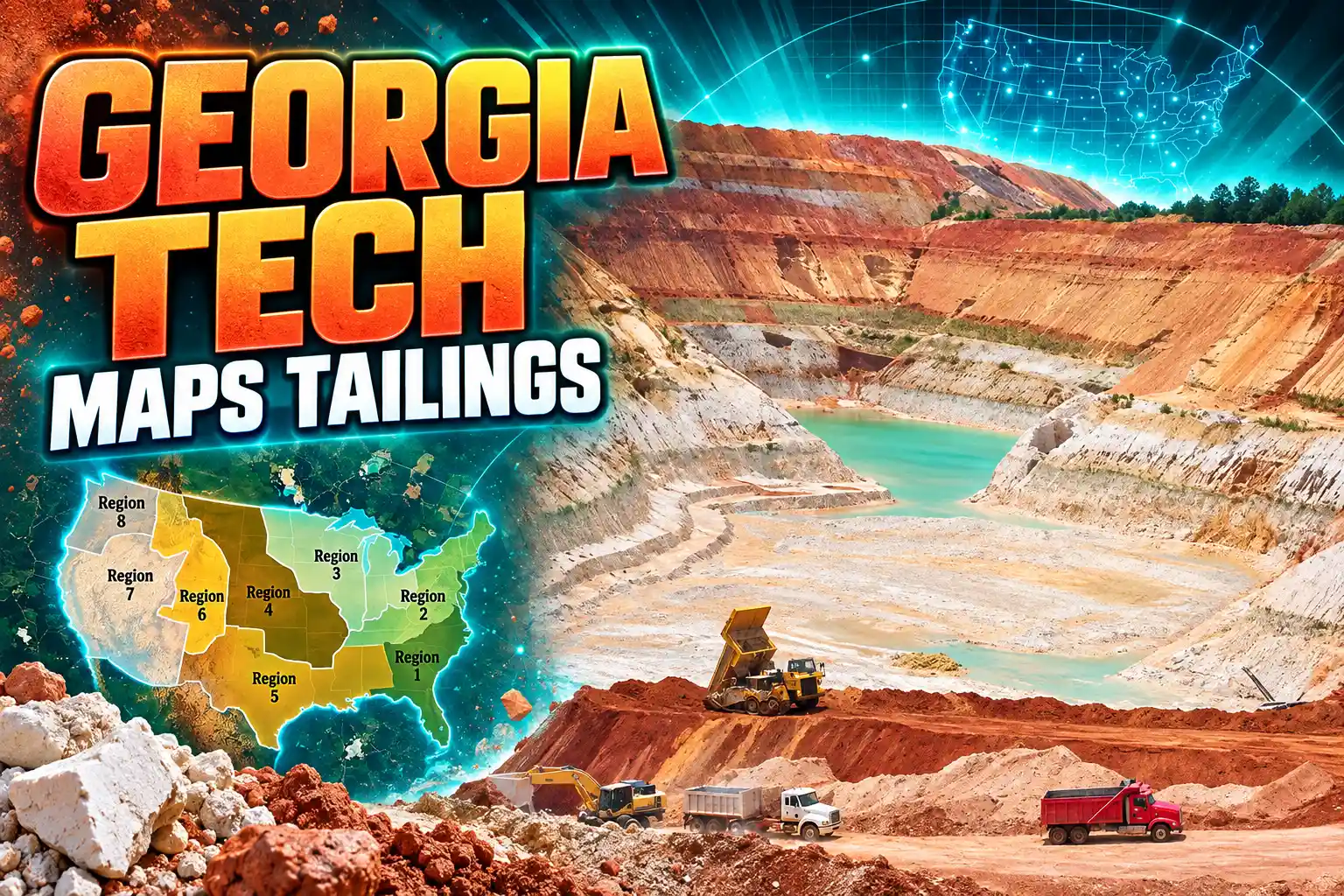
Georgia Tech will spend $7.5 million mapping rare earths in kaolin tailings, phosphate beds, and coal ash rather than staking a new mine. The Department of Energy picked the Institute on June 3, 2026, to lead Critical Minerals in the Atlantic Seaboard Plain, or CM-MAP, across a strip of the Southeast already cut by clay pits, mineral-sand plants, and old industrial ground.
The money is not a drilling budget for a greenfield orebody. It is a bet that materials already dug, burned, or left in brownfields can be typed, modeled, and lined up for recovery while a conventional U.S. mine is still in studies.
DOE Funds a Map of Old Digs
DOE’s Office of Critical Minerals and Energy Innovation announced $15 million for two regional consortia that will chase critical minerals in unconventional and secondary feedstocks. Georgia Tech Research Corporation in Atlanta leads the Atlantic seaboard project. The University of Nevada, Reno, leads a Pacific Coast and Basin and Range effort that will look at sedimentary rocks and active mine waste. The National Energy Technology Laboratory will manage both.
The two selections join six earlier CORE-CM awards and widen that program from 13 basins in the Lower 48 to eight broader regions that now include Hawaii, Alaska, and Puerto Rico. DOE’s own notice still carries a hard limit: selection for award negotiations is not a commitment to cut a check, and the department can walk away during talks. Three weeks later, on June 24, Georgia Tech described a $7.5 million award as in hand and named CM-MAP as its vehicle.
Building domestic supply chains for critical minerals and materials means realizing the value of unconventional feedstocks. Domestically abundant sources, such as coal, wastewater from oil and gas development, and acid mine drainage, can reinforce supply chains for American manufacturing and the production of essential technologies.
Audrey Robertson, Assistant Secretary of Energy (EERE), DOE announcement, June 3, 2026
CM-MAP’s written target list is sedimentary and leftover, not a new pit. Researchers will look at kaolin, bauxite, heavy mineral sands, and phosphates, then at mining residues, coal combustion byproducts, and other secondary streams. Samples from former industrial sites, the brownfields, will be broken down for composition, mineral type, critical-mineral form, and rare-earth character. Those results are supposed to feed statistics and machine learning that guess where the minerals sit and which recovery routes waste less effort.
THE TWO JUNE CONSORTIA
- Atlantic Seaboard: Georgia Tech Research Corporation will sample coastal-plain sediments, mining residues, coal ash, and brownfields, then model occurrence and extraction paths.
- Pacific Coast and Basin and Range: The University of Nevada, Reno, will compile a regional critical-minerals database from sedimentary formations and active mine waste and pair it with infrastructure and industry notes.
On July 1, 2026, the same office posted a separate $75 million round for five pilot projects that would pull rare earths and other metals from coal and coal-based feedstocks. CM-MAP is the mapping layer of that wider waste-first push, not a replacement for it.
Published Grades in Kaolin Ore and Tailings
The geology CM-MAP is being paid to remap is not a secret. Georgia leads in the production of kaolin, fuller’s earth, and iron oxide pigments, and the Survey also records the state as a producer of titanium and zirconium mineral concentrates. In 2019, the last detailed state kaolin line on that page, Georgia shipped 4.63 million metric tons of kaolin worth $781 million. Nationally, the 2026 Mineral Commodity Summaries put U.S. kaolin output at 4.64 million metric tons in 2024 and an estimated 4.8 million tons of kaolin in 2025, which means the Georgia belt is still the country’s kaolin industry in all but name.
A 2023 paper in Clays and Clay Minerals measured rare earths in central Georgia’s upper coastal plain and split the pile by what miners actually move. Mined kaolin itself ran 0.02 to 0.06 wt.% total rare earths. Kaolin mine tailings ran 0.03 to 1.9 wt.%. Sand in the kaolin-associated Marion Member ran 0.03 to 4.6 wt.%. The rare earths sat mainly in phosphate minerals, monazite and xenotime. Light rare earths tracked phosphorus in the sands and tailings at r² = 0.99.
That pattern matches a longer map. U.S. Geological Survey work on Atlantic and Gulf coastal-plain placers described an approximately 40 km-wide band of mostly Cretaceous marine sediment along the Piedmont from North Carolina to Alabama, with monazite and xenotime reaching 4.4 wt.% in the finer than 150 μm fraction of bulk sediment. An earlier Georgia kaolin study placed the clay belt itself at 40 km wide and 240 km long, from Anderson, Georgia, to Aiken, South Carolina, just south of the Fall Line.
REE GRADES ALREADY ON THE BOOKS
| Material | Published rare-earth grade | Why it is in CM-MAP |
|---|---|---|
| Mined kaolin | 0.02-0.06 wt.% | Still dug along the Fall Line |
| Kaolin mine tailings | 0.03-1.9 wt.% | Waste already above ground |
| Marion Member sands | 0.03-4.6 wt.% | Sits with the clay in the same pits |
| Coastal-plain placers | Up to 4.4 wt.% monazite/xenotime in fine sediment | USGS band from North Carolina to Alabama |
| Phosphate, coal ash, brownfields | Not graded in the award notice | Named DOE sample targets |
U.S. clay mines as a group sold or used an estimated 26 million tons in 2025, worth $1.8 billion, through about 120 companies in 38 states. Kaolin’s own uses were estimated at 56% fillers, extenders, and binders and 20% ceramics, with about 1.6 million tons exported in 2025. None of that tonnage was mined as a rare-earth ore. The rare earths rode along in grit and tailings while the clay went to paper and paint.
New U.S. Mines Average 19.1 Years
Georgia Tech’s June announcement put the strategy in one clause: focus on material already extracted or exposed, because new mining permits in the United States can take decades. The data firm that tracks mine clocks puts a number on that complaint. S&P Global Market Intelligence, in April 2025, put the average U.S. mine lead time of 19.1 years against a global average of 15.5 years. For mines that actually began operating between 2020 and 2024, the worldwide average lead time was 17.8 years, nearly three times the 1990s cohort in that same update.
THE CLOCK CM-MAP IS TRYING TO SKIP
- U.S. average: 19.1 years from the S&P Global April 2025 lead-time update.
- World average: 15.5 years in the same comparison.
- Mines started 2020-2024: 17.8 years, measured on operations that did reach production.
Those figures cover discovery through first production, not a single permit stamp. Exploration, studies, finance, and construction all sit inside them. The point for CM-MAP is narrower. Tailings, ash ponds, and brownfields are already disturbed. A map of those piles does not open a new federal mine on undeveloped ground, and it does not wait on a 19.1-year clock before anyone can take a sample.
Who Already Holds the Waste Piles?
If the minerals are in residues, the first stakeholders are the people who already own the residues. Kaolin companies along the Fall Line hold grit that mill circuits strip out before the clay is finished. Heavy-mineral sand plants in the same coastal plain already concentrate titanium and zirconium minerals; monazite and xenotime report with that heavy suite. Phosphate districts and coal-ash landfills add two more ledgers of material that was never permitted as a rare-earth mine.
Yuanzhi Tang, the Georgia Power Professor in Georgia Tech’s School of Earth and Atmospheric Sciences, and Lee Lemke of the Georgia Mining Association put that industrial fact in a May 2024 GSA Today essay after a workshop of 45 people from companies, campuses, and agencies. Coarse grit from kaolin feedstock, they wrote, holds a range of rare-earth minerals. On a back-of-envelope case using one deposit’s 10 tons of grit a day, literature grades, and then-current prices, and ignoring mining, processing, and haul costs, they put an inferred value near $1 million. Georgia, they noted, ranks seventh in U.S. industrial-mineral output, which means the mills, crews, and rail are already in the region. That, they argued, puts rare-earth recovery on a shorter clock than starting from scratch.
The hidden cost of that shortcut is where the value leaves. CM-MAP is funded to characterize and predict, not to stand up a separator on the Fall Line. Heavy-mineral operations in the Southeast have already shown that a rare-earth concentrate can be pulled from sands that were mined for titanium and zirconium, then shipped out of the region for refining. A better map can tell a mill what it is throwing away. It does not, by itself, keep the separated oxides in Georgia, Florida, or the Carolinas.
Brownfield towns sit on a different risk. DOE wants samples from former industrial sites, which means the project will walk into parcels with leftover contamination, unclear title, and neighbors who did not ask to become a critical-minerals test plot. The award text promises efficient extraction methods. It does not name who pays to move, treat, or dispose of whatever else comes up with the rare earths.
Tang Made the Kaolin Case in 2023
The principal investigator is not new to this clay. On August 31, 2023, Georgia Tech said Tang had won a National Science Foundation grant to test whether the middle and coastal plains that produce kaolin also hold large rare-earth inventories. She was then an associate professor in the School of Earth and Atmospheric Sciences, working with W. Crawford Elliott at Georgia State University. Tang said then that waste residues from Georgia kaolin mining carried high rare-earth contents and might add to domestic resources if the weathering chemistry could be read well enough to design cleaner extraction.
Through this award, we are working to build secure and resilient critical materials supply chains, from resource discovery and characterization to processing, recovery, recycling, and advanced manufacturing, while also developing the skilled workforce needed to support these emerging industries. Our vision is to create a regional innovation ecosystem that embraces both unconventional resources and circular economy approaches to maximize the value of materials already in use.
Yuanzhi Tang, principal investigator and Georgia Power Professor, Georgia Tech announcement, June 24, 2026
By June 2026 she was founding director of Georgia Tech’s Center for Critical Mineral Solutions, launched in 2024, and executive director of the Strategic Energy Institute, with a courtesy post in civil and environmental engineering. Tim Lieuwen, executive vice president for Research, cast the DOE money as the Institute stitching labs to industry, government, nonprofits, and national laboratories. The through-line is shorter than a new mine and longer than a press release: three years of kaolin-specific rare-earth work, a campus center, then a regional map paid for by DOE.
HOW THE KAOLIN CASE GOT TO DOE
- August 31, 2023: Tang and Elliott receive NSF support to study rare earths in Georgia kaolins and their waste residues.
- 2024: Georgia Tech opens the Center for Critical Mineral Solutions as a campus hub for supply-chain research.
- May 2024: Tang and Lemke, in GSA Today, argue that kaolin grit and existing industrial-mineral plants can move rare-earth work faster than a new mine.
- June 3, 2026: DOE selects Georgia Tech Research Corporation for the Atlantic seaboard CORE-CM consortium.
- June 24, 2026: Georgia Tech announces the $7.5 million CM-MAP award, with Tang as principal investigator.
The 2023 NSF write-up also put a simple number on the clay business that the USGS later restated in tons: more than $1 billion of kaolin has been cited as Georgia’s annual take in campus and NASA summaries, while the Survey’s 2019 state table logged $781 million. The tons line is the one that holds. Georgia still leads in the production of kaolin, and the waste from that lead is what CM-MAP is being paid to read.
The Models Predict Occurrence, Not Metal
CM-MAP’s product is a dataset plus a model. Field crews will collect natural and industrial samples across the Southeast. Labs will tag what is in them. Algorithms will then be asked to predict where similar material occurs and which recovery path looks efficient. That is a prospectivity map for waste and sediment, not a proven reserve, and not a kilogram of separated dysprosium.
Machine learning on geochemistry can rank likely ground. It cannot wish away the chemistry that makes heavy rare earths hard to split, the radioactivity that rides with monazite, or the water and reagent load of leaching clay-rich tailings. The 2023 mineralogy already showed the rare earths locked in phosphate grains, with weathering scrambling the original detrital mix. A model that ignores that grain-scale story will draw pretty contours over the wrong rock.
Scale is the other gap. U.S. kaolin at 4.8 million tons a year is a large clay business and a small rare-earth business if the ore grade is 0.02 to 0.06 wt.%. The richer numbers live in tailings and sands, and those numbers are ranges from specific members, not a belt-wide average. CM-MAP’s job is to turn those ranges into a sample grid someone can mine or walk away from. Until that grid exists, “domestic supply” is a research aim, not a shipping schedule.
Partners Were Convened Before the Check Arrived
The June award lands on a roster Georgia Tech had already named. The Center for Critical Mineral Solutions is the campus hub. The Georgia Partnership for Essential Materials, or GEMS, convenes Georgia Tech, the University of Georgia, Georgia State University, and the Georgia Mining Association with companies, nonprofits, development agencies, national labs, universities, and technical colleges. A U.K.-U.S. working group ties the Southeast to the Southwest United Kingdom. A Georgia Critical Mineral Supply Chain Manufacturing Demonstration Center, backed with congressional funding, is meant to connect resource work to processing, recycling, and manufacturing demos.
WHO IS ALREADY AT THE TABLE
- Campus hub: The Center for Critical Mineral Solutions, founded in 2024, with Tang as founding director.
- State platform: GEMS, tying three public universities to the Georgia Mining Association and regional agencies.
- Atlantic sample list: Kaolin, bauxite, heavy mineral sands, phosphates, mining residues, coal ash, and brownfields.
- Federal wrapper: CORE-CM, now eight regions, with NETL managing the two June 2026 consortia.
Technical colleges are on that list for a reason the geology papers do not cover. If grit circuits and ash ponds become feed, the jobs look like sampling, plant ops, and environmental monitoring, not a rush of new underground miners. The award language puts workforce next to recycling and advanced manufacturing. The test is whether those seats fill in Sandersville and the Fall Line towns that already live with the pits, or whether the data package leaves for a lab and a mill somewhere else.
CM-MAP will not pour a magnet alloy. It will not shorten the 19.1-year U.S. mine clock for a fresh orebody in the West. What it can do, if the samples match the papers, is tell the Southeast which piles already hold monazite and xenotime in amounts worth a plant trial, and which brownfields are just brown. That is a smaller prize than a new domestic mine. It is also one the clay belt can start measuring without waiting on a discovery hole.

Greed Held After a $697 Million Crypto Long Flush

Fed Minutes Keep a Year-End Rate Hike Alive

A Nanny-Cam Tape Follows Tyreek Hill Into Free Agency

Star Wars Galactic Racer Makes a Crash End the Tour

Amazon Puts Apple’s June MacBook Prices Back on Sale

The iPhone 16 Pro Flipkart Cut Did Not Last

Sophia Wootten Turns the Miss Georgia Crown Toward Cleft Care

Microsoft Prints Azure’s $29.42 Billion Quarter and Shrinks the Map

UltraTech’s Ultravolt Launch Puts Cable Multiples on Trial

IXI Autofocus Glasses Still Lack a European CE Mark
-
 NEWS1 year ago
The iPhone 16 Pro Flipkart Cut Did Not Last
-
 ENTERTAINMENT4 months ago
Sophia Wootten Turns the Miss Georgia Crown Toward Cleft Care
-
 BUSINESS1 month ago
UltraTech’s Ultravolt Launch Puts Cable Multiples on Trial
-
 NEWS1 month ago
Microsoft Prints Azure’s $29.42 Billion Quarter and Shrinks the Map
-
 NEWS9 months ago
IXI Autofocus Glasses Still Lack a European CE Mark
-

 NEWS3 months ago
Little St. Simons Island Hatches Loggerheads at 72.4 Percent
-

 NEWS4 months ago
Georgia Beach Bacteria List Leaves Swim Areas Open
-

 NEWS3 years ago
Eyal Waldman Keeps a Two-State Bet After Gaza