TAV Airports has locked in Tbilisi International Airport’s concession through 2031. The Turkish operator is committing $150 million to nearly double the airport’s capacity, from five million to ten million passengers a year, by 2028. Ten new boarding bridges, seven remote aircraft stands and an expanded terminal are part of the build.
A few kilometers from the runway, a different number is climbing too. Protesters outside Georgia’s parliament on Rustaveli Avenue have logged more than 600 consecutive days on the street, demanding the government reverse its decision to freeze the country’s European Union accession bid.
TAV Locks In Tbilisi Through 2031
TAV has run Tbilisi’s airport under concession since 2005. That agreement was due to expire in January 2027. The new deal, signed with the Government of Georgia, pushes the concession out by roughly five years and ties the extension directly to the construction bill.
TAV Airports has extended concession for Tbilisi Airport through December 31, 2031. Under the agreement, TAV Airports will complete more than $150 million in investments by 2028.
The company said as much in a statement posted to its official account, confirming the extension running through December 31, 2031. TAV Airports, in its own release, said the investment would triple the airport’s lounge capacity and add two dining venues built around Georgian cuisine, plus two children’s play areas.
The renewal itself, a concession running through 2031, closes a process that had reportedly been under negotiation for months before it became public in July.
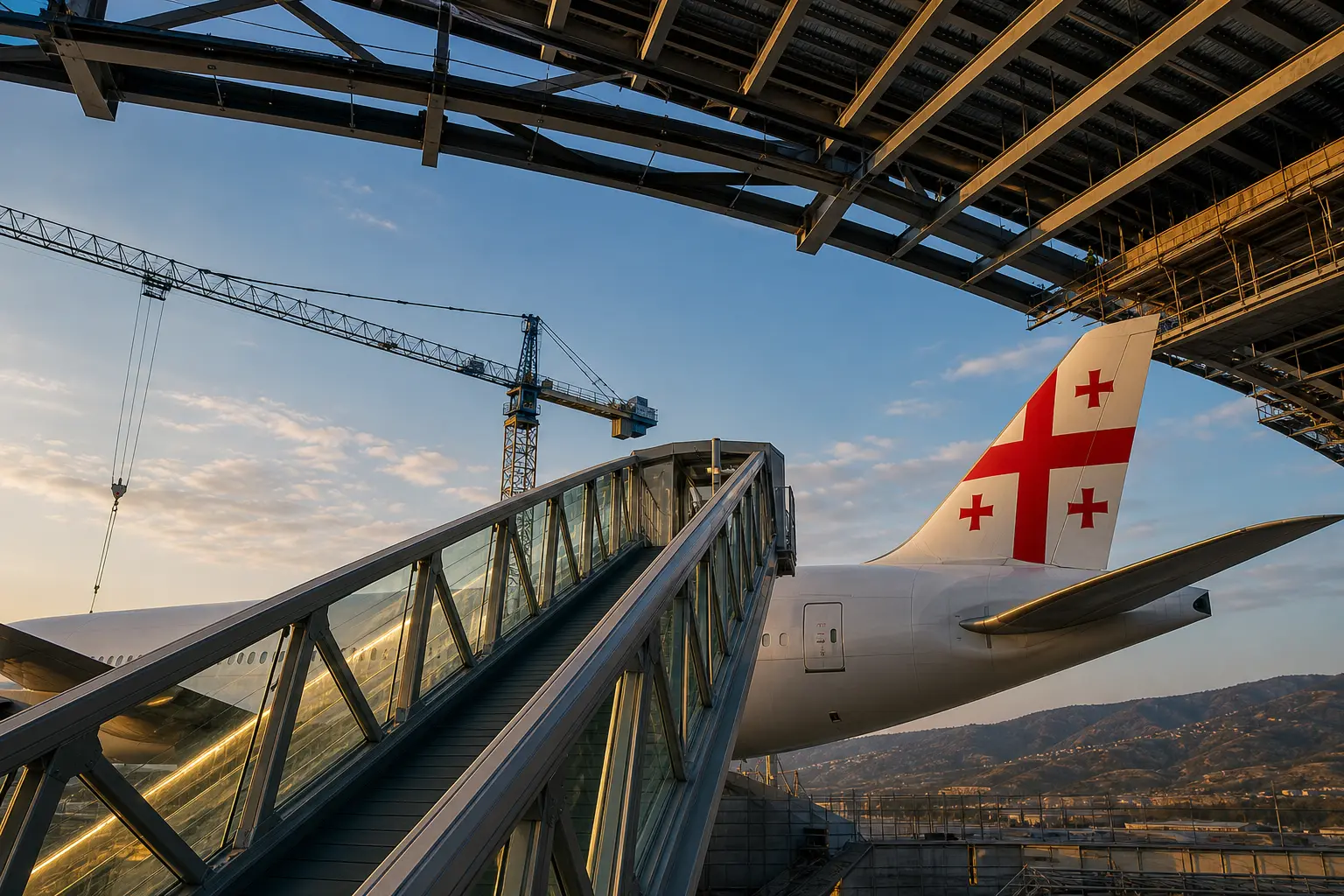
Ten Bridges, Seven Stands and a Terminal Built for Ten Million
The physical build is the easiest part of this story to picture.
| Expansion Feature | Scale |
|---|---|
| Annual passenger capacity | 5 million now, rising to 10 million by 2028 |
| Terminal footprint | 37,500 to 57,000 square meters |
| New passenger boarding bridges | 10 |
| New remote aircraft stands | 7 |
| Business lounge capacity | Tripled from current footprint |
| Investment and deadline | $150 million, complete by 2028 |
Two of the new commercial spaces go to Georgian food and drink rather than international chains, a pattern airports from Helsinki to Seoul have already tested: sell the country’s identity before the visitor ever collects a bag.
Who Profits From the Concession?
The concession sits with TAV Airports Holding, a Turkish company. Groupe ADP, the operator of Paris’s Charles de Gaulle and Orly airports, owns a controlling 46.1 percent stake. Much of the retail and lounge revenue this expansion is built to generate will flow back to that shareholder before it reaches the Georgian state.
TAV began in 1997 to build and run Istanbul’s Atatürk Airport, then went public in 2007. Groupe ADP built its stake in two moves, buying 38 percent in 2012 and adding to 46 percent in 2017, according to the company’s public ownership breakdown.
The two Georgian cuisine venues opening as part of this project will operate inside a commercial concession controlled from Istanbul and Paris, not Tbilisi. Georgian producers get the exposure. The lease income runs through TAV’s books first.
Georgia’s Tourism Machine Just Posted a 14-Year High
The bet has real numbers behind it. Georgia logged 7.8 million total travelers in 2025, up 5.9 percent from the year before. Foreign tourists alone reached 5.52 million, up 8.4 percent. Tourism revenue hit $4.4 billion, the highest figure in 14 years.
- Russia – 1.61 million visitors, up 13.4 percent, contributing more than $850 million in revenue
- Turkey – 1.26 million visitors, down 6 percent
- Armenia – 962,100 visitors, up 1.5 percent
- Israel – 411,100 visitors, up 32.2 percent
- Azerbaijan – 294,000 visitors, up 34 percent
Russia supplies the largest single share, though the mix behind that number has shifted. Industry coverage has linked softer per-visitor spending to a change from longer-staying digital nomads and relocated workers toward shorter package trips.
The reach keeps extending east, too. China Eastern’s first direct Tbilisi-Shanghai flight landed 98 percent full earlier this year, a sign carriers see Tbilisi as more than a regional stopover.
The Bet, By the Numbers
The arithmetic is straightforward. TAV is spending $150 million to chase a tourism sector already worth $4.4 billion a year, on a route network that keeps adding long-haul city pairs. Demand has held up for three straight years. Georgia’s politics are the variable investors cannot model as easily.
Six Hundred Days on the Avenue the Tourists Don’t See
Rustaveli Avenue runs a few kilometers from the terminal gates. Protesters have occupied the street outside Georgia’s parliament there since November 28, 2024, when Prime Minister Irakli Kobakhidze announced the government was suspending talks on joining the European Union. By July 20, 2026, organizers counted more than 600 consecutive days on the street.
Local coverage of that same stretch of pavement has tracked its rhythms in detail, including a period when Rustaveli Avenue itself went quiet for four months, even as the broader protest count kept climbing toward 600 days.
The demands have not changed: release of jailed demonstrators, new elections, and repeal of laws protesters call repressive. An estimated 1,600 people have been detained over the past year. Roughly 50 remain in jail, most convicted on criminal charges. Organizers have addressed an open letter directly to the European Union and its member states.
The U.S. government’s Overseas Security Advisory Council has tracked a year of sustained pro-EU demonstrations in its guidance for American organizations operating in Georgia.
A Softer National Number Behind the Airport’s Gain
One national figure runs against the airport’s own numbers. Tbilisi airport’s own passenger count, first reported by Georgia Today, rose 8 percent in the first quarter of 2026, to 1.09 million.
Georgia’s international visits overall, counted across every border crossing including land routes, actually slipped 0.2 percent in the same quarter, to 1.2 million, according to Civil Georgia’s reporting on tourism ministry figures. Those are different measures: one is a single airport’s throughput, the other every entry point into the country. Read together, they suggest air travel is gaining ground on land crossings, not that overall demand is surging uniformly.
TAV’s new terminal wing is due by 2028. Rustaveli Avenue’s protest, on day 600 and counting, has no announced end date.
Frequently Asked Questions
How many passengers did Tbilisi airport handle in 2025?
Tbilisi International Airport served roughly 5.4 million passengers in 2025, up 13.7 percent from 2024, according to TAV Airports’ figures reported by the Moodie Davitt Report. That is the airport’s own throughput count, distinct from the national tourism totals tallied by Georgia’s tourism administration.
Why have protesters gathered on Rustaveli Avenue for more than 600 days?
The demonstrations began on November 28, 2024, immediately after Prime Minister Irakli Kobakhidze announced Georgia was suspending its European Union accession talks. Protesters have continued daily since, demanding the release of jailed demonstrators, new parliamentary elections and the repeal of laws they call repressive.
What new dining and retail will travelers find at the expanded terminal?
TAV Airports’ investment plan adds two food and beverage venues dedicated to Georgian cuisine, two children’s play areas, larger retail space and lounge capacity the company says will triple from its current footprint.
Who owns TAV Airports, the company running the expansion?
TAV Airports Holding is a Turkish company majority owned by Groupe ADP, the operator of Paris’s Charles de Gaulle and Orly airports, at a 46.1 percent stake. Most of the remaining shares trade as free float on the Borsa Istanbul exchange, with a small stake held by Turkish investment group Bilkent Tepe.