Georgia’s kindergarten vaccination coverage for the 2025-2026 school year sits around 89% for core shots against diphtheria, measles and polio, according to Centers for Disease Control and Prevention figures released this week. That is a modest rise from last year’s roughly 87%, yet it remains below the level public-health agencies say is needed to limit measles spread. Exemptions climbed to 5.1%.
National coverage hovered near 92%. Georgia joined 24 states where exemptions now top 5%. Only 0.1% of the state’s kindergartners held medical exemptions; the rest were non-medical.
Georgia’s 89% sits three points under the national mark
The CDC kindergarten coverage and exemption data show U.S. rates for DTaP, MMR, polio and varicella all slipped from the prior year, landing between 92.0% and 92.4%. More than half the states saw declines. About 280,000 kindergartners lacked documentation of a complete MMR series.
Georgia’s figure of about 89% improved slightly on the previous cycle. Still, it leaves the state short of the protection threshold for highly contagious diseases. A decade earlier Georgia coverage stood near 94%.
| Metric | Georgia 2025-26 | Georgia prior year | U.S. 2025-26 |
|---|---|---|---|
| Core vaccine coverage | ~89% | ~87% | 92.0-92.4% |
| Any exemption | 5.1% | 4.8% | 4.2% |
| Medical exemption | 0.1% | ~0.1% | ~0.2% |
| States over 5% exemption | Yes (one of 24) | – | 24 states |
Roughly 155,000 U.S. kindergartners claimed an exemption from one or more vaccines this cycle, up from about 138,000 the year before.
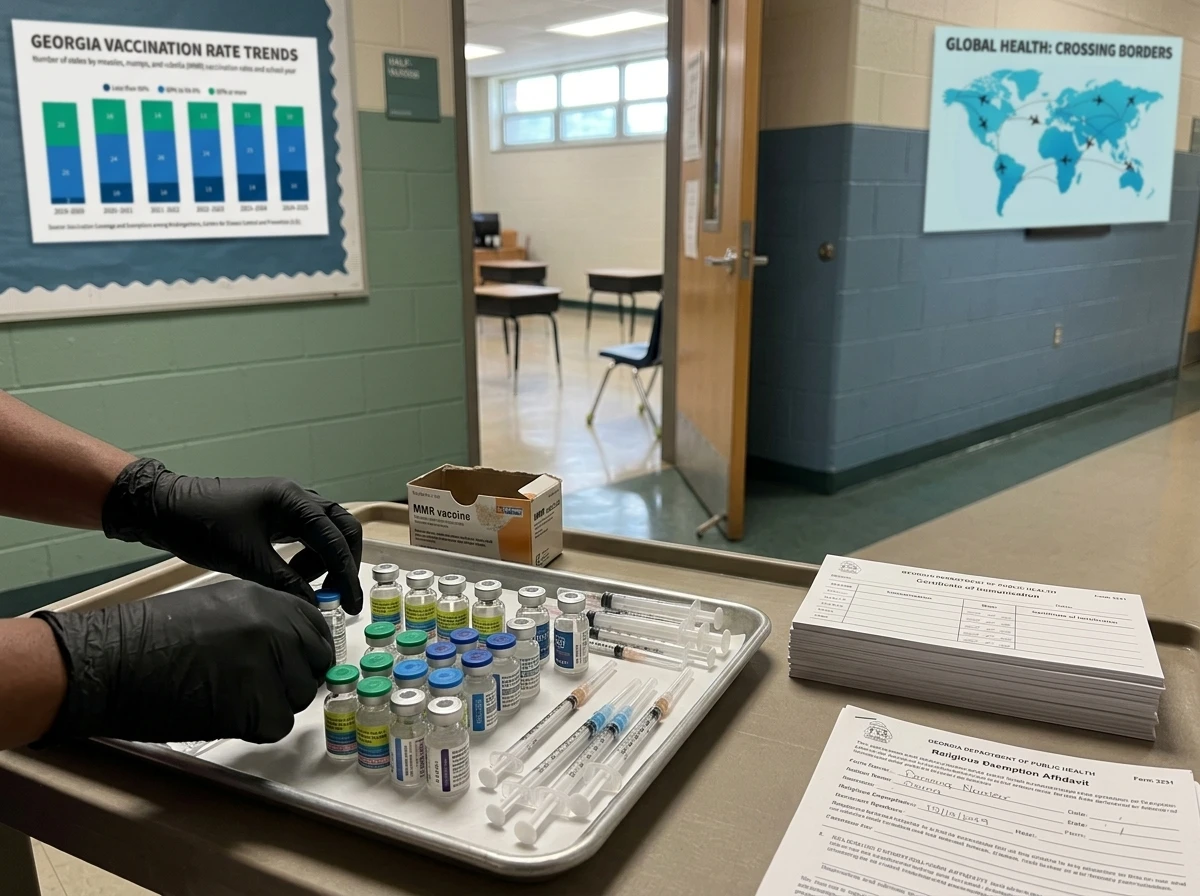
Non-medical opt-outs now drive nearly the entire rise
Georgia allows medical exemptions and religious ones. Personal or philosophical exemptions are not recognized under state law. Parents seeking a religious exemption file an Georgia religious exemption affidavit process (Form 2208) with the school or childcare facility. A completed Georgia Certificate of Immunization (Form 3231) is otherwise required for attendance from childcare through 12th grade.
- Medical exemptions remain rare at 0.1% of Georgia kindergartners.
- Religious affidavits account for the bulk of the 5.1% total.
- Schools must keep the signed form on file as legal documentation.
- Students entering 7th and 11th grades face additional Tdap and meningococcal requirements unless exempted.
Nationally the exemption jump to 4.2% from 3.6% was almost entirely non-medical. Medical exemptions stayed flat near 0.2%. The pattern holds in Georgia: the 0.1% medical share has barely moved while overall exemptions keep climbing.
Some parents and online voices describe the rise as pushback against school requirements and shifting federal signals. The numbers show non-medical claims now dwarf medical ones by a wide margin in both the state and the country.
Measles has already infected more than 2,500 Americans this year
As of August 13 the CDC recorded 2,566 confirmed U.S. measles cases in 2026, already past the full-year 2025 total of 2,289. Georgia reported 6 cases. Ninety-three percent of patients were unvaccinated or had unknown status. Thirty-eight outbreaks accounted for 94% of cases. Seven percent of patients were hospitalized; no deaths have been reported so far in 2026.
Children under 5 made up 19% of cases; ages 5-19 made up 48%. The American Academy of Pediatrics places the community immunity threshold for measles at roughly 92-94%. Coverage below that level raises the chance of sustained transmission once the virus enters a school or community.
Georgia’s 89% kindergarten rate leaves a larger unprotected pool than the national average. Last year’s prior-year Georgia kindergarten rate of 86.8% already sat well under the mark during an earlier measles surge.
The new federal order lands as schools reopen
On August 10 President Donald Trump signed an August 10 executive order on childhood vaccines titled “Delivering Gold Standard Childhood Vaccine Recommendations for Americans.” The order directs HHS to develop plans within 90 days for offering core vaccines, beginning with MMR, as separate single-disease shots once products are available, and for spacing immunizations across separate visits.
The Attorney General shall take appropriate measures to further meritorious legal actions challenging State laws that conflict with States’ constitutional and Federal statutory obligations related to parental authority, religious freedom… including… States’ obligations to provide religious and medical exemptions from childhood and adolescent immunization requirements.
The White House text also advises states to review school immunization requirements against the new “Gold Standard” categories and peer-country practices. Departments of Justice, Education and HHS are told to ensure contractors and grantees, including states, comply with obligations to provide those exemptions. At signing, Trump repeated claims linking vaccines to autism that medical organizations have long rejected.
Local doctors push parents toward clinic conversations
Dr. Cecil Bennett, a primary care physician with Newnan Family Medicine, told the Georgia Recorder that any observed link between autism diagnoses and vaccination timing is coincidental. “There’s no doubt about the efficacy of vaccines and the importance of vaccines,” he said. “So parents need to know that vaccines are safe and vaccines are effective.”
Bennett blamed falling rates on misinformation and what he called a lack of leadership from Washington. He urged parents to take concerns to their child’s own doctor rather than online searches. “If you want to find information why your child should not be vaccinated, you can find that information [online],” he said. “I would rather parents who talk to their child’s pediatrician or their child’s family physician and get correct information.”
The CDC press material accompanying the new data also encouraged families to discuss options with clinicians and described overall national rates as still high.
A multi-year slide leaves less room for error
- 2019-2020: National kindergarten coverage near 95%; exemptions about 2.5%.
- 2022-2024: Coverage falls below 93%; exemptions climb past 3%.
- 2024-2025: Georgia coverage ~86.8-87%, exemptions 4.8%; national exemptions 3.6%.
- 2025-2026: Georgia ~89% coverage, 5.1% exemptions; national coverage 92.0-92.4%, exemptions 4.2%; 24 states over 5%.
The AAP notes the 92-94% community immunity threshold for measles. Once exemption rates exceed 5% in a state, even perfect vaccination of every non-exempt child cannot reach 95% coverage. Georgia has now crossed that line. Clusters of unvaccinated children inside individual schools create the conditions for rapid spread if measles is introduced.
Medically fragile students who cannot receive vaccines themselves rely on the surrounding coverage. With medical exemptions at just 0.1%, the much larger non-medical share determines how much protection those children actually get in classrooms and on buses.
School districts must still enforce Form 3231 or the religious affidavit. Nurses and administrators become the front-line managers of incomplete records while measles continues to circulate nationally at levels not seen in decades. The combination of sub-threshold coverage, rising opt-outs and an executive order that elevates exemption access sets the practical terms for the rest of the 2025-26 school year in Georgia.