The Georgia Brass Band scored 94.467 points to win the First Section at the 2026 North American Brass Band Association Championships in Fort Wayne, Indiana, finishing more than three points clear of the field. Members of the metro Atlanta ensemble say the trophy simply confirms what they already knew about one another after 26 years.
Music director Michael Kobito called the result affirmation of steady work. The deeper story reaches back to Victorian England’s coal mines and factories, where brass bands first turned after-shift hours into fellowship, and now plays out every Tuesday at The Salvation Army Temple in Atlanta.
Blind judges and a three-point gap
Ten bands contested the First Section on April 11 at the Embassy Theatre. Three adjudicators, Colin Holman, Mark Hoskins and Andrea Price, scored without seeing the performers. Every band played the set test piece, then an own-choice work.
| Place | Band | Conductor | Own Choice | Total |
|---|---|---|---|---|
| 1 | Georgia Brass Band | Michael Kobito | Rococo Variations (Gregson) | 94.467 |
| 2 | San Antonio Brass Band | Matthew Mireles | Paganini Variations | 91.133 |
| 3 | Colorado Brass | Brett Keating | Harmony Music | 90.800 |
| 4 | Illinois Brass Band | Stephen Squires | Afterlife | 89.600 |
| 5 | Cincinnati Brass Band | Joshua Thompson | Of Distant Memories | 88.933 |
The full First Section scores and draws show Georgia drawing 10th for the set test and fourth for its own choice. Kobito told WABE the gap of about three points felt like recognition from outsiders who knew nothing of the band’s history.
The required work was Eric Ball’s Journey into Freedom, written as the 1967 Championship test piece by Eric Ball for Britain’s national finals at the Royal Albert Hall. Own-choice repertoire across the section ranged from Gregson and Philip Sparke staples to a world premiere.
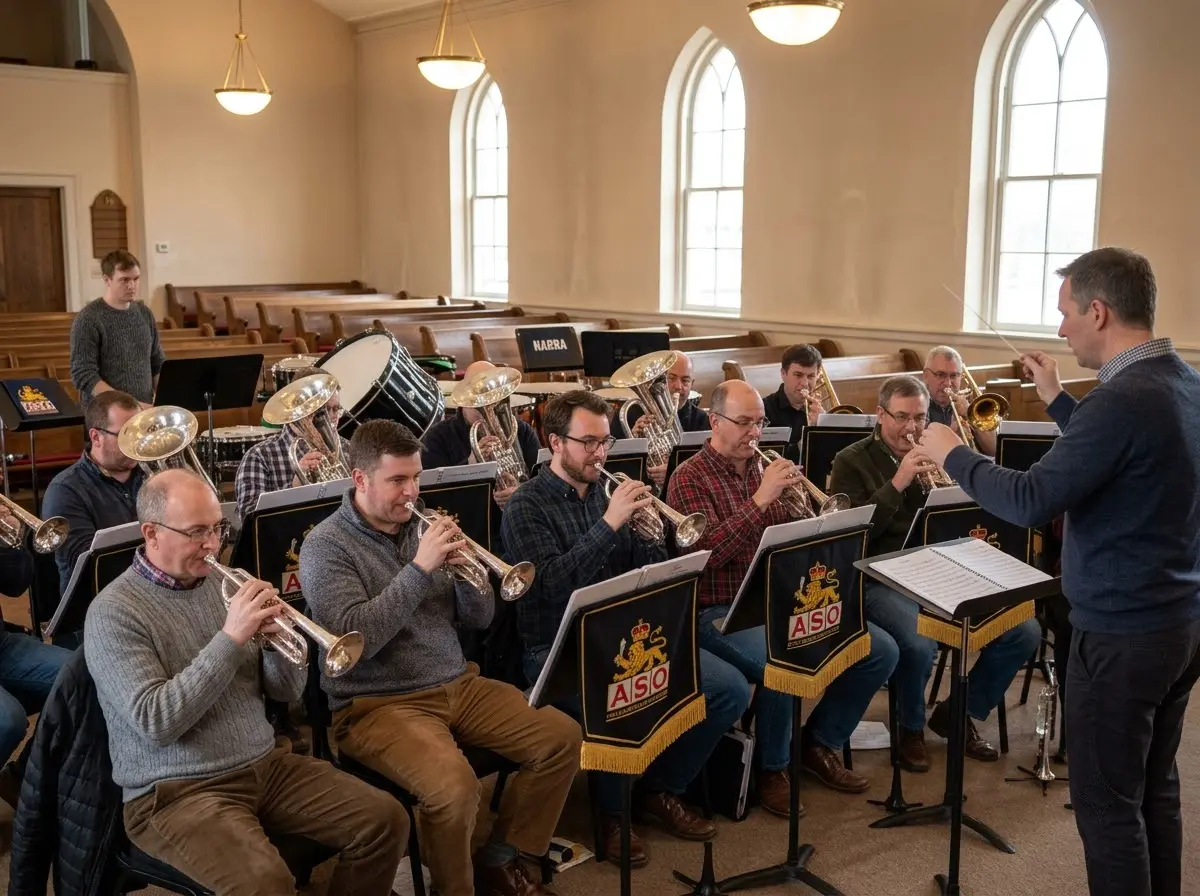
From English coal seams to an Atlanta temple
British-style brass bands took shape in the early 19th century industrial boom. Factories and mines sponsored ensembles so workers could play together after long shifts, building skills and camaraderie instead of heading to the pub. The instrumentation stayed fixed and distinctive.
- Cornets replace trumpets
- Tenor horns and baritones fill the middle voices
- Euphoniums carry melodic weight alongside trombones and tubas
- No woodwinds; percussion is limited and specific
NABBA promotes British-style brass banding since 1983 across the United States and Canada through contests, education and support. The Georgia Brass Band sits squarely inside that lineage. Founded in spring 1999 by Christopher Priest and Joe Johnson, it gave its first concert that September and has rehearsed from the start at The Salvation Army Atlanta Temple Corps.
Johnson conducted for 25 years before stepping down after the 25th season. The group’s mission remains to preserve and advance the brass band art form through performances, education and partnerships. All roughly 25 players and staff volunteer their time. The roster mixes professional musicians, educators and people with day jobs far from music.
The same faces keep showing up
Pete Betts has been there since the first rehearsal in 1999. “I’ve been with the band since 1999, since the band was founded,” he said. “In fact, we had our first rehearsal in this building.”
Principal solo cornet John Thomas Burson first met the group as a high-school student in 2006 during a joint concert with his youth band. After graduate school he joined for good. “I just loved playing brass music with my best friends, and I was like, I want to be part of the band,” Burson said. “We just build each other up through the process. No one’s here for a paycheck.”
First baritone Josh Barron, entering his fifth season, discovered the British approach opened technical and musical ground he never explored earlier. He stays for the people and the culture of mutual investment. Rehearsals have become a midweek safe haven where everyday stress drops away.
The cliché and true answer is, the people.
Michael Kobito, the band’s music director and conductor, said that line when asked what members value most. He joined as a player in 2018 and is now in his second full year on the podium. Away from the band he is a music educator who served as 2023 Georgia Teacher of the Year, directed bands at Woodland High School in Cartersville, and works as associate conductor of Tara Winds.
Tuesday nights and seven-hour Saturdays
Preparation followed the same pattern that has held the group together for decades. Players rehearsed year-round. After the new year they locked onto the NABBA program, meeting every Tuesday plus several Saturday camps that ran about seven hours each.
- 1999, Founded by Priest and Johnson; first rehearsal and September concert
- 2006, High-school Burson first hears the band in joint concert
- 2018, Kobito joins as musician
- After 25th season, Johnson retires; Kobito becomes music director
- April 11, 2026, First Section title at NABBA in Fort Wayne
At the contest the adjudicators heard only the sound. One judge came from England, one from the Northwest United States, one local. Kobito valued that anonymity. Friends and family already know the story; outsiders confirmed the work had landed.
The win sits inside a longer competitive record that includes earlier NABBA appearances and two critically acclaimed albums. The band has shared stages with guest soloists from major orchestras and military bands and has appeared at festivals and conferences across the Southeast.
Growth stays the measure
The new season is already under way. Members will take part in Atlanta Symphony Orchestra educational programs, Tara Winds and the Johns Creek Chorale. An album is planned later in the year. The group intends to return to NABBA and defend the First Section title.
Kobito keeps the hierarchy clear. “If you put all of your eggs in the basket of winning, the moment that you lose, you’ve lost,” he said. “But if you put all your eggs in the basket of growing, every opportunity is a chance to learn.”
- 26 years of continuous activity since founding
- ~25 volunteer musicians
- 94.467 winning score, 3.334 points clear of second
- 2 albums already recorded, third in preparation
That stance echoes the original industrial bands: the music was always a vehicle for people who showed up for one another after hard days. In Atlanta the hard days look different, yet the Tuesday night ritual and the Saturday camps produce the same durable loyalty. The championship simply made the sound public.
Local listeners can catch the band in the coming season alongside the city’s other live-music corners, from symphony halls to Atlanta’s broader indie music hubs. The Georgia Brass Band will keep measuring success by who is still in the chair next year.
Frequently Asked Questions
What is a British-style brass band?
It is an ensemble that uses a fixed roster of brass instruments only, led by cornets rather than trumpets and featuring tenor horns, baritones and euphoniums in the middle voices, with no woodwinds. The format grew out of 19th-century British factories and mines and remains the model for NABBA contests.
When was the Georgia Brass Band founded and by whom?
Christopher Priest and Joe Johnson founded the group in the spring of 1999. It presented its first concert that September and has rehearsed continuously at The Salvation Army Atlanta Temple Corps.
What piece did every First Section band play at NABBA 2026?
All bands performed Eric Ball’s Journey into Freedom as the set test. Ball wrote it for the 1967 British National Championships at the Royal Albert Hall; Georgia Brass Band paired it with Edward Gregson’s Rococo Variations as its own choice.
How does NABBA scoring work?
Three adjudicators score the set test and the own-choice piece without seeing the bands. Totals are averaged; draws for performance order are separate for each piece. Georgia’s combined average of 94.467 topped the 2026 First Section.
Are Georgia Brass Band members paid?
No. Every musician and staff member volunteers time and talent. The nonprofit 501(c)(3) selects players by audition and relies on donations, sponsorships and ticket sales to operate.